
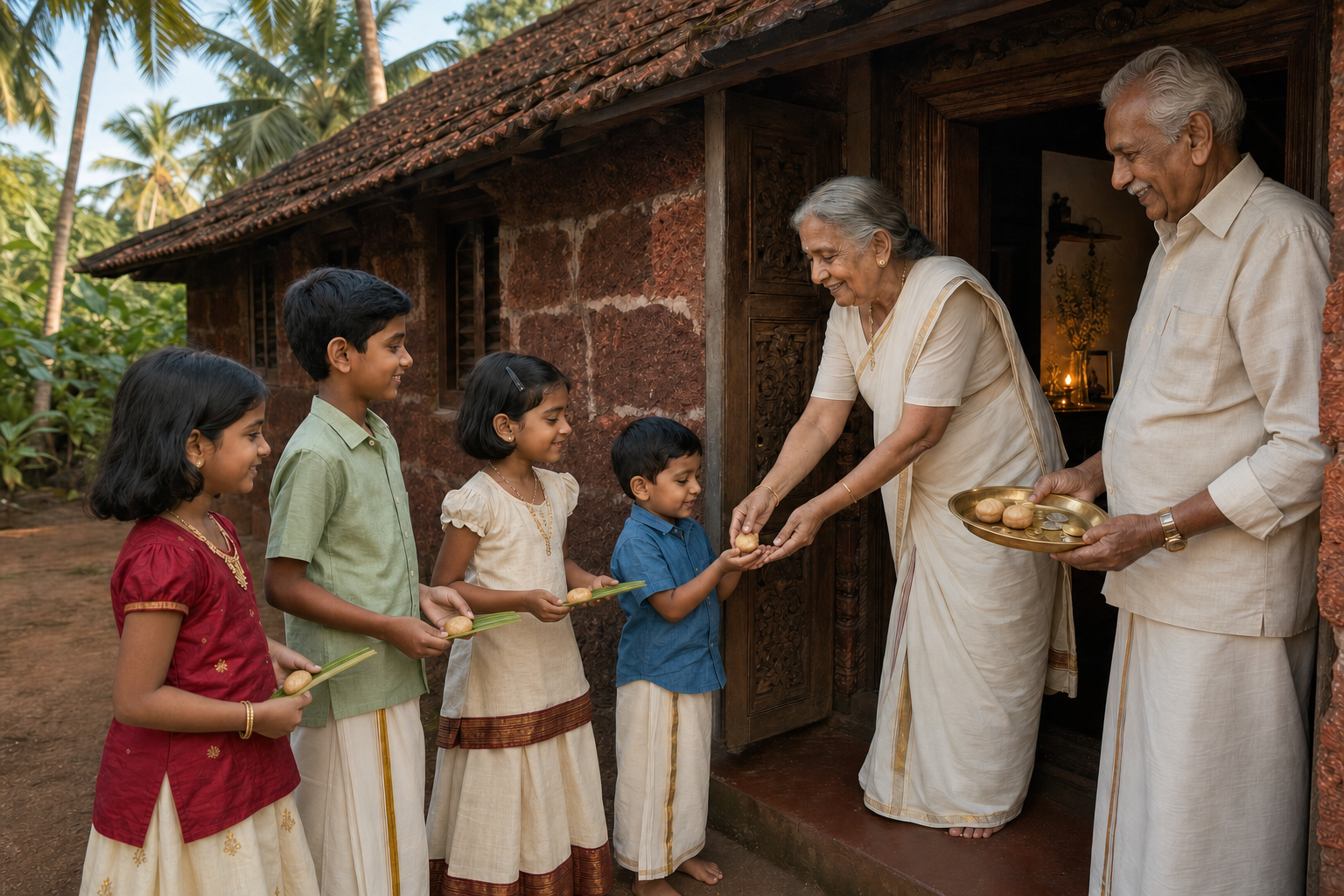
If you have heard children calling “vishukaniye, vishukaniye” outside homes in North Malabar, you may have wondered whether they were asking for Vishukkaineettam or announcing the Vishukkani. The answer is both, but the custom means more than either act on its own.
Vishukkani Vili carries the auspiciousness of a family’s dawn observance into the neighborhood. If you want to understand it, participate respectfully, or help children continue it, the crucial point is timing: the household first beholds the kani, and only afterward does the festival move from the prayer space to the threshold and the street.
Key takeaways
- Vishukkani is the auspicious arrangement viewed at dawn; Vishukkani Vili is the later neighborhood custom in which children call at homes.
- The children usually receive blessings and Vishukkaineettam. In some localities, they are also invited to see the household’s kani.
- The practice is local and variable. Its form may differ between villages, town neighborhoods, and apartment communities.
- The money is a token of generosity, not the sole meaning of the visit. The call, welcome, blessing, and restrained receiving all belong to the ritual.
- A community can preserve the custom without turning it into a staged performance: follow local memory, visit after kani-kanal, keep groups safe, and let children carry the practice themselves.
Vishukkani, Vishukkani Vili, and Vishukkaineettam are not interchangeable
Three closely connected practices shape the morning, and distinguishing them prevents the most common misunderstanding.
The Vishukkani is the carefully prepared first sight of the day. On Vishu eve, the family arranges objects associated with light, abundance, renewal, and auspiciousness. A traditional arrangement may include a lit nilavilakku, an uruli containing rice or grain, golden cucumber, lemon, betel leaves, arecanuts, coins or gold ornaments, a metal mirror, kanikkonna flowers, and an image of Sri Krishna. Family members behold this arrangement at dawn, sometimes after being guided toward it with their eyes covered.
Vishukkani Vili begins after that domestic observance. Its name joins Vishukkani with vili, the Malayalam word for a call. Children gather in friendly groups and call “vishukaniye, vishukaniye” at gates and thresholds. The human voice carries the morning’s auspicious mood beyond a single home.
Vishukkaineettam is what elders give to younger people as a token of blessing and goodwill. During Vishukkani Vili, householders commonly offer it to the visiting children. Some also give fruit or sweets. In certain villages, the children are invited inside briefly to behold the family’s kani before receiving the token.
It is therefore incomplete to describe Vishukkani Vili merely as children collecting money. Kaineettam is important because it turns goodwill into an act of dana, but it sits within a larger exchange: children voice the festival greeting, the household opens its threshold, elders bless the young, and the young receive without treating generosity as an entitlement.
It is equally important not to present every local form as a rule for all Kerala. Vishukkani Vili is especially associated with North Malabar, and its details live in neighborhood memory rather than in one standardized script. A household may give kaineettam at the gate, another may show its kani, and an apartment association may welcome all the children around one shared arrangement. Variation is evidence of a living custom, not necessarily a mistake.
The order of the morning protects the meaning of the custom
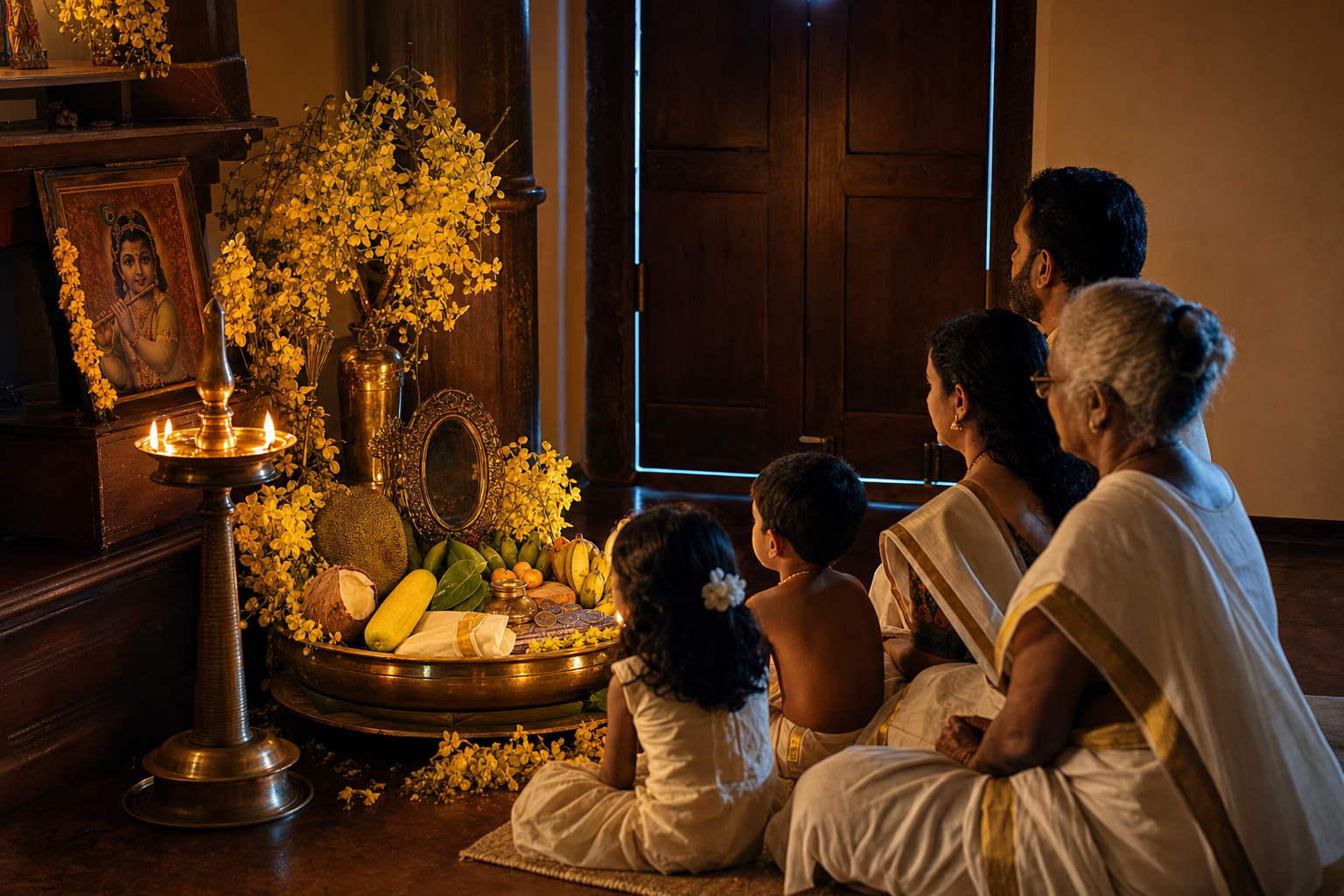
The sequence matters because Vishukkani Vili extends the household rite; it does not replace or interrupt it. If you are organizing children, teach the order before discussing routes or gifts.
- Prepare the kani on Vishu eve. The arrangement should be ready before the family gathers at dawn. This keeps the first sight deliberate rather than improvised.
- Complete kani-kanal and the household observance. Family members first behold the Vishukkani and receive the morning’s blessings within the home.
- Gather the children after sunrise. Small groups are easier to guide than a large crowd. In mixed-age groups, older children can help younger ones follow local etiquette.
- Call from the threshold. The children announce themselves with “vishukaniye, vishukaniye” rather than entering uninvited or treating the visit as a demand.
- Let each household respond in its own way. A welcome may include blessings, Vishukkaineettam, fruit, sweets, or an invitation to see the kani. No single response needs to be imposed on every home.
- Finish by late morning. The visiting circuit naturally gives way to family time and the Vishu sadhya.
This order also gives householders a practical rule: do not feel pressured to receive groups before your family has completed its kani-kanal. A community can agree on a visiting window after sunrise, especially where gates, security desks, or apartment corridors make spontaneous visits difficult.
The call should remain a greeting, not a contest over who can visit the most homes or collect the largest amount. Adults can protect that spirit by keeping the gifts modest, discouraging comparisons, and explaining that accepting with gratitude is part of the observance. The child who receives a coin and the elder who gives it are both participating in the same moral exchange.
What the kani’s objects teach when generosity crosses the threshold
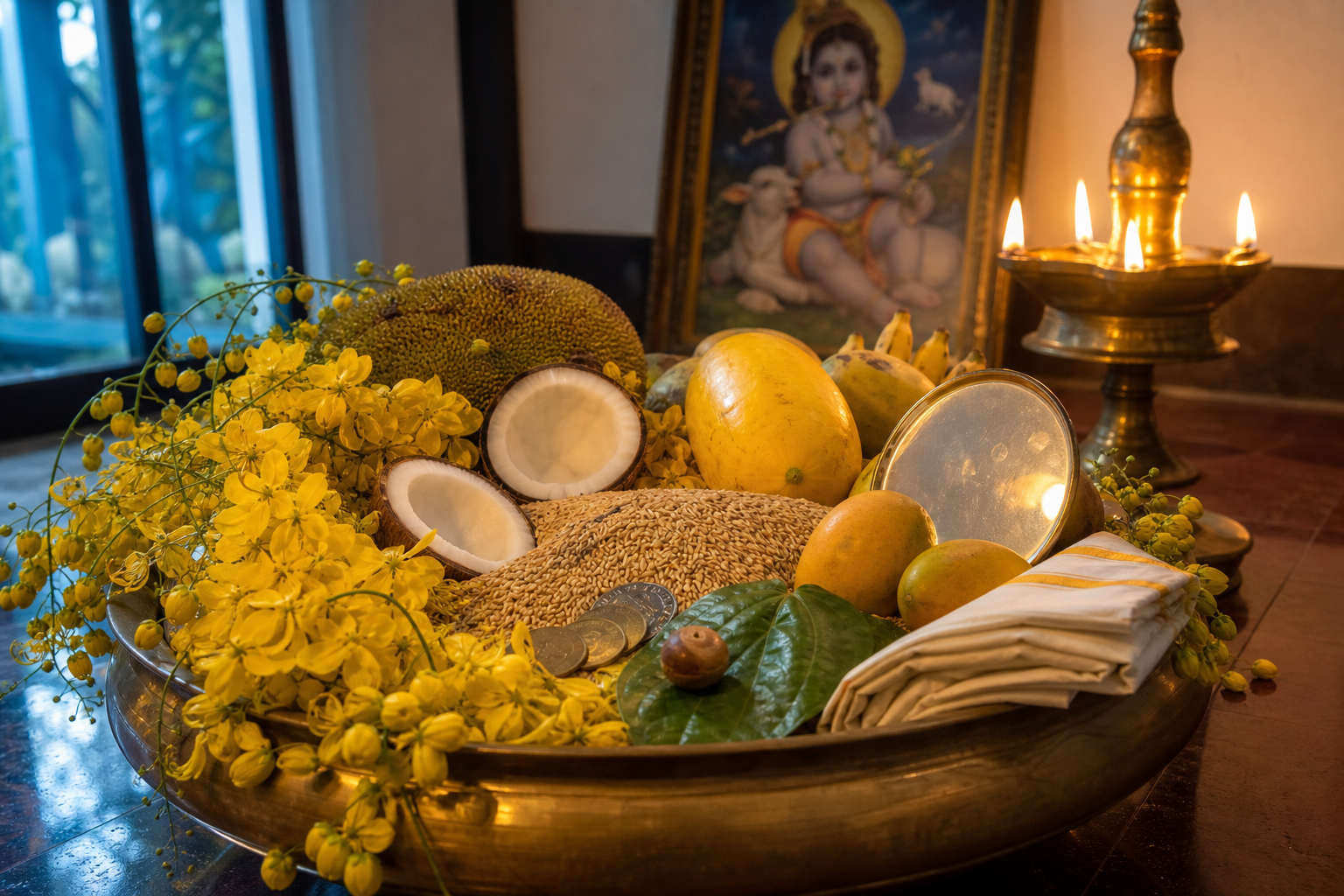
The kani brings several aspirations into one field of vision. Grain and rice signify plenty. Kanikkonna announces seasonal renewal through its brilliant yellow flowers. The lamp represents illumination. The mirror turns the gaze back toward the person who is looking and is commonly associated with self-knowledge. Coins and ornaments place material well-being within a sacred arrangement rather than treating wealth as an isolated end.
Vishukkani Vili puts those symbols into motion. Grain can signify abundance inside the uruli, but kaineettam asks whether abundance will be shared. A lamp can signify inner light, but opening the door asks whether warmth will reach beyond the immediate family. The mirror can evoke self-knowledge, but receiving a group of children also asks a social question: what kind of neighbor will you be at the beginning of a new cycle?
This is why children are not incidental to the custom. They learn its grammar by doing it. Older children show younger ones when to assemble, where to stand, how to call, how to accept a gift, and when to move on. The lesson travels through imitation and responsibility rather than a formal lecture.
The same circuit renews relationships between households. Neighbors who may otherwise pass one another without conversation meet through a recognized gesture of welcome. Auspiciousness stops being private possession and becomes shared fortune. That movement from inner sight to outward giving is the custom’s clearest Dharmic insight.
Dana resonates across Hindu, Buddhist, Jain, and Sikh traditions, although each tradition gives it its own theological and ethical setting. You do not need to erase those distinctions to recognize the shared discipline: what we possess becomes morally meaningful through the manner in which we give, receive, and restrain ourselves. Vishukkani Vili expresses that principle in a specifically North Malabar Vishu idiom.
Preserve a local inheritance without freezing it into a performance
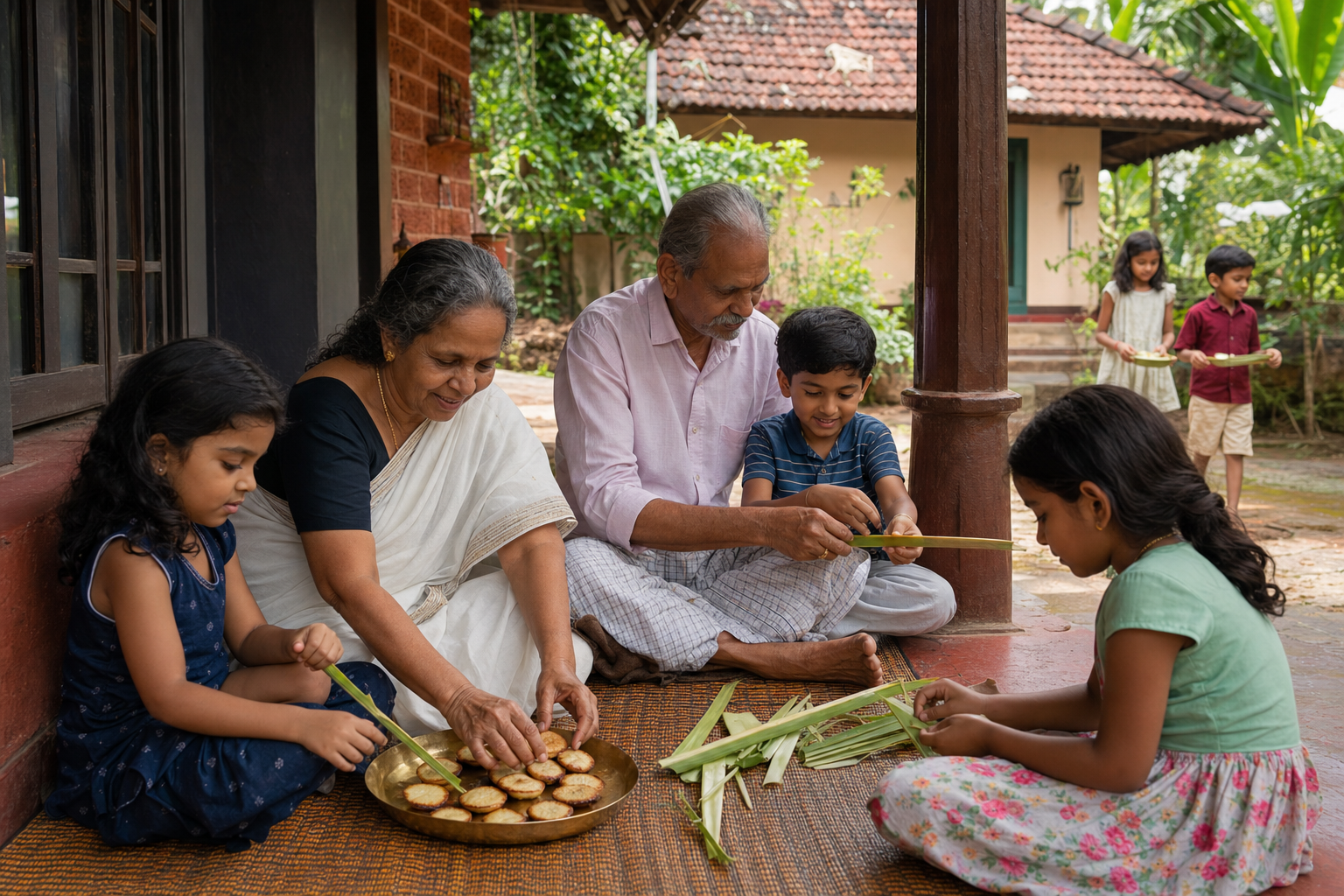
Family recollections in North Malabar describe Vishukkani Vili across generations, but written textual references are sparse. That is normal for many highly localized household and neighborhood customs. It also means we should be precise: the practice is long-standing in community memory, but an unsupported claim of a fixed, ancient origin would go beyond the available record.
If you are trying to revive it in a place where the visiting circuit has weakened, begin with the people who remember its local form. Ask elders which homes were visited, when groups left, whether children saw each kani, what was usually given, and how younger children were guided. Map the remembered route before designing a new one. This keeps revival connected to the locality instead of replacing memory with a generic festival program.
For a household receiving children
- Complete your family’s kani-kanal before the expected visiting period.
- Keep kaineettam ready in coins, notes, or reusable envelopes so the threshold does not become disorderly.
- If you invite children to see the kani, make the invitation explicit and keep the visit brief enough for the group to continue its route.
- Give fruit or sweets only if that fits your household practice; they are local variations, not compulsory additions.
- Offer the same gracious welcome even when the material token is small. The blessing should not be measured by its amount.
For parents and children’s groups
- Use small, mixed-age groups where older children can look after younger participants.
- Accompany very young children and keep all visits in daylight.
- Teach children to call from the gate or threshold, wait for a response, and never enter without an invitation.
- Avoid rankings, collection targets, or public comparisons of kaineettam. Those incentives shift attention from blessing to accumulation.
- Respect homes that are not participating or have not yet completed their observance.
For apartments and urban neighborhoods
Urbanization changes the route, not necessarily the heart of the practice. An apartment community can announce a short visiting window, obtain residents’ consent, and prepare a collective Vishukkani in a community hall. Children can still call at participating doors, or groups can be welcomed together at the shared kani where corridor access is restricted.
Digital payments may be convenient, but a coin, note, fruit, or reusable envelope retains a sensory quality that children remember. Communities do not need to reject technology; they should decide whether it supports or distracts from the face-to-face exchange. Plastic trinkets and disposable gift packaging add little to the meaning. Fruit and reusable envelopes keep the gesture tangible without creating needless waste.
For anyone documenting the tradition
Preservation should record context, not only posed images. With permission, collect elders’ recollections, identify former visiting routes, note local variations, and record the sound of the children’s call. A neighborhood map, a short oral history, and photographs of household or collective kanis can preserve details that a polished festival video may miss.
Keep copies with a local library, temple committee, cultural organization, or youth club where families can find them later. Documentation is most valuable when it returns to the community whose memory it holds. It should support the next Vishu morning, not remove the custom from ordinary life and turn it into a museum object.
If you hear the call this Vishu, respond to the whole ritual rather than only the request for kaineettam. Open the threshold, offer a blessing, and let children see that prosperity becomes auspicious when it circulates. If the call has fallen silent where you live, begin modestly: speak to elders, agree on a safe after-sunrise route, and give the children enough guidance to make the tradition their own.
References
