
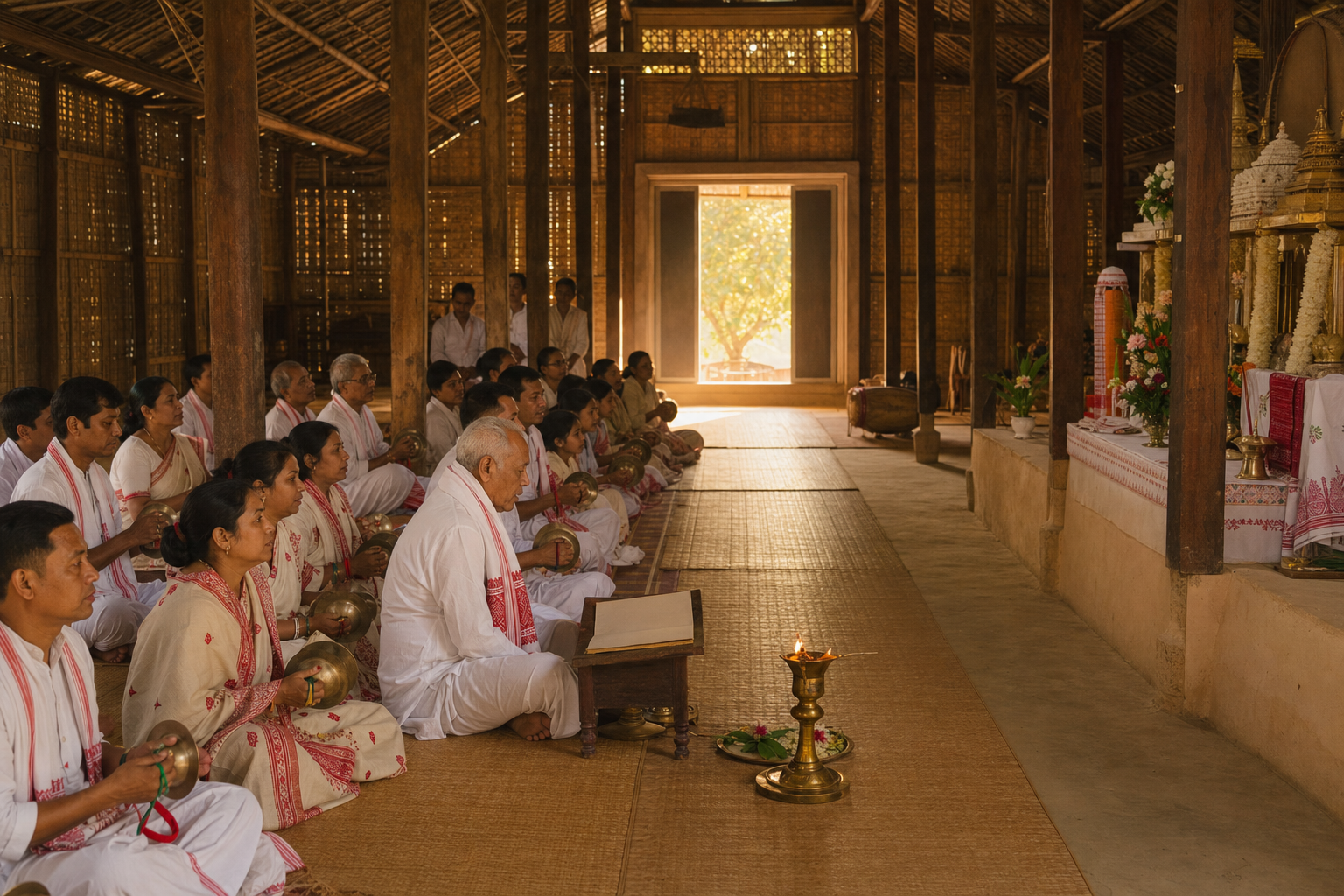
You may already have 18 April marked for Damodaradev Tithi, yet still be unsure what the day asks of you. Is it simply a saint’s death anniversary, a calendar observance, or an occasion for Naam-kirtan and seva? In Assam’s Vaishnava tradition, those dimensions belong together.
For devotees in India, Damodaradev Tithi falls on Saturday, 18 April 2026. If you live outside India, treat that as the reference date rather than an automatic local date. The tithi prevailing at your own sunrise is what matters, so confirm it with a trusted local panchang, satra, temple, or Assamese Vaishnava association before announcing a programme.
Key takeaways for the 2026 observance
- In India, observe Damodaradev Tithi on Saturday, 18 April 2026.
- Its fixed lunar identity is Shukla Paksha Pratipada, the first tithi of the bright fortnight after Amavasya.
- The North Indian name is Vaishakh Shukla Pratipada; in the Assamese calendar, it is Bohag Shukla Paksha Pratipada.
- Outside India, check which tithi is present at local sunrise instead of copying the Indian civil date without verification.
- A grounded observance joins remembrance with Bhagavata study, Naam-kirtan, prasad and a concrete act of seva.
Why the lunar tithi matters more than the printed date

A tithi is not a midnight-to-midnight date. It is determined by the changing angular separation of the Moon and Sun, divided into bands of 12 degrees. Shukla Paksha Pratipada begins just after the New Moon, when that separation has moved beyond 0 degrees but remains within 12 degrees.
This astronomical definition produces a practical rule: a tithi can begin or end during an ordinary civil day. Hindu observances are commonly assigned according to the tithi present at local sunrise. Longitude, time zone and the calculation method used by a panchang can therefore move an observance to a different civil date in another country.
| Calendar question | Practical answer for 2026 |
|---|---|
| What is the Indian civil date? | Saturday, 18 April 2026 |
| What is the lunar tithi? | Shukla Paksha Pratipada |
| What is its North Indian month name? | Vaishakh Shukla Pratipada |
| What is its Assamese calendar name? | Bohag Shukla Paksha Pratipada |
| What should a devotee abroad do? | Confirm the tithi at local sunrise with a reliable local panchang or community notice |
The Purnimanta and Amanta month systems can make calendar discussions sound more contradictory than they are. The North Indian Purnimanta system closes a month at Purnima, while the Amanta system closes it at Amavasya. For this observance, however, both identify the relevant lunar day as the first day of the bright half of Vaishakh. The Assamese calendar expresses the same placement as Bohag Shukla Paksha Pratipada.
In India, most 2026 almanac reckonings place Vaishakh Amavasya on 17 April and the following Shukla Pratipada on 18 April. Calling the tithi “the day after Amavasya” is a useful memory aid, but it should not replace the sunrise rule when you are planning an observance in Toronto, London, Singapore or any other location outside the Indian time zone.
In Assam, the tithi also arrives within the seasonal atmosphere of Bohag and Rongali Bihu. That proximity can enrich a community gathering, but the two occasions should not be collapsed into one. Bihu marks seasonal renewal; Damodaradev Tithi remembers an acharya and asks the community to renew a devotional inheritance.
Damodaradev’s place in Assam Vaishnavism
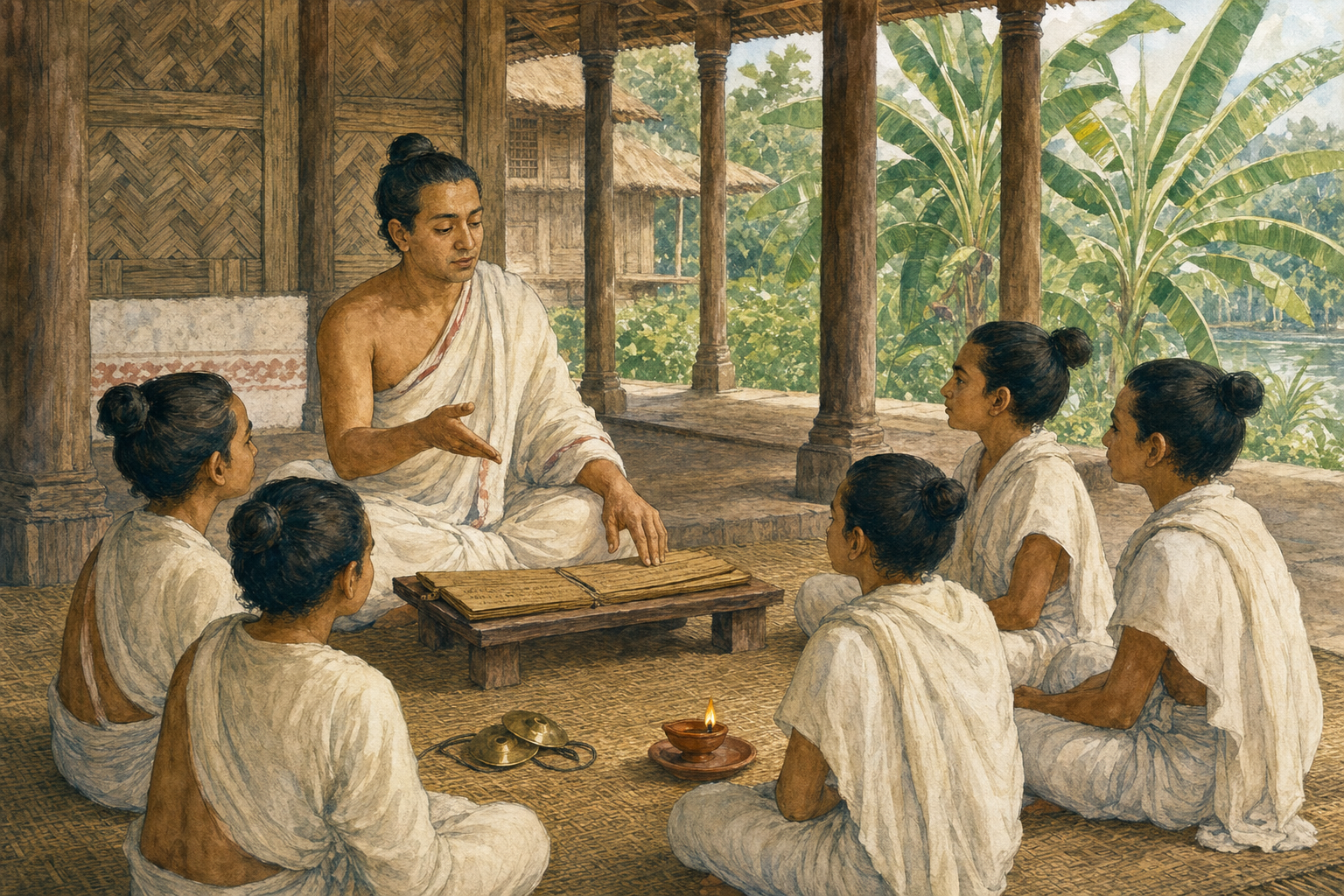
Damodaradev, also written Damodaradeva, is remembered as a Vaishnava saint of Ratnapitha, Hajo, in Kamrup. His traditional life dates are approximately 1488 to 1598, and his punya-tithi commemorates his passing or mahasamadhi. Remembering him only as a historical name, however, misses why the observance remains relevant.
His distinctive legacy lies in the union of rigorous scriptural learning and lived bhakti. Study was not separated from congregational devotion. Recitation of the Bhagavata Purana, Naam-kirtan and organized community practice supported one another, allowing learning to move beyond individual scholarship and become part of a shared religious life.
Tradition associates Damodaradev with the Brahma Sanghati. This stream retained certain Vedic samskaras while placing devotion, Bhagavata recitation and Naam at the centre. That qualification matters. Assam Vaishnavism contains identifiable lineages and forms of discipline; respect for its unity does not require pretending that every sanghati developed in precisely the same way.
Damodaradev’s organizational work also strengthened the satra network. A satra is more than a venue hired for an annual function. Within this devotional world, it carries practices of congregational singing, scriptural study, discipline, teaching and community continuity. The enduring sound of khol and taal is therefore not decorative folklore added to theology. It is one way theology becomes collective memory.
If you are introducing Damodaradev to children or to people unfamiliar with Assamese history, use three anchors:
- Person: Damodaradev was an Assamese Vaishnava acharya associated with Ratnapitha, Hajo and Kamrup.
- Practice: His legacy joins Bhagavata learning with Naam-kirtan and disciplined devotional life.
- Institution: His work helped strengthen satras as living centres of worship, instruction and community.
Hajo gives this legacy an additional setting. The sacred geography includes the Hayagriva Madhava Temple, revered by Vaishnavas and associated with the Buddha in some Buddhist traditions, as well as Kedareshwar and other shrines. This proximity shows a region in which multiple sacred memories have endured together. It should be approached as a reason for careful understanding, not as permission to erase the distinctions between traditions.
Damodaradev is often remembered alongside Srimanta Sankardev and Madhavdev. For a newcomer, that wider frame is useful: Assam’s Vaishnava inheritance was carried not only through doctrine but through teachers, congregations, music, texts and durable institutions. Damodaradev Tithi becomes intelligible when all five remain visible.
A simple home observance centred on learning and Naam
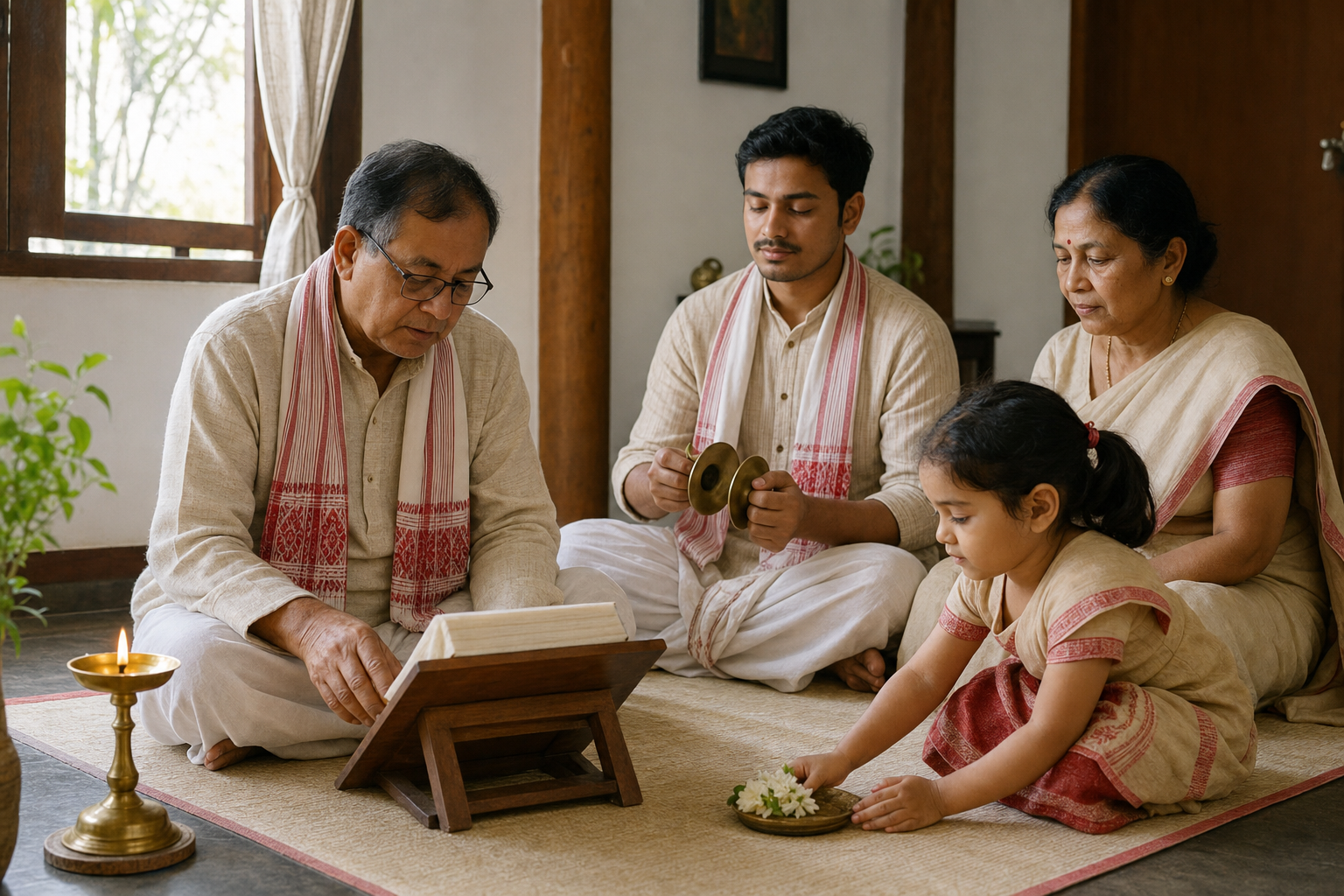
You do not need to imitate the full rhythm of a satra in your home. A better approach is to preserve the day’s devotional centre: correct sankalpa, Vishnu or Krishna aradhana, scriptural attention, Naam and service. The following sequence can be adapted to your family tradition without presenting personal preference as a universal rule.
- Confirm the local date. In India, use 18 April 2026. Elsewhere, check the sunrise tithi before fixing the gathering.
- Make a clear sankalpa at sunrise. Remember Damodaradev and dedicate the worship to the preservation of bhakti, learning and community welfare.
- Prepare a modest offering. Light a lamp and offer tulasi and seasonal fruit before Vishnu or Krishna according to the practice of your household.
- Choose one scriptural centre. Read a selected portion of the Srimad Bhagavata, recite Vishnu Sahasranama, or sing an appropriate kirtan. It is better to attend carefully to one form than to hurry through every possible recitation.
- Take up Naam or japa. Om Namo Narayanaya or the Hare Krishna mahamantra are accessible choices when they accord with your devotional discipline.
- Connect worship to memory. Speak briefly about Sankardev, Madhavdev and Damodaradev, with particular attention to the way scholarship, congregational devotion and the satra tradition support one another.
- Share prasad and complete an act of seva. Annadana, help for a neighbour, or educational support for a child gives the day’s intention a social form.
A concluding prayer for loka-kalyana, such as sarve bhavantu sukhinah, places personal devotion within the welfare of all. That movement from remembrance to responsibility is especially appropriate on a punya-tithi. The point is not to admire a saint from a distance, but to allow the virtues being remembered to change what you do.
If your circumstances permit only a compact observance, keep four elements: a lamp, a passage from the Bhagavata, sincere Naam and one act of seva. Elaborateness is not the same as attention. The most common planning mistake is to assemble so many items that the saint’s actual contribution disappears behind the programme.
Three other errors are easy to avoid. Do not copy an Indian date abroad without checking the local tithi. Do not turn the day into a biography lecture without devotional practice. And do not perform a generic Vaishnava ritual while leaving Damodaradev, Assam and the satra inheritance unexplained.
From satra gathering to diaspora programme
Build the programme around the tradition’s own forms
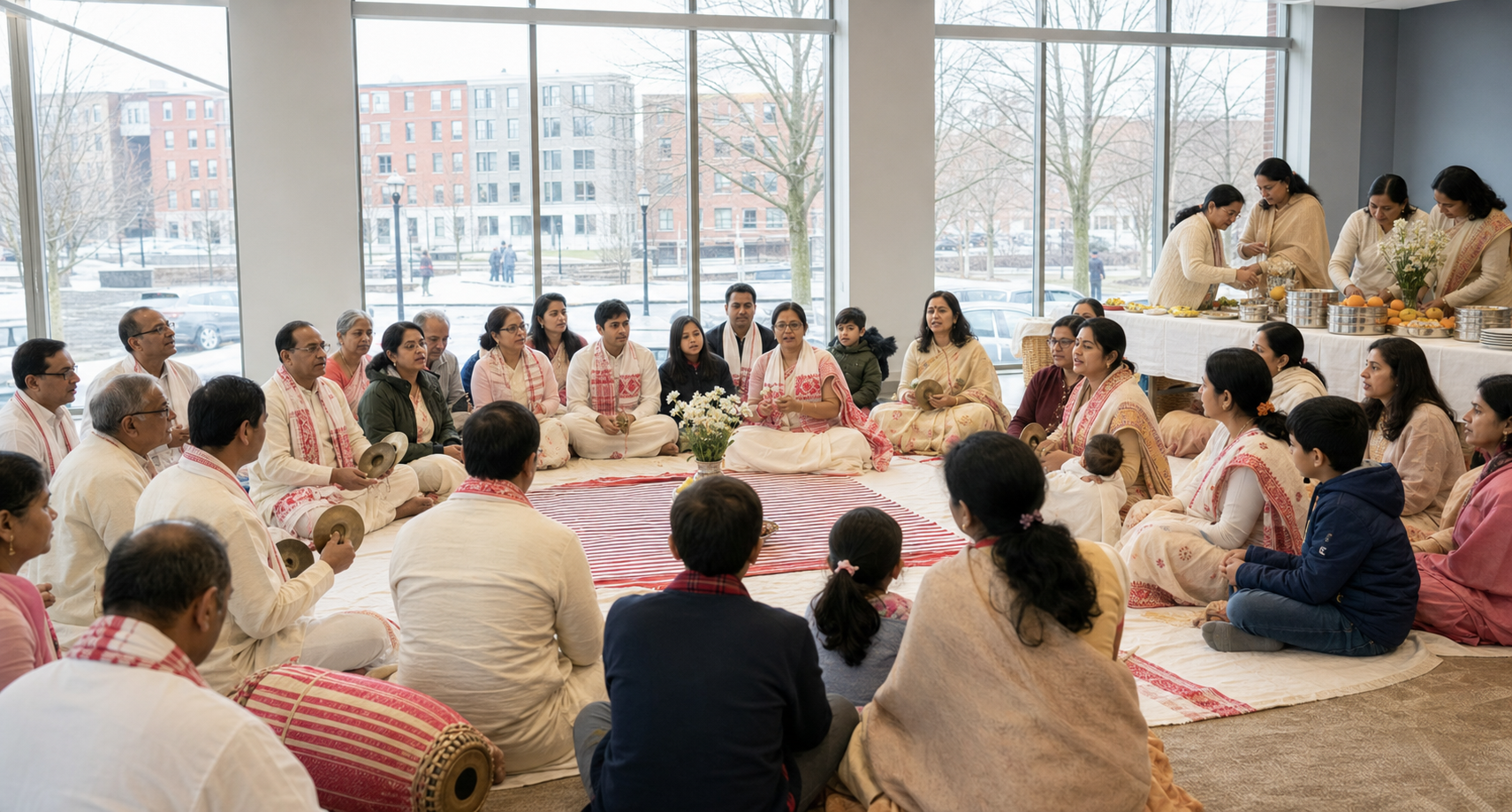
A satra or community gathering commonly brings together Naam-prasanga, Bhagavata patha, satsang and shared prasad. Those elements already express the character of the remembrance. Organizers do not need to manufacture a separate theme; they need to make the connection between the saint and the practices visible.
- Open with the tithi’s local calendar identity and a concise introduction to Damodaradev.
- Let Naam-kirtan and Bhagavata recitation form the devotional core rather than treating them as introductory performances.
- Use the satsang to explain Brahma Sanghati carefully, including its association with certain Vedic samskaras and its emphasis on Bhagavata-centred bhakti.
- Include khol and taal where practitioners within the community can carry the musical tradition naturally and respectfully.
- Conclude with prasad and a defined seva effort, such as annadana or educational assistance, so participants know how remembrance continues after the gathering.
If children are attending, give them something concrete to notice: the role of a satra, why Naam is congregational, or how a lunar tithi differs from a fixed civil anniversary. A single clear connection will teach more than a long catalogue of names and dates.
Keep a diaspora observance locally correct
For a diaspora association, the first planning task is calendrical. Resolve the local sunrise tithi before publishing a poster or reserving a programme date. If the community follows a particular panchang or temple convention, state that convention clearly so a one-day difference from India is not mistaken for carelessness.
The second task is cultural clarity. Explain Bohag and the nearby atmosphere of Rongali Bihu, but retain the distinct purpose of the punya-tithi. Seasonal celebration and acharya remembrance can share a community calendar without becoming interchangeable.
The wider Dharmic relevance should also be expressed with precision. Ahimsa and daya have deep resonance in Jain and Buddhist traditions; Naam and seva are central within Sikh practice; and Sanatana Dharma sustains many paths of devotion and service. These convergences can support fellowship, but they should not be used to claim that Hindu, Buddhist, Jain and Sikh disciplines are identical. Shared ethical commitments become more credible when each tradition’s integrity is honoured.
Your next step is straightforward. Mark 18 April 2026 if you follow the Indian observance, verify the local sunrise tithi if you live elsewhere, and choose one passage, one form of Naam and one act of service now. That preparation will make Damodaradev Tithi more than a date on an Assamese calendar: it will carry learning, devotion and responsibility into the life of your community.
References
