
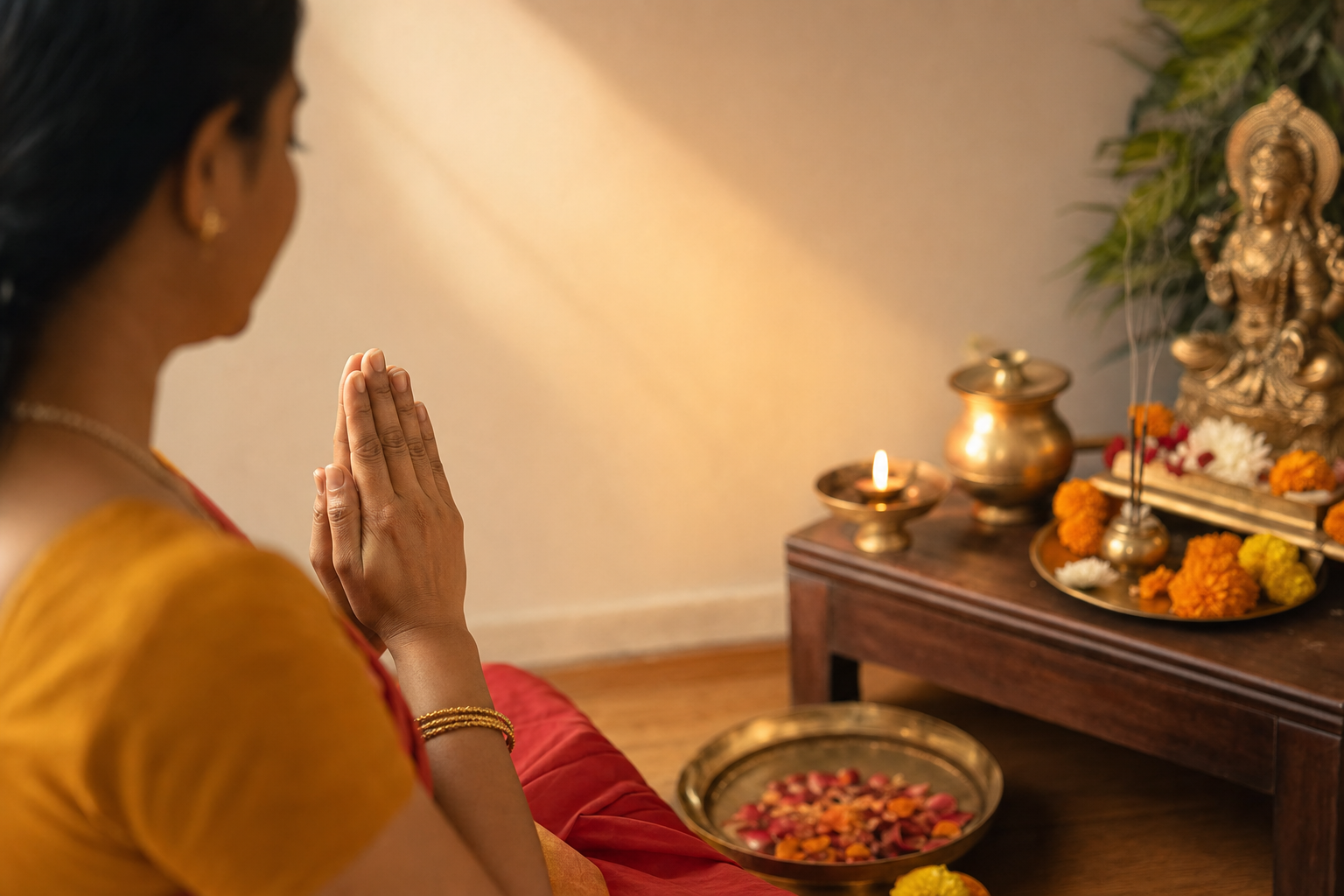
You know the mantra, the lamp is ready, and the flowers are in your hands. Then the puja reaches a transition and you hesitate: should your palms remain joined, open toward the murti, or hold the offering in a particular way?
You do not need to memorize an entire ritual vocabulary before your hands can support worship. Begin with three dependable gestures, understand what each one is doing, and let the sequence of the puja tell you when to use it. Precision can then grow without turning devotion into a performance.
Read every mudra as part of a threefold act
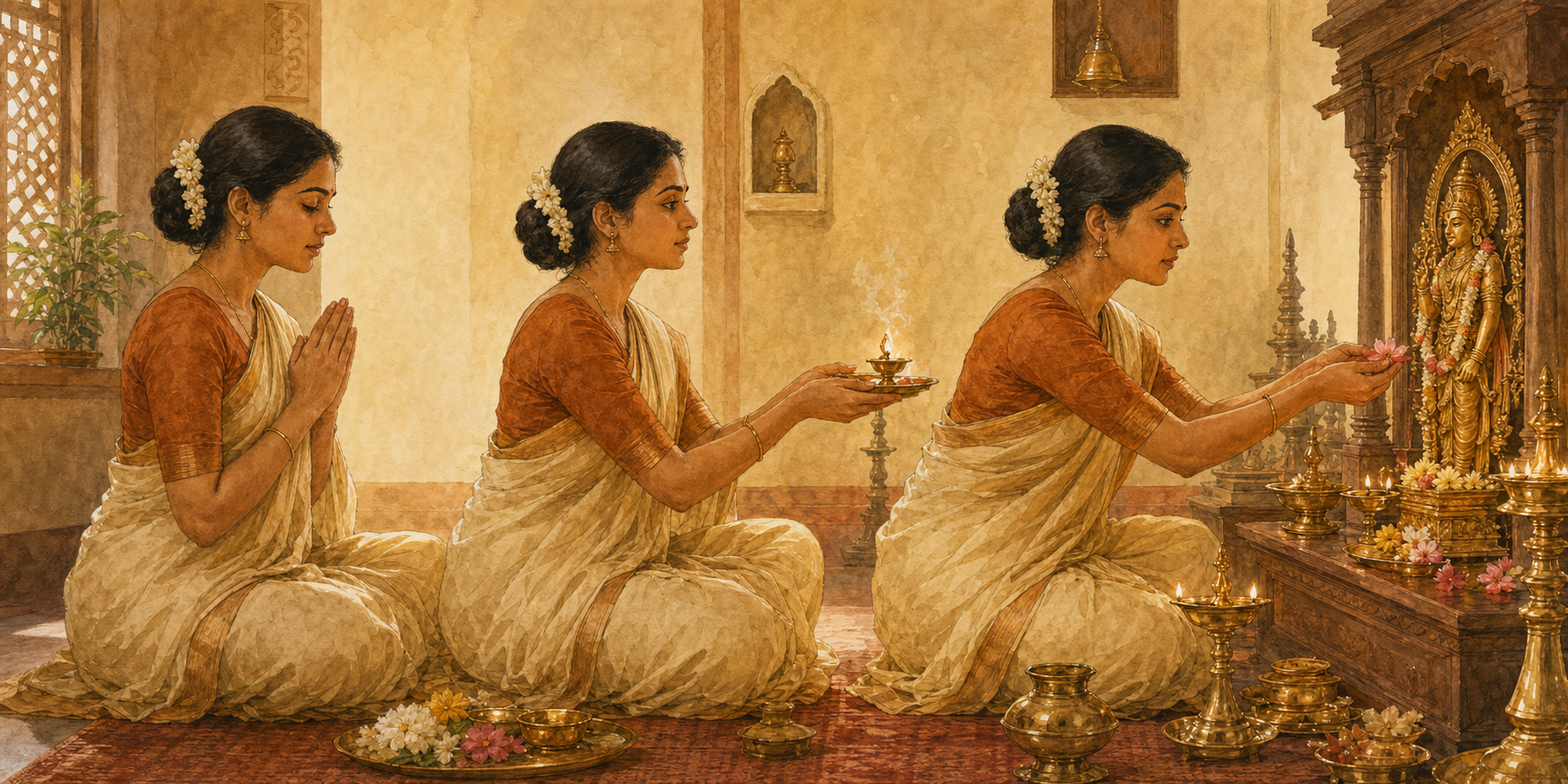
A mudra does not stand apart from the rest of puja. It belongs to a coordinated act involving kayika, physical action; vacika, mantra or spoken praise; and manasika, intention, contemplation, or bhava. Your hands show the action, your voice gives it verbal form, and your attention remains with the deity.
This gives you a practical test. Before forming a gesture, ask, “What am I doing now?” The answer should be concrete: welcoming, presenting, praising, contemplating, protecting, or concluding. Form the mudra only after that purpose is clear. If your hands indicate an offering while your mind is already searching for the next item, slow the transition and restore the connection.
The many hand forms encountered in Hindu worship become easier to understand when you sort them into four functional families:
- Deity-iconic mudras are displayed by a murti or sacred image. Abhaya presents an open, raised palm associated with fearlessness and protection. Varada presents an open, lowered hand associated with giving and benevolence.
- Ritual mudras mark changes in the liturgy, including avahana, invitation; samarpana, offering; and udvasana, the formal conclusion or respectful leave-taking where prescribed.
- Contemplative mudras, including Dhyana, Jnana, and Chin, give the body a stable position during meditation, japa, or recitation.
- Protective and integrative mudras accompany practices such as nyasa, in which mantra, touch, and visualization are coordinated. These are often specific to a lineage and should not be reconstructed casually.
This classification prevents a common mistake: assuming that every hand position seen on a murti should be copied by the worshipper. Iconography communicates the deity’s qualities. Ritual gesture performs a particular liturgical action. The forms can echo one another, but their roles are not automatically interchangeable.
Mudra is also not a freestanding charm that manufactures sacred presence. Its immediate discipline is alignment. A repeatable hand position reduces stray movement and gives your attention somewhere definite to return when it wanders. That modest function is already spiritually important: the body stops competing with the mantra and begins to support it.
Learn three mudras before adding a larger vocabulary
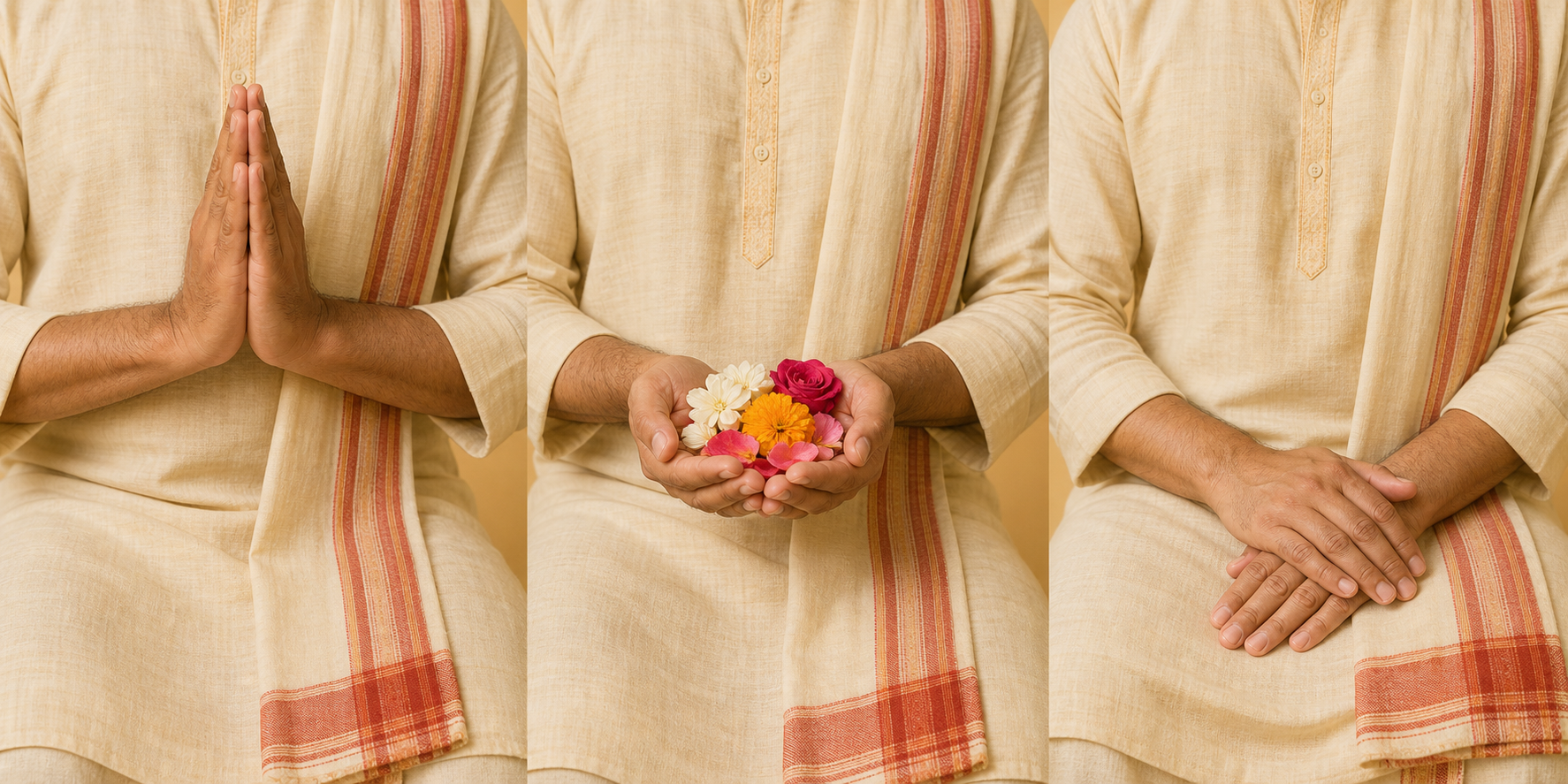
For ordinary household worship, Anjali, Pushpanjali, and Jnana or Chin provide a sound foundation. They cover reverence, offering, and contemplation. Practice them with relaxed fingers and unforced breathing before adding specialized forms from a paddhati or teacher.
Anjali: establish reverence before you act
Bring the palms together evenly. Let the thumbs touch lightly near the sternum, keep the elbows soft, lower the shoulders, and hold the head without strain. The pressure between the palms should be enough to maintain contact, not so strong that the wrists, neck, or upper chest become rigid.
Use Anjali when you first face the altar, during namaskara, and when a prayer calls for collected reverence. A common devotional interpretation sees the joined sides as the meeting of jiva and Ishvara. Whatever theological language your sampradaya uses, the practical message is clear: gather yourself before approaching the deity.
Notice the difference between stillness and stiffness. If your elbows lift, your palms press hard, or your breath becomes shallow, you are adding effort that the gesture does not need. Release the shoulders, soften the base of the thumbs, and return your attention to the mantra.
Pushpanjali: make the offering a deliberate release
Cup both hands together so they can hold flowers without crushing them. Bring the offering near the heart as the relevant mantra or prayer is recited. Then lower the hands steadily and place or release the flowers at the feet of the murti, according to the custom you follow.
The movement matters because it gives the offering a beginning and an end. You first collect the flowers and your attention; you then relinquish both into worship. Avoid tossing petals from a distance, hurriedly dropping them while reaching for the next item, or lifting them so high that they obscure the murti’s face.
If you lose your place, pause with the flowers securely cupped. Complete the mantra you know, offer them calmly, and only then continue. The correction is not a more elaborate flourish. It is a cleaner act of samarpana.
Jnana and Chin: steady the hands during inward practice
Touch the tip of the index finger gently to the thumb and let the remaining fingers extend without being locked. In the convention used here, Jnana mudra rests with the palm facing upward, while Chin mudra rests with the palm facing downward. Place the hands comfortably on the thighs or knees so the wrists do not hover under tension.
These forms suit seated japa, meditation, and contemplative recitation. They give the hands a stable resting place and can serve as a physical reminder to return to the mantra. They are not universal replacements for the open or cupped hands used when presenting an actual offering.
Do not force the thumb and finger into a hard circle. The contact should be light enough that the shape can be maintained without distracting you. If the mudra becomes the main object of muscular effort, it is no longer helping concentration.
Let the puja sequence tell you when to change gesture
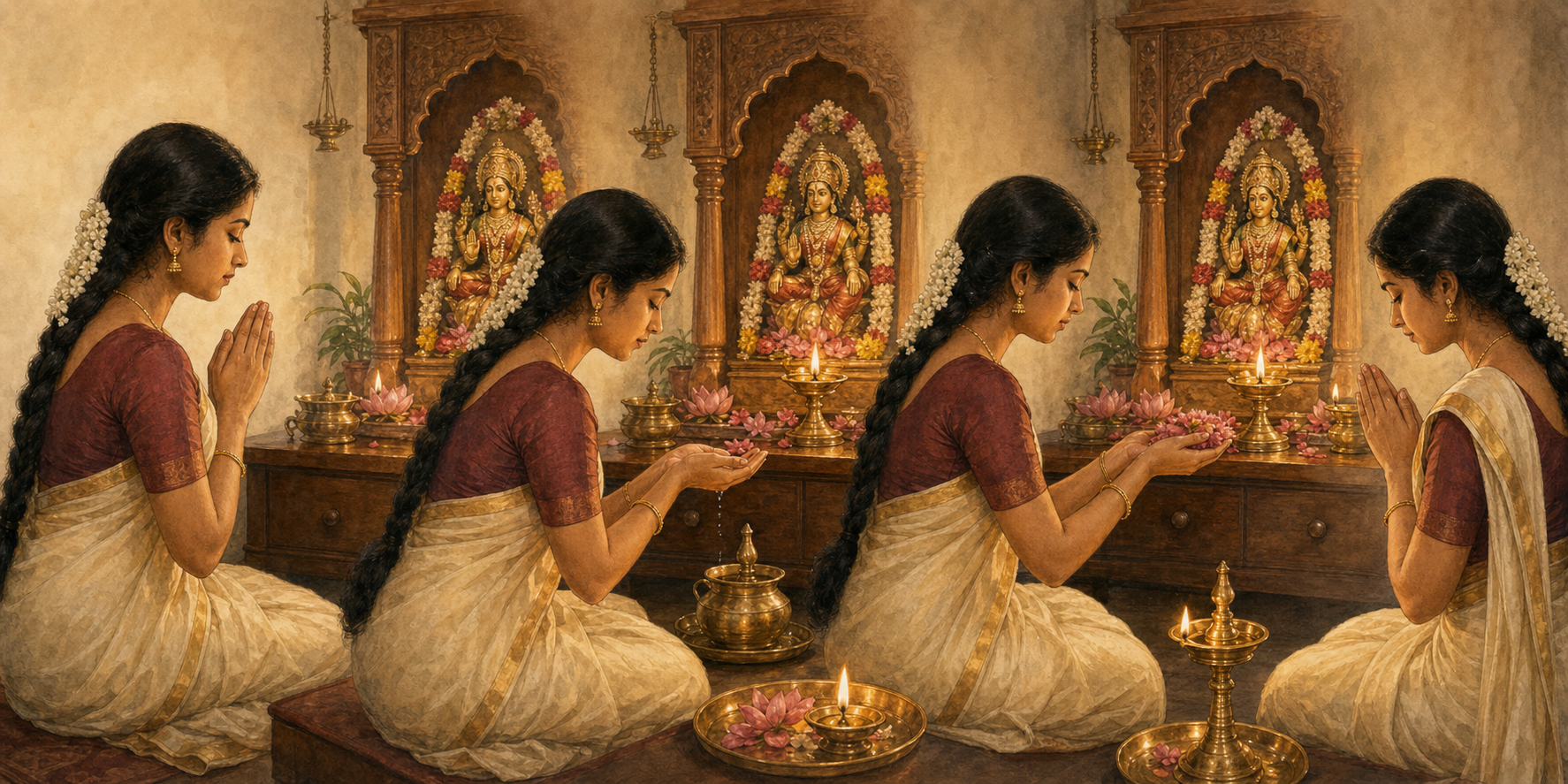
You will remember mudras more reliably when you attach them to ritual transitions rather than treating them as isolated poses. A household shodashopachara, or sixteen-offering puja, provides a useful map even when your daily worship uses fewer offerings. Regional and sampradaya-specific sequences differ, so the map below explains the gestural logic rather than imposing a universal liturgy.
- Collect yourself and invite. Begin with Anjali and a steady gaze. During avahana, use the invitational form prescribed in your practice; an open, welcoming orientation of the hands expresses the purpose more clearly than hurried movement. The offerings of asana and padya, a seat and water for the feet, are presented with hands shaped to support the imagined or physical offering.
- Purify and adorn. During snana, a controlled sprinkling or bathing movement accompanies the ritual cleansing. Vastra, gandha, and alankara are then offered as clothing, fragrance or sandal paste, and adornment. Keep the hands steady and avoid covering the murti’s face while placing anything.
- Present flowers, fragrance, light, and food. Gather flowers in Pushpanjali before releasing them. Move dhupa and dipa in calm, steady arcs rather than fast circles. Present naivedya with open, composed hands and allow the offering mantra to finish before withdrawing them.
- Conclude with full attention. Deepa-arati gathers sight, light, mantra, and gesture into the closing movement. Follow it with Anjali, namaskara, or prostration as your practice directs. If your liturgy includes udvasana, treat it as a respectful completion, not an abrupt signal that the puja is over.
At each transition, take one unforced breath, release unnecessary tension, form the next gesture, and begin the mantra. This small pause prevents the hands from getting ahead of the mind. It also makes errors easier to notice before they pass into habit.
Keep ritual objects within easy reach and in the order you will use them. This is not merely housekeeping. Reaching across the altar, transferring an object between hands repeatedly, or searching for flowers during a mantra breaks the coordination that mudra is meant to establish.
When you genuinely do not know the prescribed gesture in a non-initiatory household puja, do not invent a complicated one from memory. Use a simple, reverent presentation, complete the offering, and consult the paddhati or your teacher afterward. One clear movement is more faithful than an ornamental guess.
Keep lineage-specific forms inside their proper setting
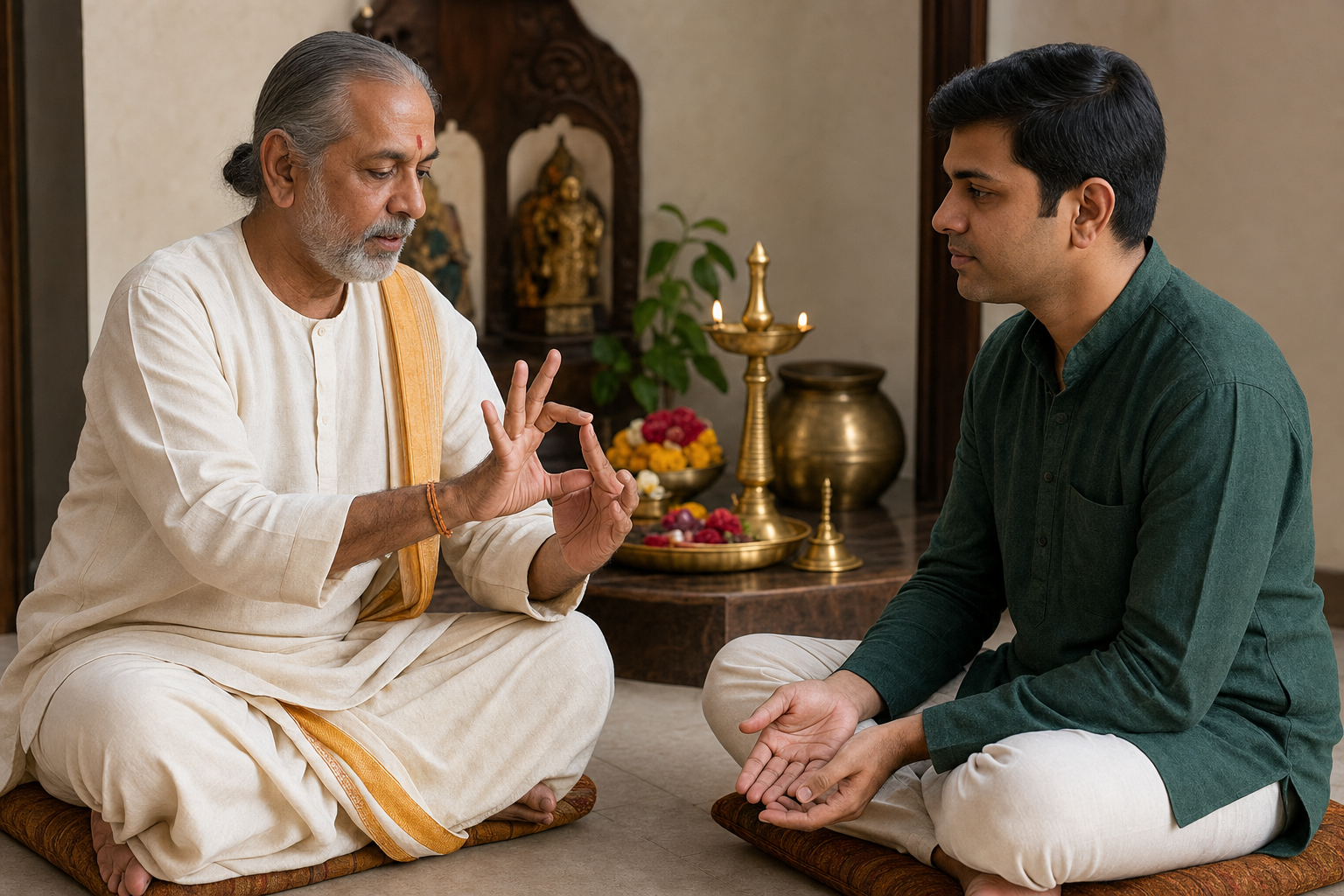
Hindu ritual traditions share a gestural logic, but they do not use one standardized sequence. Agamic practice in Shaiva, Shakta, and Vaishnava streams, including Pancharatra and Vaikhanasa traditions, preserves specialized forms alongside the simpler gestures of domestic puja. Smarta paddhatis and temple archana manuals also arrange mudras according to their own liturgical needs.
That variation matters most when a mudra is joined to a particular mantra, direction, visualization, or act of consecration. Some Vaishnava rites use hand forms evocative of Vishnu’s shankha and chakra while sanctifying water or space. Shaiva and Smarta traditions have protective or consecratory forms associated with preparations for abhishekam and archana. Shakta lineages may preserve deity-specific mudras whose correct use depends on transmission.
Nyasa is the clearest case for restraint. In kara-nyasa and anga-nyasa, the practitioner coordinates touches to the hands, fingers, or limbs with names, seed syllables, and visualization. Sequence and mantra belong together. Copying the visible touches while omitting or guessing the rest does not reproduce the practice.
Use three filters before adopting an unfamiliar mudra:
- Context: Is it a gesture for puja, temple archana, meditation, classical performance, or iconography? An overlapping hand shape does not guarantee an identical use.
- Authority: Does it appear in the paddhati your household or sampradaya follows, or has a qualified teacher instructed you in it?
- Completeness: Do you know the associated mantra, stage of worship, orientation, and purpose, or have you seen only a photograph of the final hand position?
The Natya Shastra and Abhinaya Darpana preserve hand vocabularies that overlap with devotional arts, but ritual meaning depends on ritual context. Do not transfer a dance hasta wholesale into puja merely because the fingers look familiar. Conversely, do not assume that a mudra shown by a deity is an instruction for the worshipper to imitate it at every appearance of the corresponding word.
A shared form can also carry distinct meanings across Dharmic paths. Abhaya appears in Hindu and Jain sacred imagery, while Buddhist traditions codify gestures such as Bhumisparsha, Dhyana, and Dharmachakra. Anjali is widely recognizable across the Indic world. These continuities reveal a shared civilizational vocabulary, but they do not erase the liturgical distinctions of Hinduism, Buddhism, Jainism, and Sikhism.
Adaptation is appropriate when your body cannot hold a textbook position comfortably. Reduce the range, support the forearms, keep the fingers relaxed, and avoid forcing a painful joint. Preserve the direction of attention, the mantra, and the offering as far as you comfortably can, then ask your teacher how the relevant paddhati accommodates the limitation.
Be equally careful with physiological claims. A stable hand position and gentle breathing can function as cues for collected attention, and many practitioners describe a devotional resonance near the heart while holding Anjali. Traditional explanations may speak of prana, nadis, and the anahata region. Those spiritual and experiential descriptions should not be inflated into medical promises. Mudra belongs here as embodied sadhana, not as a substitute for treatment.
Key takeaways for your next puja
- A mudra becomes meaningful when physical action, mantra, and attention express the same ritual purpose.
- Identify whether a gesture is iconographic, liturgical, contemplative, or protective before deciding how to use it.
- Begin with Anjali for collected reverence, Pushpanjali for a deliberate flower offering, and Jnana or Chin for seated contemplation.
- Let the phase of the puja cue the movement: invite openly, offer steadily, contemplate without strain, and conclude deliberately.
- Do not automatically imitate Abhaya, Varada, or another mudra displayed by a murti; iconographic and priestly uses have different contexts.
- Learn nyasa, bija-linked forms, and deity-specific mudras through the appropriate paddhati and qualified guidance.
- Keep the shoulders, wrists, and fingers relaxed. Precision means clear intention and repeatable form, not physical force.
At your next puja, place a small reminder beside the altar with three transitions: “Invite: open and welcome. Offer: cup and release. Conclude: Anjali.” Make those movements clear before adding anything more. Once they no longer compete with the mantra, learn one additional gesture from the tradition you actually follow and place it in its proper moment.
References
