

You may be doing everything you know and still feel the grip tightening: a conflict that will not resolve, a habit that outlasts your resolve, or a duty whose outcome you cannot control. Gajendra’s surrender speaks to that exact threshold. It does not ask you to abandon responsibility. It shows you how to act when self-sufficiency is no longer an honest answer.
The practical lesson is demanding but clear: tell the truth about your limits, take refuge without dictating how grace must appear, and remain willing to follow the discernment that cuts the actual bond rather than merely easing its symptoms.
Surrender begins when strength stops pretending to be absolute

Gajendra is an elephant king, a figure of formidable natural strength, yet a crocodile holds him where his strength cannot secure freedom. In the concentrated account of Srimad-Bhagavatam 2.7.17, the Lord hears the elephant’s plea, arrives on Garuda, and uses the divine wheel to end the peril binding him. The fuller movement through prayer, surrender, and liberation unfolds in Srimad-Bhagavatam 8.3-8.4.
The failure of Gajendra’s power is not a condemnation of effort. His strength was real, just not ultimate. That distinction matters whenever you confuse responsibility with control. You may be responsible for speaking truthfully, keeping a promise, setting a boundary, asking for help, or making amends. You are not therefore sovereign over another person’s response, the timing of relief, or every consequence that follows.
Sharanagati, or taking refuge, begins when you stop assigning your limited agency the role of the Divine. It changes the questions you ask:
- Instead of asking how you can force the outcome, ask which action remains yours to perform according to dharma.
- Instead of concealing fear behind spiritual language, state plainly what is happening and where your capacity ends.
- Instead of demanding that help arrive in one predetermined form, become receptive to guidance, protection, correction, and support.
This is why desperation alone is not the whole meaning of Gajendra’s prayer. Desperation can still cling to control. Surrender adds refuge: the conscious recognition that your life, strength, and final freedom do not rest in your hands alone.
Garuda and the chakra reveal what grace actually does

The manner of the rescue is part of its teaching. Garuda represents speed, sovereignty, and safe conveyance. Compassion does not remain a distant sentiment; it moves toward the being in distress. The chakra, commonly understood as Sudarshana, represents luminous discernment, protective wisdom, and the order of dharma. Grace approaches, but it also cuts.
That second movement corrects a common misunderstanding. Grace is not merely the feeling of being comforted. Sometimes comfort leaves the bondage untouched. In Gajendra’s rescue, the decisive act is the severing of what holds him. Applied to your life, this means that an answer to prayer may expose a habit, attachment, false belief, or relationship with control that you would rather preserve.
A traditional bhakti reading of the episode sees Gajendra as the embodied self, the waters as the currents of samsara, and the crocodile as constricting karma or time-bound entanglement. Garuda can then signify the momentum of revealed knowledge, while the chakra signifies the clarity that ends captivity. This contemplative reading does not make the rescue less devotional. It lets you see its pattern within your own conduct.
When you ask for grace, therefore, do not look only for a dramatic reversal of circumstances. Look for the cutting edge of dharmic clarity. Use these questions to notice it:
- Does this response return you to truth, duty, and reverence, or merely flatter what you already wanted?
- Does it loosen a destructive attachment, or give that attachment a sacred-sounding excuse?
- Does it make you more receptive to wise counsel and legitimate help?
- Does protection remain governed by compassion, or is anger borrowing the language of dharma?
- Does the experience reduce ahankara, or leave you feeling spiritually superior to others?
The chakra’s violence is not permission for indiscriminate outer aggression. Its spiritual force lies in precise protection: ignorance, predation, and bondage are cut so that life can return to dharma. The relevant question is not whom you would like to defeat. It is what must be ended for truth and compassion to govern your next action.
A practical Gajendra prayer for the moment you feel trapped
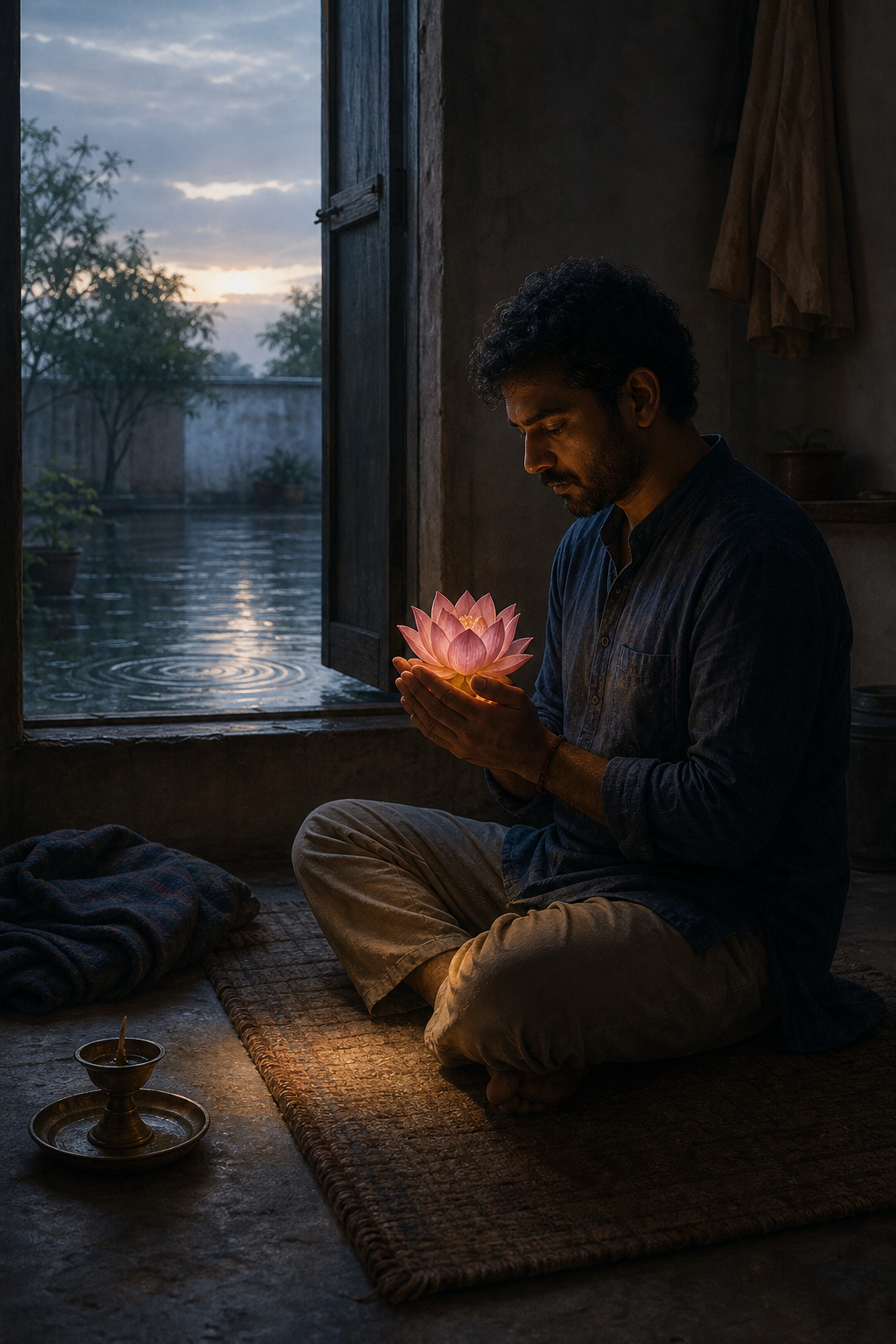
You do not need elaborate language to practise surrender. Gajendra’s example places sincerity before polish. When worry is multiplying and your mind keeps repeating the same failed strategy, move through the following sequence.
- Name the grip in one sentence. Describe the situation without exaggeration or spiritual ornament. For example: I cannot control this person’s decision, and my attempts to do so are making me dishonest. Naming the crocodile prevents a vague feeling of doom from governing everything.
- Separate capacity from control. List what remains within your agency: a truthful conversation, a boundary, an apology, a request for qualified help, or the refusal to repeat a harmful act. Then acknowledge what no effort can guarantee.
- Make an unembellished appeal. You might pray: Lord, I cannot master this by strength alone. I take refuge in You. Give me the discernment and courage to do the next dharmic thing. The purpose is not to produce impressive words. It is to stop hiding from your dependence.
- Perform the next dharmic action. Surrender should make duty clearer, not optional. Contact the person whose help you have resisted. Keep the obligation that remains yours. Step away from the exchange in which you cannot act without causing further harm.
- Ask what needs to be severed. The outer problem may not be the only bond. Pride, resentment, compulsive reassurance-seeking, refusal of counsel, or attachment to one outcome can keep the inner struggle alive even when circumstances change.
- Release your timetable and watch for guidance. Help may arrive through protection, an unexpected opening, scriptural insight, correction from a trusted person, or the steadiness to endure without abandoning dharma. Record what becomes clearer so that anxiety does not erase it later.
This practice does not manufacture grace. It makes your posture receptive to it. Prayer voices the need, dharmic action keeps you from collapsing into passivity, and reflection helps you recognize the difference between genuine release and temporary relief.
Five counterfeits that can look like surrender
It is possible to use devotional language while avoiding the actual turn Gajendra makes. Watch for these substitutes:
- Passivity: Refusing an available duty and calling the refusal trust in God. If an honest, lawful, protective step is yours to take, take it. Faith does not require negligence.
- Bargaining: Treating prayer as a demand that the Divine endorse one outcome. A plea can be specific, but refuge includes surrendering the claim that you know the only acceptable form of help.
- Polished vagueness: Speaking beautifully about detachment while refusing to name the fear, injury, or attachment involved. Gajendra’s plea has force because the need is real and undisguised.
- Isolation: Rejecting community, counsel, or skilled assistance because you expect grace to bypass human means. Help carried by another person is not spiritually inferior help.
- Aggression disguised as the chakra: Using the rescue to sanctify vengeance. Sudarshana cuts bondage under divine wisdom; it does not authorize personal rage to declare itself righteous.
If the grip involves abuse, medical distress, risk of self-harm, or another immediate danger, seek practical protection and qualified help now. Prayer can accompany urgent action, but it must not be used to delay it. Leaving danger is not a failure of surrender.
Questions people ask about surrender and grace
Should you surrender your effort or the outcome?
Surrender the illusion of independent control and your possessiveness toward the result. Retain the effort that dharma genuinely requires. Gajendra does not teach contempt for strength; he teaches that finite strength cannot be its own final refuge. Your task is wholehearted action without pretending that action makes you sovereign.
Does the Lord arriving at once mean your problem should end immediately?
No human timetable can be extracted from those words. The narrative affirms divine attentiveness and decisive compassion; it does not give you a stopwatch with which to measure whether your prayer was heard. Sometimes a circumstance changes quickly. Sometimes the first grace is clarity about what to do, what to stop doing, or what must be endured without surrendering dharma. Do not confuse delay in your preferred outcome with divine absence.
Is Gajendra’s teaching only meaningful within Vaishnava bhakti?
Gajendra-moksha belongs unmistakably to the Vaishnava devotional vision of refuge in the Lord, and that identity should not be blurred. Its structure nevertheless has recognizable resonances across dharmic traditions: Buddhist karuna responds to suffering, Jain ahimsa and kshama address the roots of harm, and Sikh ardas joins supplication with trust in hukam. These are meaningful parallels, not interchangeable doctrines. Respect begins by recognizing shared ethical movement without erasing distinct understandings of God, self, karma, and liberation.
Before the day ends, write one sentence naming the grip you cannot overcome by force and another naming the next dharmic act that remains yours. Offer both to the Lord without prescribing the answer. Gajendra’s courage was not the ability to prove that he needed no refuge. It was the willingness to bow his strength toward its true source.
References
