
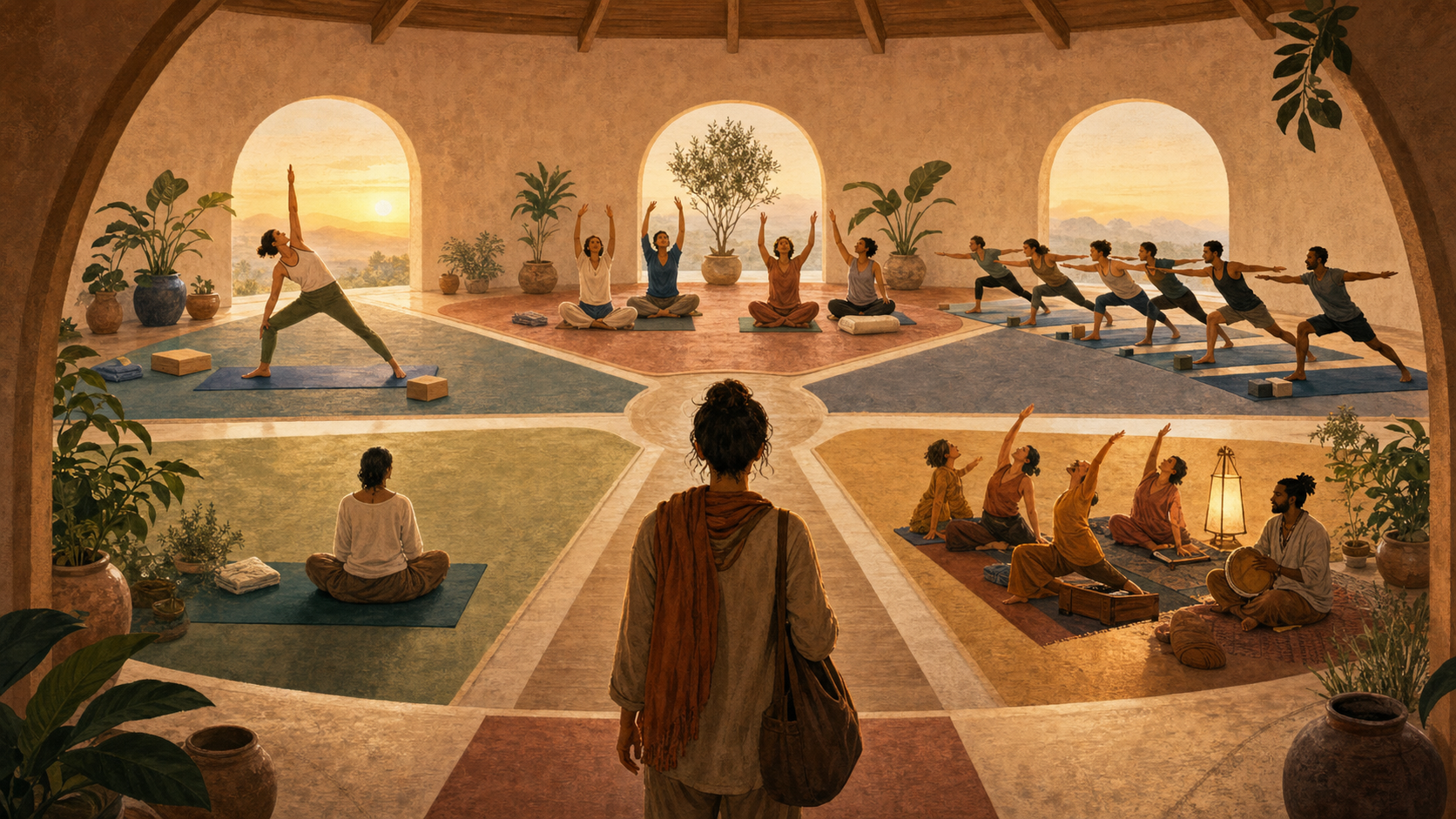
You are looking at a class schedule filled with Hatha, Kundalini, Ashtanga, Kriya and Jivamukti, but the names do not tell you which room will contain slow alignment, forceful breathing, a fixed sequence, silent meditation or devotional chanting. Choosing by intensity alone will not solve the problem. Two physically demanding classes can train the mind in very different ways.
The useful question is not which school is best. It is which method addresses your present obstacle while keeping Yoga’s ethical and meditative purpose intact. Once you understand what each tradition actually asks you to do, you can choose a suitable starting point, evaluate the teacher and avoid mistaking a specialized method for the whole of Yoga.
Start with Yoga’s full map, not the studio label
Yoga comes from the Sanskrit root yuj, meaning to yoke or unite. What is joined is not merely movement and flexibility. A complete discipline brings conduct, body, breath, senses and attention into a coherent way of living. Its foundations appear in the Vedic and Upanishadic inheritance of Bharat, its classical architecture is associated with Patanjali, and its bodily and energetic methods were developed further in works such as the Hatha Yoga Pradipika, Gheranda Samhita and Shiva Samhita.
The clearest orientation is the eight-limbed framework of Ashtanga Yoga:
- Yama governs how you relate to others through restraints such as ahimsa, or non-harming.
- Niyama cultivates personal discipline, study, contentment and devotion.
- Asana establishes a body that can remain steady without needless strain.
- Pranayama regulates the movement of breath and prana.
- Pratyahara loosens the senses’ automatic pull toward external objects.
- Dharana trains attention to remain with a chosen object.
- Dhyana develops a sustained flow of meditation.
- Samadhi is the culminating meditative absorption toward which the preceding limbs are directed.
This map corrects a common error. A posture class may be useful, but it still occupies only part of Yoga. A breath-centered lineage may cultivate pranayama and meditation deeply while assigning less class time to elaborate postures. A devotional method may use sound and surrender to steady attention. Judge a school by how coherently its methods serve the full path, not by how many techniques it displays.
The Dharmic traditions also share concerns without becoming interchangeable. Buddhist calm-abiding and insight, Jain samayik and Sikh simran each have their own doctrinal setting. Their emphasis on disciplined attention, ethical conduct and freedom from compulsive mental activity can illuminate Yoga, but none should be reduced to a renamed Yoga technique.
Five traditions and what you will actually practise
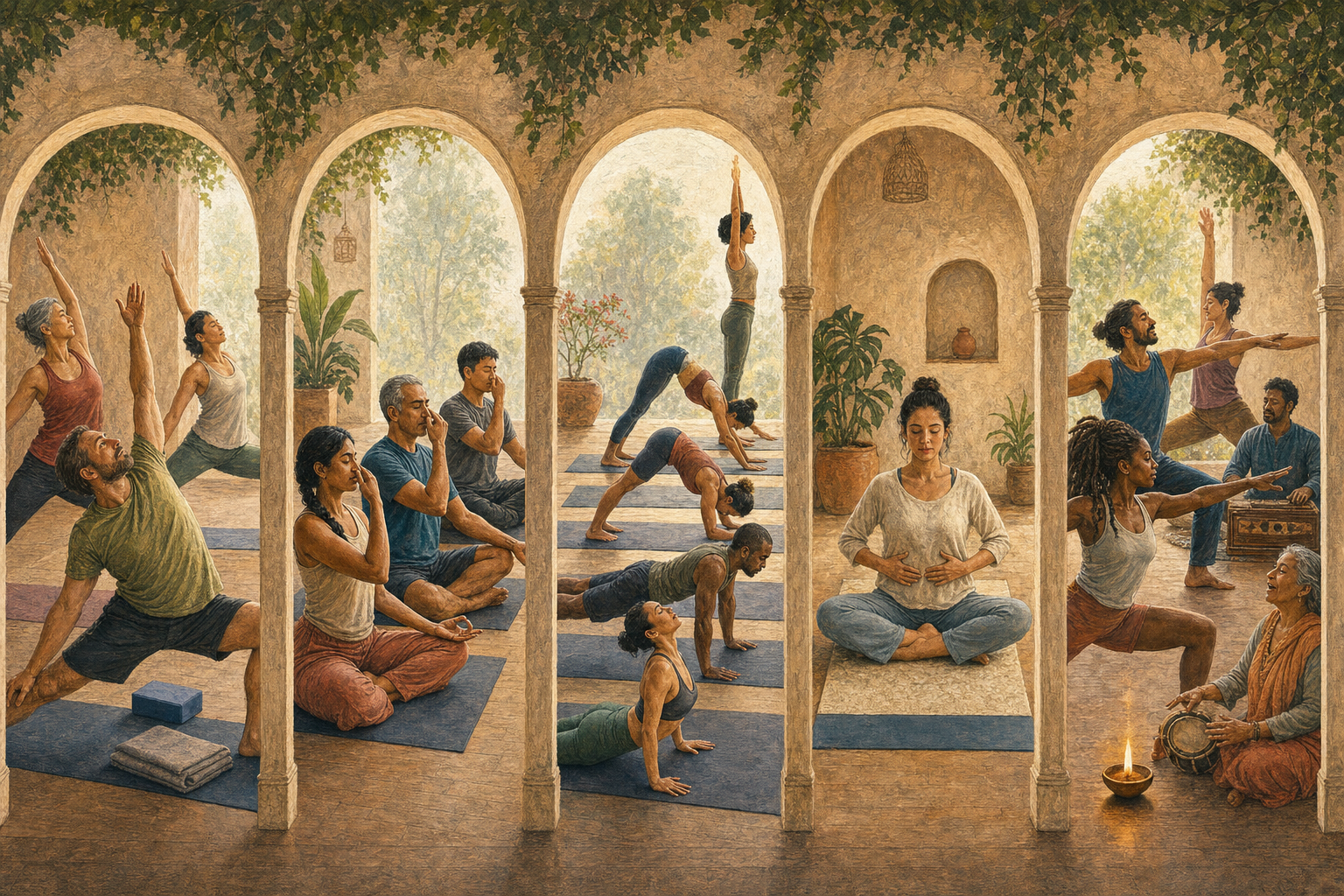
Use this table as a first filter. It identifies the dominant tools, not an absolute boundary. Competent teachers may draw on several limbs while remaining rooted in one method.
| Tradition | Dominant methods | Consider it when | What to clarify |
|---|---|---|---|
| Hatha Yoga | Asana, pranayama, mudra, bandha and, in traditional settings, cleansing practices | You want an adaptable foundation in posture, breath and stillness | Whether the particular class is gentle, athletic, alignment-focused or breath-focused |
| Kundalini Yoga | Set kriyas, rhythmic breathing, mantra, mudra, bandha and meditation | You respond to structured breath, sound and energetic symbolism | Which lineage is being taught and how stimulating practices are introduced |
| Ashtanga vinyasa | Progressive posture series joined by breath, movement, gaze and count | Repetition, heat and a defined sequence help you concentrate | How the teacher modifies the series for your present capacity |
| Kriya Yoga | Discipline, self-study and surrender; in modern lineages, meditative pranayama and inward attention | You want a regular contemplative discipline centered on breath and meditation | Whether Kriya means Patanjali’s threefold discipline or a transmission-based pranayama lineage |
| Jivamukti Yoga | Vinyasa, philosophy, meditation, mantra, sacred sound, devotion and ahimsa | You want strong movement explicitly connected to ethical and devotional life | How much movement, textual study, chanting and meditation the class includes |
Hatha Yoga: the broad foundation
Hatha is broader than the gentle stretching class its name sometimes denotes. Its traditional field includes postures, breath regulation, mudras, bandhas and cleansing methods. The practical purpose is to refine the body-breath system so that attention can settle. A well-shaped general session may move from centering and joint preparation through standing and seated postures, then toward suitable backbending or inversion work, rest, pranayama and meditation.
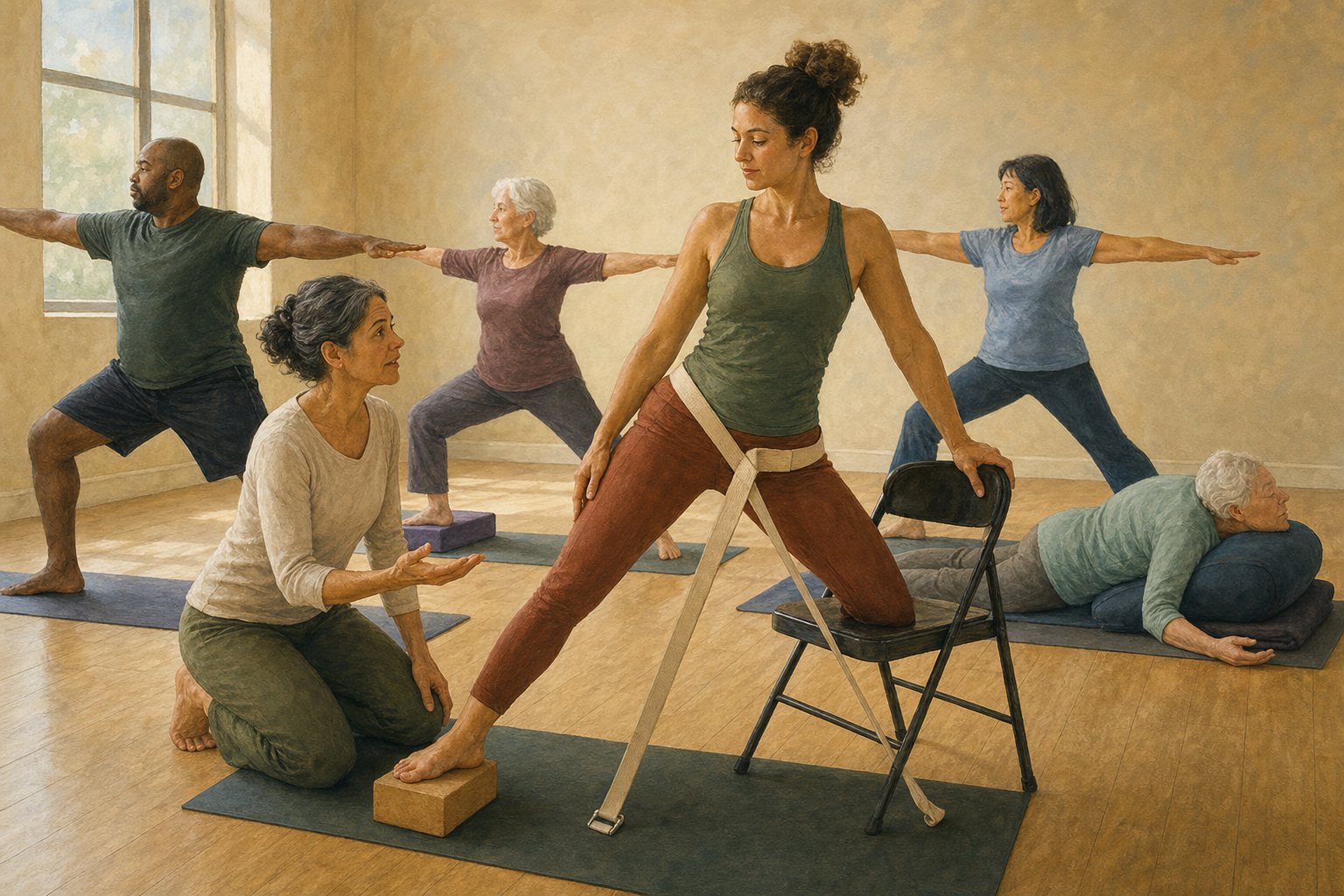
Choose Hatha when your body currently makes sitting, breathing or concentrating difficult, or when you need enough adaptability to work around limited mobility. Alignment cues and props can make a posture stable and sustainable; using a block or strap is not a lesser form of practice. The important test is whether the posture becomes steadier and the breath remains workable, not whether your shape resembles someone else’s.
Because Hatha is an umbrella term, never assume the name predicts the pace. Ask what proportion of the class is asana, pranayama and meditation, and whether the teacher offers modifications. That answer is more useful than a generic level label.
Kundalini Yoga: breath, mantra and energetic concentration
Kundalini Yoga works with kundalini-shakti, traditionally pictured as latent power at the muladhara chakra. Its subtle-body map includes ida, pingala and sushumna nadis and the ascent of prana through the chakras. This language belongs to a contemplative and symbolic anatomy. It should not be confused with an ordinary medical measurement or used to make extravagant health claims.
A Kundalini practice often follows a defined kriya rather than a freely assembled posture sequence. Asana, repeated movement, mantra, mudra, bandha and rhythmic pranayama build toward stillness, after which rest and meditation allow the experience to settle. Classical laya-oriented lineages and modern presentations do not necessarily use identical sequences, so the teacher should be able to identify what is being taught.
Methods such as kapalabhati and bhastrika can be stimulating. Do not improvise forceful breathing, prolonged retention or advanced bandhas because an intense sensation seems spiritually impressive. People with cardiovascular, ocular or neurological conditions should obtain individualized guidance from an appropriate clinician and inform a qualified teacher before undertaking stimulating pranayama. Stop the technique and return to natural breathing if you become dizzy or distressed; persistent symptoms warrant medical attention. Kundalini practice is not a substitute for medical or psychological care.
Ashtanga Yoga: two meanings you must keep separate
Ashtanga first means Patanjali’s eight-limbed path. In many contemporary studios, however, it means the dynamic vinyasa system associated with K. Pattabhi Jois. Confusing the two creates needless arguments: one is the architecture of a complete yogic path, while the other is a particular posture method that can be practised within that larger architecture.
The vinyasa method coordinates posture, a paced breath commonly called ujjayi, drishti or gaze, and counted transitions. Its Primary Series, known as Yoga Chikitsa, supplies the baseline; later series introduce increasingly demanding patterns. Repeating a sequence reduces decision-making, so breath and attention can become the central work. For a person who thrives on rhythm and disciplined repetition, that structure can function as moving meditation.
The fixed sequence is a teaching instrument, not a command to force every position. Shorter holds, props, reduced tempo and suitable substitutions let you preserve the logic of the method without treating pain as a test of commitment. Choose an instructor who can explain why a modification still serves the sequence rather than one who equates advancement with acquiring difficult shapes.
Kriya Yoga: discipline in Patanjali and a modern pranayama lineage
Kriya means disciplined or transformative action, but Kriya Yoga has two important uses. Yoga Sutra 2.1 defines it through tapas, svadhyaya and Ishvara-pranidhana: sustained discipline, self-study or sacred recitation, and surrender to the highest. This definition is immediately practical. Do the work steadily, examine the mind honestly and refuse to turn spiritual effort into self-glorification.
In modern usage, Kriya Yoga also identifies a meditative pranayama tradition associated with Lahiri Mahasaya and later made widely known by Paramahansa Yogananda. Its methods employ refined breathing, inward mantra and attention associated with the spinal axis to quiet mental activity and turn awareness inward. Detailed instructions differ by lineage, and advanced practices are commonly transmitted through instruction rather than reconstructed from fragments.
If someone offers Kriya, ask which meaning is intended. A daily application of tapas, svadhyaya and surrender can begin without pretending to possess a specialized initiation. A lineage-specific pranayama should be learned in the form in which it is actually taught. Mixing partial instructions from unrelated systems makes it harder to judge dosage, purpose or effect.
Jivamukti Yoga: a modern method that keeps philosophy in the room
Jivamukti is a contemporary vinyasa method established by Sharon Gannon and David Life. Its configuration is modern, though many of its elements are traditional. A class can combine demanding asana with meditation, mantra, kirtan, scriptural reflection, devotion and teaching on ahimsa. The intended result is not merely a stronger body but a practice that affects conduct beyond the mat.
Choose Jivamukti if physical intensity engages you but a movement-only class feels spiritually incomplete. Expect the teacher’s philosophical choices to matter. Listen for whether ahimsa is treated as a living discipline or merely a slogan, whether texts are presented with context, and whether devotion leaves room for sincere inquiry. If you do not want chanting or philosophical teaching in class, the method may be a poor fit even when you enjoy its vinyasa.
Its strongest practical challenge is also its value: you must connect what happens during asana with how you consume, speak, work and respond to other beings. A class that invokes compassion but rewards aggression toward your own body has missed that connection.
Choose the teacher before committing to the label
A school name identifies an emphasis. It does not guarantee judgment, safety or depth. Before making a class your regular practice, ask questions that reveal what will actually happen:
- What does a typical session contain? Ask about the balance among postures, breathing, chanting, textual teaching and seated meditation.
- How are beginners introduced to rapid breathing, breath retention, bandhas and inversions? A competent answer should include progression and alternatives, not only encouragement to push through.
- How is the sequence modified for pain, limited mobility or a health condition? The teacher should be able to preserve the method’s purpose without demanding an unsuitable shape.
- Which lineage, text or definition stands behind the class name? This is especially important for Kundalini and Kriya, whose content varies across presentations, and for Ashtanga, which has classical and vinyasa meanings.
- What place do yama, niyama and meditation have? The answer shows whether you are entering a complete discipline, an asana specialty or a fitness class using Sanskrit vocabulary.
- What should a student do if a technique causes dizziness, pain or marked agitation? The safe answer begins with stopping or modifying the practice, not interpreting every adverse response as purification.
Lineage can clarify how a method was transmitted, but a lineage name alone does not prove that an instructor teaches responsibly. Look for three observable qualities: precise explanations, willingness to adapt and restraint around dramatic promises. Be wary when intensity is presented as spiritual rank, ordinary discomfort is romanticized, or a teacher cannot distinguish symbolic subtle-body language from medical claims.
Your own temperament matters too. Choose Hatha when you need a broad and adjustable base. Choose Ashtanga vinyasa when repetition organizes your attention. Explore Kundalini when breath, mantra and energetic contemplation genuinely draw you and qualified guidance is available. Approach modern Kriya when seated inward practice is your priority and you are willing to respect its mode of transmission. Choose Jivamukti when you want movement explicitly tied to devotion, philosophy and ethical action.
Build a complete practice from any starting point
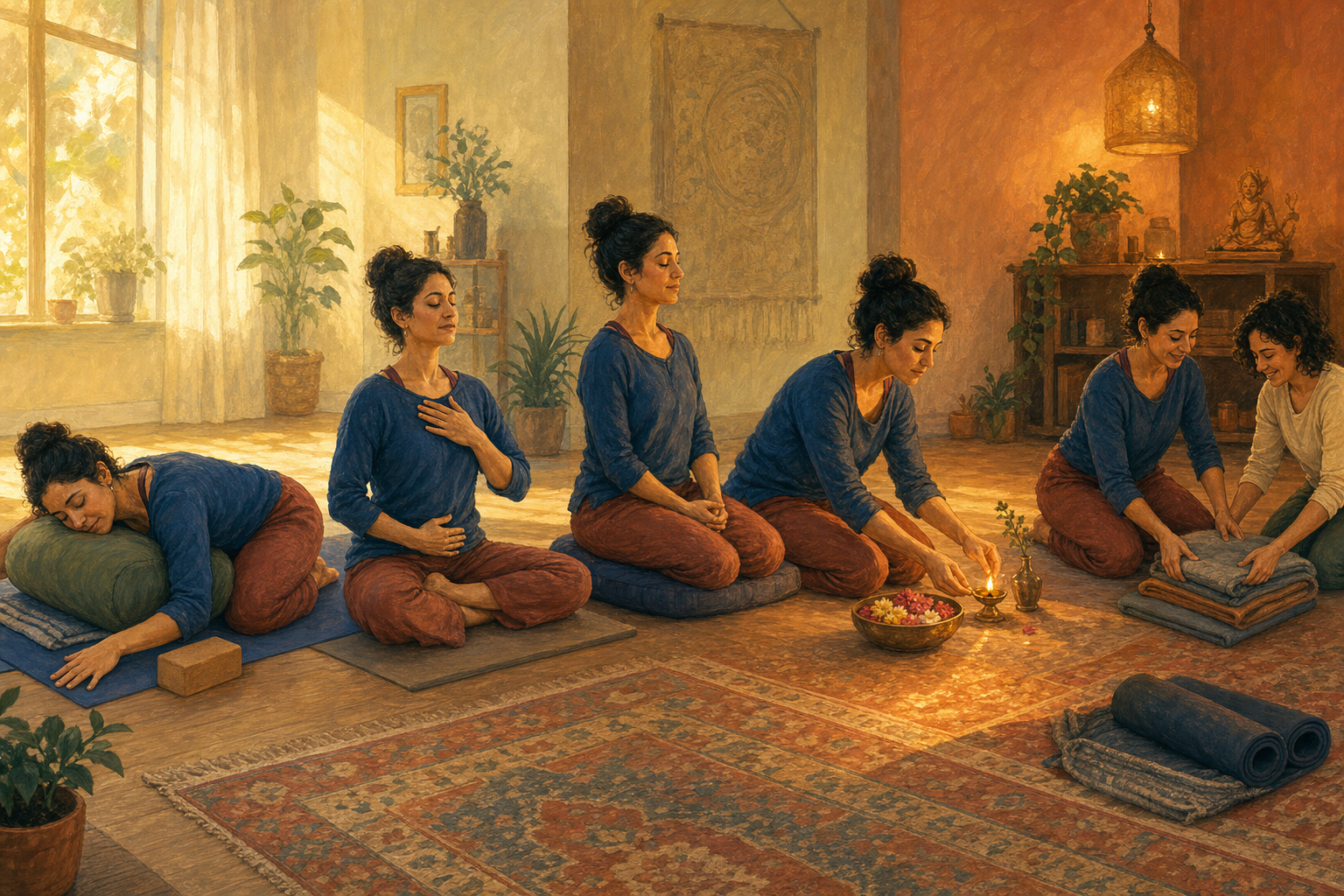
You do not need to collect five systems. You need a coherent practice whose emphasis serves your present condition and whose neglected limbs are not forgotten. A simple structure can keep any chosen method oriented toward Yoga’s larger purpose:
- Begin with an ethical intention. Choose one expression of ahimsa, truthfulness, discipline or service that the practice should strengthen in daily life.
- Settle before manipulating the breath. Notice posture, contact with the floor and the natural respiratory rhythm before adding a technique.
- Use asana to establish steadiness. Select the Hatha, Ashtanga, Kundalini or Jivamukti movements appropriate to your method, but preserve a breath you can observe without panic or strain.
- Add one suitable pranayama rather than stacking techniques. Nadi-shodhana can cultivate balance, bhramari can support settling, and gentle ujjayi can pace attention. Advanced kumbhaka and forceful methods belong under competent guidance.
- Turn the senses inward. Reduce unnecessary stimulation and use a stable drishti, the sensation of breath or another clear object to gather attention.
- Sit for dhyana. Rest attention at the nostrils, with a mantra or on another anchor proper to your lineage. When the mind wanders, return without turning the lapse into a verdict about your ability.
- Close by translating practice into conduct. Name the conversation, duty or choice in which greater steadiness and non-harming are actually required.
The order matters more than novelty. Ethics gives direction; posture makes stillness sustainable; breath links body and attention; concentration prepares meditation; daily conduct tests whether the practice is maturing. Your chosen school may devote more time to one part, but specialization should deepen the path rather than amputate it.
Repeat a modest, intelligible sequence before adding new methods. Change a single variable when you need to learn what is helping. After practice, notice whether your breathing settled, whether attention became clearer, whether the body carries lingering strain and whether you behave with greater restraint. A dramatic session that leaves you scattered is not automatically deeper than a quiet one that improves discernment.
Abhyasa, sustained practice, works with discernment rather than compulsion. If your needs change, adjust the emphasis. Hatha can prepare you for meditation; Ashtanga vinyasa can teach concentrated rhythm; Kundalini can deepen the disciplined use of mantra and breath; Kriya can intensify inward study; Jivamukti can press ethical insight into action. They can complement one another, but additions should be deliberate and advanced techniques should not be casually spliced together.
Key takeaways
- Choose according to the method you need, not the most impressive name: Hatha offers an adaptable base, Ashtanga vinyasa offers disciplined repetition, Kundalini emphasizes energetic breath and mantra, Kriya emphasizes transformative discipline and inward pranayama, and Jivamukti joins vinyasa to philosophy and devotion.
- Keep the two meanings of Ashtanga separate: Patanjali’s eight limbs describe Yoga’s full architecture, while the Jois-associated system is a particular progressive vinyasa method.
- Clarify which Kriya or Kundalini lineage is being taught before adopting advanced instructions. Shared terminology does not guarantee identical practices.
- Evaluate a teacher by precise explanations, appropriate progression, usable modifications and honesty about risk. Charisma and intensity are not evidence of realization.
- Do not force stimulating pranayama or breath retention. Relevant medical conditions require individualized professional guidance, and Yoga does not replace medical or psychological care.
- Whichever tradition you choose, preserve the movement from ethical intention through body and breath toward concentration, meditation and better conduct.
Choose one class whose actual method matches your present need, ask the teacher the practical questions above, and remain with a modest sequence long enough to observe its effect on attention and conduct. The right starting tradition is the one that helps you practise steadily without losing sight of what Yoga is for.
References
