
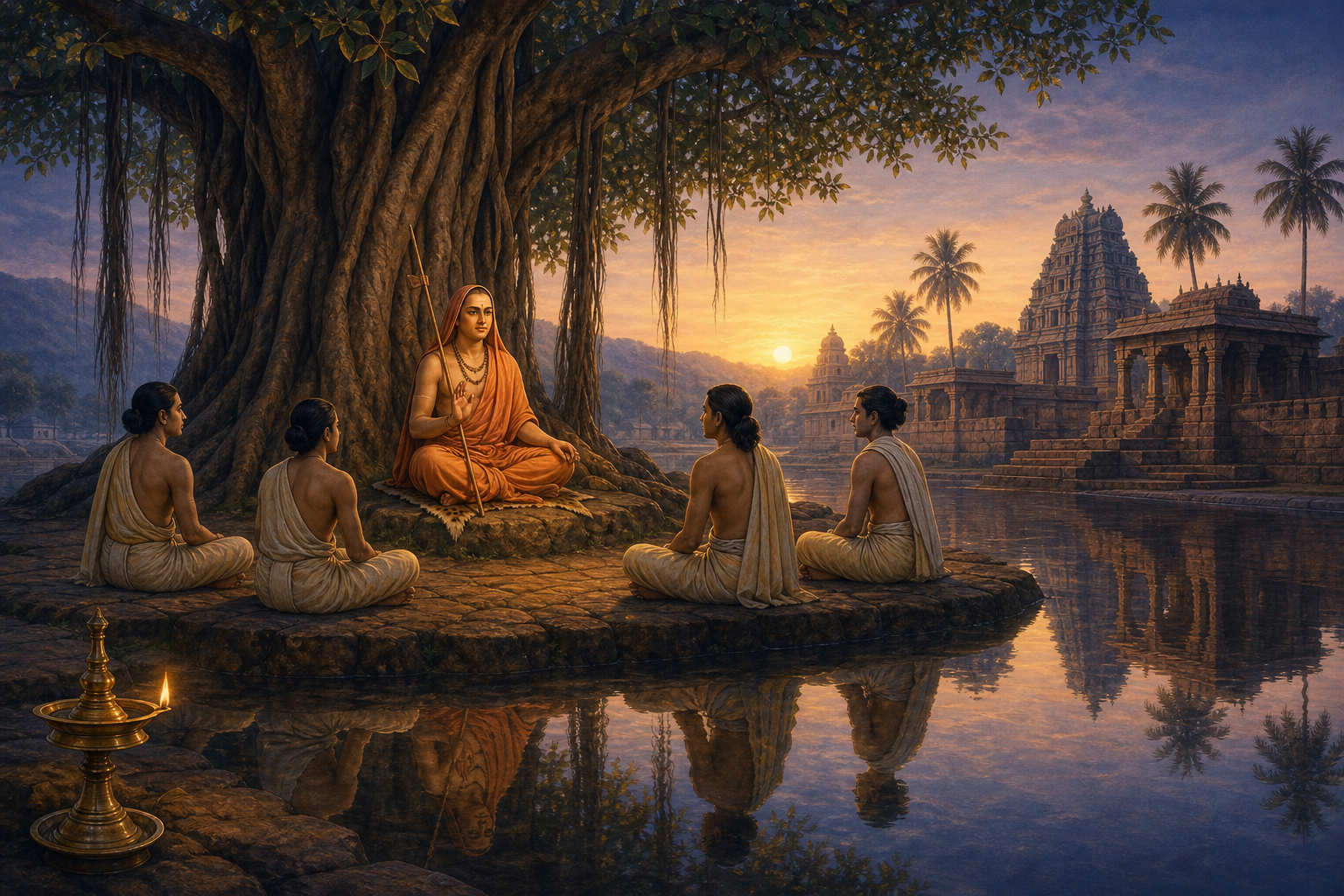
You may know that Shankara Jayanthi calls for a lamp, a stotra, and reverence for the Guru, yet still wonder what would make the observance more than an annual ritual. The answer lies in connecting the worship to the problem Adi Shankaracharya asked you to examine: the mistaken identity you carry through ordinary life.
A meaningful observance therefore has three movements. Honor the Acharya, study one teaching carefully, and test that teaching against your conduct. You do not need an elaborate ceremony. You need enough steadiness to hear what Advaita is actually saying and enough honesty to notice where your life contradicts it.
Begin with the error Advaita is trying to remove
Adi Shankaracharya was a philosopher, commentator, renunciate, and teacher associated with Kalady in Kerala. He studied under Govinda Bhagavatpada and became the pre-eminent expositor of Advaita Vedanta. His foundational work includes commentaries on the principal Upanishads, the Bhagavad Gita, and the Brahma Sutras, collectively known as the Prasthanatrayi, as well as the independent Upadesa Sahasri.
The chronology of his life is disputed. Modern scholarship generally places him in the eighth to early ninth century CE, while a widely cited traditional chronology gives 509-477 BCE. You need not settle that historical disagreement before learning from him. The decisive question on Jayanthi is whether you will examine the confusion his teaching addresses.
Advaita makes a precise claim: Brahman is the nondual reality, and Atman, your true Self, is not other than Brahman. The Upanishadic declarations tat tvam asi, aham brahmasmi, ayam atma brahma, and sarvam khalvidam brahma express this identity from different directions. They are not affirmations meant to inflate the individual personality. They remove the assumption that the personality is the whole of what you are.
The immediate obstacle is adhyasa, or superimposition. The body changes, the senses fluctuate, thoughts arrive and disappear, and social roles come and go. Yet you habitually transfer all their conditions to the witnessing Self: ‘I am diminished,’ ‘I am complete because I succeeded,’ or ‘I am nothing without this role.’ Advaita asks you to distinguish every changing experience from the awareness to which the change appears.
That distinction does not mean the world is simply nonexistent. Advaita distinguishes the absolute, empirical, and illusory orders of reality: paramarthika, vyavaharika, and pratibhasika. Calling the world mithya means that it is dependent rather than independently absolute. A promise, a hungry person, an injury, and a duty still matter in empirical life. ‘All is Brahman’ is never permission to ignore consequences or evade dharma.
Use one inquiry during Jayanthi: What changed, and what was present to know the change? Apply it to a sensation, a mood, a memory, and your sense of status. Do not force a mystical answer. Notice that each answer you can observe is itself an object of awareness. This is the beginning of discrimination between the seer and the seen, not the end of the inquiry.
Prepare the mind before turning nonduality into a slogan

Advaita does not treat intellectual agreement as liberation. You can repeat ‘I am Brahman’ while remaining governed by anger, craving, vanity, and fear. Shankara’s discipline begins by making the mind capable of receiving knowledge without immediately bending it around personal preference.
The traditional preparation is sadhana-chatushtaya, the fourfold qualification. Use it as a practical examination rather than a list to admire:
- Viveka, discernment: Separate what is lasting from what is passing. Ask which temporary possession, opinion, relationship, or role you are currently treating as the basis of your existence.
- Vairagya, dispassion: Do not confuse this with indifference. Notice where anticipated pleasure or fear of loss is controlling your judgment, then perform the right action without making the desired result your identity.
- Shama and the other six virtues: Cultivate quietude of mind, restraint of the senses, freedom from compulsive activity, endurance, trust in the teaching and its method, and steady attention. These are traditionally named shama, dama, uparati, titiksha, shraddha, and samadhana.
- Mumukshutva, desire for liberation: Ask whether you want truth even when it unsettles a cherished self-image, or merely want a spiritual idea that makes the present self-image more comfortable.
Once this preparation is underway, the teaching proceeds through shravanam, mananam, and nididhyasanam. First, listen to or study the teaching in a disciplined manner. Next, reason through your doubts rather than suppressing them. Finally, contemplate the understood teaching until habitual misidentification no longer overrides it at every moment of pressure.
This sequence tells you what to do when a passage seems inspiring but remains vague. Do not rush straight from reading to silent meditation. Write down the passage’s actual claim. Identify the objection in your mind. Resolve the meaning through scripture, reasoning, and qualified instruction. Then contemplate the resolved meaning. Meditation cannot stabilize an idea you have not understood.
Karma Yoga and bhakti belong in this preparation. Selfless action exposes attachment to results. Devotion to Ishvara softens the insistence that the individual ego must control the whole field of experience. Neither is an embarrassing preliminary to ‘higher’ philosophy. They help produce the clarity, humility, and steadiness through which knowledge can take root.
Observe Shankara Jayanthi at home without making it complicated
Shankara Jayanthi is observed on Vaisakha Shukla Panchami, the fifth lunar day of the bright fortnight of Vaisakha. It is not tied permanently to one Gregorian date. In 2026, the pan-India observance fell on Tuesday, 21 April, because Panchami prevailed at sunrise across most Indian panchangs.
If you live outside India, do not automatically copy the Indian civil date. Tithi boundaries shift with location, and communities may also follow different calendrical conventions or temple traditions. Check a trusted local panchang, matha, or temple schedule for the date determined at your local sunrise. This is especially important when Panchami straddles two civil dates.
For a home observance, use the following sequence and adapt ritual details to your family parampara:
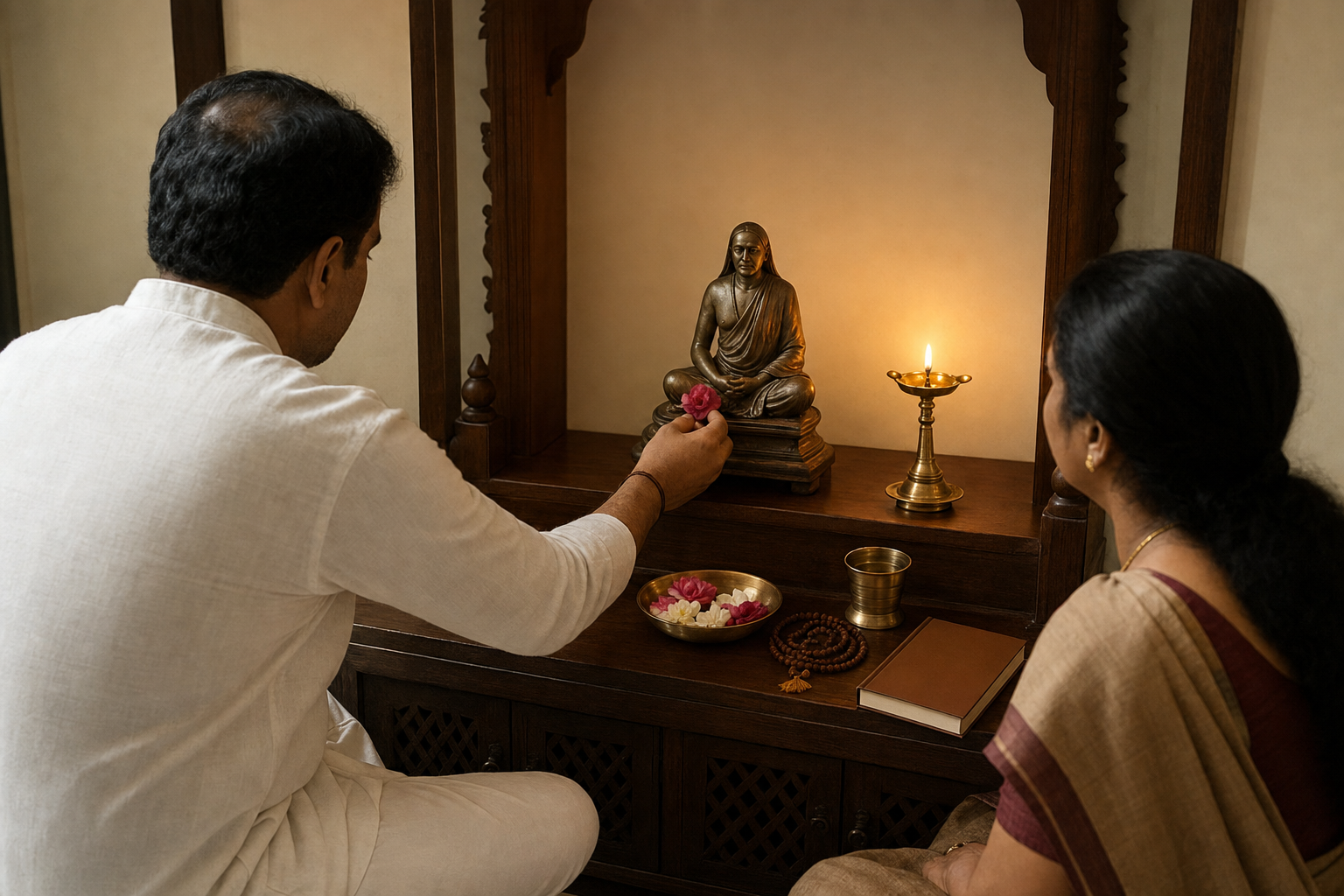
- Prepare yourself and the space. Bathe in the morning, perform achamana if it belongs to your practice, clean the worship area, and place an image of Adi Shankaracharya or his padukas near the lamp.
- Take a clear sankalpa. State that the worship is being offered on Shankaracharya Jayanthi and dedicate the period to Guru-bhakti, Self-knowledge, and the removal of ignorance. Use the ritual wording received in your tradition if you have it.
- Offer Guru-puja. Light the lamp and perform panchopachara, shodashopachara, or the simple form of worship customary in your home. Elaborateness is secondary to attention and reverence.
- Recite one composition attentively. Nirvana Shatakam, Bhaja Govindam, or Maneesha Panchakam can anchor the observance. Read the meaning as well as the Sanskrit so that recitation becomes instruction rather than sound alone.
- Study one manageable passage. Choose a section from an Upanishad commentary, the Bhagavad Gita Bhashya, the Brahma Sutra Bhashya, or Upadesa Sahasri. Write down its main proposition and one genuine doubt. A short passage understood carefully is more useful than many pages hurriedly completed.
- Move from reflection to contemplation. Sit quietly with the proposition you have examined. If the passage distinguishes awareness from the body-mind, observe changing thoughts without assigning their arrival or departure to the unchanging witness.
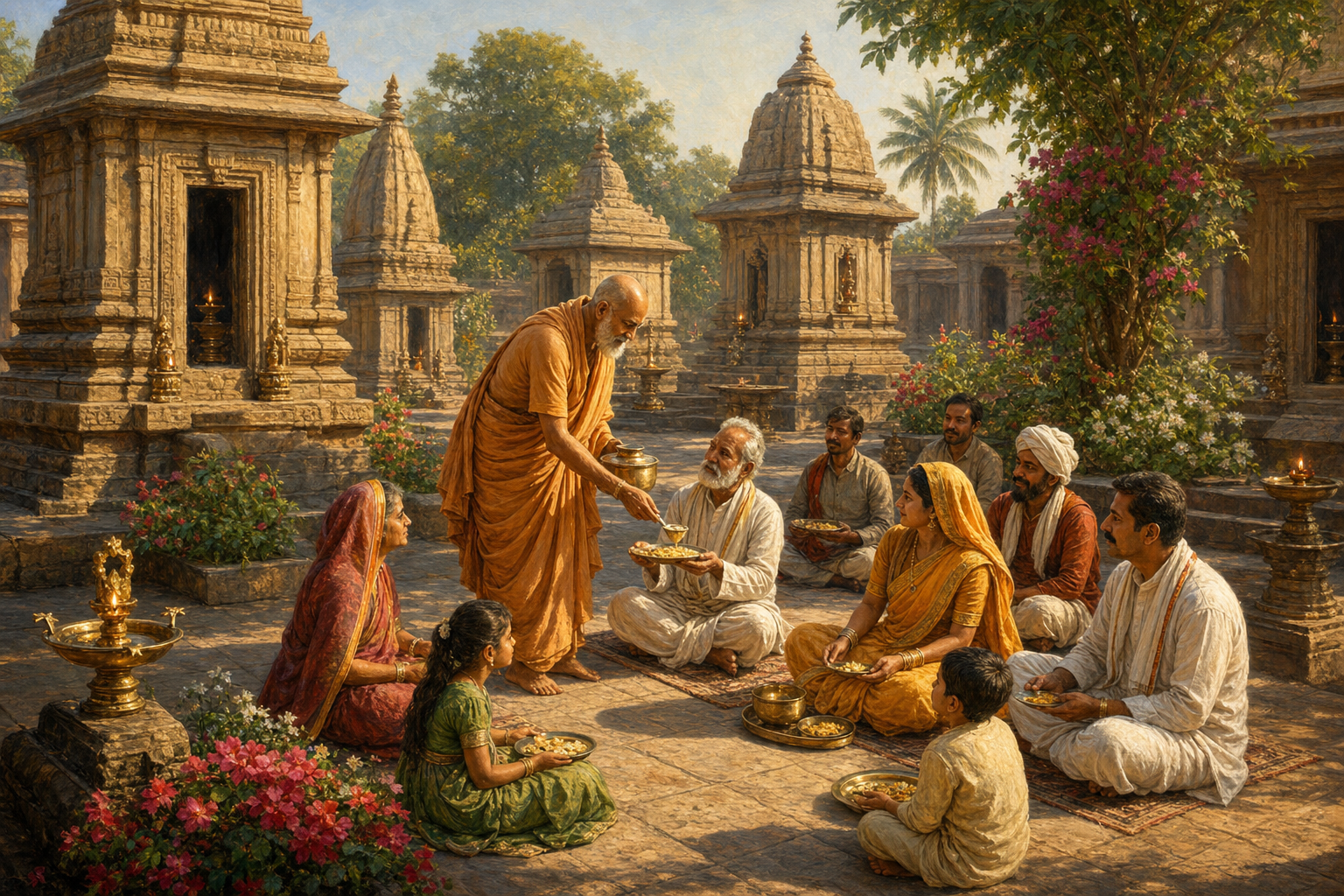
- Complete the observance through seva. Offer food, support learning, assist a temple or community activity, or serve someone without seeking recognition. Let Guru-puja alter the use of your time and resources.
If you attend a temple or matha, the observance may include Veda-parayana, puja to the Acharya’s padukas, homa, stotra recitation, and a discourse on Vedanta. Listen for one point you can carry into practice. A long programme can still remain external if you leave without examining a single attachment or assumption.
Modern scholarship does not accept every popular work attributed to Shankara with equal certainty. Upadesa Sahasri and the foundational bhashyas have firmer acceptance, while authorship of several widely transmitted stotras and teaching texts is debated. You do not need to dismiss a cherished recitation because of that debate. Simply distinguish devotional and pedagogical authority within the living tradition from a claim of historically certain authorship.
Keep devotion, difference, and dharma in their proper place
Some seekers assume that Advaita requires them to abandon their Ishta-devata, ritual practice, or sectarian inheritance. Shankara’s teaching does not demand that abrupt rejection. Saguna Brahman, Ishvara approached with attributes, has a valid place in spiritual life, while Nirguna Brahman names the attributeless Absolute. Devotion purifies the heart and directs the ego toward surrender; knowledge removes the fundamental error concerning the Self.
Tradition also associates Adi Shankaracharya with the Shanmata framework, which gives an integrated place to the worship of Shiva, Vishnu, Shakti, Surya, Ganapati, and Skanda. The practical lesson is not that every form is interchangeable in every ritual. It is that sincere devotion through different forms need not become rivalry when their ground is understood as one.
The same care is needed when speaking about the wider dharmic family. Advaita’s identity of Atman and Brahman, Sikh affirmation of Ik Onkar, Buddhist teaching on anatta, and Jain anekantavada are not identical doctrines. Flattening them into one formula shows neither unity nor respect. You can recognize shared disciplines such as compassion, non-clinging, non-harm, truthful inquiry, and restraint while allowing each tradition to state its own metaphysical position accurately.
Nonduality should become visible in the way you handle difference. Before dismissing a person, separate the conduct you oppose from the consciousness by which that person’s experience is known. Before using harsh speech, ask whether correction truly requires humiliation. Before claiming spiritual unity, check whether your treatment of workers, relatives, strangers, animals, and the natural world reflects it.
This does not require passivity toward adharma. Empirical distinctions remain operative: truth differs from falsehood, protection from aggression, and responsible judgment from indifference. Advaita removes hatred and egoic absolutism; it does not remove viveka. Act firmly where dharma requires firmness, but do not turn the opponent into a being outside the one reality you profess.
Tradition associates Shankara with the Dasanami order and the four amnaya mathas at Sringeri, Dvaraka, Puri, and Jyotirmath. Their enduring lesson is that realization requires transmission, disciplined study, and institutions capable of preserving knowledge across generations. If Jayanthi matters to you, support those functions: learn from a qualified teacher, help younger people access the texts, or contribute to a genuine programme of Vedic and Vedantic education.
Key takeaways
- Shankara Jayanthi honors the Guru most fully when puja leads to inquiry, disciplined study, contemplation, and ethical action.
- Advaita says that Atman is non-different from Brahman; it does not say that the individual ego is all-powerful or that everyday consequences are unreal.
- Use the fourfold qualification to examine your readiness: viveka, vairagya, the six virtues, and mumukshutva.
- Follow the sequence of shravanam, mananam, and nididhyasanam. Understand the teaching before trying to stabilize it through contemplation.
- Confirm Vaisakha Shukla Panchami through a reliable local panchang or matha, particularly outside India.
- Keep bhakti, Karma Yoga, and seva within the observance. They prepare the mind and prevent nonduality from becoming a merely intellectual identity.
- Respect resonances among dharmic traditions without pretending that their doctrines are interchangeable.
Choose one teaching now for your next observance, along with one attachment or habit through which you will test it. When Jayanthi changes what you study, how you respond, or whom you serve, remembrance of Adi Shankaracharya becomes a living link in the Guru-shishya parampara.
References
- DharmaRenaissance Blog – Adi Shankaracharya’s Advaita: Timeless Oneness Uniting All Beings, Minds, and Matter
- DharmaRenaissance Blog – Shankara Jayanthi 2026 (Adi Shankaracharya Jayanti): Date, Panchang, Rituals, and Dharmic Unity