
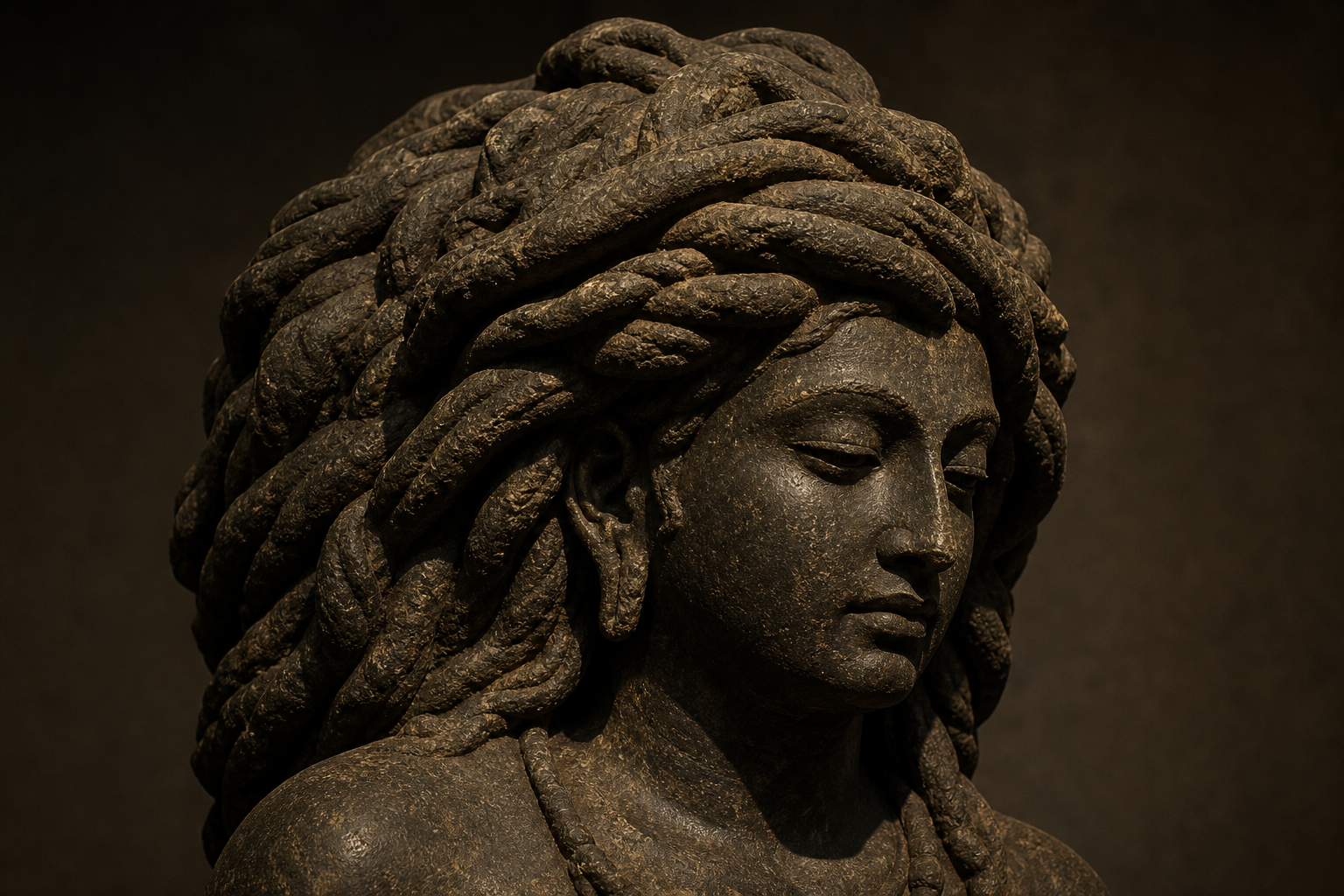
If you have ever stopped before a Hindu sculpture because the figure’s head seems enveloped by thick, restless locks, do not dismiss the hair as decoration or damage. Its shape may be telling you how the figure’s spiritual nature should be understood.
The most useful distinction is between jata bhara, a weighty mass of matted hair, and jata mukuta, matted locks organized like a crown. Once you know what separates them, you can read the image more carefully without making the common mistake of naming a deity from the hairstyle alone.
Recognize the mass before trying to name the figure
The central feature of jata bhara is not simply long hair. It is a dense, heavy mass of matted locks whose accumulated volume changes the figure’s entire silhouette. The hair may spread around the head, project outward, hang with visible weight, or form an irregular body of thick strands. Even when individual locks remain visible, your eye first registers the whole mass.
Begin by stepping back from the details. Ask what the hair does to the outline of the head. Does it broaden the figure? Does the head appear to carry a substantial, almost physically present weight? Do separate locks merge into a larger, untamed volume? If so, jata bhara is a stronger description than a generic reference to long or curly hair.
This visual weight matters. A sculptor could indicate hair with a few orderly grooves, but jata bhara occupies space and demands attention. It makes ascetic identity visible before you have examined a hand gesture, ornament, or accompanying figure. In a weathered carving, the outer contour may therefore be more informative than the surviving surface detail.
Do not read the apparent wildness as careless workmanship or ordinary neglect. Sacred iconography transforms matted hair into a deliberate sign. What might look socially unregulated in everyday life becomes, within an ascetic image, evidence that the figure is not governed by ordinary expectations of grooming, status, or presentation.
Jata bhara and jata mukuta organize the same material differently
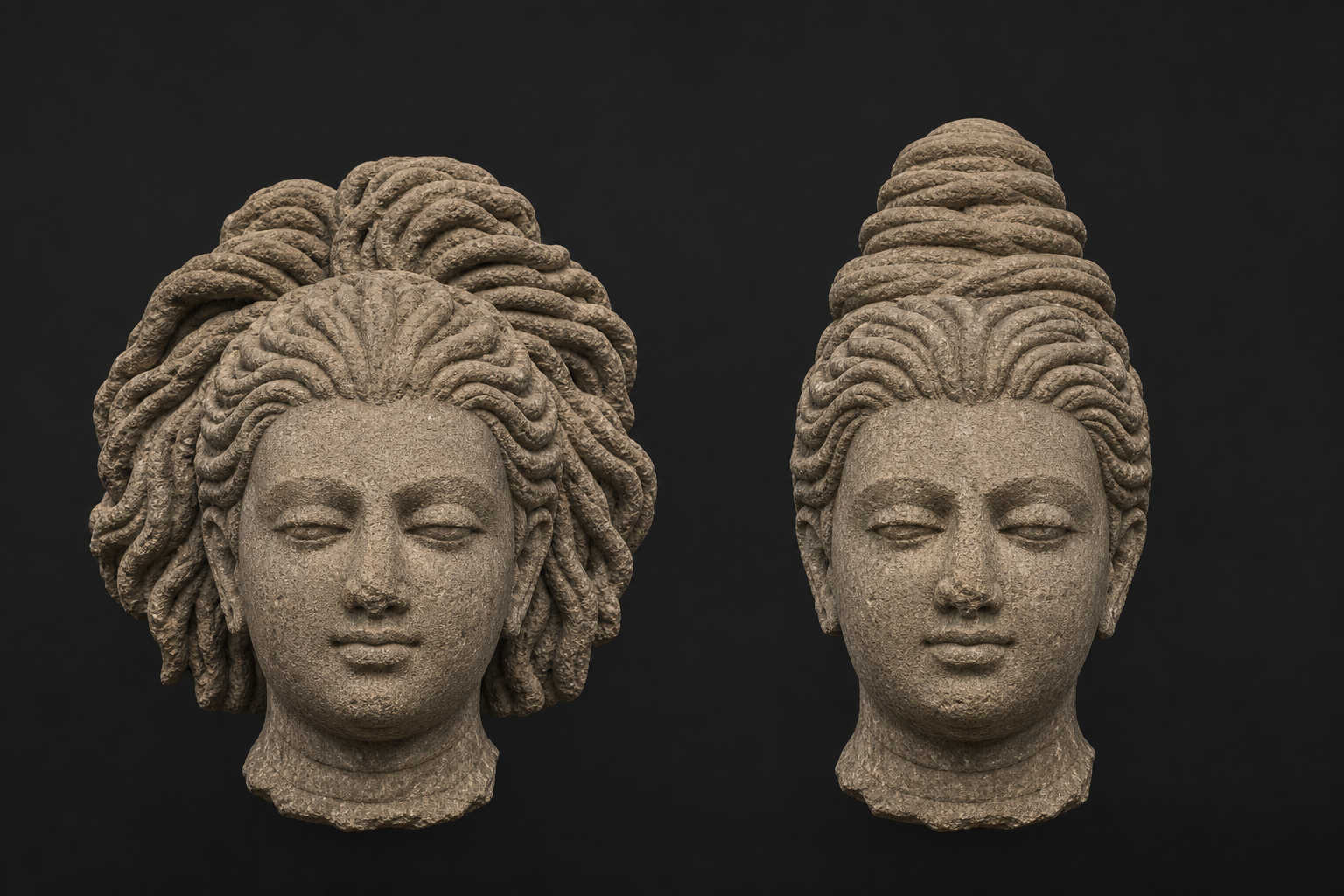
Both forms use matted locks, so texture alone will not settle the identification. The decisive question is how those locks have been organized. Jata bhara emphasizes gathered weight and expansive volume. Jata mukuta arranges the locks into a more structured, crown-like formation rising above the head.
| Feature | Jata bhara | Jata mukuta |
|---|---|---|
| Overall silhouette | Broad, dense, spreading, or heavily gathered | Elevated and crown-like |
| Organization | Individual locks contribute to a dominant mass | Locks follow a more clearly constructed upward arrangement |
| First visual impression | Weight, abundance, and controlled wildness | Height, structure, and formal elevation |
| Best identifying question | Does the hair seem to possess substantial volume of its own? | Has the hair been composed into the role of a crown? |
A useful test is to imagine the small details disappearing in shadow. If the remaining outline still resembles an architectural crown, jata mukuta is likely the better term. If the outline is dominated by a substantial, irregular body of hair, jata bhara is more likely.
Not every example will fit a perfect diagram. A sculptor can give a heavy mass some upward order, or give a crown-like arrangement conspicuously thick locks. In such a case, describe what you can actually see: a mass of matted hair arranged upward, for example, is more responsible than forcing an uncertain object into a rigid category.
Condition also affects the judgment. A broken upper section can make a once-tall arrangement appear broad and truncated. Erosion may erase the bands or repeated ridges that revealed deliberate structure. Before deciding, check whether the top is complete, whether one side has been lost, and whether the surviving locks follow a repeated axis.
The apparent wildness communicates disciplined ascetic power
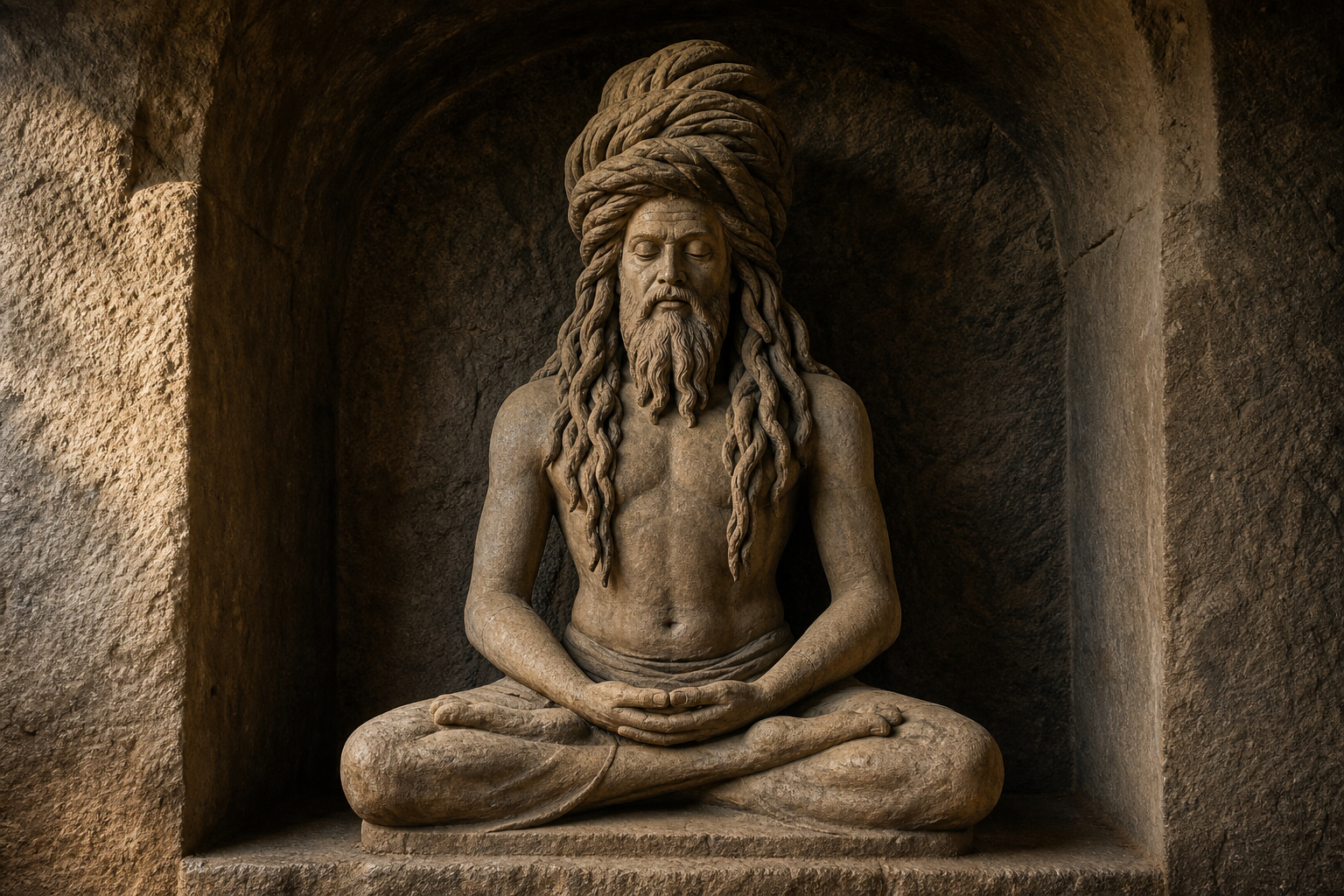
Jata bhara works because it holds two impressions together. The locks appear free from courtly polish, yet their presence in a carefully composed sacred image is anything but accidental. The resulting tension is central to the form: outward wildness can signify inward discipline.
Matted hair belongs to the visual language of renunciation, austerity, and tapas. It directs your attention away from comfort and social presentation and toward concentrated spiritual practice. The mass makes that concentration visible. Its weight need not imply exhaustion; it can suggest accumulated intensity, restraint, and potency.
This is particularly important when you encounter Shiva or another divine-ascetic form. The hairstyle should not be reduced to an unusual fashion. It participates in the theology of the image. The sacred can contain qualities that ordinary categories keep apart: wilderness and order, detachment and presence, stillness and formidable energy.
The sculpted locks are therefore not a documentary portrait of how an unidentified person happened to wear his hair. Iconography selects and intensifies visible traits so that an inner condition can be perceived. Jata bhara gives ascetic force a contour, texture, and apparent weight.
That does not make the hairstyle an identity card. More than one divine or ascetic form can bear matted hair, and not every figure with prominent hair should be identified as Shiva. Hair establishes a field of meaning; the rest of the image determines who stands within that field.
Use a five-step method when examining a sculpture
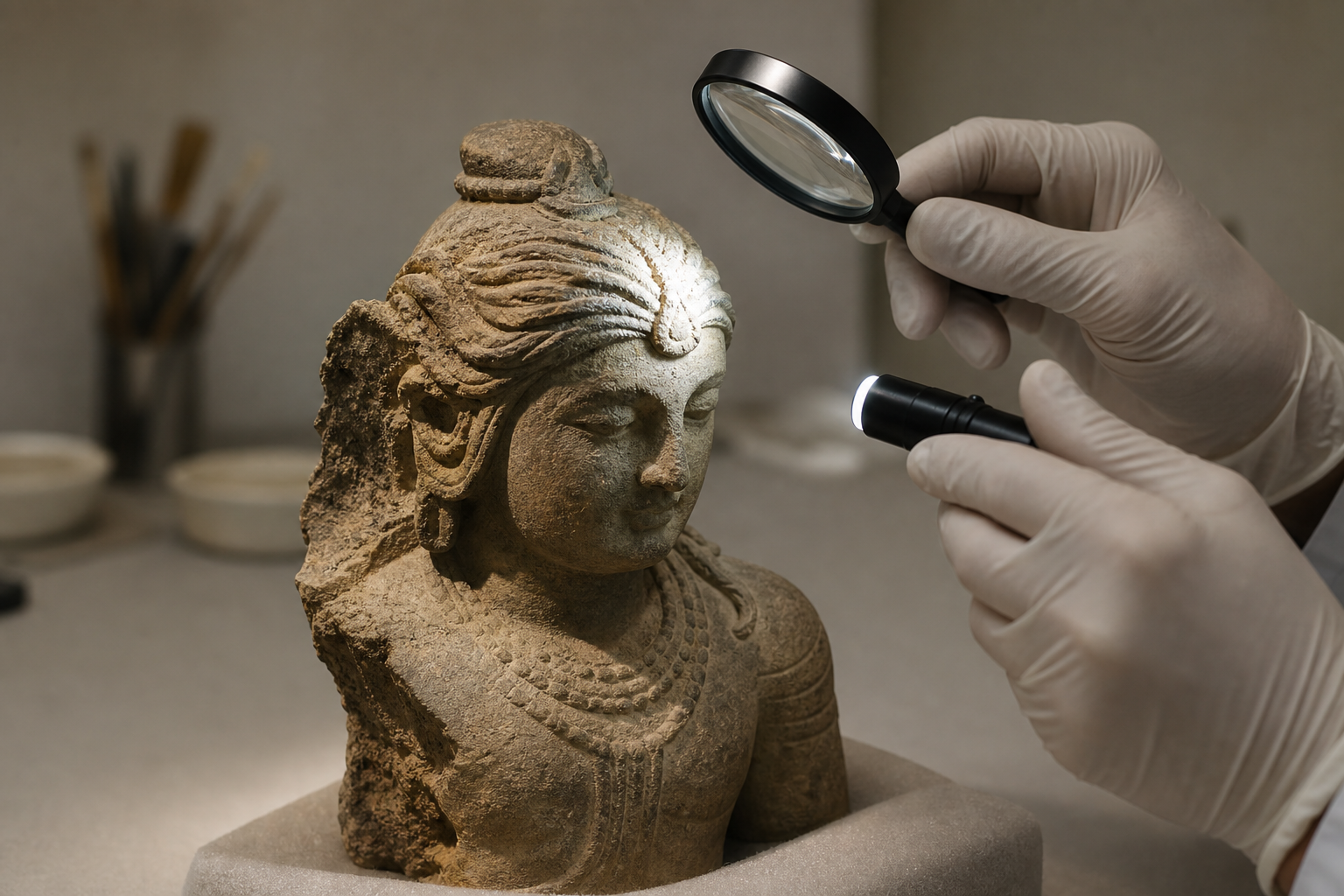
Whether you are in a temple, museum, archive, or photographic collection, the following sequence will keep a striking hairstyle from overpowering the rest of your reading.
- Read the silhouette first. Stand back, or reduce the photograph on your screen. Note whether the hair broadens the head, spreads outward, hangs heavily, or rises in a constructed vertical form. This separates mass from ornament before fine detail distracts you.
- Trace the locks rather than counting them. Follow the direction of the carved ridges. Locks that accumulate into a dense body support a reading of jata bhara. Locks repeatedly directed into a crown-like axis support jata mukuta. The pattern matters more than an exact number.
- Name the visual effect in plain language. Before assigning a Sanskrit term, write one neutral sentence such as: The figure bears a broad, irregular mass of thick locks around the head. A description made before identification helps prevent your conclusion from dictating what you think you see.
- Check the complete iconographic setting. Examine posture, expression, hand attributes, ornaments, attendant figures, and the figure’s place within the larger ensemble. Treat the hair as one strong clue among several, not as sufficient proof of identity.
- Account for loss and restoration. Look for broken edges, unusually smooth areas, mismatched surfaces, and missing upper portions. If the sculpture is incomplete, state the uncertainty rather than reconstructing an unseen hairstyle with confidence.
If you are documenting the object, take both a frontal and a side view when permitted. A frontal image records breadth and symmetry; a side view shows whether the volume projects backward, hangs, or rises. Also photograph or transcribe the object label separately. You may later disagree with an identification, but you should preserve the information that accompanied the object.
When comparing several figures, begin within the same sculptural setting. Repeated treatment can show which grooves are ordinary hair conventions and which figure has been given exceptional mass. This is more reliable than comparing isolated images photographed at unrelated angles and under different lighting.
Key takeaways
- Jata bhara is identified by the dominant mass and apparent weight of matted hair, not merely by hair length.
- Jata mukuta uses matted locks in a more structured, elevated, crown-like arrangement.
- The controlled wildness of jata bhara communicates renunciation, concentrated ascetic practice, and spiritual potency.
- A hairstyle establishes meaning but does not, by itself, prove the identity of a deity or ascetic.
- Silhouette, lock direction, surrounding attributes, and the sculpture’s physical condition should all be checked before you settle on a reading.
The next time you face a figure with monumental matted hair, pause before searching for a name. Describe the contour, decide whether the locks form a mass or a crown, and then return to the whole image. That small change in viewing order will let the sculpture disclose its ascetic character without asking one feature to carry more certainty than it can bear.
References
