
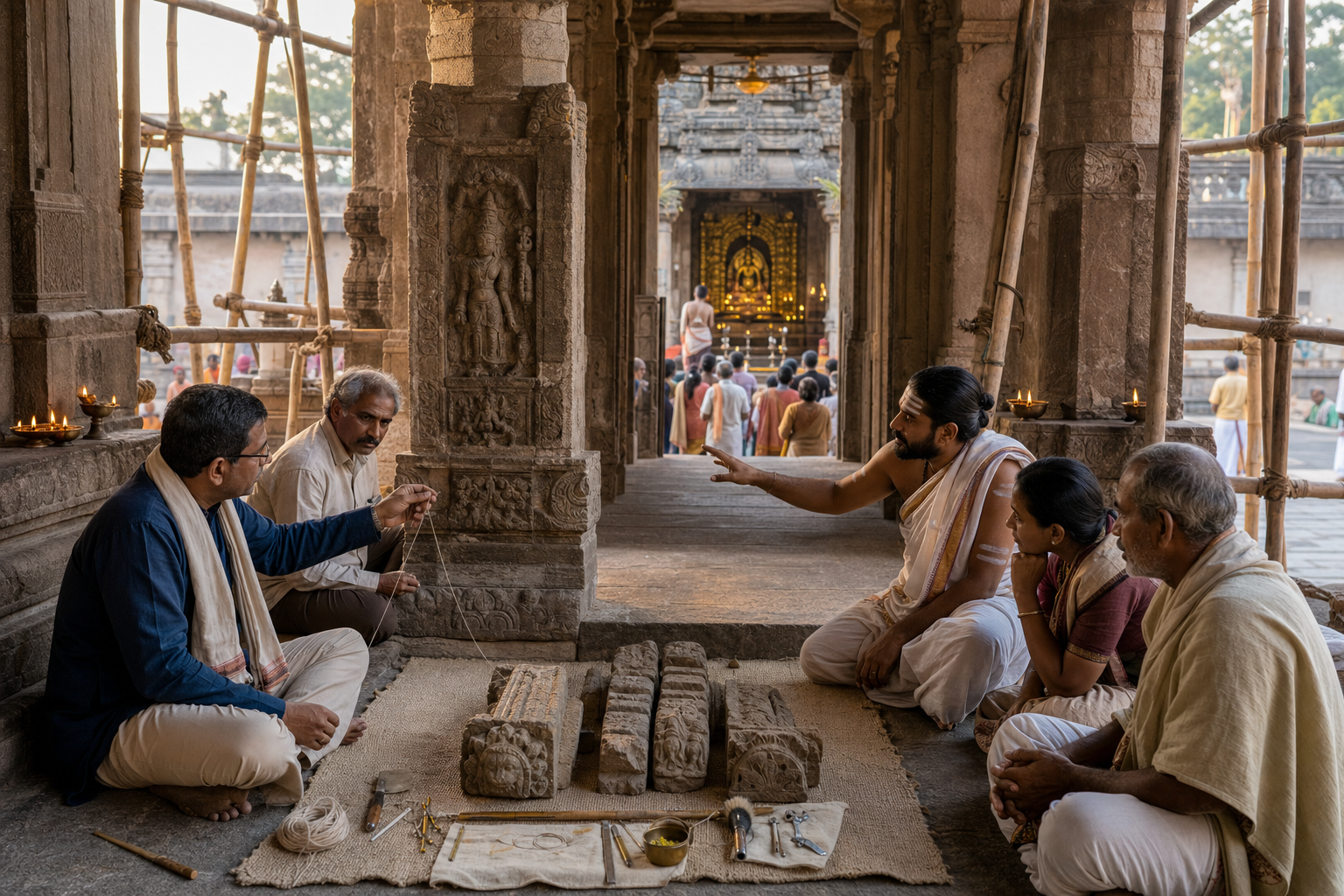
Someone on your temple committee has probably asked a practical question: Should a damaged image be completed, should weathered stone be replaced, should a donated ornament be accepted, or can worship resume as soon as construction ends? These questions sound separate. They are not.
Your task is to keep four forms of continuity aligned: the temple’s physical fabric, the iconographic identity of its sacred images, the ritual standing of the shrine, and the community that will care for it after reopening. Exclude any one of them and the result may be structurally safe but iconographically false, visually impressive but ritually incomplete, or ceremonially renewed without the means to endure.
Name the work before commissioning it
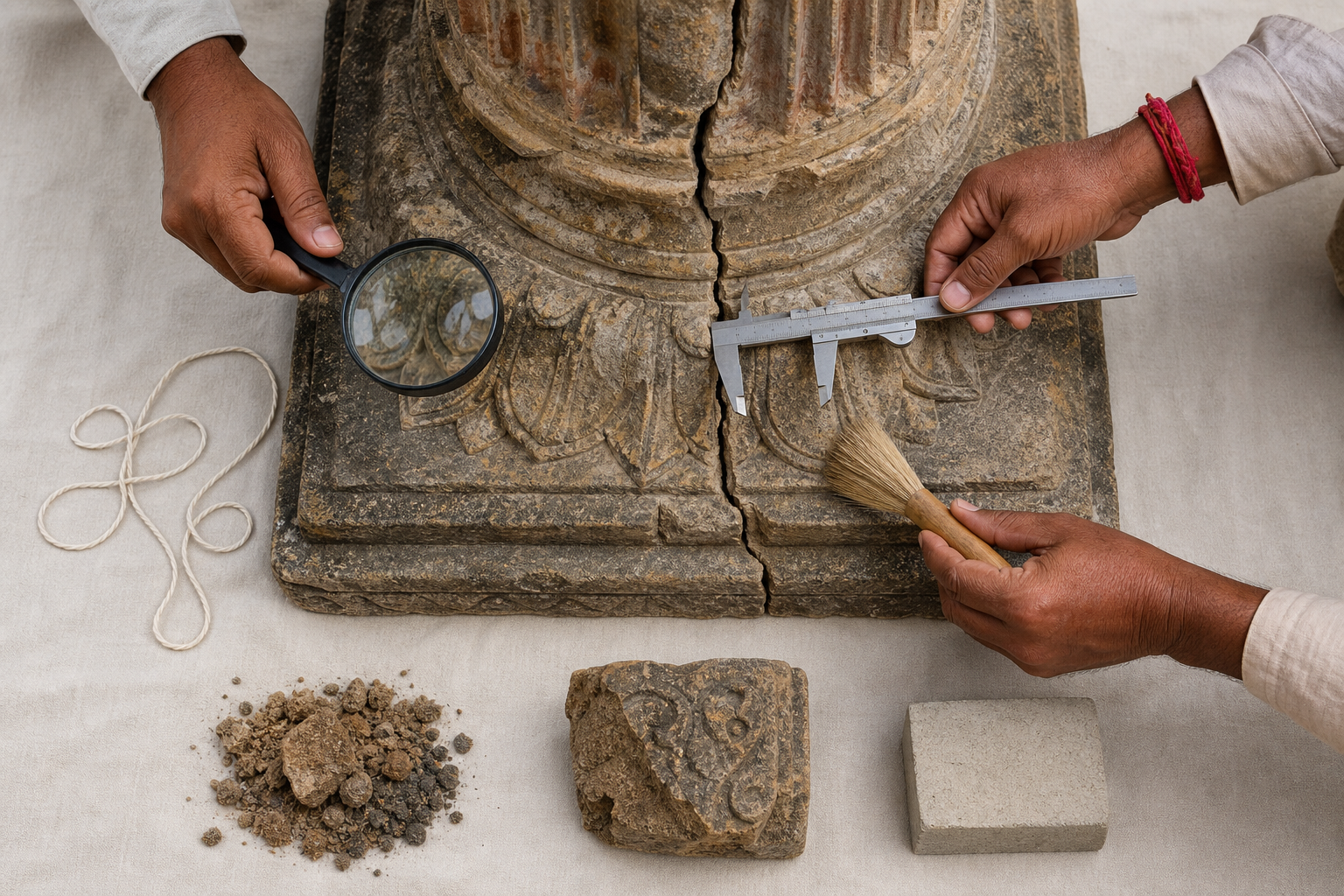
The word restoration is often used for every intervention, from securing a loose stone to manufacturing an entirely new image. That ambiguity creates expensive mistakes. Before seeking quotations or approving a design, give each proposed action a precise working name:
- Conservation retains surviving material and slows further deterioration.
- Repair corrects a failure, such as an unstable architectural member or broken fastening.
- Restoration recovers a form for which credible evidence survives.
- Reconstruction remakes a missing element and therefore carries a greater risk of conjecture.
- Renovation introduces a new convenience, finish, or arrangement rather than recovering an established sacred form.
- Ritual reinstatement returns a shrine or image to worship under the requirements of its own tradition.
A single temple project may need all six, but they should never be treated as interchangeable. A committee can approve a structural repair without possessing the authority to declare a Mūla mūrti ritually fit. A priest can determine ritual requirements without certifying that a damaged superstructure is physically safe. A sculptor can reproduce a motif with technical brilliance while still needing evidence that the motif belongs to this deity, this location, and this lineage.
Belur shows why the distinctions matter. By 1397 CE, the Chennakeshava Temple’s main entrance had been burned, its tower razed, sculptural elements broken and dispersed, and its principal image defaced. The response under Gunda Dandanāyaka was not a surface makeover. It combined architectural repair, the resetting and recreation of sculptural work, ritual purification, renewed worship, and the reactivation of patronage. Skilled workers followed the established Hoysala vocabulary even though the intervention occurred during Vijayanagara rule.
That history gives you a useful principle, but not a template to copy mechanically: restore continuity through the particular grammar of the temple in front of you. Chennakeshava at Belur, commissioned around 1117 CE under Viṣṇuvardhana, required craftspeople who understood its stellate plan, soapstone carving, horizontal friezes, deep eaves, door mouldings, and distinctive sculptural rhythm. Another temple may demand a different material discipline, Āgamic lineage, regional vocabulary, and history of additions.
Start with a scope register before approving irreversible work. Give every affected component its own entry and record:
- Its name and exact location.
- Its observed physical condition, without yet proposing a remedy.
- Its structural, iconographic, ritual, or processional function.
- The evidence for its earlier form: surviving fragments, old images, measurements, inscriptions, comparable work within the same temple, or applicable textual prescriptions.
- What remains uncertain or contested.
- Who has authority to make the physical, iconographic, and ritual decisions.
- Whether the proposed intervention can be reversed or corrected later.
- Who will inspect and maintain it after completion.
Treat an empty evidence field as a stop sign, not as permission for creative completion. Stabilizing an immediate hazard may be necessary while questions remain open. Carving an undocumented replacement is different: once installed, a plausible invention can quickly be mistaken for inherited tradition. A short delay preserves options; an irreversible conjecture removes them.
Read the sacred image before redrawing what is missing
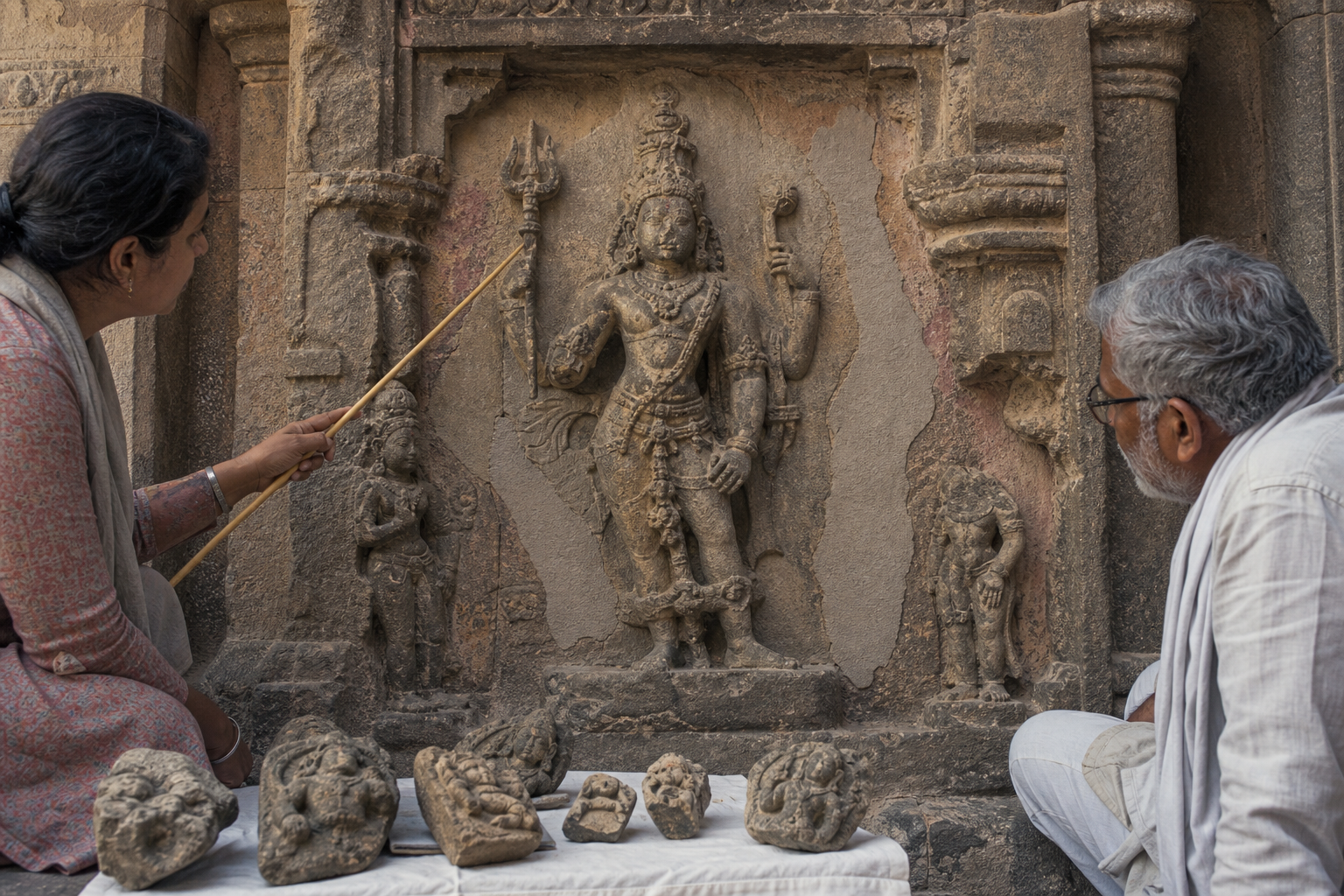
Sacred iconography is a grammar, not a collection of attractive motifs. Posture, hand gestures, attributes, crown, hairstyle, attendants, vehicle, jewelry, facial direction, and even a small asymmetry can identify a form or establish its devotional mood. Restoring each feature independently can produce an image whose individual parts look convincing but whose total identity is incoherent.
The ear ornament offers a particularly clear test. A doḷa kuṇḍala is a pendulous earring whose defining visual quality is its swing. It can draw the eye toward the face, catch low temple light, and suggest life through controlled movement. Its location beside the ear can also evoke śravaṇa, the receptive listening through which mantra and instruction are heard, while its oscillation can suggest sacred rhythm. Reducing it to generic jewelry strips away both visual function and meaning.
Do not use familiar ornament names as loose synonyms. The makara-kuṇḍala incorporates the aquatic makara. Patra or pātra forms are associated with leaf-like or dish-like shapes. The jhumka belongs to a bell-shaped family, the tāṭaṅka is characteristically disc-like, and the doḷa kuṇḍala is distinguished by its pendant movement. Texts such as the Vishnudharmottara Purana, Mānasāra, and Śilparatna discuss image-making and ornaments in relation to form and suitability. They should help frame the investigation, not become an excuse to override the shrine’s living sampradāya.
Before recreating an ornament or damaged feature, complete an iconographic inventory:
- Identify the deity’s precise form and the temple’s ritual tradition. Vishnu, Krishna, a dancing form of Shiva, and a form of Devi do not receive interchangeable visual treatment.
- Record both sides of the image separately. Do not assume the surviving right side can simply be mirrored onto the left.
- Map every surviving attribute, fastening point, break, repair, socket, and abrasion before moving the image.
- Distinguish an original element from a historically significant later addition. Age alone does not decide which layer belongs.
- Compare fragments first with intact features in the same icon and shrine, then with closely related images from the same regional and sectarian context.
- Record the degree of certainty behind each proposed line, volume, motif, and attachment. Unknown is an acceptable and often responsible conclusion.
Asymmetry deserves special attention. In Chola images of Shiva Nataraja, the earrings and their outward movement can reinforce the rotation of the ānanda tāṇḍava. A restorer who regularizes them into a matching pair may make the image neater while weakening its kinetic logic. The same caution applies to head tilt, flying locks, garment edges, and the direction of pendant elements.
Material and use also determine the right intervention. A pendant carved in stone represents movement without physically moving. A bronze processional image may carry separately suspended elements that genuinely oscillate. South Indian bronzes can use a mattal, a support chain joining an earring to the hair ornament, to distribute weight and control movement. Removing that apparently secondary chain may increase stress on the ear; adding an oversized donation may cause the pendant to strike the shoulder, crown, or adjacent ornament during procession.
For detachable festival jewelry, document weight, length, suspension method, support, range of movement, and clearance before fabrication. Test the geometry with a non-contact template or separate model rather than repeatedly fitting an unfinished metal component to the sacred image. The aim is not maximum movement. It is a measured motion that remains visible under lamps and during procession without damaging the mūrti.
Shared Dharmic craft vocabulary should sharpen this care, not blur identities. Pendulous ornaments also appear on Buddhist bodhisattvas and on Jain yakṣas and yakṣīs, while Jain Tīrthaṅkaras themselves are characteristically unadorned. Similar techniques can express compassion, sovereignty, abundance, protection, or auspicious presence in different settings. A familiar motif is therefore evidence of a broad artistic language, not proof that it belongs on the particular image you are restoring.
Plan ritual reinstatement before construction begins
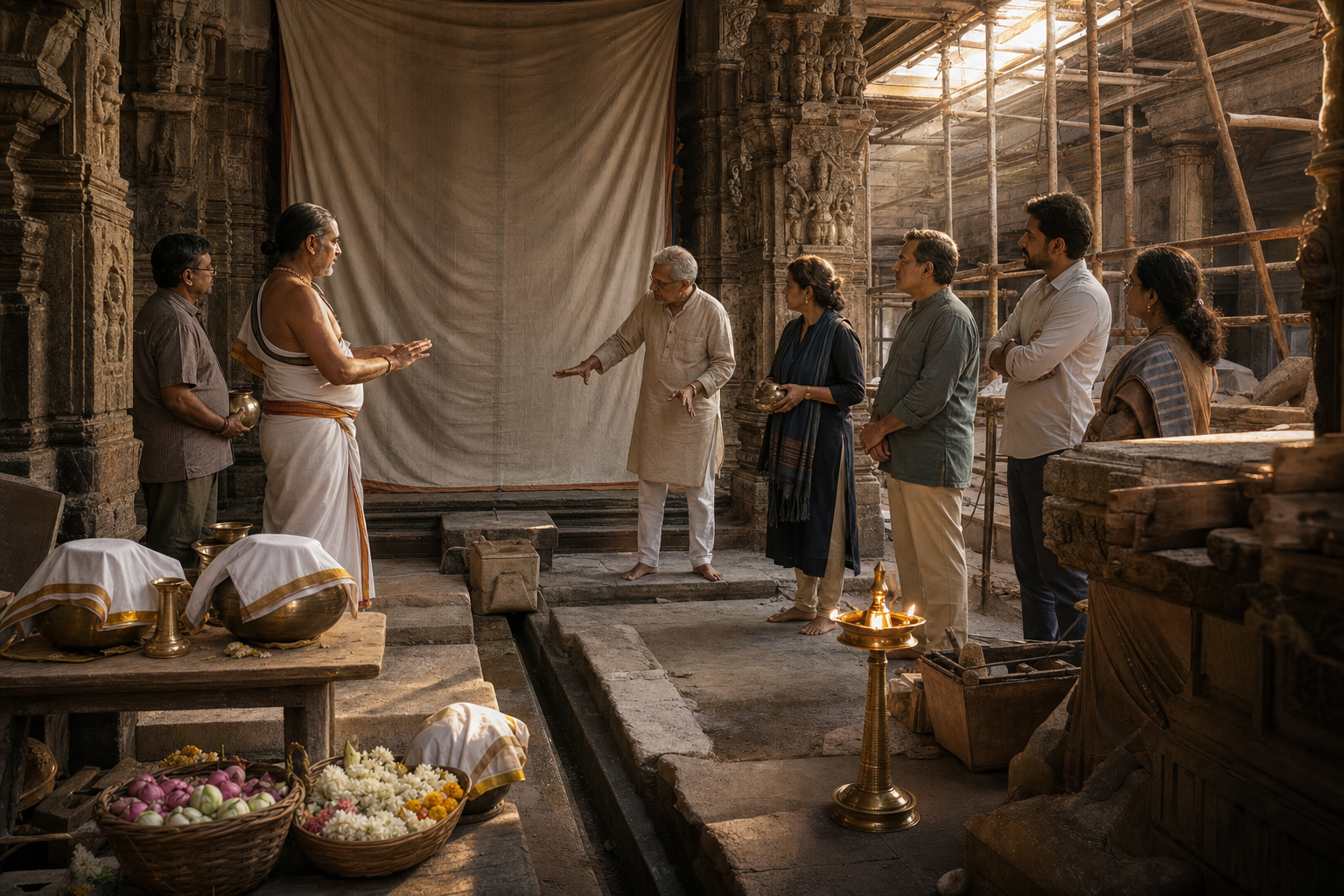
A repaired building is not automatically a restored temple. Physical completion answers whether the structure can stand and function. Ritual reinstatement answers whether the deity, sanctum, and precinct can resume worship in canonical continuity. These workstreams must coordinate, but neither can silently substitute for the other.
At Belur, material reconstruction was accompanied by purificatory and reconsecratory observances that included homa, prāyaścitta, kumbhābhiṣeka, and punar-pratiṣṭhā where required. The applicable Vaiṣṇava framework appears to have involved Vaikhānasa and/or Pāñcharātra prescriptions. That qualification matters. The exact rites, their sequence, and the threshold for reinstalling an image vary by tradition and circumstance; Belur’s response should not be converted into a universal checklist.
Bring the competent ritual authority into the project before the physical scope is frozen. Waiting until scaffolding comes down can reveal that an image was handled, shifted, repaired, or replaced in a way that complicates the required rites. Resolve these questions at the beginning:
- Is the affected object the Mūla mūrti, an utsava mūrti, a subsidiary deity, a guardian, a vāhana, a detachable ornament, or an architectural image?
- Has it remained in place, been displaced, been broken, or been exposed to a condition treated as ritual defilement?
- Which observances must precede examination, movement, temporary custody, repair, and re-entry?
- Does the tradition permit repair of the existing image, require a remedial rite, or require a different response?
- Who may handle the image at each stage, and what conditions must the workshop or temporary location satisfy?
- Which construction materials, residues, tools, or access arrangements must be cleared before the sanctum can be ritually prepared?
- What must occur before public worship, procession, and the regular festival calendar resume?
- What endowment, supply, staffing, and maintenance obligations begin once worship restarts?
Do not assume that visible damage always requires a new image. Do not assume that retaining the old image always preserves ritual continuity either. The relevant Āgama, sampradāya, shrine custom, and competent authority must determine the ritual response. The conservator’s condition report supplies facts about material integrity; it does not pronounce ritual validity. Conversely, a ritual decision does not replace structural or materials assessment.
Create a shared handover point between the physical and ritual teams. At that point, the project record should show what was moved, retained, reattached, replaced, cleaned, or recreated; which materials were introduced; where surviving fragments are stored; and which uncertainties remain. Ritual authorities can then act on an accurate account rather than on a polished appearance that conceals the intervention.
Turn reopening into a handover, not a finish line
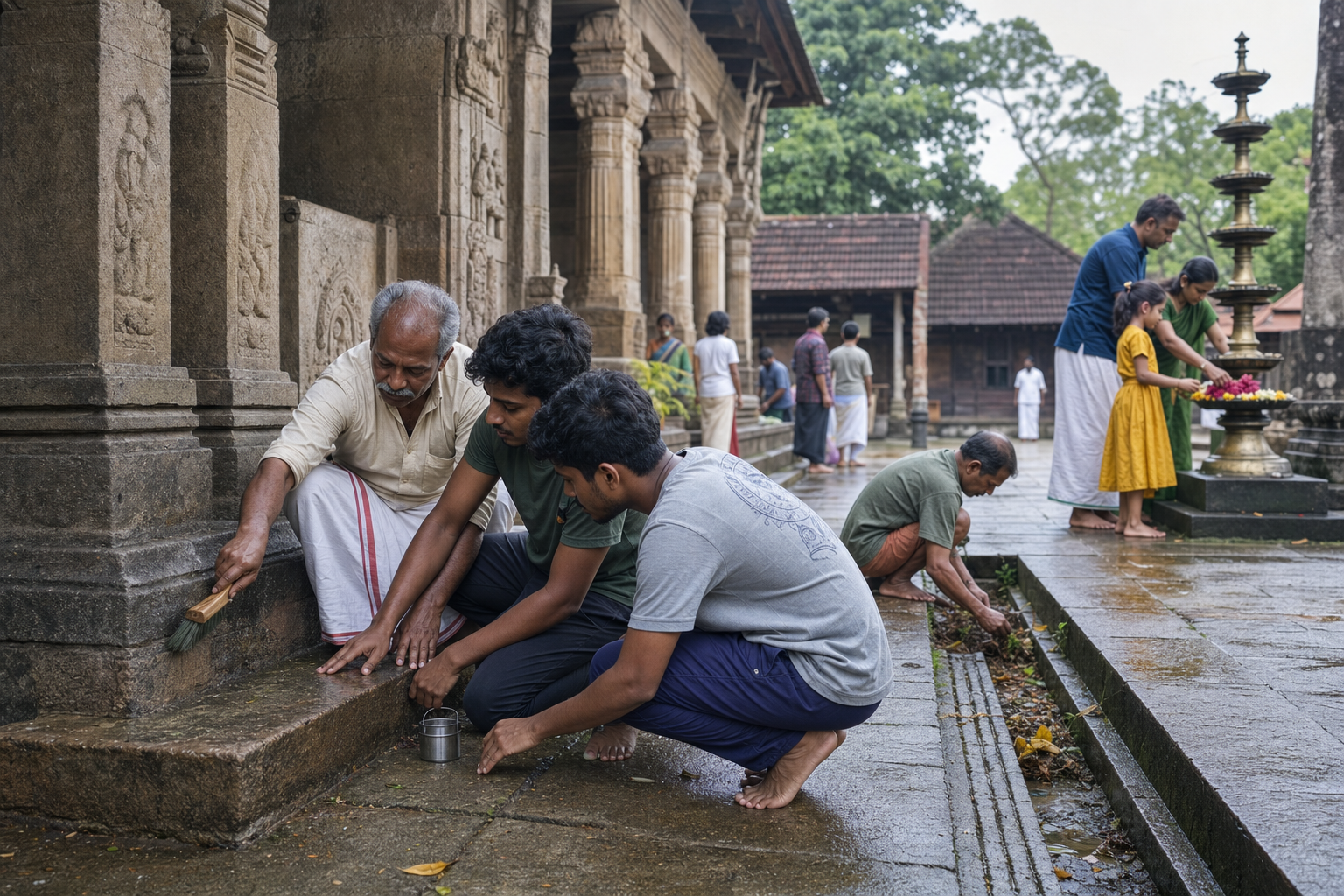
A temple survives because people maintain a system around it. Historically, the recovery of a major shrine could reconnect artisanal work, agrarian support, merchants, festivals, charitable kitchens, endowments, and local administration. At Belur, reconstruction and reconsecration reanimated a wider temple economy and civic order. The work restored relationships as well as stone.
You do not need to recreate a medieval economic arrangement to apply that lesson. You do need named custodians, recurring resources, an inspection process, and a record that remains usable after the present committee changes. A restoration budget that ends on inauguration day transfers a predictable burden to the next generation.
Use the following sequence to keep the project governable:
- Form the decision group. Include temple administration, competent ritual authority, conservation and structural expertise, an appropriate sthapati or śilpin, and people responsible for records and future maintenance.
- Document before touching. Photograph, measure, map, number, and describe every affected element, including loose fragments and previous repairs.
- Classify the work. Mark each action as conservation, repair, restoration, reconstruction, renovation, or ritual reinstatement.
- Separate evidence from proposal. Keep what is observed, what is inferred, and what is newly designed in different fields.
- Stabilize urgent hazards. Do not allow the desire for a complete visual scheme to delay necessary protection of people or surviving fabric.
- Approve iconography explicitly. Record the deity form, textual and local basis, surviving evidence, uncertainties, material, scale, attachment, and expected use.
- Approve the ritual sequence before movement or fabrication. Link rites to the actual construction and handling schedule.
- Supervise specialist work. Require approval at drawings, models, carving or casting stages rather than discovering deviations after installation.
- Create an as-completed record. Identify new material, retained repairs, stored fragments, maker, date, and maintenance requirements without falsely aging the intervention.
- Fund custody after reopening. Assign responsibility for condition checks, jewelry handling, fragment storage, records, routine care, and escalation when new damage appears.
Keep decision authority tied to competence. Trustees can govern scope, money, access, and accountability. Ritual authorities can determine canonical requirements. Architects, engineers, conservators, and craftspeople can address their respective physical disciplines. Iconographic questions may require both textual knowledge and close familiarity with the shrine’s regional form. When these domains conflict, record the disagreement and resolve it before fabrication; do not let the fastest contractor or largest donor make the decision by default.
Donations require the same discipline. A gift of gold, a new pendant, or a replacement panel may be generous yet unsuitable in weight, scale, imagery, material, or ritual use. Accept funding against an approved need. Do not exchange design authority for a donation. If a proposed object cannot pass the same iconographic, mechanical, ritual, and custodial review as commissioned work, it should not be attached to the mūrti.
Your budget should make invisible work visible. Include documentation, temporary protection, specialist assessment, skilled craft, ritual requirements, safe storage, security for detachable ornaments, and a reserve for continuing care. These lines are not administrative extras. They are what prevent a celebrated reopening from becoming the first day of another cycle of avoidable loss.
Key takeaways
- Restore a living sacred system, not merely a building surface.
- Use precise terms for conservation, repair, restoration, reconstruction, renovation, and ritual reinstatement.
- Require evidence before recreating a missing form, and preserve uncertainty when the evidence is weak.
- Read ornaments, gestures, attributes, posture, and asymmetry as parts of one iconographic grammar.
- Match materials and mechanics to use: a stone pendant, a bronze processional ornament, and detachable festival jewelry do not behave alike.
- Bring competent ritual authority into planning before images are handled or the construction scope is fixed.
- Document new work honestly, retain displaced fragments safely, and fund care beyond reopening.
At your next project meeting, ask for the scope register before looking at the proposed finished design. If the team cannot show the evidence, decision authority, ritual pathway, reversibility, and future custodian for an intervention, pause that intervention. Sacred continuity is protected by knowing when to act, how to act, and when the honest answer is that more must first be understood.
References
- DharmaRenaissance Blog — Belur 1397 CE: Vijayanagara Resilience and Gunda Dandanatha’s Restoration of Chennakeshava
- DharmaRenaissance Blog — Unveiling Dola Kundala: The Pendulous Earring’s Power, Symbolism, and Living Legacy in Hindu Art
