
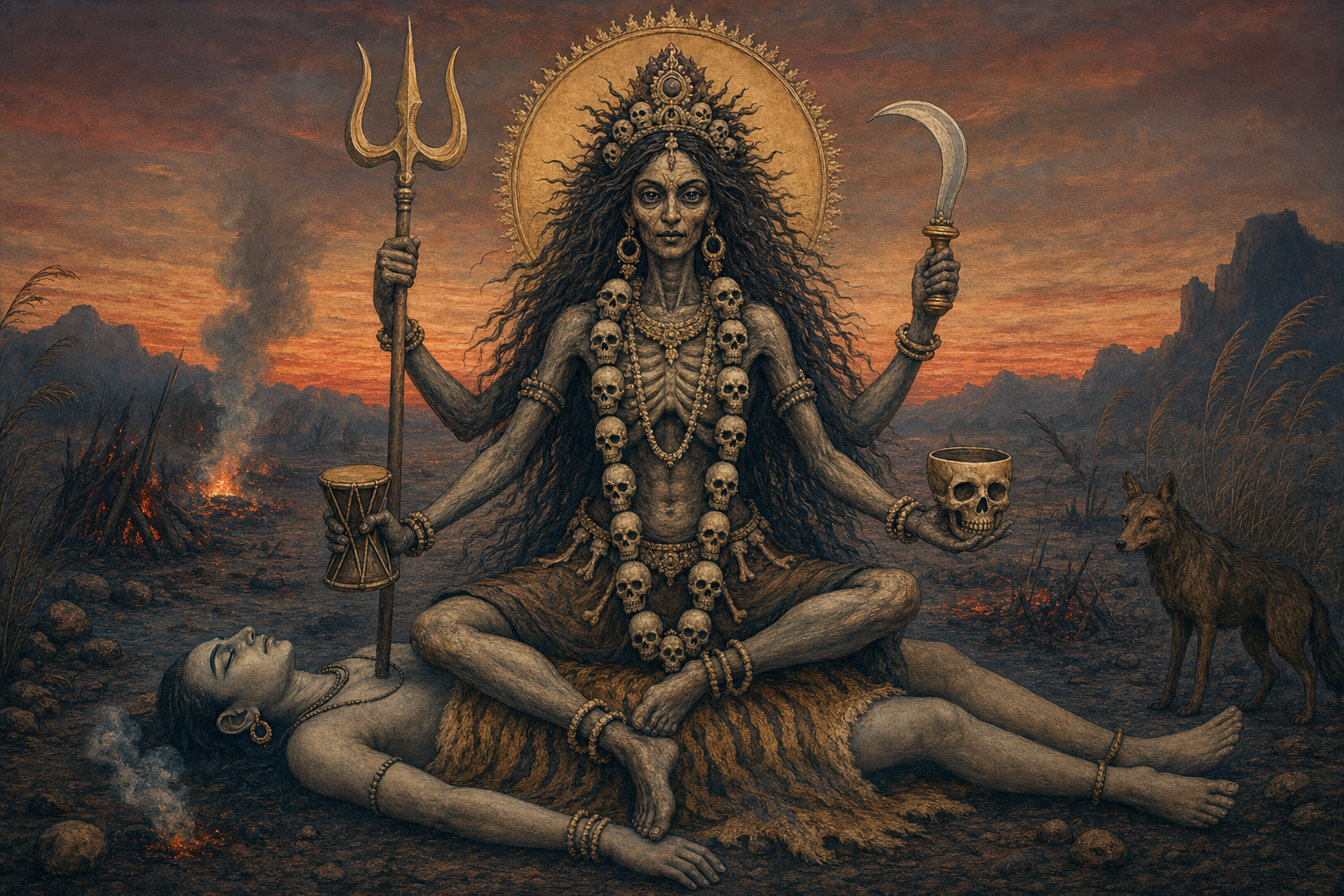
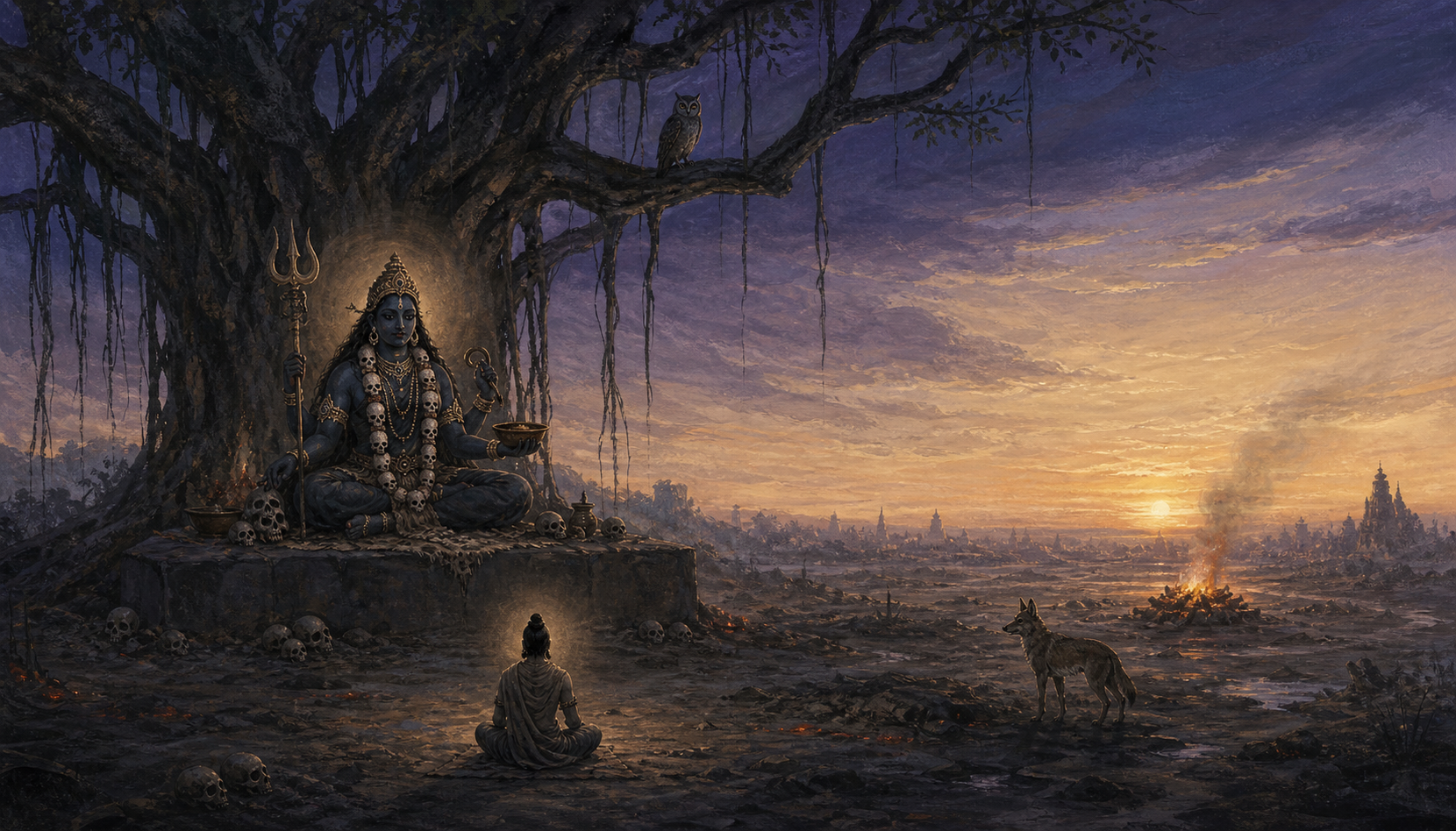
You may recognize that Chamunda is a form of Devi and still feel uncertain before her image. The ribs, hollow abdomen, skulls, corpse-seat and scavenging jackal seem to reverse everything expected of an auspicious Hindu deity. If you read those details as horror, however, you miss the protection encoded in them.
Chamunda does not make death divine for its own sake. Her emaciated form exposes what time does to every form and what craving does to the mind. Once you understand that central claim, the rest of her iconography becomes coherent: the skull cup, severed heads, corpse and cremation ground all teach that freedom cannot be built upon what inevitably passes away.
The skeletal body is a teaching about appetite
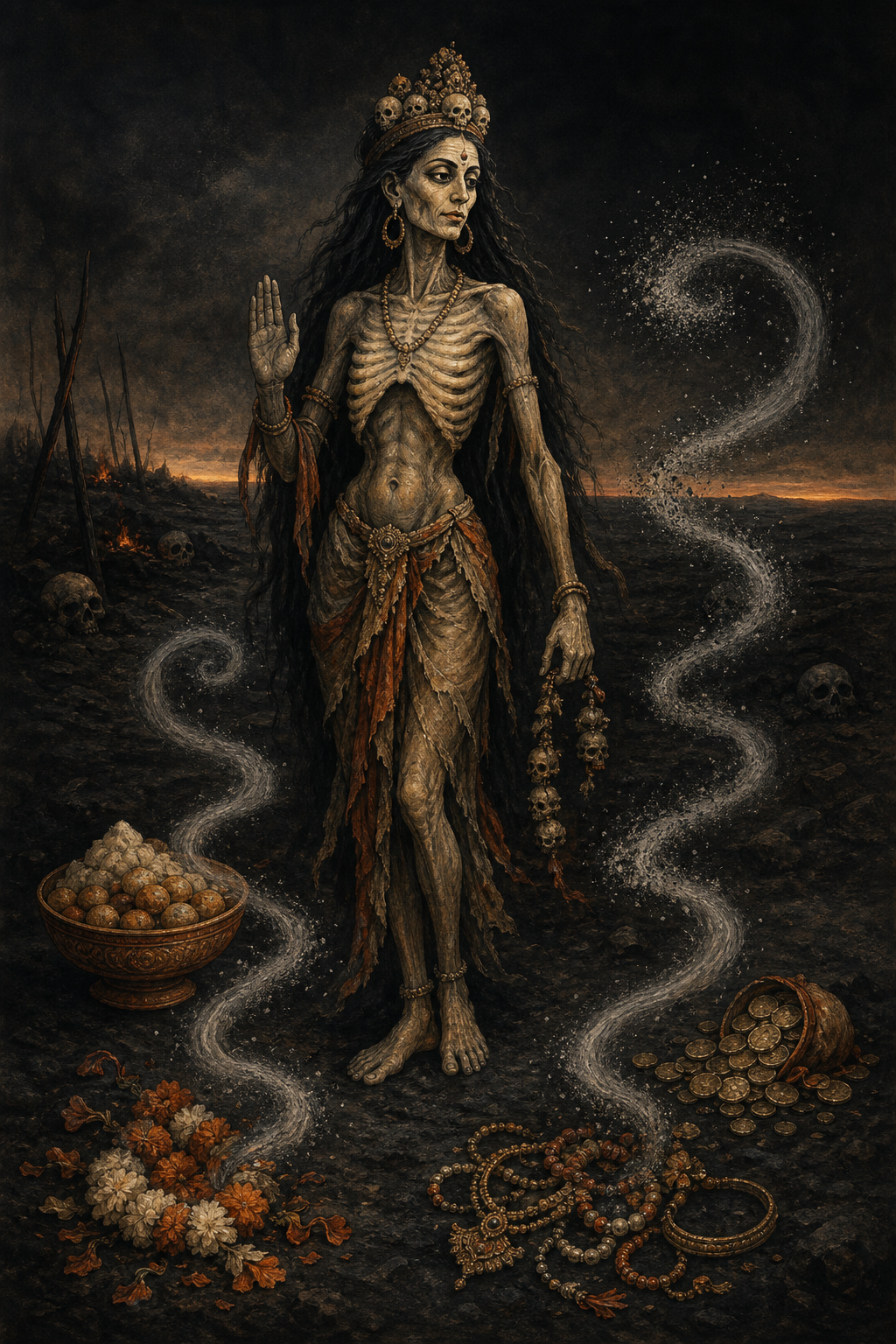
Begin with the body rather than the weapons. Chamunda’s prominent ribs, dry flesh and sunken belly do not portray a goddess who has been defeated, neglected or deprived of power. She remains sovereign. The body is gaunt because ordinary nourishment has lost its claim upon her.
This is the fierce visual language of vairagya, or dispassion. In this context, the withdrawal of rasa means that the vital sap and attraction associated with material enjoyment have been drawn out of the image. Other forms of Devi reveal fertility, beauty, learning or abundance. Chamunda reveals what remains when none of those temporary gifts can be possessed. These forms are complementary, not contradictory. The same Divine Mother who nourishes life also releases her devotee from clinging to it.
Her thinness therefore should not be read as praise for physical starvation. The icon addresses attachment, not body size. To imitate the appearance through harmful deprivation would confuse a metaphysical image with a bodily instruction. The practical question is not how little you can eat or own. It is whether feeding a desire has ever brought that desire to a final end.
That distinction explains Chamunda’s apparently unfillable hunger. Samsaric appetite renews itself after every satisfaction. More recognition creates a need for more recognition; possession generates fear of loss; victory can create another enemy. Chamunda’s body refuses to pretend that one further acquisition will complete this cycle. She does not satisfy compulsive hunger. She reveals its mechanism and withdraws its authority.
Her bones carry a second meaning. They are the durable outline exposed after time has removed beauty, status and individuality. As Kala-Shakti, the power of time, Chamunda makes impermanence visible before death forces you to acknowledge it. When viewing her, ask what the image has stripped away: age, ornament, social identity, comfort and the fantasy of permanence. Then notice that sacred power has not disappeared with them.
Read the attributes as one coherent sentence
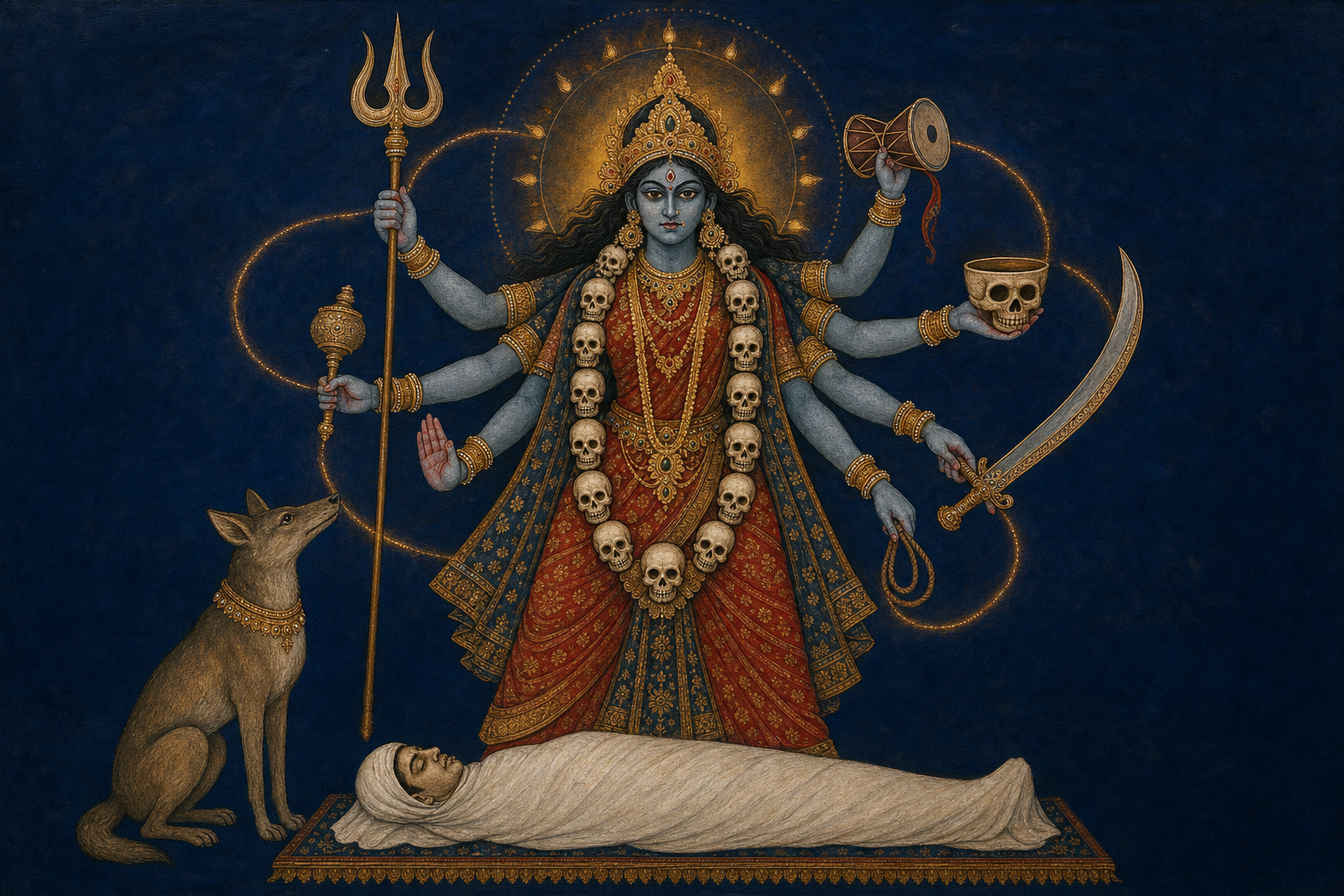
No single object identifies every Chamunda image, and regional sculptures do not always give her the same number of arms or the same collection of implements. Look for a cluster of signs. Read them from the body outward, because each one develops the body’s first lesson.
- Start with the gaunt torso. Visible ribs and a hollow abdomen establish radical dispassion and the action of time. If the body is skeletal but commanding rather than helpless, you are already within Chamunda’s visual world.
- Examine the head and neck. A lolling tongue intensifies her fierce, consuming character. The mundamala, or garland of severed heads, is not merely a display of violence. It signifies the ending of ignorance and egoic multiplicity: the many identities through which ahankara keeps asserting itself.
- Identify what the hands hold. A kapala, or skull cup, turns death’s remnant into a vessel of emptying and insight. A trishula expresses penetrating divine power. A damaru introduces the rhythm of manifestation and dissolution. A khatvanga, the skull-topped staff, reinforces her mastery of the boundaries ordinary consciousness fears.
- Look below the body. A corpse-seat, or pretasana, places divine sovereignty directly upon mortality. Chamunda does not avert her gaze from the lifeless body; she sits where fear expects sacredness to be absent.
- Check for five skulls. The Panchamundi Asana is interpreted differently across lineages: the five may be related to elements, aggregates or entrenched limiting tendencies. Do not force one universal enumeration onto every representation. Its stable meaning is mastery over the finite structures that bind ordinary experience.
- Read the surrounding world. Ash, bone and cremation-ground attendants locate her in the shmashana, where social rank, physical beauty and possession have reached the same end. A jackal, frequently her vehicle or companion, belongs to this threshold. As a scavenger, it moves through what society rejects and shows the capacity to face what fear and disgust would rather exclude.
Now combine the details. The skull is emptied, the heads no longer multiply, the corpse no longer terrifies, and the jackal crosses a forbidden boundary. The image is making one sustained argument: whatever the ego refuses to face becomes a source of bondage, while what is met with discernment can become a ground of freedom.
This method also prevents a common mistake. A skull by itself does not prove that a sculpture is Chamunda, just as a trident by itself does not distinguish every form of Devi. Identification becomes stronger when the skeletal body, skull symbolism, corpse or cremation setting, jackal and fierce facial features converge. The sculpture’s placement within a group of Matrikas can supply another important clue.
Her battle with Chanda and Munda defines fierce protection
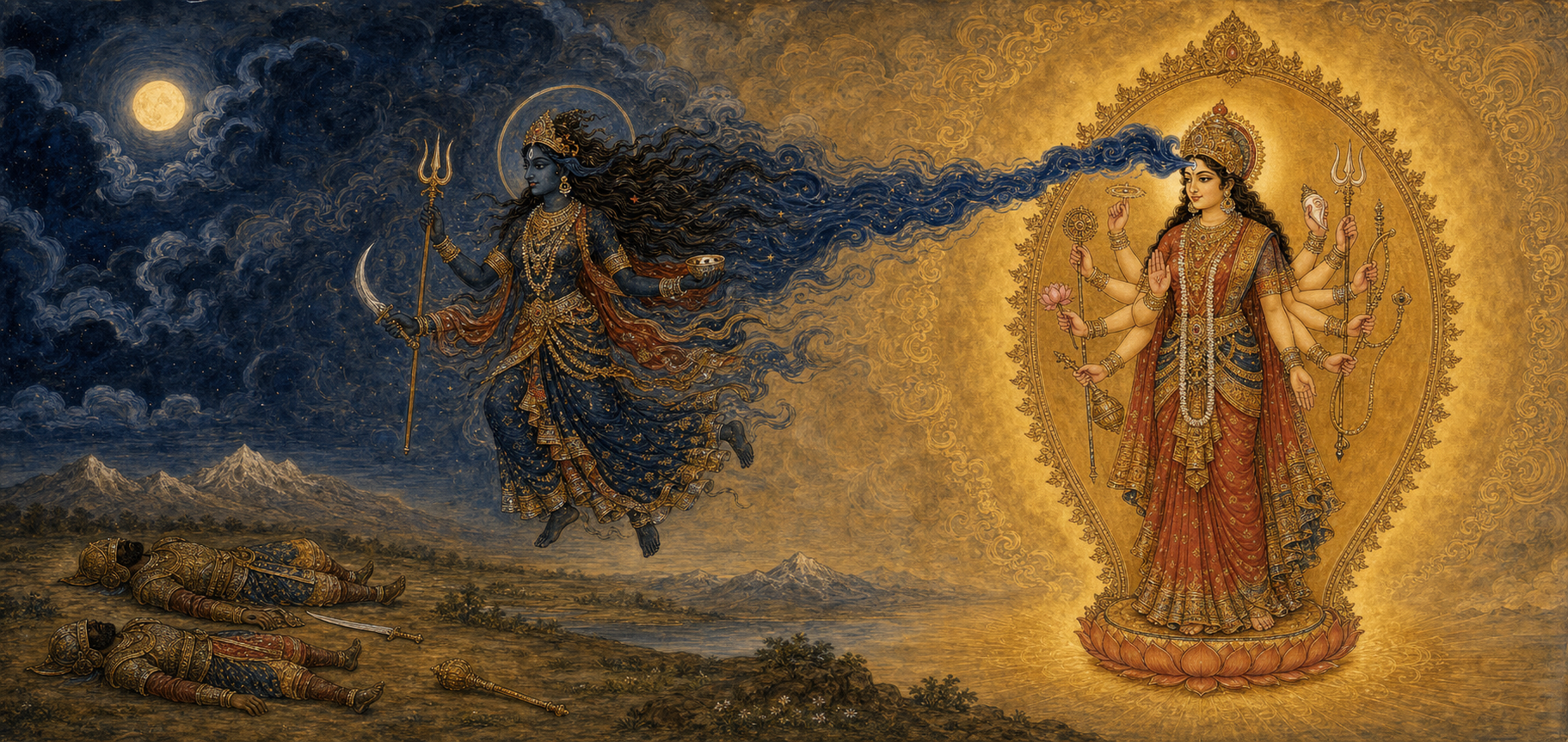
The Devi Mahatmya gives the name Chamunda its narrative force. During the Goddess’s battle, a terrifying power destroys the asura generals Chanda and Munda and presents their severed heads. In many recensions, the slayer is the fearsome Kali, who receives the name Chamunda through that victory. Later traditions may treat Chamunda as a distinct goddess, a specialized aspect of Kali, or a member of the Matrikas. Those differences matter, so Kali and Chamunda should not be collapsed into a single identity in every temple, text or lineage.
The battle clarifies why the icon is protective rather than nihilistic. Chanda and Munda are not overcome through negotiation or further nourishment. Their capacity to continue the conflict is severed. On the inward plane, anger, greed, pride and delusion behave in much the same way: indulging them usually strengthens the pattern that produced them. Chamunda represents the moment when Shakti stops feeding that proliferation.
Blood and the extended tongue in related Kali-Chamunda imagery sharpen this point. Blood suggests a force that can reproduce violence when allowed to fall back into the field of conflict. The consuming Goddess intercepts that multiplication. Destruction becomes protection because she destroys the process by which harm renews itself.
This is why it is misleading to place a maternal Devi on one side and a terrible Chamunda on the other. A mother who only consoles but never removes danger would offer incomplete protection. Chamunda is maternal power in its least sentimental register: she acts against what binds and harms, even when the cure does not resemble comfort.
Her historical temple settings reinforce this wider identity. Early medieval and later representations appear across Rajasthan, including Osian, as well as the Deccan, Odisha and Karnataka. Some regional workshops stress the skeletal torso; others give greater weight to the skull garland, attendants or surrounding cremation imagery. When Chamunda appears among the Matrikas, read her both individually and relationally: she is one fierce power within a coordinated field of maternal Shaktis.
Tantric shock is disciplined pedagogy, not spectacle
The cremation ground is not included simply to make the image more dramatic. It removes the supports through which ordinary identity reassures itself. Wealth cannot be displayed there. Youth cannot be preserved there. Social position cannot protect the body there. Shmashana imagery confronts the practitioner with the equality imposed by impermanence.
This is shock pedagogy. Fear, revulsion and longing usually drive consciousness in opposite directions: we cling to what attracts us and flee what disgusts us. Chamunda places sacred presence inside the rejected half of that movement. The aim is not to cultivate morbidity but to prevent aversion from controlling perception. If the Divine can be recognized amid ash, bone and death, fear loses its claim to define where truth may be found.
That does not make every cremation-ground practice suitable for independent experimentation. Shmashana sadhana, skull symbolism and advanced Tantric disciplines belong within lineages that provide competent guidance and ethical boundaries. Curiosity is not initiation. Do not copy a ritual from an isolated description, collect human remains, enter cremation grounds without permission, or treat transgression as spiritual attainment. The icon can teach every devotee, but specialized practice requires the authority and safeguards of a living tradition.
You can still engage the image contemplatively without pretending to undertake advanced Tantra. Use a four-part reading whenever you encounter Chamunda in a shrine, sculpture or painting:
- Describe one feature literally before interpreting it: visible ribs, a skull cup, a severed-head garland, a corpse or a jackal.
- Name your immediate response without decorating it: fear, disgust, fascination, reverence or confusion.
- Ask what attachment the feature exposes. The ribs may point to appetite, the skull to identity, the corpse to mortality, and the jackal to what you exclude from conscious attention.
- Translate the insight into one bounded dharmic act. Decline one unnecessary indulgence, admit one impermanent situation you have resisted, repair harm created by pride, or perform one useful act of seva without seeking recognition.
This sequence matters. Observation prevents fantasy; naming the response reveals your own conditioning; interpretation connects the symbol to its teaching; action keeps contemplation from becoming aesthetic consumption. Chamunda is not asking merely to be admired as unusual religious art.
Her imagery also belongs to a wider Dharmic conversation without making all traditions identical. Vajrayana charnel-ground dakinis similarly place liberating insight in frightening settings. Jain vairagya and ahimsa address the conquest of craving without adopting Chamunda’s violent visual grammar. Sikh discipline seeks the dissolution of haumai through simran rather than skull-bearing deity forms. The shared concern is freedom from ego and fear; the theology, ritual form and ethical vocabulary remain distinct.
That distinction lets you recognize resonance without appropriating one tradition as a decorative version of another. Compare the problem being addressed before comparing appearances: clinging, egoic multiplication, aversion and fear. Then respect the different paths by which Hindu, Buddhist, Jain and Sikh traditions discipline those forces.
Key takeaways for reading Chamunda correctly
- Her skeletal body signifies radical dispassion and the devouring action of time, not divine weakness or an instruction to harm the body.
- Her apparent hunger exposes the futility of trying to end craving through repeated satisfaction.
- The mundamala, kapala, corpse-seat and Panchamundi Asana turn mortality and egoic limitation into signs of conquered bondage.
- The jackal and cremation ground mark a threshold where rejected realities must be faced rather than denied.
- Her victory over Chanda and Munda frames destruction as protection: harmful proliferation is stopped at its root.
- Regional and sectarian differences mean that Chamunda may be distinct from Kali, closely allied with her, or situated among the Matrikas; identify the full iconographic cluster rather than relying on one object.
- Her image is open to careful contemplation, while advanced Tantric ritual requires lineage guidance, permission and ethical discipline.
The next time you stand before Chamunda, resist the urge to look away or reduce her to the macabre. Spend one minute with a single attribute and ask what cannot follow you through time. Then let the answer change one choice you make that day. That movement from recognition to restraint is where her fearsome image begins to do its compassionate work.
References
