

If you remember the Golden Deer episode as nothing more than Sita wanting a beautiful animal and suffering for it, you have inherited a moral far cruder than the Ramayana gives you. That reading turns a carefully engineered act of adharma into a warning against desire, curiosity, or women.
Read the sequence closely and a more demanding lesson appears. The danger is not beauty itself. The danger is deception that captures attention, imitates a trusted voice, disrupts a protective arrangement, and then approaches in the costume of sanctity. The episode teaches you how viveka, discernment, must operate when duty and emotion are both under pressure.
The trap is a sequence, not a single mistake
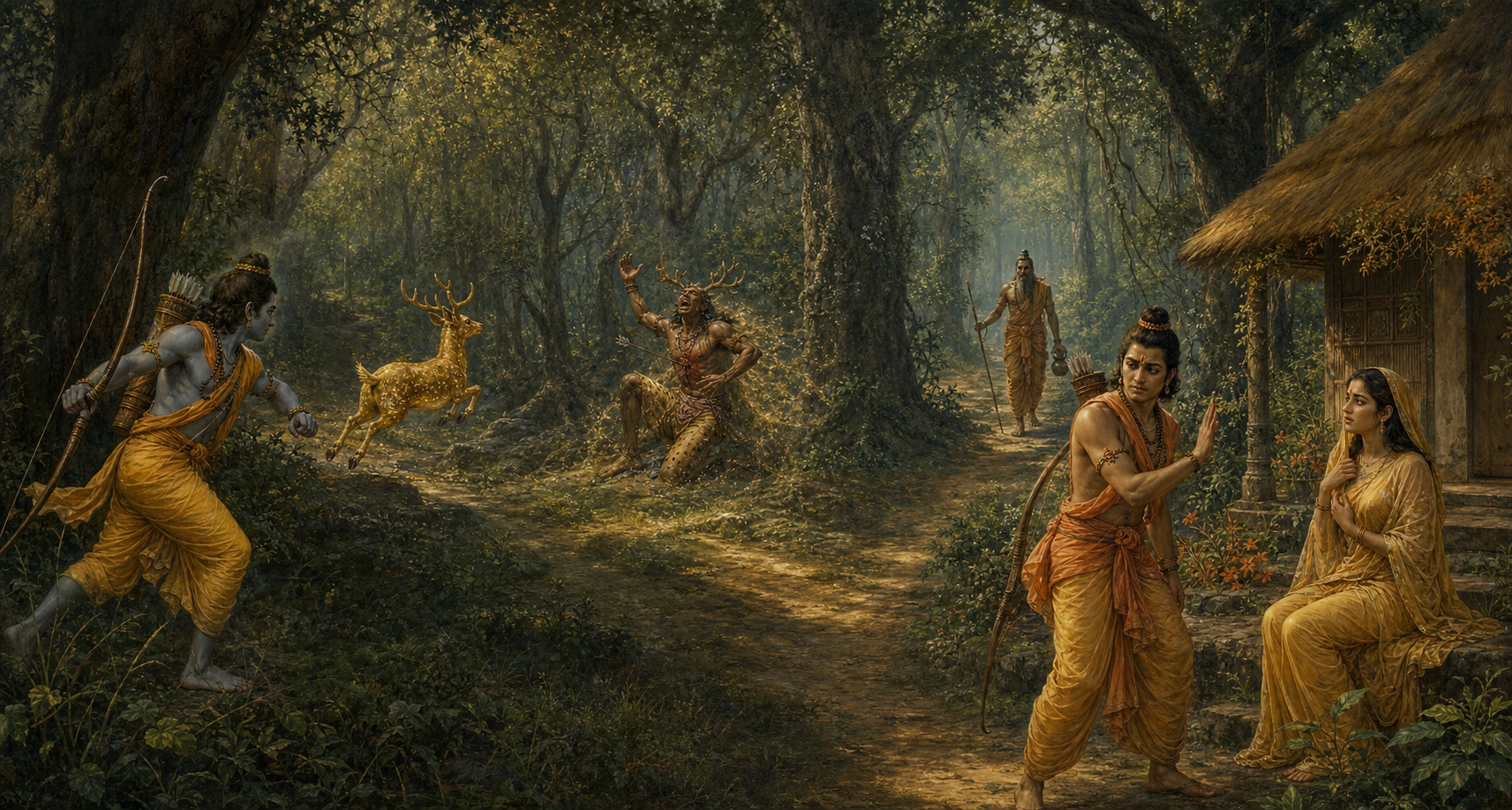
The core sequence in Aranya Kanda matters because Ravana’s plan depends on several linked deceptions rather than one moment of carelessness:
- Maricha assumes the form of an extraordinary Golden Deer so that Sita and Rama will see something rare, radiant, and worthy of attention.
- Sita asks Rama to obtain the deer as a keepsake.
- Rama pursues it after entrusting Sita’s protection to Lakshmana.
- When Rama mortally wounds him, Maricha imitates Rama’s cry and makes danger appear immediate.
- Sita, fearing for Rama, presses Lakshmana to go to him. The remaining protector therefore leaves his assigned position.
- Ravana arrives disguised as a mendicant, exploits the obligations of hospitality, and abducts Sita.
The design has three distinct parts: a dazzling diversion, a counterfeit distress signal, and an impersonation of a person entitled to trust. The deer draws Rama away. The cry changes Lakshmana’s calculation. The mendicant’s appearance lowers the final barrier. No single device has to defeat everyone; each one only has to move one person out of place.
This is why the episode remains useful wherever people must make decisions under uncertainty. An adversary rarely attacks the strongest arrangement directly. A diversion creates separation, urgency interrupts verification, and a trusted appearance gains the access that force could not obtain. The vulnerable moment is often the handoff: one duty is suspended because another suddenly looks more urgent.
The sequence also clarifies the relation between daiva and purushakara, destiny and human effort. Destiny in the Ramayana does not reduce the characters to puppets. It unfolds through choices made with incomplete knowledge. Sita’s request, Rama’s pursuit, Lakshmana’s departure, Maricha’s imitation, and Ravana’s disguise form a causal chain. To acknowledge destiny is not to deny agency; it is to recognise that consequences can exceed anyone’s immediate field of vision.
Why blaming Sita misses the ethical centre
A shallow reading assigns great moral weight to Sita’s attraction and surprisingly little to the deliberate conduct of Ravana and Maricha. That reverses the ethical order. Wanting something beautiful is not equivalent to manufacturing a false appearance, copying a loved one’s voice, violating the trust extended to an ascetic, and committing abduction.
Sita’s response to the deer can be read as aesthetic delight and curiosity. Within a Hindu theological reading that understands her as Śrī, it is especially inadequate to reduce that response to greed. The sharper lesson is that even an innocent or refined desire can become usable material for adharma. A desire does not have to be wicked before someone can exploit it.
Rama’s pursuit likewise deserves more than a careless verdict. He has to respond to Sita’s request while considering the hazards of forest life. Entrusting her to Lakshmana is an act of delegation, not abandonment. Lakshmana then confronts a conflict between Rama’s instruction and Sita’s urgent fear for Rama’s safety. The plan fails because deception alters the information on which each person acts.
Ravana and Maricha are different. Their conduct is organised around knowledge of the falsehood. They create the misleading object, the misleading signal, and the misleading identity. That intention is decisive when you assign moral responsibility.
- Distinguish the architect from the target. The person whose ordinary affection is exploited is not morally interchangeable with the person who designed the exploitation.
- Separate imperfect judgment from intentional deceit. A decision made under false information can still be examined, but it is not the same act as deliberately supplying that false information.
- Judge the whole character, not one vulnerable moment. Sita’s fortitude during captivity is part of the episode’s moral horizon. Her dignity cannot be erased to make the abduction into a simplistic punishment story.
This distinction does not remove agency from Sita, Rama, or Lakshmana. It prevents causal participation from being confused with equal culpability. Several choices can contribute to an outcome while the principal guilt still belongs to those who knowingly created the trap and committed the violation.
The deer’s radiance tests discernment, not your capacity for wonder

The name hiranyamriga joins gold and deer in one impossible form. Gold can evoke prosperity, brilliance, and tejas. It can also become the surface through which lobha and maya seize attention. The image works because radiance is not automatically corrupt. If the deer looked plainly monstrous, no discernment would be required.
In a yogic interpretation, the swift deer resembles the restless mind and roaming senses. Attention runs toward movement, rarity, and shimmer before reflective judgment catches up. Modern terms such as salience bias, novelty bias, and the affect heuristic describe a related tendency: what is vivid, unusual, or emotionally charged can feel more important than quieter obligations.
That does not make the deer itself an emblem of evil. Maricha has appropriated an attractive form for a destructive purpose. The distinction matters. The answer to illusion is not suspicion of every beautiful thing, just as the answer to Ravana’s disguise is not contempt for every mendicant. Viveka tests appearance without declaring appearance worthless.
The scene’s emotional movement reinforces the point. Adbhuta, the rasa of wonder, is gradually darkened by bhaya, fear, and then opens into vira, heroic resolve. Wonder is not deleted from the story; it becomes the threshold at which disciplined perception is needed.
Other Dharmic lenses sharpen this distinction. In the Ruru, or Golden Deer, Jataka, the deer is associated with compassion, truth, and moral instruction. In the Ramayana, a golden deer is a decoy. The same luminous outward sign can therefore accompany opposite moral realities. Jain aparigraha asks how attachment narrows freedom, while anekantavada warns against treating a partial view as the whole. Sikh teachings on maya and hukam likewise direct attention away from glitter that displaces right alignment. Across these perspectives, the practical rule is consistent: do not infer moral worth from splendour alone.
A four-question viveka check
When something rare or urgent captures your attention, pause long enough to ask four questions:
- What exactly has attracted me? Name the feature doing the work: beauty, rarity, prestige, fear, urgency, or apparent authority.
- Which standing duty would I interrupt? The cost of pursuing a new object is often hidden in the responsibility temporarily left unattended.
- Can I verify the signal independently? A familiar voice, respectable costume, or emotionally compelling message is still only one channel of information.
- What protection remains after the handoff? If one person must leave a role, decide who takes it over and what happens if the new emergency is itself a deception.
This check applies without reducing the Ramayana to a management manual. A fraudulent request, a political spectacle, a prestigious opportunity, or an alarming message can all combine salience with urgency. The point is not to become paralysed. It is to prevent the most vivid object in front of you from silently rewriting every prior obligation.
The Lakshmana Rekha belongs to a later textual layer

Many readers remember an inviolable line drawn around Sita and assume it belongs to every form of the episode. The Lakshmana Rekha motif is absent from the Valmiki critical edition and becomes prominent in later North Indian tellings.
That distinction does not make the later motif worthless. A living sacred narrative can carry meaningful elaborations through vernacular and regional traditions. Kampaṉ’s Iramavataram, the Adhyatma Ramayana, and regional Rama-kathas preserve the central lure while varying dialogue, tone, theology, and protective-boundary imagery. What you should not do is silently move a later detail into Valmiki and then use it to claim that Sita violated a rule stated in that textual form.
Two questions keep interpretation honest:
- Which Ramayana or performance tradition are you discussing? Name the textual layer before drawing a conclusion from one of its distinctive details.
- Does your interpretation depend on the boundary line? If it does, present it as a reading of the later motif. If it does not, return to the older chain of lure, pursuit, false cry, departure, disguise, and abduction.
As a modern metaphor, the Lakshmana Rekha can still teach something precise. A boundary protects only when everyone understands its purpose, knows how to verify an emergency, and has a safe response when the expected protector is absent. A line without shared protocol can create confidence without resilience.
Key takeaways for reading and living the episode
- The Golden Deer episode depicts an engineered diversion followed by a false distress signal and an abuse of trusted appearance.
- Beauty is not the villain. Maricha’s deliberate use of beauty as camouflage is the problem.
- Sita’s attraction explains how the plot advances; it does not transfer Ravana’s moral guilt to her.
- Dharma under uncertainty requires more than good intentions. It requires verification, clear handoffs, and protection that survives an unexpected absence.
- The Lakshmana Rekha is important in later tradition but is not present in the Valmiki critical edition.
- Viveka lets you honour wonder without surrendering judgment, and practise hospitality without becoming credulous.
The next time something dazzling demands an immediate decision, do not treat your capacity for wonder as a fault. Give it a companion: pause, identify the duty at risk, verify the signal, and make the handoff explicit. That small discipline is how admiration remains humane without becoming an opening for adharma.
References
