
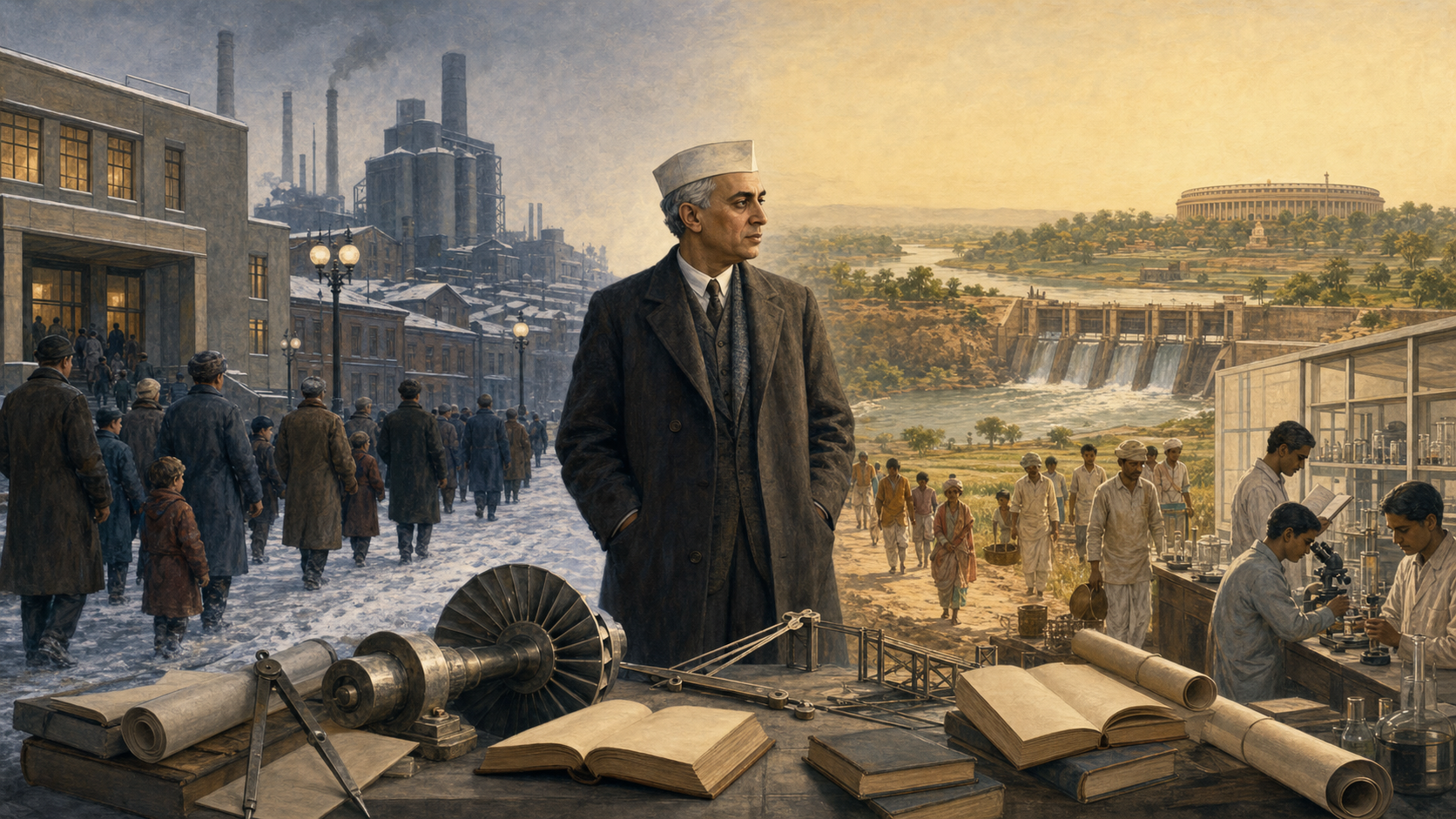
If you’ve been told that Jawaharlal Nehru went to the Soviet Union in 1927, returned as a communist convert, and later imposed Moscow’s system on India, you are being offered a conclusion before the evidence has been sorted. The opposite claim – that the journey had little effect on him – is no more convincing.
The defensible answer is more precise. The November 1927 journey strengthened Nehru’s interest in planning, science, public investment, education and social equality. It did not persuade him to reproduce Soviet one-party government. If you keep economic instruments separate from political institutions, both his influence and its limits become much easier to see.
Start with the visit Nehru was actually allowed to make
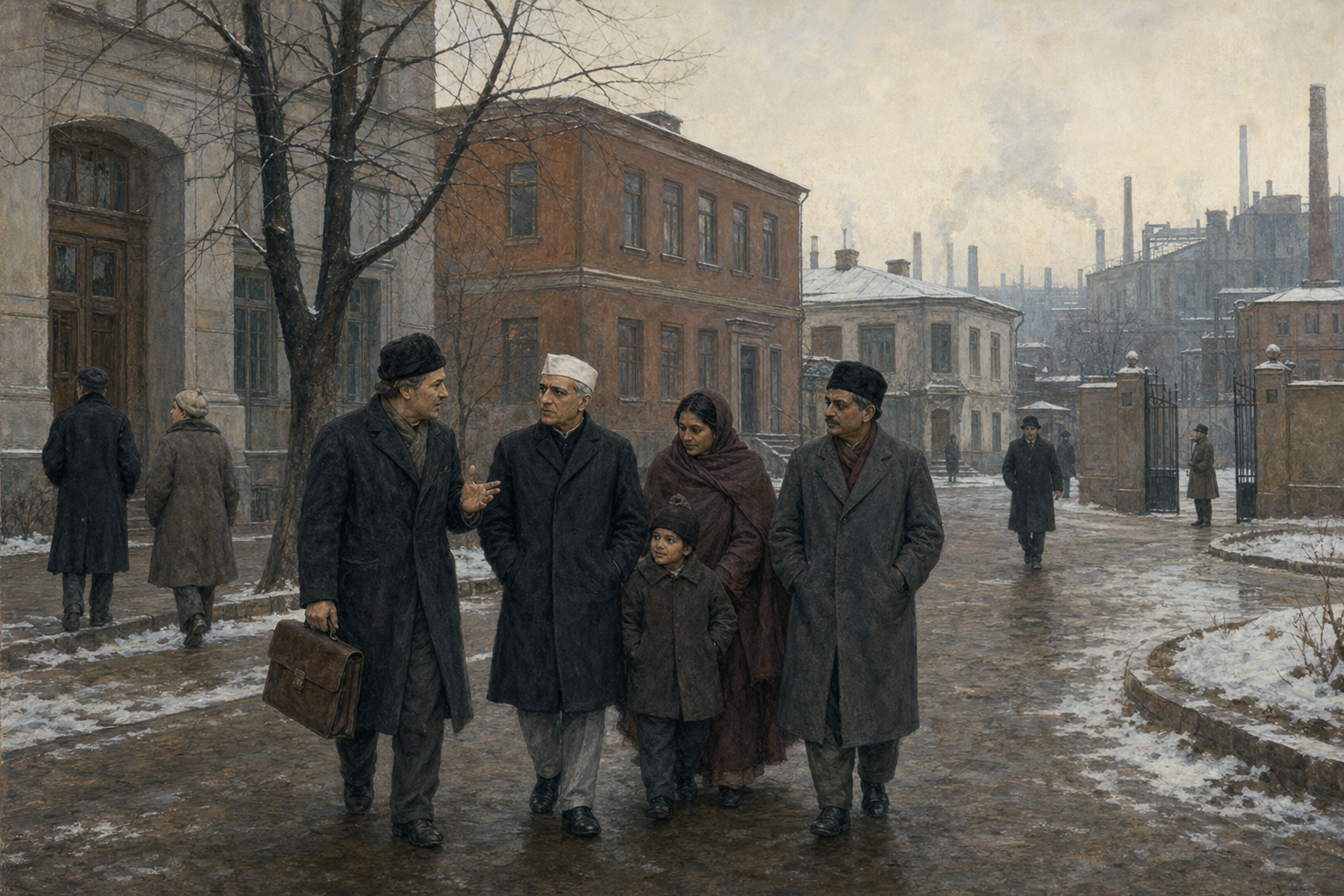
Jawaharlal Nehru travelled with members of his family, including Motilal Nehru, at the invitation of the Soviet government. They arrived for commemorations of the tenth anniversary of the Great October Revolution. The timing matters: the New Economic Policy was approaching its end, while the first Soviet Five-Year Plan had not yet begun. Nehru was looking at a revolutionary state in transition, not a mature planning system with a long record that could already be audited.
The Nehrus were also official guests. Their hosts arranged transport, escorts, meetings and visits to selected institutions in Moscow and Leningrad. The programme placed model schools, workers’ clubs, scientific institutes, municipal services and cultural venues in front of them. Officials, intellectuals and professionals supplied explanations. This was substantial exposure, but it was not independent access to every factory, village, prison, ration queue or dissenting voice.
Use three filters when deciding what that itinerary could establish:
- Timing: Nehru saw an experiment at a particular turning point. Later Soviet outcomes cannot simply be projected backward and treated as facts he witnessed in 1927.
- Selection: A model institution proves that the host could create that institution. It does not prove that the model represented ordinary conditions across a vast country.
- Purpose: An anniversary tour was designed to commemorate and persuade as well as inform. Pageantry tells you what a government wants foreign visitors to remember.
None of those filters makes the visit worthless. Curated diplomacy often combines real achievements with selective visibility. The right question is not, “Was everything fake?” It is, “Which observations were genuine, how representative were they, and what remained outside the frame?” Apply that question to Moscow in 1927 just as you would apply it to an official tour of London, Washington or any other capital.
Separate Nehru’s admiration from ideological conversion
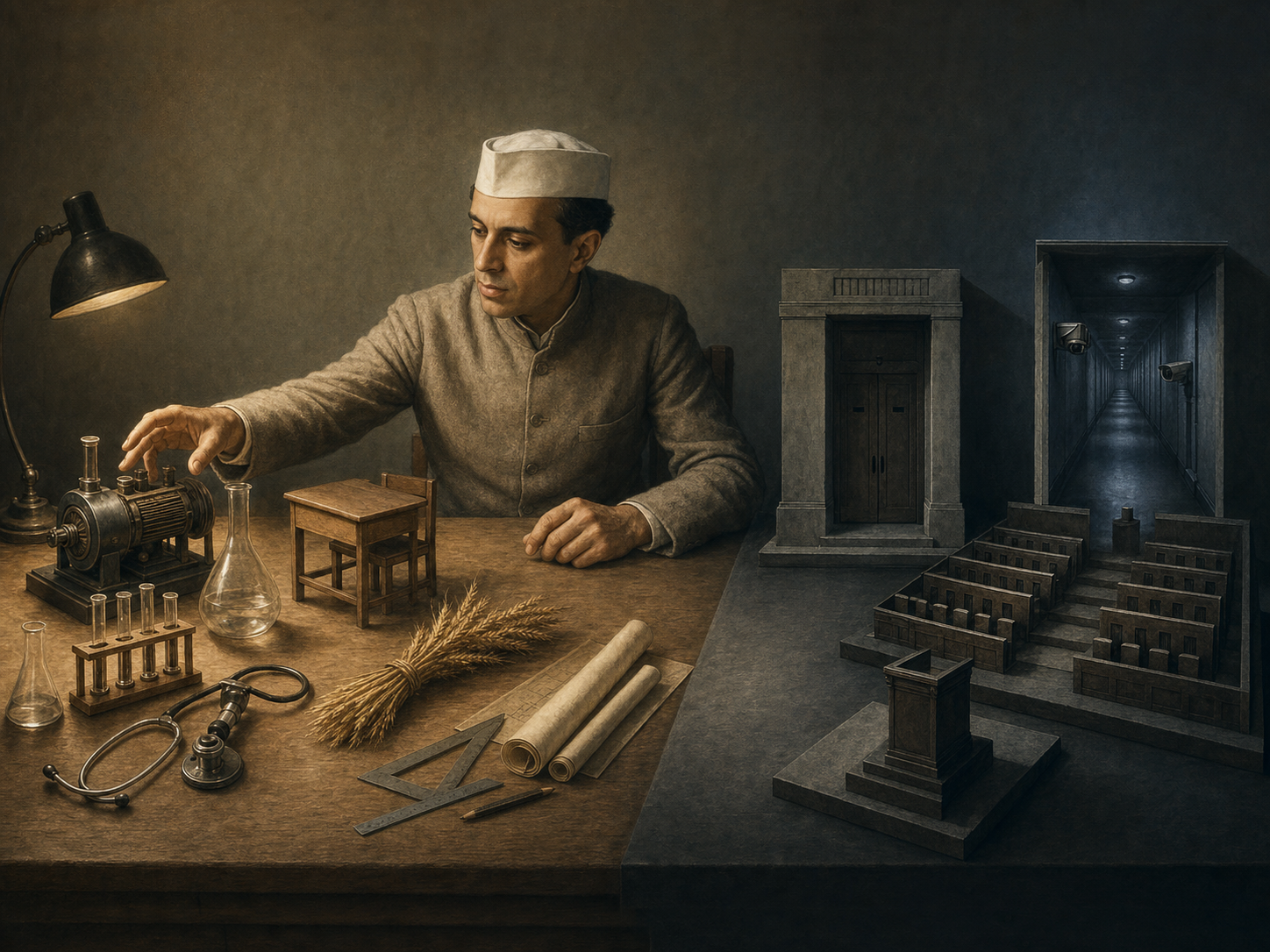
Nehru’s response was divided in a revealing way. He admired large-scale social organisation, the drive for mass education, the importance assigned to science and technology, and the greater visibility of women in public life. He also noticed ideological conformity, restricted civic space and the human costs that could accompany accelerated transformation.
That combination matters. A convert explains away the warning signs because loyalty to the system requires it. Nehru did not do that. Nor did the Soviet visit create his concern with inequality from nothing. It deepened an existing attraction to coordinated development, social equity and public investment at a time when colonial India faced mass poverty and limited industrial capacity.
You can test the conversion claim by separating four different levels of influence:
- Observation: Nehru saw that a state could make literacy, science, industrialisation and social mobilisation national priorities.
- Preference: The visit reinforced his belief that leaving development entirely to private capital and colonial market structures would not transform India quickly enough.
- Institution: He later supported organised planning bodies, technical expertise, infrastructure and a substantial public sector.
- Regime: Independent India did not adopt Soviet one-party rule, abolish competitive politics or discard constitutional rights.
The Soviet influence is strong at the first three levels and breaks at the fourth. Calling every planning institution “communist” erases that distinction. So does presenting India’s democratic safeguards as minor decorations around an essentially Soviet state. Universal adult franchise, federalism, judicial review, freedom of worship and a press able to confront the government changed the nature of the system in which planning operated.
India borrowed developmental tools, not a complete Soviet order
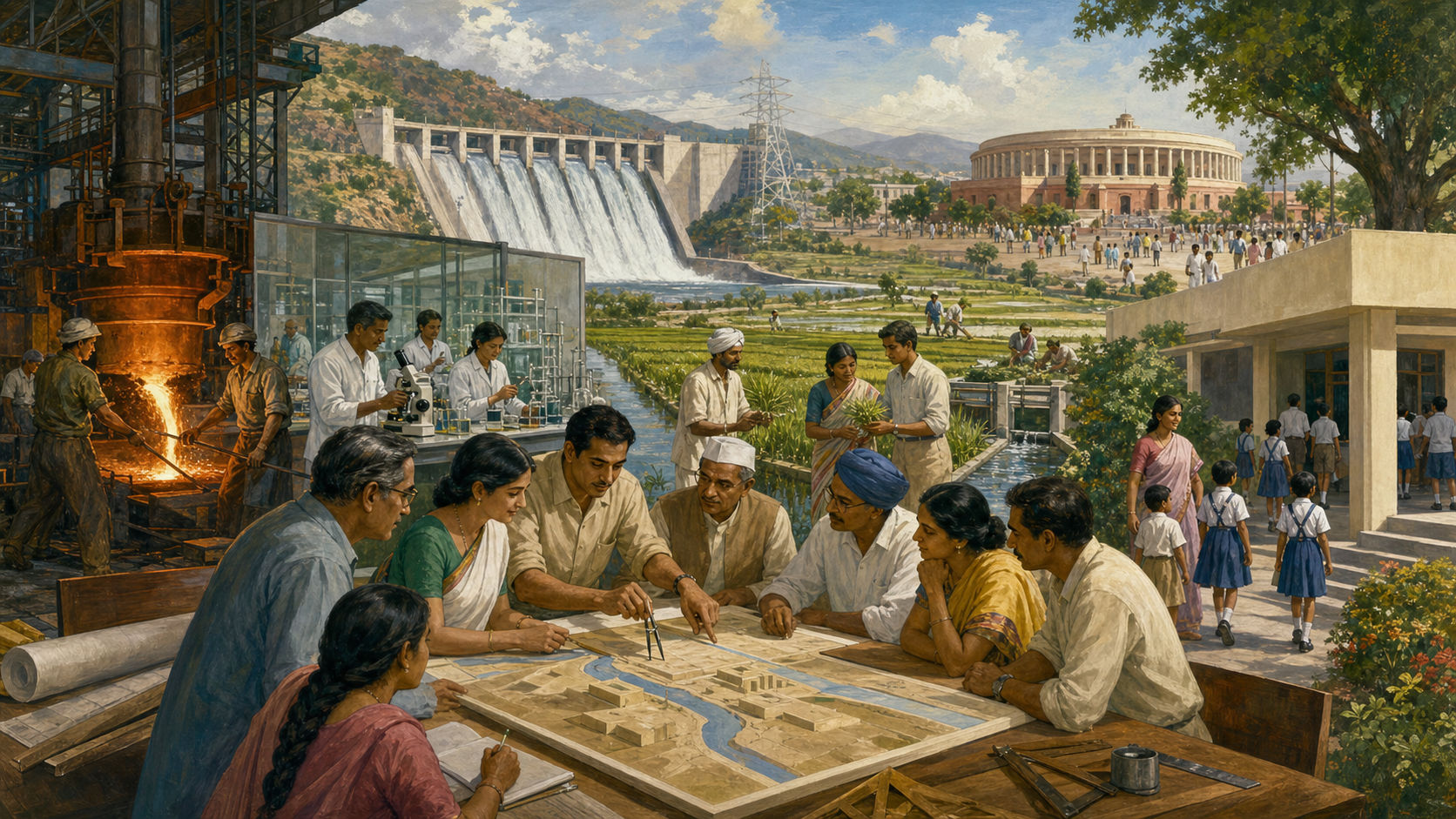
The phrase “Soviet model” is too blunt unless you specify the part being discussed. Economic coordination, scientific investment, public ownership and political monopoly are not one indivisible package. India combined some of the first three with constitutional arrangements that rejected the fourth.
| Theme | What drew Nehru’s attention | Later Indian expression | Indian boundary or modification |
|---|---|---|---|
| National planning | Large-scale social organisation and coordinated modernisation | National Planning Committee in 1938, Planning Commission in 1950 and Five-Year Plans beginning in 1951 | Planning operated within parliamentary government, a mixed economy and a constitutional order |
| Science and human capacity | Mass education, scientific institutes, technology and women’s public participation | CSIR laboratories, IITs, expanded higher education, community development, public-health efforts and electrification | These institutions existed in a religiously and associationally plural society rather than under a single official ideology |
| Heavy industry and infrastructure | Scale, sequencing and state capacity | A large public sector, protective tariffs, river-valley projects and long-gestation industrial investment | India acquired technology from several countries instead of depending exclusively on the Soviet Union |
| Political power | Ideological conformity and narrow civic space appeared as costs, not achievements | India established universal adult franchise, federalism, judicial review and competitive parliamentary politics | The Soviet one-party template was not adopted |
The steel plants make the distinction especially concrete. Bhilai received Soviet assistance, Rourkela involved West German collaboration, and Durgapur drew on British support. That spread of partners is better understood as developmental autonomy than as allegiance to Moscow. India wanted industrial capacity without making one foreign power the sole gatekeeper of its modernisation.
This is also where non-alignment becomes relevant. It was not merely a posture of equal distance in diplomatic speeches. It allowed India to seek technology, capital and political relationships across blocs while resisting strategic dependence. Nehru’s later 1955 Soviet visit and reciprocal leadership visits took place within that wider effort, not as a simple continuation of the 1927 anniversary tour.
Use the chronology before assigning cause
A frequent historical error is to move directly from “Nehru admired something in 1927” to “therefore every later planning decision came from the USSR.” Chronology shows a slower process involving Indian political problems, Indian experts and constitutional choices.
- 1927: Nehru encountered selected Soviet institutions near the end of the New Economic Policy and before the first Soviet Five-Year Plan.
- 1928 and 1934: He developed his impressions in Soviet Russia: Some Random Sketches and Impressions and later revisited them in Glimpses of World History. His response included both admiration and criticism.
- 1938: The National Planning Committee brought economists, engineers and public-health specialists into an Indian effort to define development priorities.
- 1950 and 1951: Independent India established the Planning Commission and then began its Five-Year Plans. P. C. Mahalanobis’s statistical planning contributed to a system built around a mixed economy, public investment and industrial development.
- After independence: India combined planning with multiple foreign partnerships, non-alignment and the institutions of electoral democracy.
The interval between the visit and the National Planning Committee is important. During those years, the Indian National Congress was confronting purna swaraj, agrarian distress, labour rights and the question of how an impoverished colony could industrialise. Soviet experience supplied one set of examples, but India’s demand for planning also arose from conditions inside India. A foreign demonstration can enlarge a leader’s toolkit without becoming the sole cause of the construction that follows.
The same discipline is needed when judging results. State-led development helped build infrastructure, laboratories, higher education and industrial capacity. It also produced administrative bottlenecks, shortages, foreign-exchange constraints and the frictions of the license-permit system. A serious assessment must keep both sides on the ledger. Good intentions do not cancel implementation costs, and later inefficiencies do not prove that every early investment lacked value.
The causal verdict can therefore be stated without evasion: the Soviet journey expanded Nehru’s conception of what organised public power might accomplish. It did not dictate India’s entire economic settlement, and it did not determine India’s constitutional regime.
Key takeaways: apply a Dharmic test to borrowed statecraft
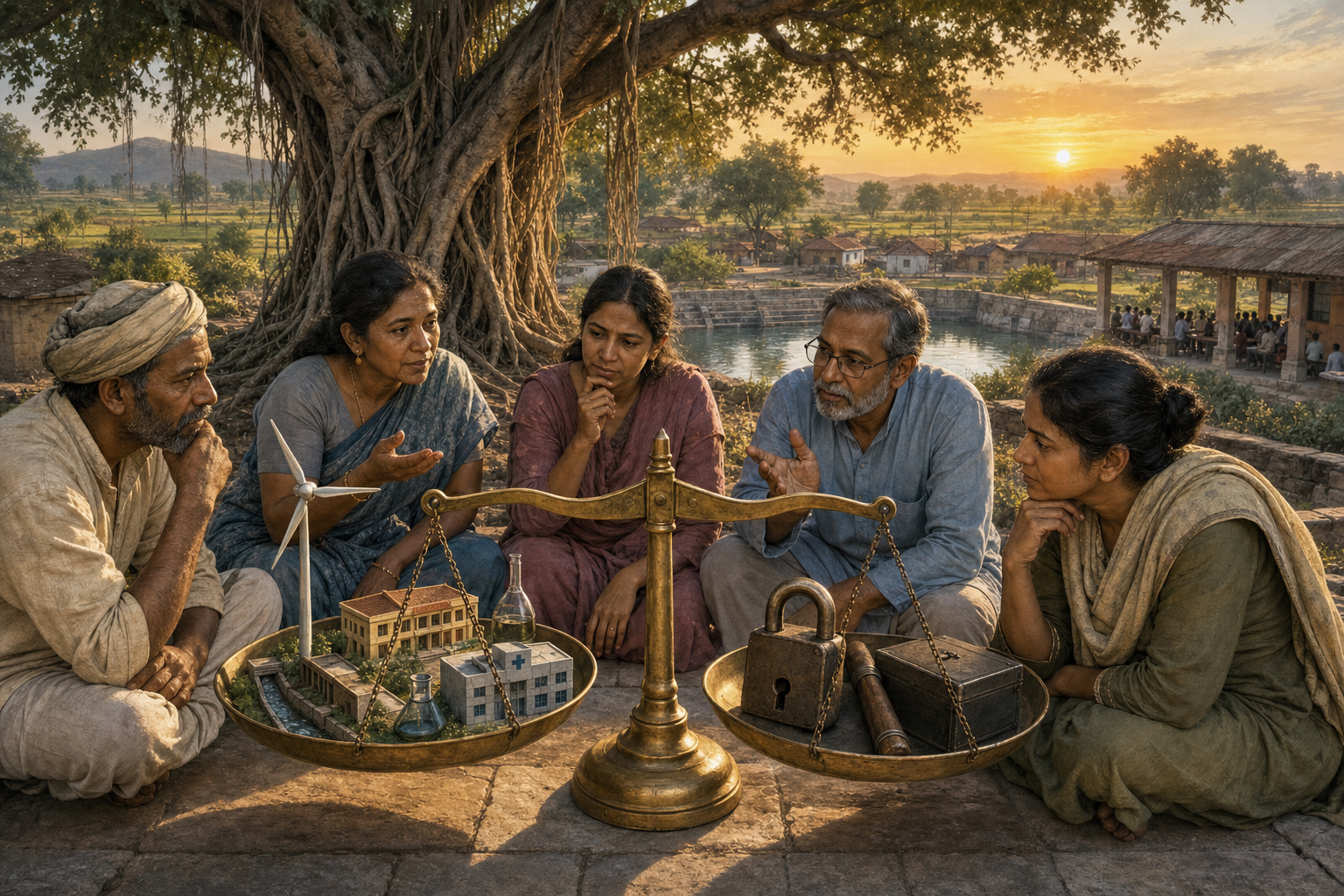
A Dharmic reading does not require us to pretend that Nehru derived economic planning from scripture, nor does it require approval of every policy made in his name. It asks whether an imported technique serves human flourishing without turning the state into an absolute power. Lokasangraha, the welfare and sustaining of the whole, supplies an end; ahimsa, dignity and freedom of conscience place limits on the means.
- Call the journey formative, not determinative. It sharpened Nehru’s existing preferences, but decades of Indian debate, institution-building and expert work stood between the 1927 tour and post-independence planning.
- Read official hospitality as theatre plus data. Selected schools or institutes may be genuine achievements. They still cannot establish how an entire society lived or what coercion made those achievements possible.
- Match each claim to the correct level. Admiring electrification does not equal accepting one-party rule. Supporting a public steel plant does not settle a leader’s position on courts, elections or religious freedom.
- Audit outcomes as well as intentions. Count laboratories, universities, power and industrial capacity, but also count shortages, administrative delay and restrictions created by the license-permit regime.
- Keep the state subordinate to civilisational ends. Development worthy of Bharat must preserve space for Hindu, Buddhist, Jain, Sikh and other communities to live, organise, argue and worship without ideological compulsion.
The next time you hear that Nehru “imported the Soviet system,” ask which layer the speaker means: an observation, a policy preference, a planning institution or a form of political rule. Then demand evidence at that same layer. That simple test leaves room for a firm critique of Nehru’s economic errors without turning history into a slogan – and it protects India’s right to learn from the world without surrendering the civilisational standards by which those lessons must be judged.
References
