

You have the authority to decide, the strength to enforce your decision, and a trusted person telling you to stop. At that moment, the easiest question is whether you can prevail. The harder question is whether the power that lets you prevail is still serving dharma.
The Mahabharata is unusually practical about this problem. It does not treat strength as a sin or peace as the only moral outcome. It asks how power should be corrected when pride, attachment, fear, or loyalty begins to distort judgment. If you lead a family, institution, community, or public body—or if you must advise someone who does—its method can help you decide when to act, when to yield, and how to make unwelcome counsel usable.
Power first becomes dangerous when it narrows what you can see
Bhima is not weak, indecisive, or reluctant to use force. His strength is essential to the Pandavas. Yet during the forest exile, a great serpent seizes him in a grip that physical power cannot break. Greater effort produces no better result. The problem has moved outside the range of the instrument Bhima knows best.
The serpent is Nahusha, a former king whose rise had ended in arrogance. Elevated to extraordinary authority, he had treated sages as instruments of his status and offended Agastya. His fall into the body of a python gives moral form to a political truth: power can become a coil around the person who misuses it. The ruler who tries to reduce everyone else to an object eventually loses his own freedom of judgment.
Yudhishthira does not arrive with a stronger weapon. He asks, listens, distinguishes, and answers questions about dharma. Nobility is tested through conduct—truthfulness, restraint, charity, compassion, and righteous action—rather than secured by ancestry or title alone. Nahusha releases Bhima, and the encounter also releases Nahusha from the condition created by his own hubris.
This is not a victory of passivity over courage. It is a correction of category. Bhima possesses the capacity to fight, but this crisis requires discernment. Yudhishthira possesses no greater physical leverage, but he identifies the level at which the problem can actually be resolved.
- Capacity answers: What can you make happen?
- Authority answers: What are you entitled or obligated to decide?
- Legitimacy answers: Why is this decision right, and to whom are you accountable for it?
- Dharma orders all three: Which action protects rightful relations without allowing power, status, or appetite to become its own justification?
When a conflict persists despite more pressure, do not immediately conclude that you need more pressure. Ask whether you are facing a problem of force, interpretation, legitimacy, or trust. A disciplinary matter may require enforcement. A disputed obligation may require clarification. An injured party may require restitution. Treating all three as resistance to be crushed is how legitimate authority decays into coercion.
Bhima also models a neglected virtue of the strong: he permits another kind of excellence to lead. Yielding to sound counsel does not diminish his warriorhood. It completes it. Kṣātra without the ability to recognize its proper limit is not mature strength; it is merely force waiting for the wrong occasion.
Ethical counsel must diagnose, correct, and preserve agency

Advice becomes ethical counsel only when it does more than express approval or discomfort. It must identify the duty at stake, explain the distortion affecting the decision, and name a practicable correction. A warning that offers no path back to dharma may be emotionally sincere, but it is incomplete.
Name the duty attached to the role
A king is not merely a powerful father, patron, or clan elder. Rajadharma gives public obligations priority over private preference: protect the vulnerable, uphold agreements, discipline wrongdoing, secure lawful order, and refuse to make kinship a substitute for justice. The same distinction applies on a smaller scale. A parent, trustee, teacher, judge, employer, or committee chair may care deeply about the person whose conduct is in question, but affection does not erase the duty of the role.
Begin counsel with that role, not with an attack on character. The useful opening is not that the decision-maker is corrupt or heartless. It is that this office carries a specific obligation, and the proposed action conflicts with it in a specific way. That gives the person a route to correction without requiring a theatrical confession of moral worthlessness.
Expose the attachment that is bending judgment
Dhritarashtra receives warnings because his predicament is not a shortage of intelligence or information. His attachment to Duryodhana, fear of the Pandavas, dependence on formidable warriors, and desire to preserve immediate family advantage produce paralysis. He can recognize danger while repeatedly declining the action that would address its cause.
Narada’s remembered warning to Dhritarashtra presses the ruler toward restitution, restraint of Duryodhana, and reconciliation before the conflict becomes catastrophic. The precise placement of the intervention varies across recensions, but its ethical function is clear: the ruler is shown that partiality has become public policy and that delay is multiplying the eventual cost.
Vidura’s juridical clarity, Sanatsujata’s spiritual instruction, and Krishna’s peace mission approach the crisis from different directions. The court therefore cannot plausibly claim that no alternative was presented. Ethical failure persists because counsel is heard ceremonially but denied operational authority.
When you advise someone, identify the attachment without assuming that attachment automatically proves bad intent. It may be affection, fear of instability, dependence on a talented wrongdoer, anxiety about reputation, or reluctance to admit a previous mistake. Then show how that attachment is changing the standard. The decisive question is simple: would the same conduct receive the same response if another person had done it?
Pair the warning with a proportionate remedy
Narada’s counsel is not an abstract demand to become virtuous. The remedy follows the breach: recognize the Pandavas’ rightful claim, restore what justice requires, restrain the conduct driving the conflict, and use reconciliation while reconciliation remains possible. Prophecy functions here as conditional political reasoning. If injustice continues, destruction becomes increasingly likely; if the ruler corrects the cause, the future can still change.
This preserves the distinction between daiva and human agency. What later appears inevitable may be the accumulated momentum of choices that were once reversible. Karma is not an excuse for passivity. It explains why repeated acts create conditions that become harder to escape.
Good counsel should therefore contain four elements: the governing duty, the present breach, the least destructive adequate remedy, and the likely consequence of delay. Without a remedy, the adviser merely announces danger. Without a consequence, the decision-maker can pretend there is unlimited time. Without a duty, counsel collapses into personal preference.
Key takeaways
- Strength is necessary for protection, but it cannot determine the moral purpose of its own use.
- Judge a claim to virtue by conduct, not merely by birth, office, learning, or religious vocabulary.
- Ethical counsel identifies a role-based duty, the attachment distorting it, and a concrete path of correction.
- Restitution is not appeasement: it restores a rightful claim rather than surrendering principle to pressure.
- What people later call fate is often the hardened result of warnings ignored while action was still possible.
Why rulers hear good counsel and still refuse it
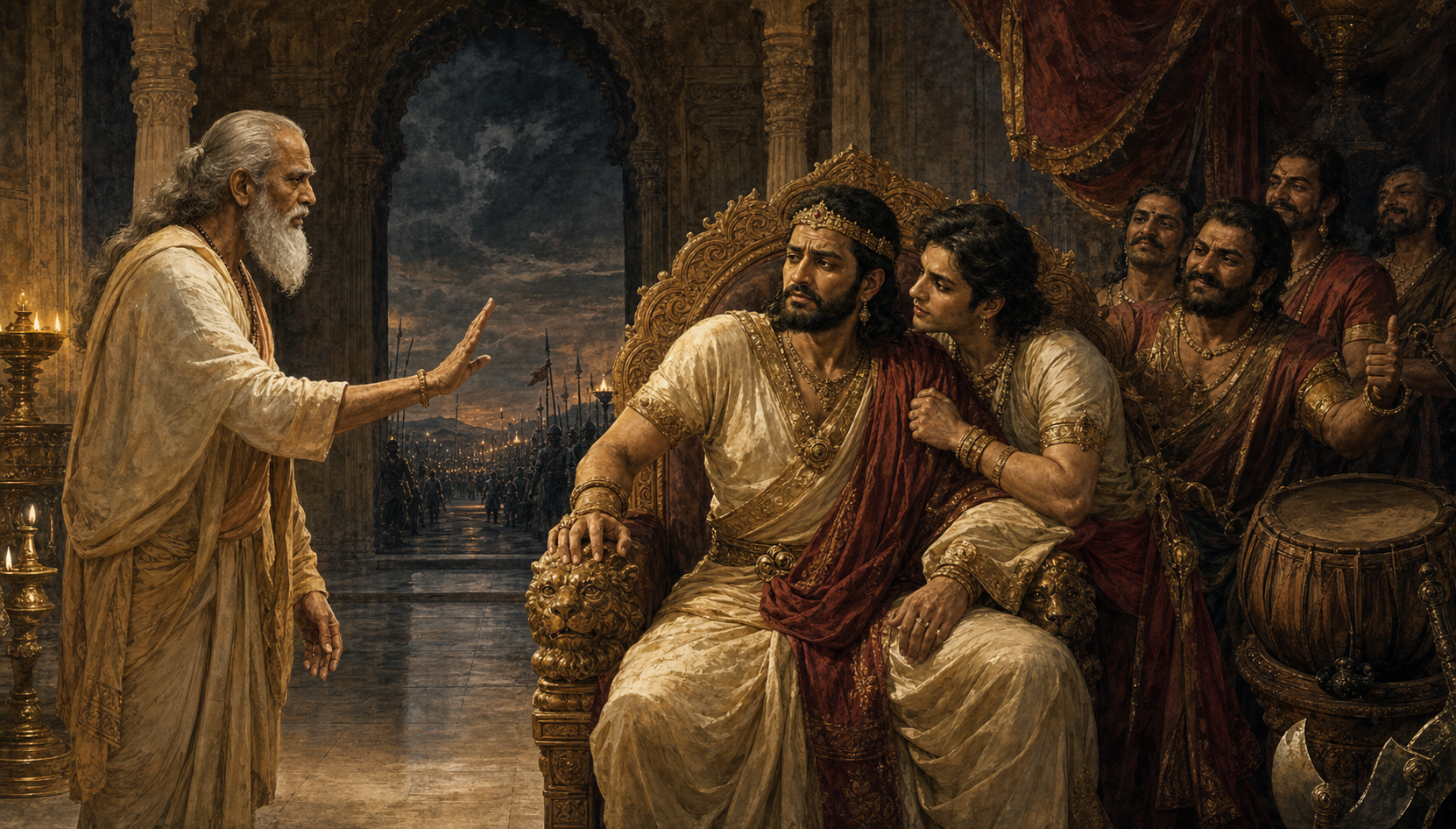
The usual failure is not that authority hears nothing. It is that authority converts counsel into ceremony. Advisers are allowed to speak, the ruler displays patience, and the underlying decision remains protected from challenge. Listening becomes a performance used to legitimize what power already intended to do.
You can detect this failure before the consequences arrive. Watch for five habits:
- Loyalty replaces accuracy. Advisers are judged by whether they support the leader, not whether they identify the truth. Correct this by asking the most trusted supporter to state the strongest case against the preferred course.
- The adviser’s motive replaces the adviser’s argument. A warning is dismissed as disloyal, pessimistic, envious, or badly timed. Correct this by answering the factual and ethical claim before evaluating the speaker.
- Restitution is renamed surrender. Returning what is due is made to look like weakness. Correct this by separating a rightful claim from a demand created by intimidation.
- Delay is renamed neutrality. Refusing to intervene appears even-handed even when one party continues benefiting from the wrong. Correct this by asking who gains from preserving the present arrangement.
- Military or institutional capacity replaces moral judgment. The discussion turns to whether resistance can be defeated rather than whether the underlying claim is just. Correct this by deciding legitimacy before calculating enforcement.
Dhritarashtra’s partiality is especially instructive because it can disguise itself as paternal duty. A ruler may tell himself that protecting his son is righteous. But once a private relationship controls public judgment, the duties of father and king have been confused. Dharma does not demand lovelessness. It demands that affection stay within the limits set by the responsibility one has accepted.
The same confusion appears whenever a leader shields a relative, favored employee, admired teacher, generous donor, useful ally, or powerful faction from a standard applied to others. The relevant test is not whether the favored person has also done good. It is whether past merit cancels the present obligation. Usually it does not. Gratitude may shape the manner of correction, but it cannot erase the need for correction.
Peace also needs a precise meaning. Peace is not the temporary absence of visible opposition. If calm depends on the injured party accepting an unresolved wrong, the conflict has been hidden rather than healed. A durable settlement normally requires three things: acknowledgment of the rightful claim, correction proportionate to the breach, and credible restraint against repetition.
This is why the Mahabharata’s treatment of war is neither pacifist nor celebratory. Conciliation is pursued because war carries terrible costs. Yet the refusal to confront entrenched injustice can also transfer those costs to the innocent. Dharma-yuddha becomes thinkable only after peaceful remedies have been seriously attempted and the cause, intention, and means remain answerable to dharma. Kṣātra exists to protect order, not to spare authority the discomfort of admitting error.
Use a six-question dharma test before a consequential decision

Dharma cannot be reduced to a slogan that mechanically resolves every conflict. Roles can pull in different directions, facts may be disputed, and every available option may carry a cost. You can still make the reasoning disciplined. Before an important decision becomes difficult to reverse, answer these six questions in plain language.
- What duty comes with my role here? Name the responsibility before naming your preference. Do not combine incompatible roles. If you are acting as a trustee, chair, teacher, ruler, or mediator, say what that role requires independently of friendship and kinship.
- What rightful claim, promise, or protection is at stake? Identify what is owed and to whom. A vague appeal to harmony should not override an agreement, a legitimate share, or protection from wrongful conduct.
- Am I judging conduct or protecting status? Apply the proposed standard to an ally and an opponent. If your answer changes with the person’s pedigree, faction, wealth, usefulness, or title, partiality has entered the reasoning.
- What correction would restore order with the least unnecessary harm? Look first for restitution, restraint, clarification, or reconciliation. Do not choose humiliation when correction is enough, and do not choose symbolic regret when material restoration is required.
- Have non-violent and conciliatory avenues been genuinely attempted? A ritual invitation to negotiate is not enough if the rightful claim is excluded in advance. Record what was offered, what was refused, and whether either side was asked to surrender principle merely to preserve appearances.
- What happens if everyone in this position follows the precedent I am creating? A convenient exception can become tomorrow’s governing rule. Consider not only the immediate victory but also the incentives, resentments, and permissions the decision will leave behind.
If you cannot answer the first two questions in a sentence each, you are not ready to debate tactics. The purpose and obligation remain unclear. If the third answer changes according to identity, correct the standard before proceeding. If the fourth and fifth have no serious answer, force is likely being used to avoid the work of justice.
The sixth question guards against self-exemption. Adharma often enters through a special case that seems too urgent, too personal, or too politically costly for the ordinary rule. The decision-maker insists that the exception will occur only once. But institutions learn from what leaders reward, tolerate, and excuse. A private compromise can quietly become a public permission.
None of this means that you must postpone every decision until certainty arrives. Yudhishthira’s discernment and Bhima’s capacity belong together. Once the duty is clear, a rightful claim has been tested, peaceful correction has been attempted where possible, and the means are proportionate, continued indecision can itself become a failure of dharma. Counsel must govern action, not replace it.
Build a court that can contradict you before the crisis

Personal virtue is not a sufficient safeguard for power. Attachment is hardest to recognize precisely when it feels like loyalty, responsibility, or compassion. You need a practice that makes contradiction possible before your reputation becomes tied to one outcome.
If you lead, establish the following sequence for decisions that affect rights, discipline, resources, or institutional trust:
- Seek counsel before announcing an irreversible position. Advice requested after public commitment is more likely to become damage control.
- Give the adviser access to the relevant facts and the freedom to address your preferred option directly. A censored briefing produces ceremonial counsel.
- Require the objection to name the duty, breach, remedy, and consequence. This prevents vague opposition from consuming the discussion.
- Restate the objection in terms the adviser accepts before replying. If you cannot state the warning fairly, you have not yet heard it.
- Explain why the chosen course serves the role’s duty, not merely why it is expedient. If you override counsel, identify the fact or principle on which you disagree.
- Set a point for reconsideration before further harm makes reversal impossible. New facts should be allowed to change the decision without being treated as humiliation.
If you are the adviser, speak with enough precision that authority cannot evade the issue by praising your sincerity. A useful four-sentence structure is: Your duty in this role is… The present course breaches that duty because… The least disruptive adequate correction is… If correction is delayed, the likely consequence is…
That structure also disciplines the adviser. Religious language, seniority, and confidence do not make counsel dharmic. The adviser must offer reasons, apply the same standard across factions, and remain willing to distinguish fact from inference. Yudhishthira’s exchange with Nahusha matters here: ethical standing is verified through conduct. A celebrated title cannot substitute for truthfulness and self-restraint.
An independent counsellor is valuable because non-attachment changes what can be seen. Narada can warn a king because his authority does not depend on belonging to the king’s faction. Vidura can diagnose the court because he refuses to let loyalty mean agreement with wrongdoing. Their independence does not require indifference to the people involved. It permits a deeper loyalty—to justice, the realm, and the long-term welfare of everyone endangered by the ruler’s partiality.
The principle reaches beyond Hindu statecraft. Buddhist emphasis on insight and right conduct, Jain discipline against one-sided certainty, and Sikh teachings on humility and selfless service all resist the ego’s claim to be its own moral authority. The shared civilizational point is not that power should disappear. Power should become answerable to truth, restraint, compassion, and the welfare it exists to protect.
At your next consequential decision, do one thing before defending your preferred course: ask a person who is free to disagree to identify the duty, the injured claim, and the smallest adequate correction. Then repeat the objection accurately. Power begins to serve dharma when it can hear the truth before consequences make the truth unavoidable.
References
- DharmaRenaissance Blog — When Strength Yields to Dharma: Bhima, the Serpent Nahusha, and Wisdom’s Enduring Victory
- DharmaRenaissance Blog — Narada’s Prophetic Warning to Dhritarashtra: Dharma, Karma, and Inevitable Justice for Leaders
