

You already recite Sri Suktam, or you are preparing to learn it, and you have heard that adding Shrim, Hrim, or Klim can make the practice more powerful. The first question is not which combination sounds strongest. It is whether you can add a frame without changing the hymn, blurring its pronunciation, or turning worship into a demand for money.
If your Sri Suktam is not yet stable, keep reciting it plainly. If the text, rhythm, and sequence are secure and your tradition permits samputikarana, begin with the simplest outer enclosure you have actually received. That one decision prevents most of the confusion surrounding Samputitha Sri Suktam.
What the samputa changes, and what it must leave untouched
Samputa means a casket, clasp, or enclosing container; karana is the act of making or applying it. In mantrashastra, a bija or mantra is placed around a core recitation so that the core unfolds within a defined ritual boundary. The elementary pattern is:
samputa + core mantra or verse + the same samputa
More elaborate forms can use a mirrored sequence, such as B1 B2 + core + B2 B1. The enclosing sounds are traditionally understood to focus intention, attention, breath, and mantra-shakti rather than merely decorate the recitation. Some lineages also coordinate the enclosure with nyasa, yantra, homa, and particular functions of bija syllables.
Applied to Sri Suktam, the most accessible form is bahya samputa: recite the chosen seal before a complete rik, recite that rik without alteration, and repeat the identical seal after it. Then move to the next rik and use the same structure again. The interior of the Vedic verse remains untouched.
This distinction matters because Samputitha Sri Suktam is not the same as saying a Lakshmi mantra once before the hymn and once after it. Both formats exist, but they are different disciplines. Per-rik samputikarana encloses every verse. A whole-hymn enclosure surrounds the complete Sri Suktam only once. Follow one format from beginning to end; do not drift between them during a session.
Antara and madhya samputa place a seal inside a verse, at a division recognized by a particular lineage. Varna samputa can work at the level of successive sounds or words. These are not good formats for experimentation. An arbitrary insertion can disturb wording, metre, breath, and Vedic transmission. For a householder who has permission to use a samputa but no instruction in internal placement, the outer form is the prudent choice.
Sri Suktam is transmitted in more than one living recension. A commonly used form has 15 principal riks, while some traditions recite 16 or 17. Those differences belong to transmission, not to a menu from which verses should be mixed. Choose the complete version taught in your family, temple, Vedic school, or parampara, and keep that version intact.
The traditional theory describes sacred sound, intention, and prana acting together. Treat it as a ritual discipline, not as a mechanical promise that adding a syllable will produce cash. Samputikarana intensifies the demands of practice as well as its devotional focus: you repeat more material, carry a more complex sequence, and have more opportunities to lose the verse. Greater complexity is justified only when it produces greater steadiness.
Choose the level of practice before choosing a bija
Bija syllables are not interchangeable spiritual accessories. Within Lakshmi worship, Shrim is associated with nourishment, auspiciousness, and prosperity; Hrim with radiance, discernment, and transformative clarity; and Klim with cohesion, attraction, and relational harmony. Aim is associated more broadly with knowledge and speech. These are lineage-shaped associations, not a universal dictionary that authorizes any practitioner to assemble a new formula.
| Your present situation | Appropriate form | Decision to make |
|---|---|---|
| You are still learning the riks or regularly lose the sequence | Plain Sri Suktam | Stabilize the received text before adding an enclosure. |
| Your tradition permits a simple Lakshmi-centred outer seal | Om Shrim Mahalakshmyai Namah before and after each complete rik | Use the same wording around every rik for the entire session. |
| You have received a multi-bija formula | The exact formula and order taught to you | Do not add, remove, or rearrange bijas according to a desired result. |
| Your lineage uses Lakshmi Gayatri around the whole hymn | One enclosure before and after the complete Sri Suktam | Do not quietly convert it into a per-rik samputa. |
| The practice includes internal insertion, detailed nyasa, purashcharana, or homa | Teacher-directed procedure | Receive the placement, count, pronunciation, and closing rules together. |
A simple Lakshmi seal such as Om Shrim Mahalakshmyai Namah is easier to preserve than a long formula and keeps the devotional relationship explicit. A multi-bija seal such as Om Shrim Hrim Klim Mahalakshmyai Namah carries a more particular mantric architecture. Longer formulas, including the Kamale Kamalalaye form, are also used in established practice. The governing rule is one seal, one placement pattern, and an unchanged Sri Suktam throughout the cycle.
Roman transliteration can help you identify a mantra, but it cannot teach its sound. Shrim, Hrim, and Klim include phonetic features that English spelling represents imperfectly. If your practice depends on Vedic svara, sandhi, anusvara, or a particular pronunciation of the bija, learn those features by hearing and repeating them under someone competent in that transmission.
Your sankalpa should also determine whether samputikarana is appropriate. Sri is more than possession. She signifies auspiciousness, nourishment, beauty, sustaining order, and the capacity to use resources well. A prayer for stable livelihood, freedom from disorder, generous stewardship, or the welfare of a household accords with that field. An attempt to compel another person, evade honest work, or acquire wealth through harm does not become dharmic because sacred syllables surround it.
A workable Samputitha Sri Suktam routine at home

The following routine is intentionally modest. It assumes that you already possess a reliable Sri Suktam text and that your tradition allows the outer samputa you intend to use. It does not substitute for the fuller viniyoga, nyasa, or ritual order of a particular parampara.
- Fix your recension. Put the complete riks in their received order on one clean page or in one book. Do not combine a 15-rik sequence with optional verses borrowed from another transmission.
- Choose the seal and count before you sit. Write the exact samputa at the top of the page. If you are new to the structure, one complete avartana is enough: every rik in your recension, each enclosed once. Increase the count only when pronunciation and attention remain stable.
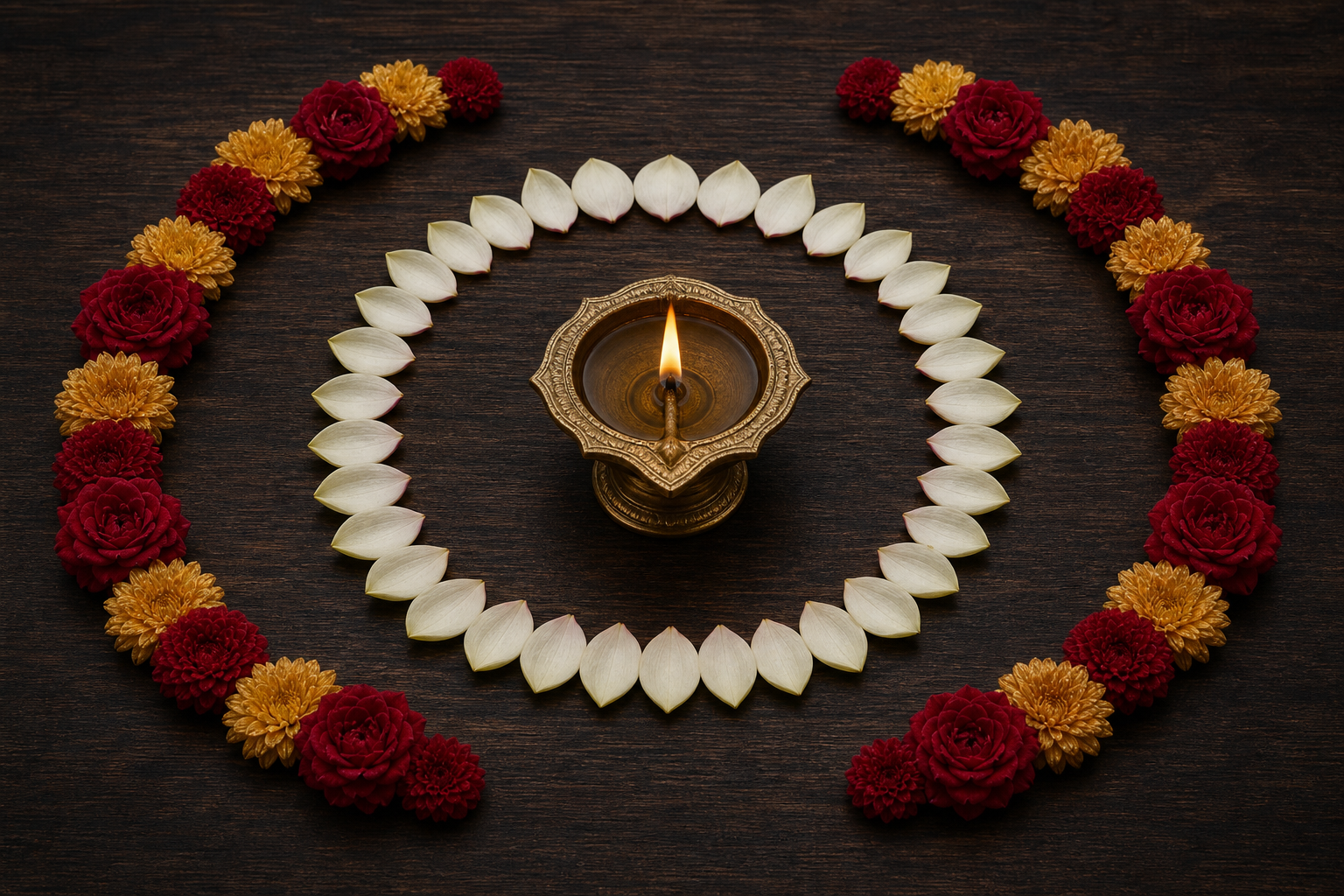
- Prepare a simple space. Bathe or wash, wear clean clothing, and sit in a quiet, ventilated place. Facing east or north, with a lamp, water, and flowers, is customary. Elaborate decoration is unnecessary.
- State a concrete, dharmic sankalpa. You might pray for Mahalakshmi’s grace in maintaining the household, meeting obligations honestly, using resources wisely, and supporting the welfare of others. If you use the traditional declaration, the purpose can be expressed as Sri Mahalakshmi prityartham: for the pleasure or gracious presence of Sri Mahalakshmi.
- Settle the transition into worship. Perform achamana and gentle pranayama if these belong to your practice. Offer a brief Ganesha vandana, guru remembrance, and Lakshmi dhyana. Do nyasa only when you have received its syllables and placements.
- Recite in complete units. Say the samputa, pause naturally, recite the entire rik exactly as transmitted, pause, and say the same samputa again. Continue to the next rik. Do not squeeze all three parts into one breath.
- Keep sound ahead of speed. Use a soft, audible voice, stable pitch, clear consonants, and unforced breath. If the enclosure makes the Vedic verse less accurate, slow down. If accuracy still collapses, finish with plain Sri Suktam rather than forcing the intensified form.
- Close the session. Recite the shanti or closing prayers customary in your home, offer gratitude, and ask forgiveness for errors. Let a small act of dana or seva complete the movement from receiving to giving.
- Record only useful observations. Note the recension, seal, number of complete avartanas, any rik where you lost clarity, and the act of generosity connected with the sankalpa. This journal is for correcting practice, not manufacturing predictions from passing moods.
What one recitation unit should look like
The repeatable unit is simple: your chosen samputa, one complete rik, and the identical samputa. The brackets sometimes used in written explanations are directions, not words to recite. Finish all three parts before counting that rik as complete.
Do not change the seal midway because one verse seems related to gold, fertility, protection, or food. Samputikarana directs the whole hymn through a stable frame; it is not a verse-by-verse catalogue of desired objects. If you have two legitimate intentions that call for different seals, undertake them as separate sessions or vratas rather than mixing their mantric grammar.
How much and when
Friday, Purnima, Deepavali, Shukla Paksha, and Margashirsha observances are associated with Sri worship. A steady daily hour, however, is more useful than repeatedly postponing practice until an auspicious date. Common counts include 1, 3, 9, 11, 16, 27, 54, and 108 avartanas; some household vratas use 11 daily recitations for 21 or 40 days. These are established forms of discipline, not a ladder on which the largest number automatically wins.
Choose the smallest count you can complete without rushed riks, skipped enclosures, breath strain, or neglected obligations. A vow that makes you careless with family, employment, health, or debt has already separated the pursuit of artha from dharma.
Homa is not the next step merely because parayana has become familiar. Samputitha Sri Suktam homa coordinates fire invocation, offerings, the verse and seal, svaha, prescribed materials, purnahuti, and closing rites. An improvised fire ritual introduces both physical fire risk and ritual uncertainty. Learn it from a qualified priest or teacher in your tradition; until then, continue parayana and make a simple non-fire offering.
Correct the practice by watching these five signs
Do not judge Samputitha Sri Suktam only by whether money arrives. Traditional prosperity includes order, sufficiency, clarity, relationship, generosity, and freedom from waste. More importantly, mantra practice does not replace budgeting, debt management, honest work, tax obligations, or qualified financial advice. Let the sankalpa guide those duties rather than compete with them.
- Textual integrity: You can identify exactly which recension you are reciting, and every original rik remains unchanged.
- Structural consistency: The same samputa appears before and after every rik, with no accidental omissions or substitutions.
- Phonetic stability: The added mantra does not cause you to swallow consonants, abandon the received pitch, or race through the Vedic text.
- Attentional steadiness: The enclosure returns your mind to Lakshmi and the sankalpa instead of making you preoccupied with counting or imagined signs.
- Ethical congruence: Your handling of work, money, consumption, promises, and generosity increasingly matches what you ask Sri to bless.
If you repeatedly lose your place, prepare a practice copy in which each complete rik is visibly separated and the samputa is printed before and after it. If the seal is fluent but the rik has become blurred, remove the seal for a time and restore the plain recitation. If breathing is strained, lower the volume and allow a natural pause between the seal and the verse. Samputikarana requires symmetry, not one continuous breath.
If you make an error, stop at the next natural boundary, correct what you can, and close with kshama-prarthana. Do not respond by inventing a compensatory bija or doubling the count. The useful correction is better preparation at the next session.
The ethical test also connects Sri worship with the wider Dharmic family. Dana and restraint prevent abundance from hardening into possession; Buddhist right livelihood joins sustenance to non-harm; Jain aparigraha disciplines acquisition; and Sikh kirat and seva connect honest labour with service. You do not need to collapse these traditions into one ritual system to act on their shared warning: prosperity that circulates through dharma sustains life, while accumulation without responsibility eventually creates disorder.
Key takeaways
- Learn one complete Sri Suktam recension before intensifying it.
- For household practice, bahya samputa is the clearest form: seal, complete rik, identical seal.
- Use one mantra and one placement pattern throughout a session; never improvise internal insertions.
- Choose the seal through parampara and sankalpa, not by collecting the largest number of bijas.
- Begin with a count that preserves pronunciation, breath, and ordinary responsibilities.
- Measure soundness by textual accuracy, steady attention, and dharmic conduct, not by a promised financial deadline.
- Leave nyasa, internal samputa, purashcharana, and homa to properly transmitted instruction.
For your next session, resist the urge to add another syllable. Confirm the recension, write down one dharmic sankalpa, and recite at the level where every word remains clear. When that foundation is stable, a permitted samputa can deepen Sri Suktam without displacing it.
References
- DharmaRenaissance Blog — Samputikarana Bija Mantras Explained: Bija Akshara, Tantric Methods, and Cross-Dharmic Harmony
- DharmaRenaissance Blog — Samputitha Sri Suktam Mastery: Step-by-Step Parayana, Samputa Mantras, and Homa for Prosperity
- DharmaRenaissance Blog — Mastering Sri Suktam Samputikarana: Precise Mantra Seals for Prosperity, Peace, and Dharma
