

You may remember Bhagavan intensely when a job, illness, examination, or family crisis leaves you with nowhere else to turn. Then the danger passes and remembrance thins out. Or perhaps you have kept praying, but disappointment has made every unanswered request feel like evidence that devotion is pointless.
The practical aim of constant bhakti is not to sustain an elevated emotion all day. It is to keep your relationship with the Divine from becoming dependent on a favourable outcome. You can ask for help, work earnestly for change, grieve what is lost, and still return. That return is where non-transactional devotion begins.
Recognise the bargain hiding inside your prayer

A transactional prayer makes continued devotion conditional: if this request is granted, you will trust; if it is denied, delayed, or answered differently, you will withdraw. The ritual begins to function like payment and the desired result like a debt owed by the Divine.
Non-transactional bhakti does not prohibit requests. The Bhagavad Gita 7.16-18 recognises people who approach the Divine in distress, in search of material benefit, through inquiry, and through wisdom. Need can be an honest doorway. The deeper movement is from approaching only because you need something to loving without making the gift the price of that love.
Bhagavata Purana 1.2.6 gives mature devotion two demanding qualities: ahaituki and apratihata. Its direction is neither controlled by a private payoff nor stopped by changing circumstances. This does not mean that a devotee has no hopes. It means hope no longer holds devotion hostage.
You can identify the bargain by asking three direct questions:
- Would I still perform this practice if the outcome remained uncertain?
- Am I treating success as proof of divine favour and hardship as proof of rejection?
- Has disappointment made me less truthful, compassionate, or willing to fulfil my duty?
If one answer is uncomfortable, do not pretend that you have no desire. Name the desire plainly. Then separate three things that anxiety often mixes together: what you want, what dharma requires you to do, and what you cannot control. Ask for the first, carry out the second, and release your claim over the third.
A simple prayer can follow that structure without borrowing any special formula: tell Bhagavan what you hope for, ask for the clarity and strength to act rightly, and offer the result. This is surrender with responsibility. It is not resignation, carelessness, or an excuse to avoid difficult action.
Build a practice that can survive an ordinary day

Constant bhakti is traditionally compared with a steady stream of oil. The image matters because oil does not fall in disconnected splashes. In the same way, devotional constancy grows through repeated contact, not through rare bursts of intensity followed by long neglect.
This does not require conscious chanting during every waking second. It means returning so regularly that distraction does not become abandonment. Yoga Sutra 1.14 describes durable practice as something cultivated over a long period, without repeated breaks, and with sincere regard. Intensity may start a practice, but repeatability carries it through changing moods.
Use a daily framework simple enough to retain when your schedule contracts:
- Remember before receiving input. Before opening messages or beginning the day’s demands, offer a pranam and repeat the Name associated with your chosen form of the Divine.
- Give undivided attention for a few minutes. Sit for mantra-japa, coordinate it gently with the breath if that helps, and bring the mind back whenever it wanders. The return is part of the practice, not evidence that the practice failed.
- Read a short passage slowly. A verse from the Bhagavad Gita is more useful when you carry one instruction into the day than when you hurry through a large amount of text.
- Choose one act of seva. Decide where devotion will become useful: caring for a relative, helping a colleague without seeking credit, feeding someone, maintaining a shared space, or completing an obligation reliably.
- Close the day with an honest review. Offer gratitude, notice where fear or ego controlled your conduct, make any necessary correction, and finish with quiet remembrance or kirtana.
Protect a minimum version for disrupted days. When travel, caregiving, illness, or exhaustion prevents the full routine, keep one deliberate remembrance, one sincere offering of the next duty, and one evening pranam. Reducing the form for a genuine constraint is different from abandoning the relationship.
Attach remembrance to transitions already present in your life: before a meal, at the start of work, while entering the home, or before answering a difficult message. These small thresholds prevent devotion from remaining confined to the puja room. If you miss one, resume at the next threshold. Guilt that postpones the return is another form of self-absorption.
Stay with a chosen practice long enough for it to become familiar. Constantly replacing a mantra, teacher, method, or form of worship because the latest one has not produced a desired result reproduces the transactional habit in spiritual clothing. Variety has a place, especially when temperament or circumstances genuinely change, but novelty should not become an escape from steadiness.
The same practical structure appears across the dharmic family without erasing important theological differences. A Hindu may use mantra and remembrance of an ishta; a Sikh may centre Naam Simran and seva; a Buddhist may cultivate recollection and metta; a Jain may maintain samayik and recitation of the Namokar Mantra. In each case, recollection is joined to disciplined conduct rather than left as an occasional feeling.
Carry remembrance from the altar into your conduct
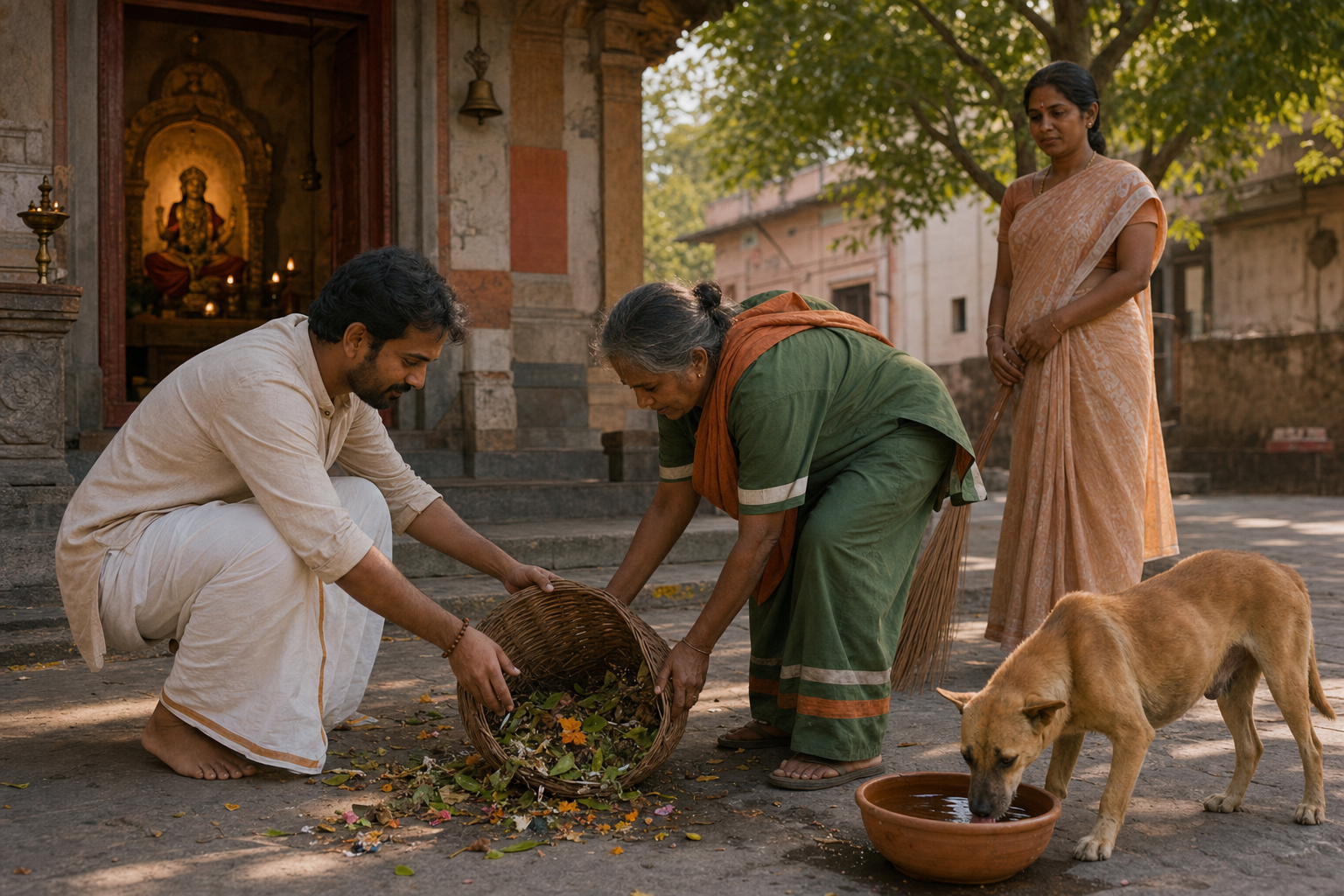
The altar trains attention. The day reveals whether that attention has changed you. If remembrance disappears the moment another person frustrates you, the answer is not necessarily to add more elaborate ritual. First connect the ritual you already perform to the conduct immediately in front of you.
Before an important action, make a brief three-part pause:
- Remember: bring the Divine Name or your ishta to mind.
- Discern: ask what honesty, compassion, courage, and duty require here.
- Offer: perform the action carefully without demanding control over every consequence.
This is where bhakti and karma-yoga meet. Bhagavad Gita 2.47 separates responsibility for action from ownership of its fruits. The teaching does not reduce standards. It asks you to work without letting fear of failure, hunger for praise, or obsession with control decide the moral quality of the work.
If you are caring for an ailing parent, remembrance can interrupt the moment when fatigue starts hardening into resentment. It will not remove the work, but it can help you perform the next necessary act without making the person in your care bear the weight of your frustration. If you lose professional security, a stable morning practice can keep panic from dictating an unethical shortcut. If you are a student, remembrance becomes concrete when it supports disciplined study, truthful work, and service to classmates rather than a plea for results without effort.
The Bhagavad Gita’s portrait of the devotee in 12.13-20 emphasises freedom from malice and envy, steadiness, self-restraint, contentment, and conduct others can trust. These qualities give you a better measure of progress than tears during kirtana or unusual inner experiences. Devotional emotion can be genuine, but it is not a substitute for character.
Watch especially what happens under pressure. Do you speak with less cruelty when contradicted? Can you act fairly when unfairness would benefit you? Do you keep a promise after the admiration has disappeared? Can you serve without announcing the service? Bhakti integrated with dharma becomes visible through reliability, compassion, non-harming, and restraint.
This is also why constant devotion is not passive. Offering an outcome does not mean tolerating preventable harm, refusing to plan, or waiting for divine intervention while neglecting your role. A steady heart should free your hands for courageous and skilful action. If your interpretation of surrender repeatedly excuses avoidance, examine the interpretation.
Keep bhakti honest during pain, dryness, and doubt

Adversity exposes conditional devotion quickly. When a prayer seems unanswered, you may intensify rituals in an attempt to force a result, move restlessly between methods, blame yourself for insufficient faith, or stop practising altogether. None of these reactions needs to be hidden. Bring the disappointment itself into prayer.
Kunti’s prayer in the Bhagavata Purana treats hardship as an occasion for deeper remembrance. That should not be distorted into a command to seek suffering or refuse relief. Pain is not automatically purifying, and preventable harm does not become sacred because religious language surrounds it. The usable principle is narrower: when hardship arrives, do not let it sever remembrance, honesty, or right action.
Keep prayer and practical response together. Seek appropriate care when health is involved. Ask for help when a burden exceeds what you can carry safely. Correct an injustice through dharmic means. Apologise when you have caused harm. Bhakti can steady these actions, but it should not be used to replace them.
Dryness is different from crisis. Sometimes practice feels flat because attention is scattered, the body is tired, repetition has become mechanical, or the mind has been watching for a reward. Treat dryness as information, not as a final verdict on your devotion.
- Shrink the practice before dropping it. Keep a modest, attentive form rather than forcing an ambitious routine that breeds resentment.
- Change the mode without changing the commitment. Navadha-bhakti allows hearing, chanting, remembrance, service, worship, reverence, devoted service, friendship with the Divine, and self-surrender. If silent japa has become dull, listen, sing, study, serve, or pray conversationally while preserving the same devotional centre.
- Keep one ethical promise. On a day without devotional feeling, truthful speech or patient service may be your clearest act of worship.
- Use satsanga and accountability. Good company helps expose self-deception, restores proportion, and prevents a private mood from becoming a new theology.
- Revisit the hidden contract. Ask whether you expected practice to guarantee comfort, status, certainty, or a particular mystical state. Release that demand and return to relationship.
You do not need to deny anger, sorrow, or doubt to prove faith. A relationship that permits only pleasant speech is not yet honest. Say what hurts, remain present, and continue the next dharmic action. Constancy is demonstrated less by never wavering than by refusing to turn every wavering into departure.
Key takeaways: what progress actually looks like
Measure constant bhakti through stable tendencies over time, not through the emotional intensity of a single prayer. Look for these changes:
- You can ask for a desired outcome without threatening, inwardly or outwardly, to abandon devotion if it does not come.
- You remember in favourable periods instead of approaching the Divine only when frightened.
- You return sooner after distraction and spend less energy dramatizing the lapse.
- Your speech becomes less harmful under pressure, and your decisions become more trustworthy.
- Seva continues when there is no audience, praise, or obvious return.
- You distinguish surrender from avoidance and remain willing to take difficult, dharmic action.
- You can move through grief or uncertainty without pretending that pain has vanished.
Begin with the next morning, not with an ideal future. Choose one form of remembrance suited to your ishta and temperament, one daily transition that will cue your return, one act of seva, and one honest evening review. Keep those points of contact on both the easy day and the difficult one. The next sincere return is how an unbroken life of bhakti is built.
References
