
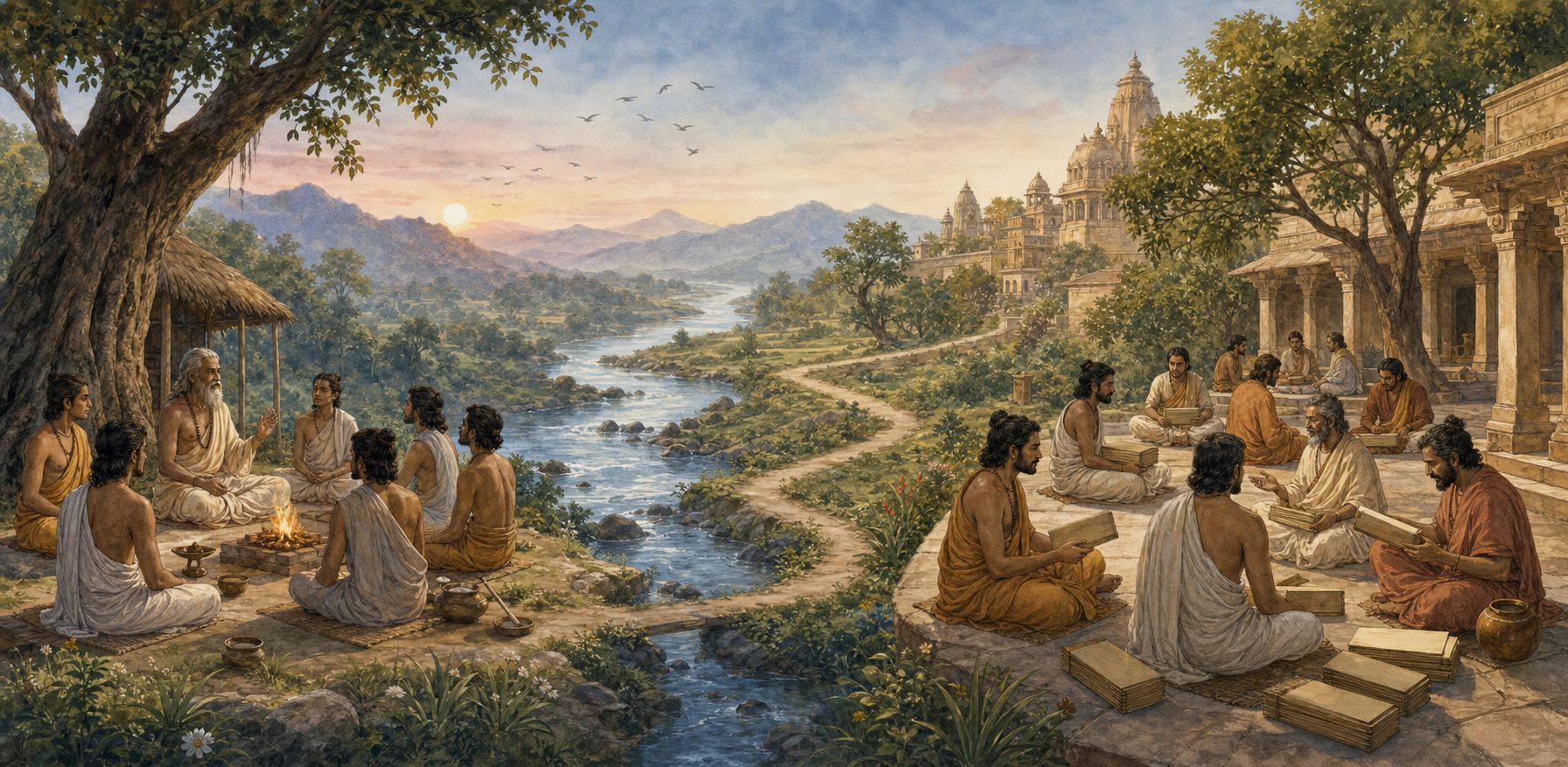
You open two texts labelled “Sanskrit.” One has accent marks, unfamiliar verbal forms, and verses whose grammar seems to bend around the metre. The other builds an argument through precise definitions or carries half a page inside one compound. If you approach both with the same grammar and dictionary, perfectly legitimate forms can look irregular, corrupt, or needlessly obscure.
The practical answer is to identify more than the language name. Before you translate, recite, compare manuscripts, or trace a dharmic term across traditions, determine the text’s historical stratum, transmission branch, functional register, and script. Those four decisions tell you which rules and tools actually apply.
Key takeaways
- Vedic and Classical Sanskrit are historical and grammatical classifications, not names for two scripts.
- “Vedic” is not one uniform idiom: Ṛgvedic hymns, later ritual prose, early Upaniṣadic language, and different śākhās have their own features.
- Classical Sanskrit has a transregional grammatical norm, but epic, kāvya, śāstra, Buddhist, Jain, and dramatic registers use that inheritance differently.
- Pali and the Prakrits are Middle Indo-Aryan languages with their own systems, not incorrectly pronounced Classical Sanskrit.
- A manuscript’s script can reveal a route of transmission, but it does not by itself identify the language, date, school, or doctrine.
Separate historical stratum, transmission branch, and register
The word “lineage” carries several meanings in Sanskrit studies. Confusing them is the quickest way to misclassify a passage.
- Historical stratum asks whether the language is early Vedic, later Vedic, Classical, Middle Indo-Aryan, or a later vernacular form.
- Transmission branch asks which śākhā, recension, manuscript family, or scholastic community preserved the wording.
- Register asks what the language is doing: hymn, ritual explanation, philosophical dialogue, epic narration, court poetry, aphorism, commentary, drama, or sectarian scholarship.
- Script asks how the language was written in a particular material setting. It is evidence about transmission, not a substitute for linguistic identification.
Vedic and Classical Sanskrit both belong to Old Indo-Aryan, but they are not interchangeable labels for “older” and “newer-looking” spelling. Vedic Sanskrit extends from the earliest Ṛgvedic hymns through the Brāhmaṇas, Āraṇyakas, and early Upaniṣads, across a period placed broadly in the second to first millennia BCE. Its internal development is substantial: late ritual prose does not simply reproduce the grammar or discourse of an early hymn.
Classical Sanskrit acquired a durable transregional norm through Pāṇini’s Aṣṭādhyāyī and the grammatical work associated with Kātyāyana and Patañjali. It took recognizable form around the middle of the first millennium BCE and then served philosophy, literature, science, statecraft, inscription, and religious scholarship for more than two millennia. That history is not a clean relay in which Vedic abruptly stopped and Classical began. Early Upaniṣadic language remains Vedic while developing philosophical vocabulary that later Classical schools formalized; the epics, meanwhile, sometimes preserve forms and constructions that do not resemble a strict classroom presentation of Pāṇinian Sanskrit.
Use the labels as coordinates, not rankings. “Vedic” does not mean unsystematic, and “Classical” does not mean spiritually secondary. Nor does polished Sanskrit establish that a work is Hindu: Buddhist and Jain intellectuals also used Sanskrit, reshaped its registers, and transmitted it far beyond Bharat.
Recognize Vedic Sanskrit before forcing a Classical parse

A Classical grammar can help you recognize stems and endings in a Vedic passage, but it cannot account for every Vedic category. If a translation depends on a verbal mood that Classical Sanskrit no longer uses productively, treating the form as an exception is not enough. You need the older grammatical system.
| What to inspect | Vedic tendency | Classical tendency | What you should do |
|---|---|---|---|
| Accent | A meaningful pitch system of udātta, anudātta, and svarita | Pitch is no longer normally distinctive, although Vedic recitation preserves it | Use an accent-bearing edition when accent affects recitation or interpretation |
| Verbal moods | Productive subjunctive and frequent injunctive forms | Subjunctive is drastically restricted and the injunctive has become obsolete | Consult a Vedic grammar instead of assigning the nearest Classical category |
| Prohibition | mā can combine with an injunctive for a negative command | The injunctive is no longer a productive part of the system | Test the construction as a unit rather than translating mā in isolation |
| Verbal narrative | Root aorists and imperfects, sometimes without the augment, are frequent | The inherited system is more regularized and streamlined | Do not “restore” an augment before checking the passage’s stratum and syntax |
| Word order and particles | Second-position enclitics and particles such as ha and u help organize discourse | These are not defining features of ordinary Classical prose | Read the clause rhythmically; a small particle may structure the whole utterance |
| Sandhi and metre | Metrical requirements can occasionally suspend expected sandhi | The learned norm applies sandhi more consistently | Check the metre before treating an uncombined form as scribal damage |
| Morphology and voice | Athematic formations remain robust, and the middle voice can vividly mark participation or benefit | Morphology is more streamlined, with some older meanings carried lexically | Ask what participant relationship the middle voice contributes before paraphrasing it away |
| Compounds | Compounding is available but does not dominate every Vedic register | Tatpuruṣa, bahuvrīhi, dvandva, and avyayībhāva compounds become exceptionally productive | Do not use compound length alone to identify Sanskrit, but treat extensive compounding as a strong Classical register clue |
No single clue settles the classification. Accent marks strongly point toward a Vedic transmission context, but their absence does not prove that a text is Classical: an edition may omit or normalize them. Likewise, one archaic-looking form in an epic passage does not turn the whole work into Vedic Sanskrit.
Genre narrows the diagnosis. Early Ṛgvedic hymns rely on metre, compact syntax, particles, and an older verbal inventory. Brāhmaṇa prose develops extended ritual explanation, interpretive etymology, and its own connective habits. Āraṇyakas and early Upaniṣads carry the later Vedic inheritance into speculative and philosophical discourse. When a form resists analysis, compare it first with the grammar of its textual layer, not with an imagined uniform “language of the Vedas.”
Recitation raises the standard further. Udātta, anudātta, and svarita are not decorative editorial marks, and Sāmavedic performance adds melodic conventions that cannot be recovered from ordinary Devanāgarī spelling alone. If your purpose is liturgical recitation, use a text and oral teacher belonging to the named tradition. A pronunciation reconstructed from a normalized printed page may be linguistically plausible yet wrong for that śākhā.
A Veda is a family of recensions, not one interchangeable text
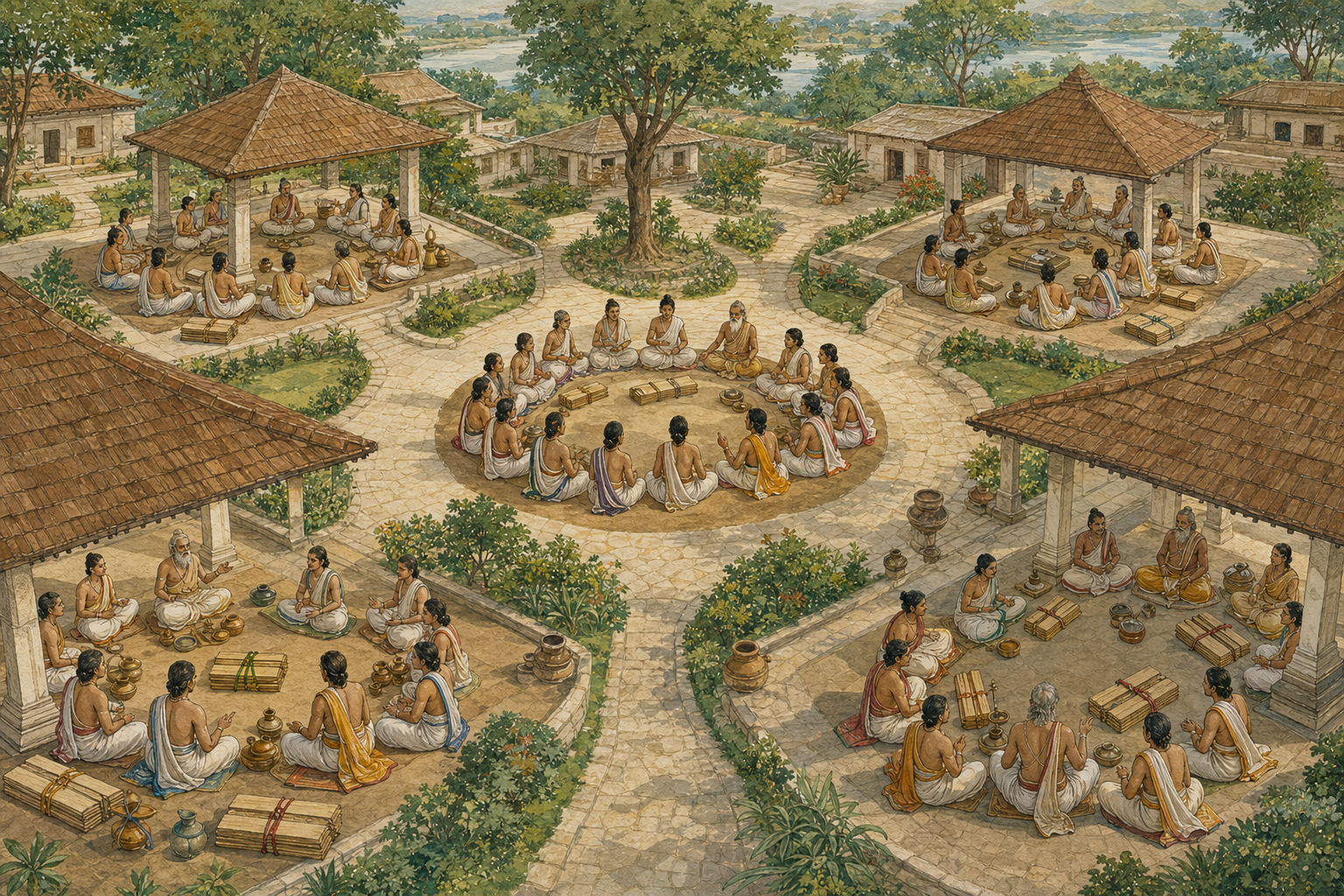
Once you know that a passage is Vedic, the next question is not merely “Which Veda?” It is “Which Veda, which textual layer, and which branch?” A śākhā is a disciplined transmission tradition with its own readings, accentuation, phonetic practice, and arrangement. Variation between two branches therefore need not be a copying mistake.
- Ṛgveda: the Śākala and Bāṣkala recensions can differ in readings and accent placement. Compare like with like before deciding that one printed form corrects the other.
- Śukla Yajurveda: Mādhyandina and Kāṇva are distinct branches. The branch name belongs in any serious citation or recitation note.
- Kṛṣṇa Yajurveda: Taittirīya, Maitrāyaṇīya, and Kapiṣṭhala-Kaṭha traditions can differ in vocabulary, ritual sequence, and phonological detail.
- Sāmaveda: melodic elaboration affects syllabic weight and the realization of accent. A bare verbal transcript does not preserve the entire performed form.
These examples are not an exhaustive catalogue. They show why “the Vedic version” is often an incomplete description. Even the distribution of particular sounds, including the behavior of liquids such as ḷ, can vary by branch; broader phonological contrasts also changed as Sanskrit moved toward later norms.
For every passage you intend to quote, compare, or teach, record this metadata:
- the Veda and the name of the work;
- the textual layer, such as hymn, Brāhmaṇa, Āraṇyaka, or early Upaniṣad;
- the śākhā or recension, when known;
- the passage numbering used by the edition;
- whether accents are printed, omitted, or editorially normalized;
- the script and edition you actually consulted;
- the oral lineage followed, if your claim concerns recitation rather than grammar alone.
This habit prevents two common errors. The first is combining readings from different recensions into a synthetic wording that belongs to none of them. The second is declaring one inherited pronunciation defective because it differs from a modern generalized Sanskrit norm. Compare the reading inside its own lineage before comparing it across lineages.
Classical Sanskrit is standardized without having one voice
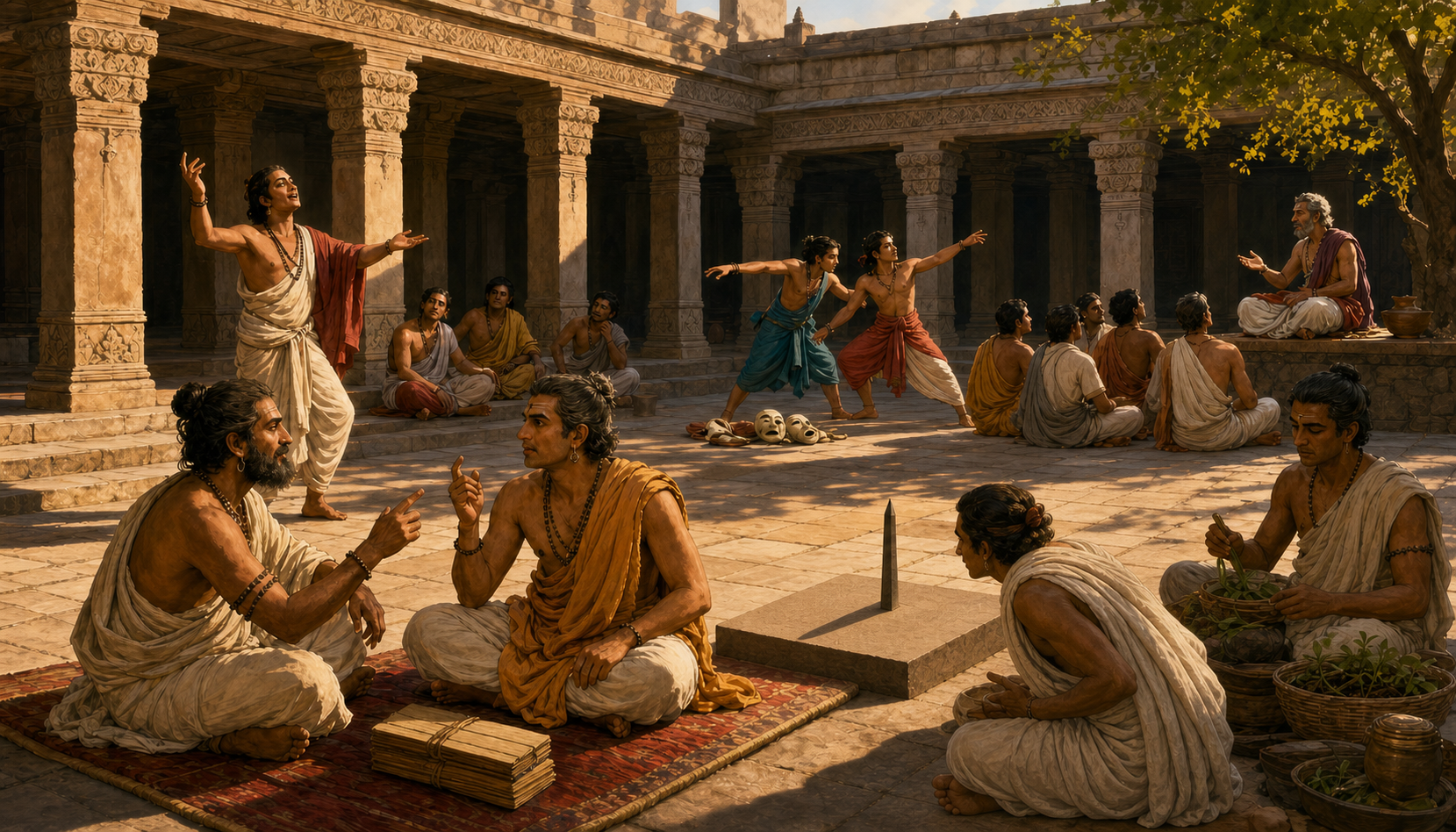
Pāṇinian grammar made an extraordinary transregional learned language possible. A scholar could participate in debate, commentary, poetry, or technical inquiry across regional boundaries. Yet a common grammatical framework did not make every Classical text sound alike. Register still determines what counts as normal, elegant, concise, or intelligible.
- Epic Sanskrit: the Mahābhārata and Rāmāyaṇa contain features that can depart from a strict Pāṇinian ideal, reflecting long histories of composition and performance. Do not emend every non-textbook construction before checking epic usage and the manuscript tradition.
- Kāvya: courtly literature uses elaborate compounds, figures of speech, controlled ambiguity, and dense intertextuality. Begin by identifying the main finite verb, then unpack compounds from the outside inward and test more than one possible compound relation.
- Śāstra: technical Sanskrit values controlled definition and taxonomic precision. Nyāya, Mīmāṃsā, Vedānta, Vyākaraṇa, Āyurveda, Gaṇita, Jyotiṣa, and Arthaśāstra do not assign identical working meanings to every shared word. Build a glossary from the work’s own definitions before relying on a general dictionary gloss.
- Sūtra, bhāṣya, and kārikā: a sūtra compresses, a bhāṣya expands and argues, and a kārikā often organizes doctrine in verse. Translate each form according to its job; supplying an unstated connection may be necessary in a sūtra but intrusive in discursive prose.
- Buddhist Sanskrit: Mahāyāna and Vajrayāna materials circulate in Sanskrit, while Buddhist Hybrid Sanskrit can retain Middle Indo-Aryan influence in phonology and morphology. Treat that mixture as a register with a history, not automatically as careless Classical Sanskrit.
- Jain Sanskrit: Sanskrit narrative and scholastic writing coexists with Ardhamāgadhī and Jaina Māhārāṣṭrī traditions. Determine which linguistic system governs the passage before normalizing its forms.
- Drama: Sanskrit and several Prakrits share the stage. Kings and male Brahmin characters often receive Sanskrit, queens and heroines may use Śaurasenī or another Prakrit, and ascetics can shift register. This is a literary multilingual convention, not permission to treat every character’s speech as Sanskrit with variant spelling.
The decisive question is therefore not “Does this obey Pāṇini?” but “What relationship does this register have to the Pāṇinian norm?” A technical commentary may pursue maximum referential precision. Kāvya may cultivate several simultaneous readings. Epic narration may preserve performance-shaped forms. A Buddhist or Jain composition may combine Sanskritization with Middle Indo-Aryan inheritance. Each demands a different first move from the reader.
Doctrinal identity cannot be inferred from grammatical polish. Sanskrit carried Hindu ritual and philosophical traditions, but it also carried Buddhist dhāraṇīs and philosophy across Asia and supported Jain narrative and scholastic work. The language created a shared intellectual arena without dissolving the doctrinal boundaries of the communities that used it.
Trace the wider lineage without mistaking genealogy for hierarchy

Place Sanskrit, Pali, Prakrit, and Apabhraṃśa on the right map
A useful broad sequence runs from Old Indo-Aryan, including Vedic and Classical Sanskrit, through Middle Indo-Aryan languages such as Pali and the Prakrits, through Apabhraṃśa, and into New Indo-Aryan languages including Hindi, Bengali, Marathi, Gujarati, Punjabi, Assamese, Odia, Nepali, and Sinhala. Read that as a map of historical development, not as a claim that Sanskrit disappeared whenever a later stage arose. Classical Sanskrit continued as a learned language while Prakrits, regional languages, and mixed literary ecologies flourished beside it.
Pali and Prakrit forms should not be reverse-engineered as though speakers had merely mispronounced Classical words. Pairs such as dharma/dhamma, karma/kamma, maitrī/mettā, and prajñā/paññā reveal related vocabularies operating through different phonological and inflectional systems. Translate the form within its own language first; compare its Sanskrit cognate second.
That order protects both linguistic accuracy and doctrinal precision. Pali dhamma, Sanskrit dharma, and the related forms used in later languages share a history, but a shared etymological field does not guarantee identical meanings in every Buddhist, Hindu, Jain, or Sikh context. The same caution applies to ahiṃsā, tapas, satya, sevā, dayā, and karuṇā. Cognates open a conversation; they do not complete the interpretation.
Apabhraṃśa is especially important when you are tracing the movement from later Prakrits into the earliest attested New Indo-Aryan vernaculars. Skipping it can produce an imaginary jump directly from Classical Sanskrit to a modern language. Conversely, treating every modern Sanskritic word as a direct learned borrowing can hide the forms inherited and transformed through Middle Indo-Aryan development. A tatsama is taken over from Sanskrit with relatively little formal change; a tadbhava reflects historical transformation. Keep those pathways separate in your notes.
Do not confuse script with language
Sanskrit has no exclusive script. Its written history includes Brāhmī, northwestern Kharoṣṭhī, Gupta-derived hands, Kashmir’s Śāradā, southern Grantha, Siddhaṃ in Buddhist transmission to East Asia, and Nāgarī or Devanāgarī as the familiar standard of later printing. A Grantha manuscript can contain Sanskrit; a Siddhaṃ manuscript may preserve Buddhist Sanskrit or a dhāraṇī; and a Devanāgarī page is not necessarily Classical rather than Vedic.
The same discipline matters when reading Sikh materials. Gurmukhi identifies a script, while the linguistic ecology of Sikh scripture and literature includes Braj, Sant-bhāṣā, regional forms, and both inherited and learned Sanskritic vocabulary. Calling the entire linguistic content “Sanskrit” obscures the very history that connects it to the wider Indic world.
Record script and language in separate fields. Then add religious or institutional setting as a third field. That prevents conclusions such as “Siddhaṃ means a separate language,” “Devanāgarī proves Hindu authorship,” or “Sanskritic vocabulary makes a passage Classical Sanskrit.” None of those shortcuts holds.
Identify an unfamiliar passage in seven checks
- Establish the work. Use its title, passage location, surrounding prose, and stated tradition. Do not classify from the visual appearance of one isolated line if fuller metadata is available.
- Choose the historical stratum. Look for Vedic accent, older moods, augmentless forms, characteristic particles, and metrical behavior. If those are absent, determine whether the passage fits Classical, Middle Indo-Aryan, or a later language rather than defaulting automatically to Classical Sanskrit.
- Name the transmission branch. For Vedic material, record the śākhā or recension. For other works, retain the manuscript family or edition when it affects the reading.
- Identify the register. Decide whether you are reading hymn, ritual prose, Upaniṣadic dialogue, epic, kāvya, sūtra, bhāṣya, technical śāstra, Buddhist Sanskrit, Jain Sanskrit, drama, Pali, or a Prakrit. This determines which apparent irregularities deserve investigation.
- Parse with the appropriate system. Use Vedic grammar for productive Vedic moods and accent, Classical grammar for the Pāṇinian norm, and dedicated Pali or Prakrit tools for Middle Indo-Aryan forms. Do not translate a Pali form by mechanically changing it into its Sanskrit cognate.
- Separate language from script. Write both down explicitly. Treat the script as evidence about place, period, and transmission only when other evidence supports the inference.
- State what remains uncertain. If the accent was omitted, the recension is unknown, or a form admits both a hybrid and a scribal explanation, preserve that uncertainty. A qualified classification is more useful than a confident normalization built on missing metadata.
Your next translation or recitation note should begin with one line: language stage | corpus and layer | śākhā or recension | genre and register | script | edition. Fill in what you can and mark what you cannot. That small discipline keeps linguistic history, sacred transmission, and doctrinal interpretation connected without collapsing them into one vague label.
References
