

You may have found three different labels for the same coming month, two sets of dates, and a long menu of austerities. The first decision is not how much to fast or chant. It is which local panchang and lineage convention you are actually following.
Once that is settled, Purusottama Month becomes remarkably practical. It asks you to receive an interval created by sacred timekeeping, reduce avoidable material expansion, and give a defined portion of your day back to hearing, chanting, remembrance, and service.
First settle the calendar, not the austerity
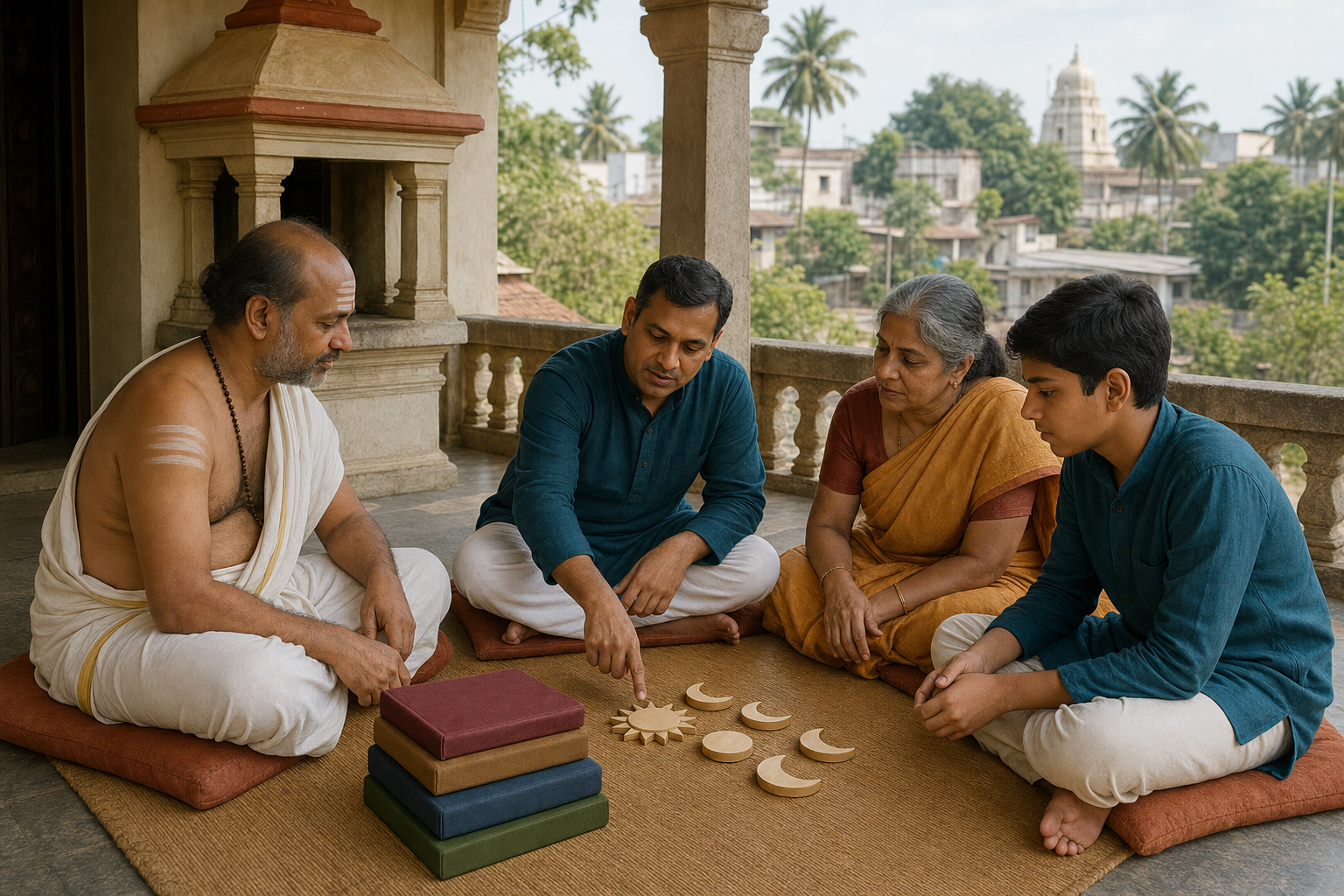
The classical Vedic calendar keeps two rhythms in relationship. Lunar months organize many observances, while the movement of the sun keeps those months connected to the seasons. The two rhythms do not remain aligned by themselves, so the calendar occasionally inserts an additional lunar month.
The determining rule is precise: when a lunar month contains no sankranti, or solar entry into a new zodiac sign, that month is treated as intercalary. It is Adhik Masa, the added month. This generally happens about once every 2.5 to 3 years; over a 19-year span, it tends to occur seven times.
This matters because Purusottama Month is not an arbitrary religious addition to an otherwise complete calendar. The insertion is part of the calendar’s internal logic. Astronomy identifies the interval; tradition explains how that interval should be received and used.
The name on your calendar may still vary. Some regional systems repeat the name of an adjacent lunar month. Vaishnava traditions, especially Gaudiya Vaishnavism, honor the interval as Purusottama Month and dedicate it to Lord Vishnu. A difference in labeling does not necessarily mean that one calendar has omitted the month. It may reflect a different regional or sampradaya convention.
Do not calculate the observance by copying dates from a calendar made for another city. Tithis and religious day boundaries depend on astronomical conditions, including local sunrise and lunar timing. This becomes especially important when you are observing outside Bharat, where a date circulated by an Indian temple may not apply unchanged to your location.
- Choose a reliable panchang configured for your location, not merely your country or time zone.
- Confirm that its convention matches the one followed by your family, temple, or sampradaya.
- Write down the local beginning and ending dates before making your vrata.
- Record both Ekadashi dates separately. Do not assume a date seen on social media applies locally.
- If two calendars disagree, ask your temple which convention it uses instead of combining the start date from one with the fast-breaking time from another.
Key takeaways
- Adhik Masa is inserted when a lunar month contains no solar transit into a new zodiac sign.
- The insertion keeps lunar observances in relationship with the solar seasons.
- Purusottama Month is the Vaishnava devotional name for this intercalary interval.
- Your local panchang should determine the dates of the month and its Ekadashi observances.
- A modest vrata completed steadily is more useful than an impressive one abandoned after a few days.
Sacred time begins with a change of priority
The Padma Purana supplies the central theological frame. The added month initially lacked a presiding deity and therefore appeared neglected. Lord Vishnu accepted the otherwise unclaimed interval and elevated it, giving it the name and dignity of Purusottama.
The point is larger than the origin story. A period that appears surplus is not treated as disposable. It is consecrated. Sacred timekeeping therefore does more than tell you when a festival occurs. It periodically corrects your priorities, just as intercalation corrects the calendar.
For a devotee, that correction takes four recognizable forms: sravana, hearing sacred teaching; kirtana, chanting and glorification; smarana, deliberate remembrance; and seva, service offered without making the self the center. Purusottama Month is not chiefly a contest in severity. It is an invitation to give these practices a larger and more dependable place in your day.
This is why many households refrain from beginning major worldly undertakings such as weddings, housewarmings, or new business ventures during the month. The convention is meant to protect devotional attention. It concerns the ceremonial launching of new material commitments, not the abandonment of existing duties. Caring for family, keeping promises, earning honestly, and completing work already underway do not become less dharmic because the calendar has entered an intercalary month.
If you are considering a wedding, housewarming, or business opening, distinguish three questions. Is this truly a new commencement? Does your family or sampradaya observe the restraint? What dates does your local panchang identify? Customs vary, so a generic online prohibition should not overrule the tradition that will actually conduct the samskara or ceremony.
Purusottama Month is sometimes compared with Kartika, but the two periods should not be collapsed into one. Both encourage vows and intensified Vaishnava practice. Kartika carries a particular Damodara mood, while Purusottama Month emphasizes the sanctification of added time and a special intensification of devotion. If Kartika has helped deepen your devotional feeling, Purusottama can be used to strengthen the habits that protect that feeling.
Build a vrata that can survive an ordinary day

The most common planning error is to choose a vow for your best day. A useful vrata must also fit the day when work runs late, children need attention, or concentration is poor. The month is long enough to expose an unrealistic promise and long enough to establish a sustainable rhythm.
Begin with your present baseline. If you already chant daily, add a fixed amount you can maintain. If your reading is irregular, establish a non-negotiable passage rather than promising to “read more.” If seva happens only when someone asks, assign it a weekly place in the calendar.
A workable four-part vrata
- Daily japa: Set a definite quota and attach it to a stable part of the day, preferably early. Do not choose the number merely because it sounds austere; choose one you will still honor on a difficult morning.
- Daily shastra: Fix the text and the unit of reading in advance. One chapter of the Bhagavad-gita each day is a clear option. After Chapter 18, begin again or continue with a section of the Srimad-Bhagavatam selected before the month starts.
- Weekly seva: Name the recipient and the action. Temple service, prasada preparation and distribution, hospitality to pilgrims, community help, and a regular act of dana are more concrete than a general intention to be helpful.
- Ekadashi discipline: Verify the local date and follow the food practice recognized in your tradition. The purpose is attentive restraint and remembrance, not an improvised fast so severe that you cannot keep your duties or devotional focus.
Add a small accountability system. A vrata journal does not need to become another project. Give each daily practice a box, record completion, and write one sentence when something interferes. After a week, that sentence will show you whether the real obstacle is timing, distraction, an excessive quota, or lack of preparation.
Dietary simplicity can support the same aim. Sattvic food, mindful restraint around heavy foods or stimulants, and careful Ekadashi observance are commonly chosen because they reduce friction around practice. Keep the relationship clear: food discipline supports remembrance; it is not the measure of a person’s devotion.
Define a recovery rule before you need it. If you miss a reading period, resume at the next fixed time. If a vow begins late or is briefly interrupted, the traditional response is earnest resumption rather than discouragement. Where appropriate, you can add reading, service, or charity, but do not turn one lapse into an impossible burden of accumulated quotas.
A minimal observance can therefore be complete without being elaborate: a fixed japa quota, a defined shastra passage, one weekly seva commitment, and locally correct Ekadashi observance. Complete those four before adding dietary rules, multiple study programs, or ambitious public commitments. Consistency is itself a form of tapas.
Make the month visible in the household and community

A private vow becomes easier to sustain when the environment remembers with you. The devotional rhythm associated with Mayapur – arati, kirtan, scriptural recitation, yajna, pilgrimage, and service – offers a pattern that can be scaled down without being emptied of meaning. You do not need to reproduce temple life inside a home. You need a few visible cues that prevent the month from disappearing into an ordinary schedule.
- Place the month’s dates and both Ekadashis where everyone can see them.
- Choose one shared reading time, even if individual family members keep different japa commitments.
- Give children a participatory role: a verse to memorize, an instrument or response in kirtan, or a simple part of prasada preparation.
- Set one household seva goal, such as hospitality, dana, temple help, or prasada distribution.
- Hold a short weekly review focused on what made practice easier, not on comparing one person’s austerity with another’s.
This approach also helps a person who cannot travel. A home altar, steady chanting, and a sincere reading circle can make sacred geography present through remembrance. Pilgrimage remains valuable, but physical distance from Mayapur or another tirtha does not prevent you from organizing the home around a sacred rhythm.
Temple and community organizers have a corresponding responsibility. Publish location-specific dates and Ekadashi timings early. State which panchang convention is being followed. Offer a simple reading syllabus for newcomers, a deeper option for established practitioners, and seva that includes people who cannot fast, travel, or attend every gathering. Calendar clarity is part of pastoral care; it prevents confusion from becoming avoidable guilt.
Purusottama Month can also make Dharmic kinship more visible without pretending that all traditions are identical. Its ethical grammar of tapas, daya, satya, and sauca – restraint, compassion, truthfulness, and purity – has recognizable parallels in Buddhist uposatha discipline, Jain pratikraman and anuvrata practice, and Sikh simran and seva. The rituals and theologies remain distinct. The shared insight is that disciplined time can make conduct more truthful, compassionate, and service-oriented.
Before choosing an elaborate austerity, write four lines: your verified local dates, your daily japa quota, your exact reading unit, and your weekly seva. Put them where you will see them tomorrow morning. That is enough to turn an added month from a calendar curiosity into time deliberately returned to the Divine.
References
- Dandavats – Purusottama Month 2026 in Mayapur: Sacred Timekeeping, Austerity Vows, and Dharmic Unity
