
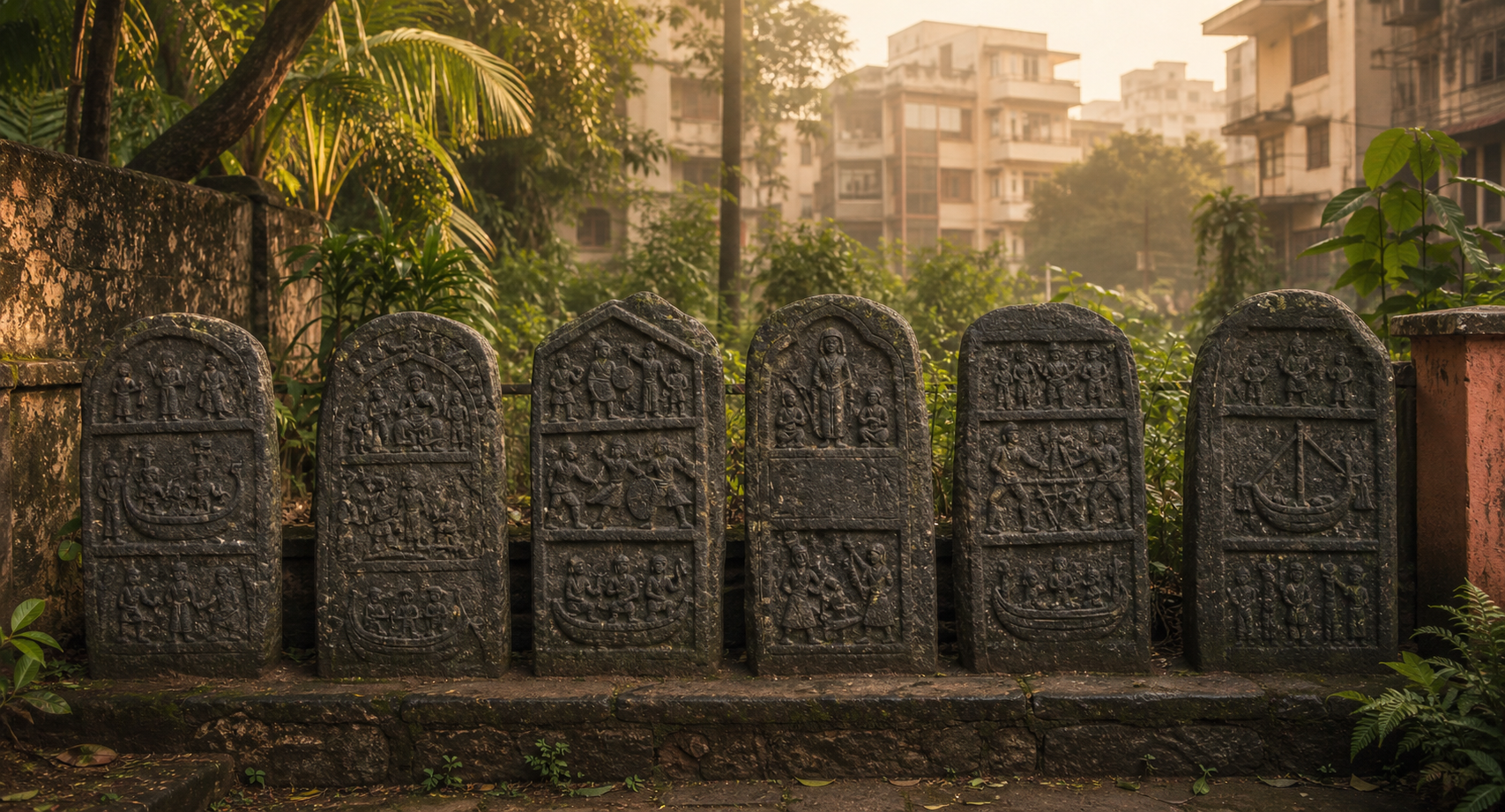
If you live in Borivali, the danger is familiarity. A residential compound can look too ordinary to contain a civilisational archive, yet Eksar’s six hero stones preserve a rare visual memory of ships, soldiers, sacrifice and sacred ascent on the Konkan coast.
You can help protect that memory without pretending to be an archaeologist. The first task is to distinguish what the carvings visibly establish from what scholars have proposed about them. The next is to document the stones without touching them and ask their custodians for a small set of measurable protections.
Start with what the stones actually show
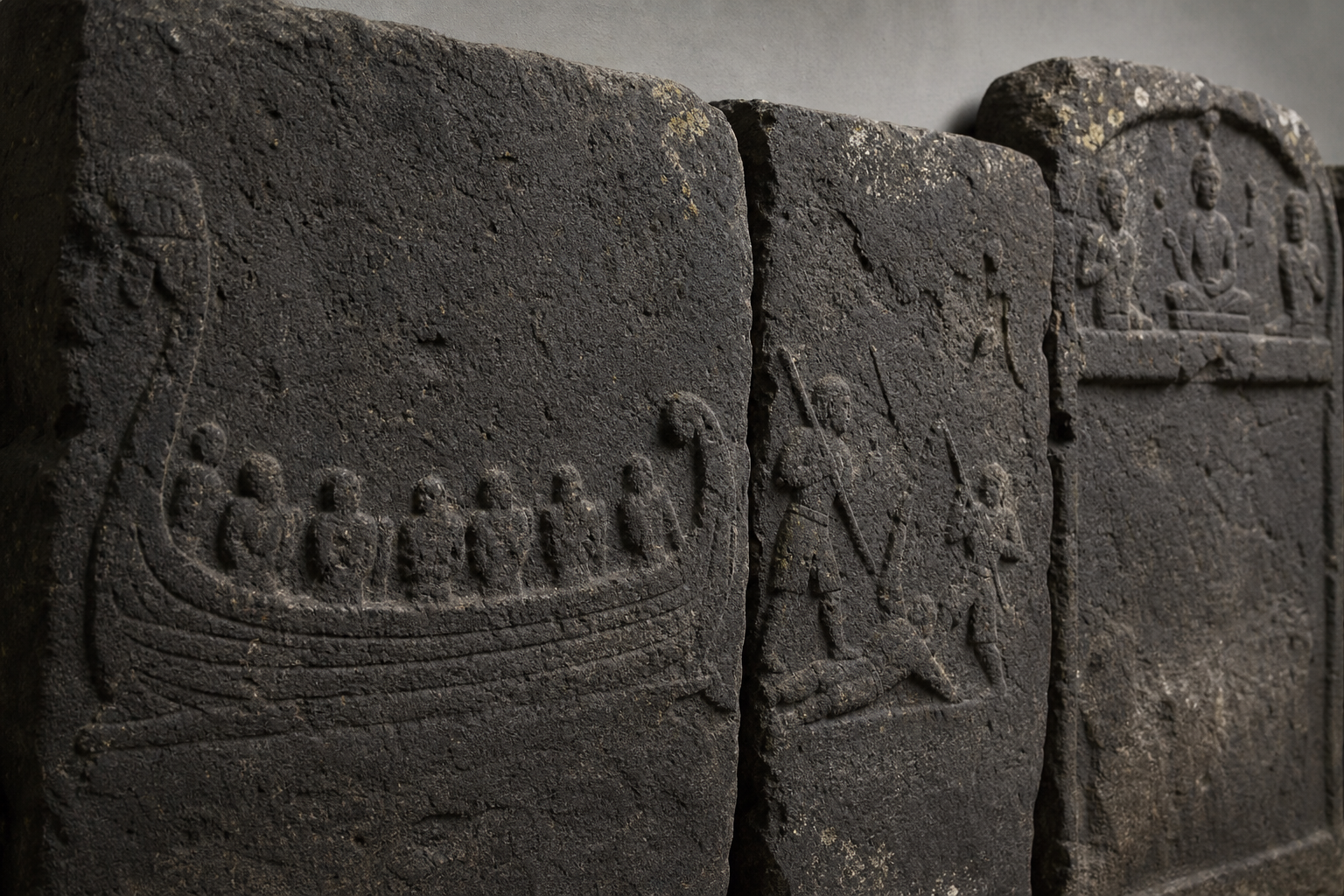
A viragal is a memorial stone erected for a person remembered for a heroic act, commonly a warrior, soldier or saviour. The term combines vira and kal and entered Marathi usage from Kannada; dagada is the more usual Marathi word for stone. Such memorials are found widely across Maharashtra and southern Bharat, but Eksar’s group is exceptional because one of its stones carries an unmistakable naval scene.
There are six stones in the Eksar group. The first three described in detail are each approximately ten feet high, three feet wide and six inches thick. Their scale matters. These aren’t portable curios meant to be glanced at in a cabinet. They are monumental narratives whose panels were designed to lead the eye through action, death, honour and a sacred destination.
Read the narrative upward, not as one crowded picture
On the first hero stone, the lower panels show combat on land: horsemen, archers, a foot soldier with a lance, swordsmen and warriors mounted on elephants. The dead hero and his comrades then appear moving through the sky. Apsaras guide them towards Sivaloka. In the upper sacred register, a man and woman worship a Sivalinga while music is performed; above them, Apsaras carry a bone-relic casket.
The second stone follows a comparable movement. Its battle registers contain fallen bodies, mounted rulers, attendants, horsemen and elephants. The upper panel depicts Kailasa, the dead warrior receiving garlands, women singing and dancing, and flying divine beings accompanying a relic casket. Large round earrings on some warriors were interpreted as Konkan markers, partly because the Arab traveller Sulayman also associated such earrings with the region’s people. Treat that detail as a historical interpretation, not as a facial-recognition system carved in stone.
This upward sequence tells you how to look. Begin at the lowest surviving panel. Identify vessels, animals, weapons and human groups before trying to name anybody. Then move to the transitional scenes of death or celestial travel. Finish with the divine register. A close-up of a single warrior may be visually striking, but it can erase the relationship between earthly duty, heroic death and sacred culmination that gives the monument its meaning.
The third stone is the maritime key
The bottom panel of the third viragal depicts five ships fitted with masts. Nine oars are visible along one side, and armed men occupy the decks. Women appear on the bow of the last vessel, which has consequently been interpreted as a possible royal ship. The women are visible; the royal identification remains an inference.
That distinction is crucial. You don’t have to prove which king occupied which ship to recognise the panel as evidence of a developed maritime imagination. It records multiple crewed vessels, propulsion by oars, masts and armed men at sea. In a city whose public memory often begins with later imperial and colonial periods, those carved ships force the timeline backwards into medieval Konkan.
The divine registers are equally important. The stones don’t present battle as an isolated spectacle of violence. Their visual movement joins courage and death to Indraloka, Sivaloka or Kailasa, worship of the Sivalinga, Apsaras, music, garlands and care for bodily relics. You are looking at a Dharmic memorial grammar: mortal action is judged and remembered within a larger cosmic order.
Separate the naval evidence from the named battles
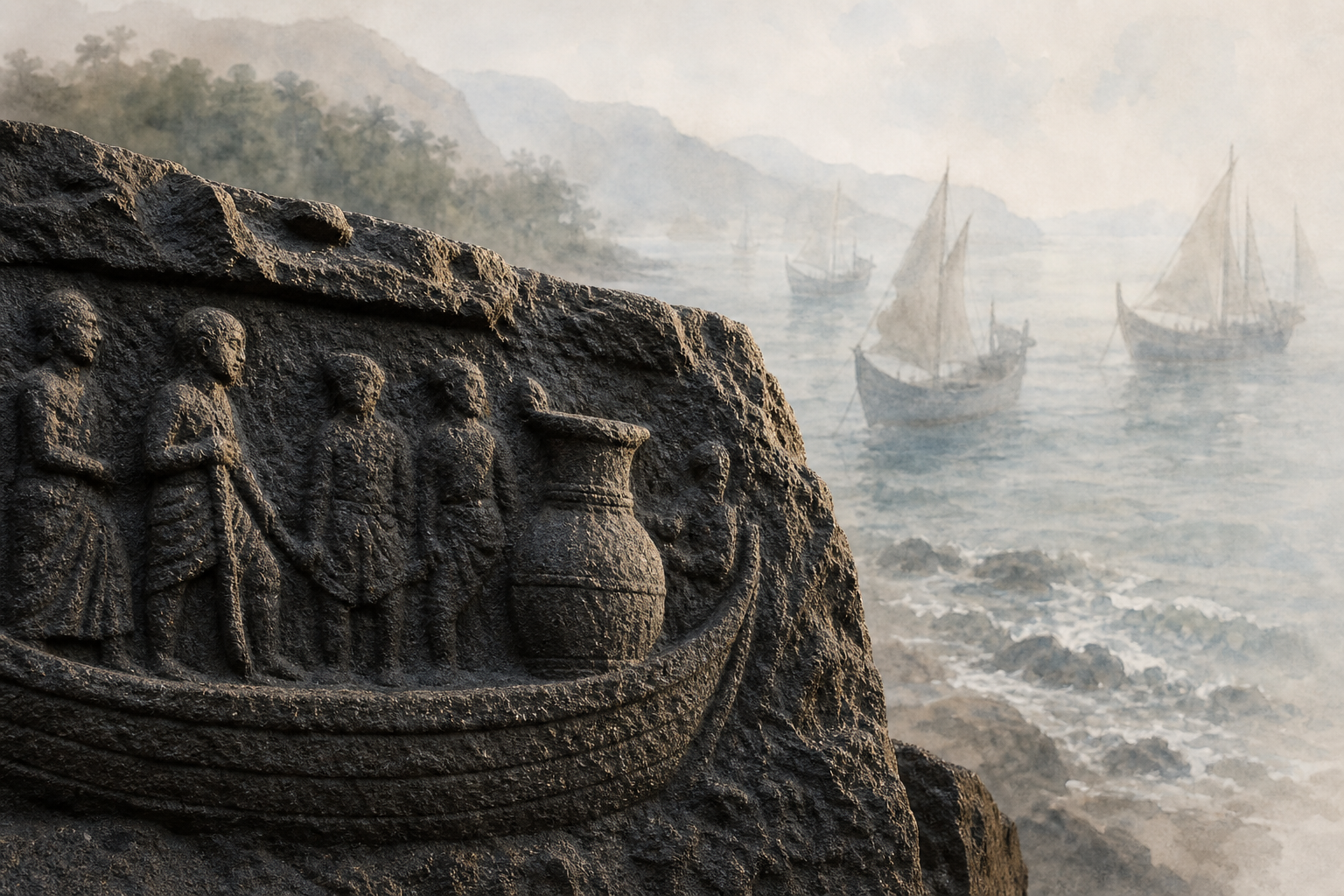
The safest historical claim is also the most powerful one: at least one Eksar hero stone portrays a naval engagement. Assigning that image to a specific war is harder. Moti Chandra dated the viragals to the eleventh century, while Moti Chandra, Braz Fernandes and A.S. Altekar also connected the wider battle tradition around Eksar and Sopara with conflicts extending from 1019 to 1265.
| Period | Conflict associated with the region | What you can responsibly conclude |
|---|---|---|
| 1019 | Paramara Bhoja’s conquest of Konkan and defeat of the Shilahara ruler Arikesari | Inscriptional evidence has been used to characterise this as a fierce naval engagement. It supplies strong regional context, but the date alone doesn’t identify a particular Eksar panel. |
| 12th century | Kadambas of Gopakapattana in Goa against the Shilaharas of North Konkan near Sopara | A sea conflict is associated with the area, but surviving details are sparse. Avoid filling the gaps with a confident story. |
| 1265 | Shilahara king Someshvara’s final war against the Sevuna monarch Mahadeva | The conflict is remembered as a determined sea war in which Someshvara chose death in the sea. Because this date is later than the eleventh-century dating proposed for the stones, any direct identification requires additional evidence. |
The chronological tension isn’t a reason to dismiss the stones. It is a reason to label interpretation honestly. A public sign should say that scholars have proposed connections to these conflicts, not that every carved figure has been conclusively identified. Good heritage work strengthens public trust by showing where observation ends and reconstruction begins.
The strategic prize linking these wars was Sopara, approximately 38 kilometres from Eksar. Eksar therefore makes better sense as part of a coastal network than as an isolated village with an inexplicable picture of ships. Ports depend on approaches, settlements, landing places, supply routes and communities able to crew and defend vessels. The stones preserve one human dimension of that network: people were expected to fight and die for control of it.
When you explain the site to somebody else, use three levels of certainty. Say, first, what is visible: five masted ships, oars and armed men. Say, second, what the location makes plausible: participation in the maritime world serving Sopara and North Konkan. Say, third, what remains proposed: a direct connection between particular panels and one of the named wars. This simple discipline prevents both exaggeration and unnecessary scepticism.
Urbanisation can erase a site without smashing a stone
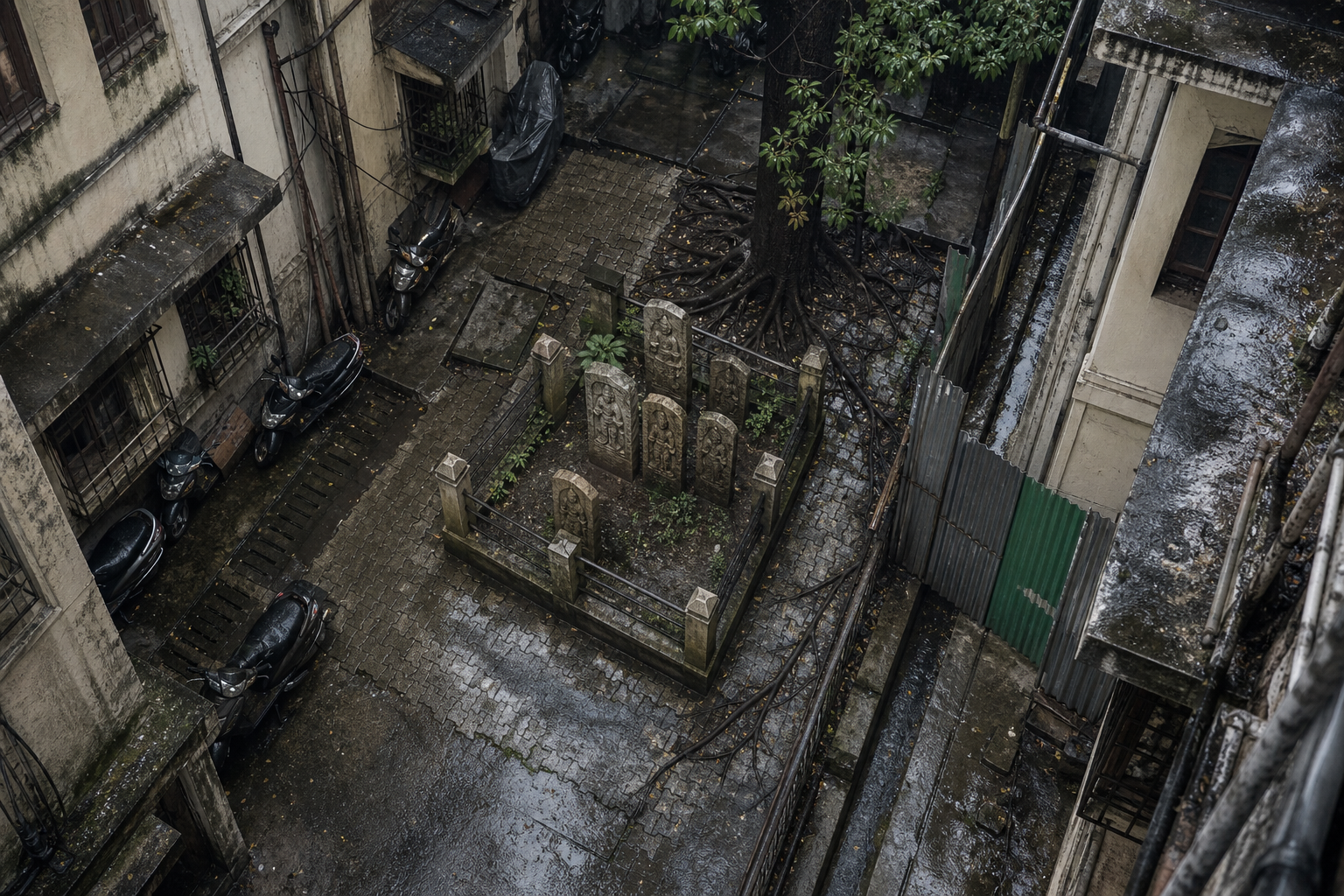
Eksar’s history reaches back to at least the second century CE, but most of that depth is no longer legible in the modern streetscape. The six viragals are housed inside the compound of Club Aquaria, associated with the Wadhwa Group. Nearby, the Eksar Gaon Devi Temple survives as another clue to the older settlement, although surrounding high-rises have overwhelmed its visual presence.
No responsible observer should diagnose the stones’ physical condition from a written description or a few photographs. Endangerment, however, isn’t limited to a slab breaking in half. A monument can remain upright while losing the three things that allow society to inherit it: access, context and an intelligible record.
- Access is lost when residents, students and researchers don’t know whether they may see the stones, whom to ask or under what conditions.
- Context is lost when the naval panels are treated as decorative old stones rather than evidence belonging to the Eksar-Sopara maritime landscape.
- Knowledge is lost when no repeatable photographic and condition record exists to show whether cracks, leaning, deposits or surface details have changed.
- Sacred meaning is lost when battle panels are reproduced without their upward movement towards Sivaloka, Kailasa, worship and commemoration.
A managed compound can offer a measure of physical security, but protection that depends entirely on informal memory remains fragile. Staff change. Residents change. Maintenance contractors may not recognise archaeological stonework. A written access procedure, a professional condition file and permanent interpretation can convert accidental survival into deliberate stewardship.
The Gaon Devi Temple should appear in that interpretation as part of Eksar’s surviving cultural landscape, but it shouldn’t be assigned the same date as the viragals without evidence. Place-based interpretation can connect the two without collapsing their histories: both help a visitor notice that modern Borivali overlays an older community rather than replacing an empty space.
A preservation plan you can execute without harming the stones
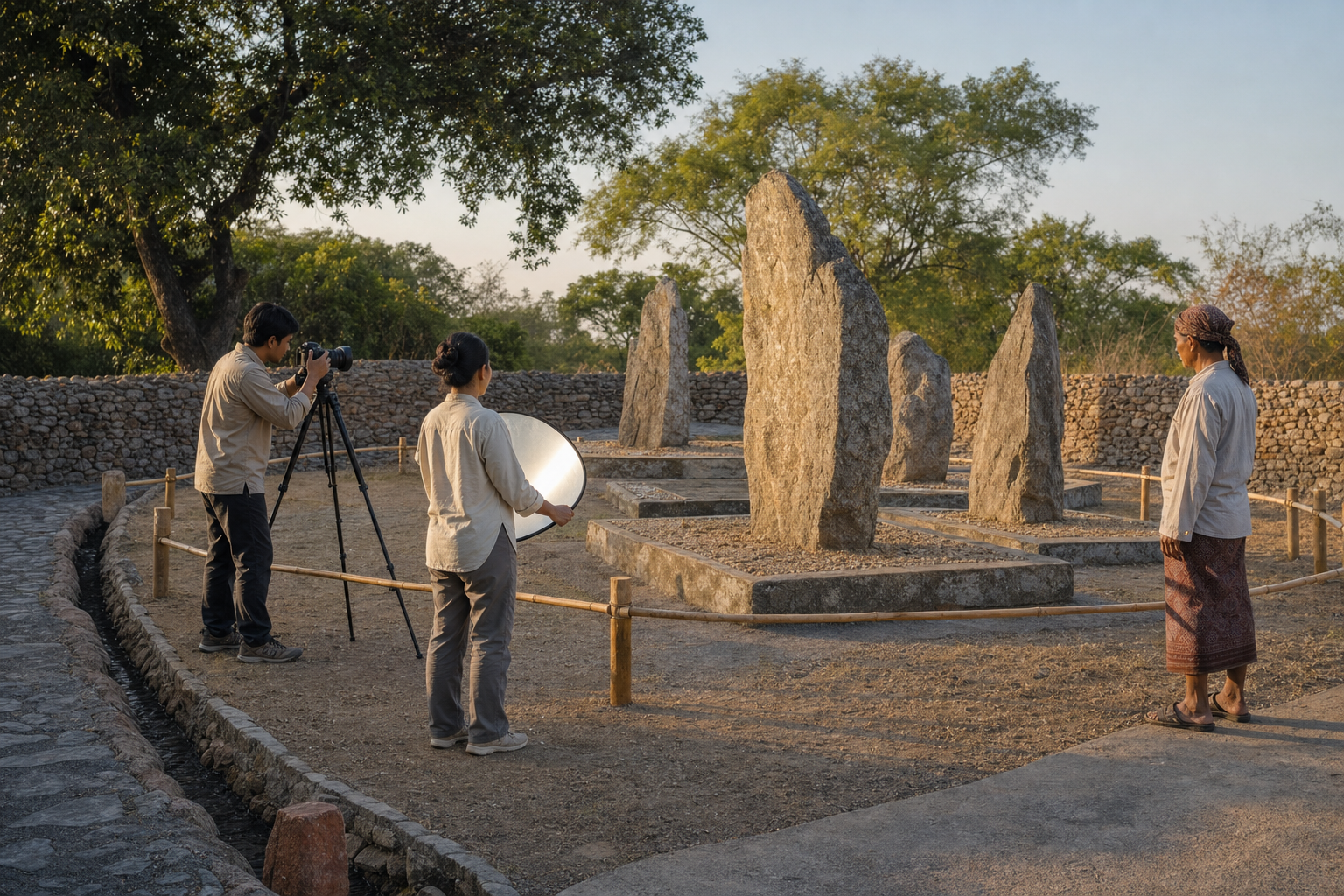
Heritage seva begins with disciplined accuracy. A dramatic campaign launched without permission, baseline photographs or a precise request can make access harder while doing nothing for the stone. Start with a record that a custodian, conservator, teacher or public heritage office can actually use.
Before visiting, secure permission and define your purpose
Because the stones stand within a managed compound, don’t assume that general public access is automatic. Ask the property custodian for a written appointment. State the number of visitors, the equipment you intend to carry and whether the images will be published. Keep the first visit limited to non-contact observation and photography.
Do not touch, climb on, wet, oil, chalk, paint, scrape or make rubbings from a carved surface. These techniques can lodge material in recesses, abrade weakened stone or leave residues that complicate later conservation. Don’t move vegetation, barriers or nearby objects yourself. If something obstructs the stone, record it and ask the custodian to have a trained person assess it.
Create a baseline that another person can repeat
A useful record is systematic, not merely beautiful. Use the same numbering for the stones in every folder, note who assigned that numbering, and preserve the original image files. A filename such as EKS-V03-P01-YYYY-MM-DD tells a later researcher that the photograph shows Eksar stone 3, panel 1 and the date of capture.
- Photograph the whole setting first. Show the six stones in relation to one another, the protective enclosure, nearby structures and the route by which they are accessed.
- Make one straight-on image of each complete stone. Keep the camera level enough that later photographs can reproduce the viewpoint.
- Photograph every panel separately, with overlapping frames where a panel is too large for one detailed image. Use light from different safe angles rather than applying anything to the surface to increase contrast.
- Place any scale or identification card near the stone without leaning it against the carving. Never insert an object into a crack or joint.
- Write observations in plain visual language: crack running from the upper-left edge, dark deposit below a figure, stone leaning towards the rear. Don’t convert an observation into a diagnosis such as structural failure or biological attack unless a qualified conservator makes that finding.
- Record the date, time, weather, camera or phone model, file numbers and access conditions. Note any area you couldn’t photograph instead of silently omitting it.
- Keep the originals in at least two independent locations. Publish smaller copies if necessary, but retain the full-resolution files and an unedited master list.
- Before public release, remove residents’ faces, vehicle numbers and other unrelated personal details. Heritage documentation doesn’t require exposing the people who live around the monument.
Repeat photography becomes valuable only when the angle, numbering and file names remain stable. Choose a review interval the local group can sustain and compare like with like. If a new crack, shift or loss appears possible, preserve both images and seek professional assessment; don’t announce deterioration as fact from mismatched photographs.
Ask for five concrete protections
A useful representation to the custodian is short enough to answer and specific enough to measure. Attach a one-page significance note, a contact sheet of photographs and the baseline inventory. Then request:
- A professional condition assessment covering all six stones, with numbered photographs and recommendations for preventive care.
- A written access protocol naming the contact point, permitted hours, group-size limits and photography rules.
- A non-contact protective arrangement designed or reviewed by a conservator, including instructions for maintenance staff. Don’t prescribe drilling, coating or chemical cleaning.
- An interpretive panel in Marathi and English showing how to read the registers, identifying the five-ship scene, locating Eksar in relation to Sopara and marking the proposed battle associations as interpretations.
- A digital archive containing the full-resolution record, condition reports, access history and any future conservation work, with copies held by more than one responsible institution or community body.
The core request can be stated plainly: We ask that the six Eksar hero stones be professionally assessed, recorded, protected from untrained handling, explained on site and made accessible under a documented procedure. We are not requesting amateur restoration or immediate relocation.
That last sentence prevents a common mistake. Relocation may sometimes be necessary, but moving a monument can damage it and sever whatever remains of its setting. It shouldn’t be the opening demand before provenance, structural condition, security and conservation needs have been professionally assessed. In-situ protection with controlled access is a credible first objective.
If the initial request receives no answer, send the same factual dossier to the relevant public heritage or municipal office after verifying its jurisdiction. Record dates and responses. Publish verified facts, unanswered requests and the protections being sought; don’t allege destruction or negligence without evidence. Precision gives the campaign staying power.
Key takeaways
- Eksar’s strongest maritime evidence is visible on the third hero stone: five masted ships, nine oars on one side and armed men on deck.
- The carvings establish naval combat more securely than they establish the name and date of a particular battle.
- The battle traditions associated with the area include conflicts in 1019, the 12th century and 1265, all linked to competition for the prized port of Sopara.
- The stones are Dharmic memorial narratives, not only military pictures; their upper registers connect heroic death with Sivaloka, Kailasa, worship, music and celestial honour.
- Citizens should document without contact, preserve full-resolution records and ask for a professional condition assessment, written access, protective management and honest interpretation.
Your most useful next step is small: find two or three careful people, prepare a permission request and make a repeatable baseline record of all six stones. Let the ships draw attention, but let accuracy govern the work. That is how Eksar can move from accidental survival to public memory without sacrificing the evidence you are trying to save.
References
