
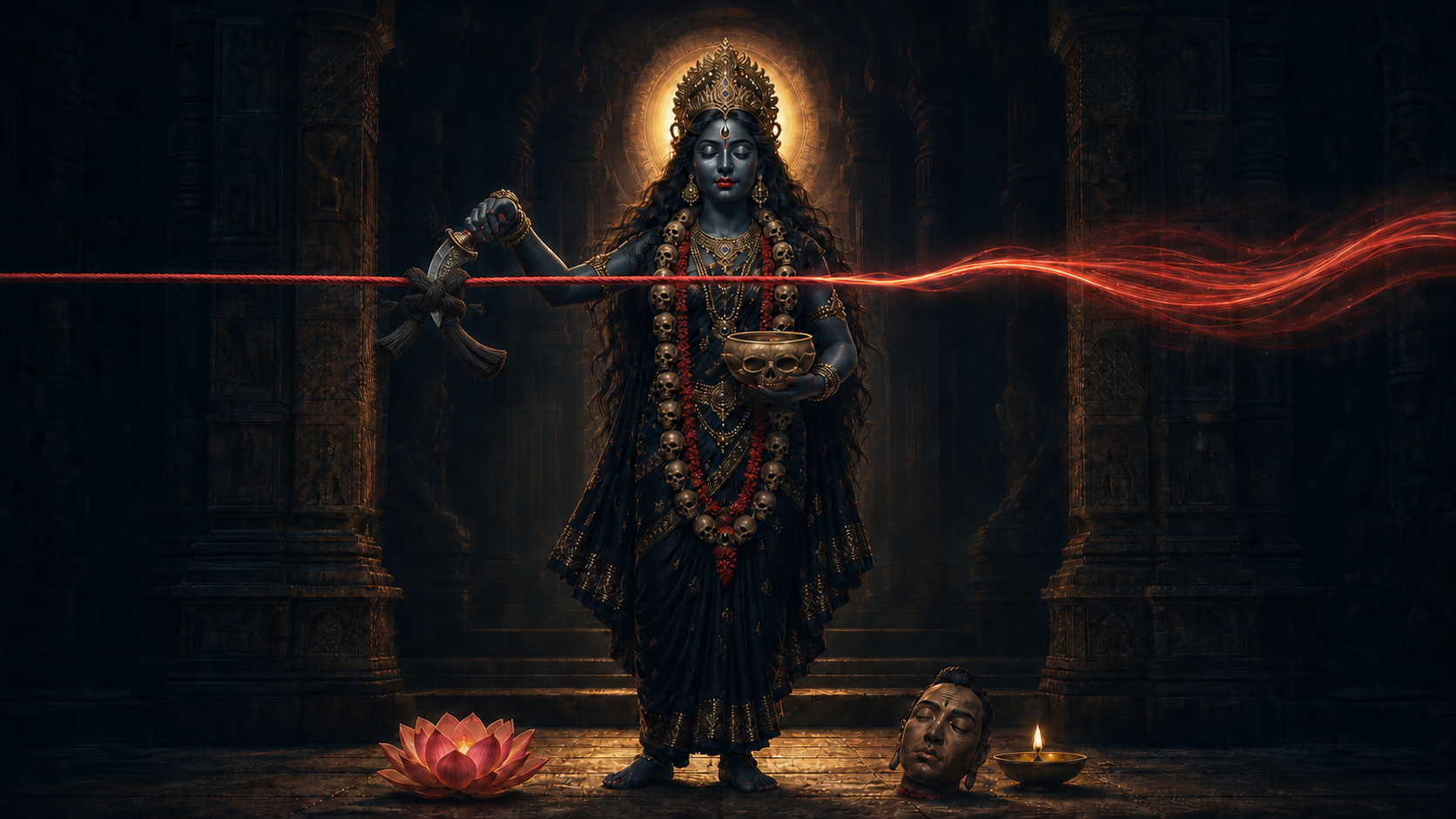
You stand before Kali and see a severed head, a raised blade, a skull-bowl, and a cremation ground. It is reasonable to wonder whether the image condemns desire, glorifies violence, or asks you to destroy your individuality. Read that way, the symbolism becomes either frightening or unusable.
The more demanding reading is also the more practical one. Hindu sacred symbolism does not ask you to stop wanting, seeing beauty, exercising power, or acting in the world. It asks you to notice the instant a desire becomes a claim, the claim becomes an identity, and the identity demands that reality obey it. That is where kama begins to serve ego rather than dharma.
Desire is not the problem; enthroning it is
Kama belongs within the four purusharthas alongside dharma, artha, and moksha. Desire therefore has a legitimate place in a human life. Affection, beauty, pleasure, creativity, recognition, prosperity, and intimacy do not become impure merely because you want them. The governing question is whether the desire remains answerable to dharma.
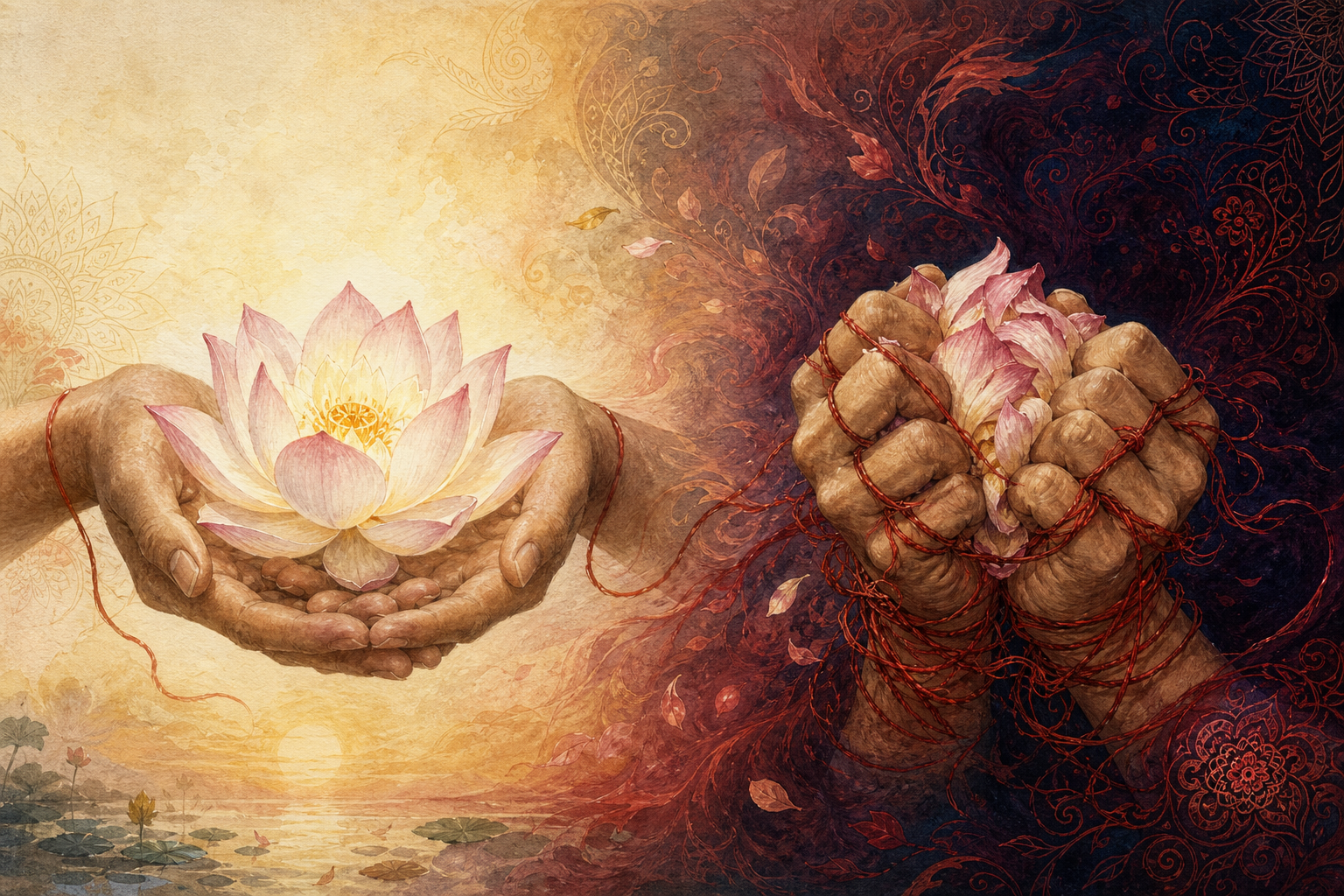
A desire governed by dharma can accept proportion, timing, consent, responsibility, and even disappointment. A desire governed by ego says, ‘Because I want this, it must be mine.’ That single change in grammar turns preference into entitlement. Another person becomes an obstacle or possession, and a desired outcome becomes proof of your worth.
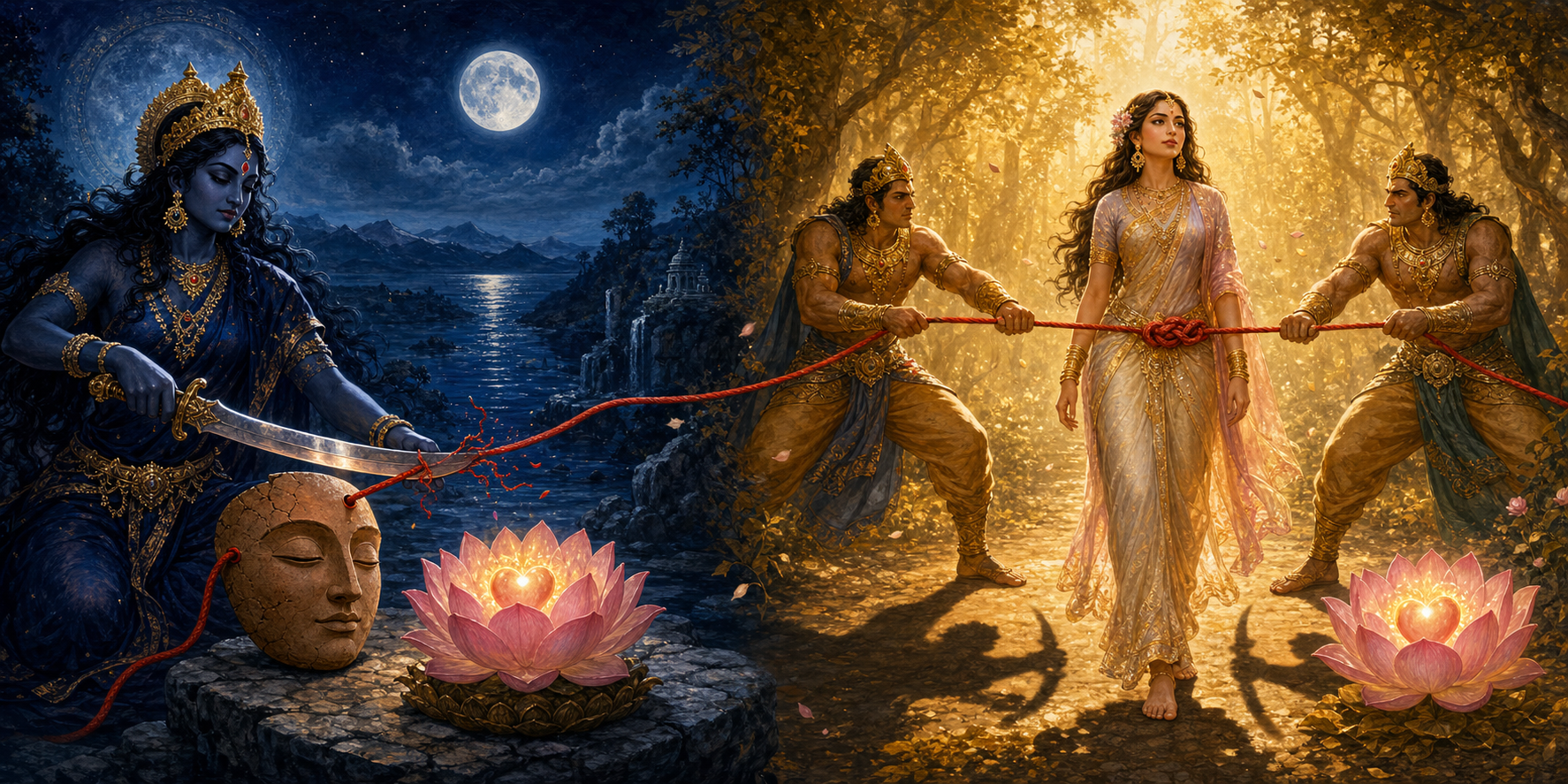
Sunda and Upasunda embody this transition with unusual precision. The brothers gain formidable power through tapas, remain united through conquest, and can be killed by no one except each other. When both claim Tilottama, however, possessive desire converts their unity into mutual destruction. Beauty does not manufacture their defect. It reveals a defect that success had concealed.
This is why austerity alone cannot guarantee wisdom. Tapas can concentrate energy, but character determines its direction. Discipline without discernment may make an ego more capable rather than less dominant. Before calling a desire spiritual, noble, romantic, or necessary, test it with four questions:
- What legitimate good am I actually seeking: affection, security, pleasure, status, belonging, or service?
- What limit does dharma place on how I may pursue it?
- If I do not receive it, will I become deceptive, punitive, contemptuous, or reckless?
- Am I relating to another being as a person, or reducing that being to an answer to my need?
Your answer to the third question is especially revealing. A desire that can survive refusal without becoming hatred is still under some degree of governance. A desire that immediately recruits anger, humiliation, or revenge has already fused with ego.
What Kali’s severed head and ritual blade actually cut
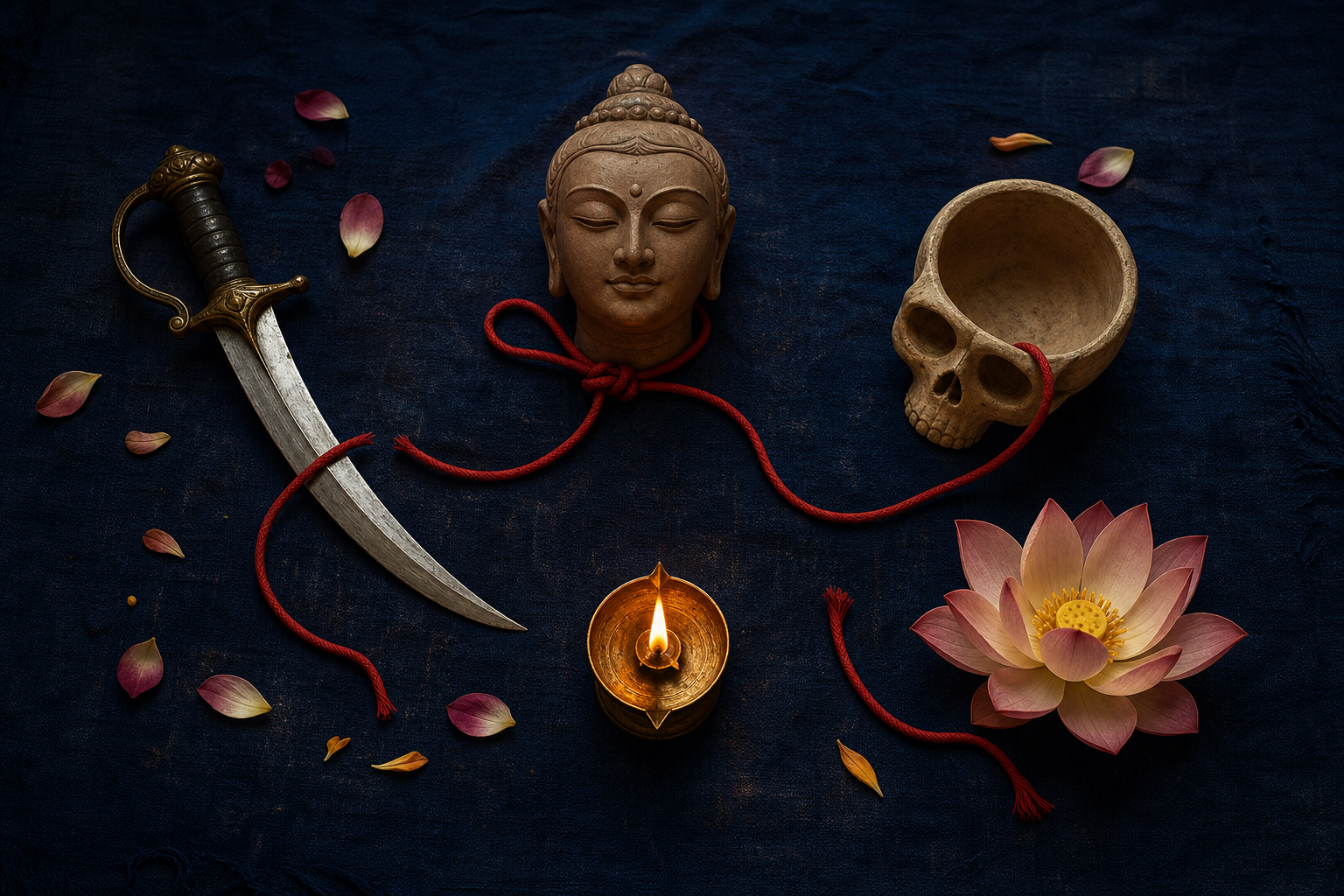
The severed head in fierce Shakta imagery does not command the destruction of intelligence, personality, or human dignity. It represents the cutting of the ego-knot: the false identification that treats a temporary role, possession, opinion, achievement, or wound as the whole self. The target is not the person. The target is bondage to a mistaken account of the person.
This distinction matters in ordinary life. Giving up the belief that you must always be right is not the same as giving up discernment. Releasing ownership over another person is not indifference. Refusing to build your identity around status is not refusing excellent work. Sacred renunciation removes the compulsive claim while preserving the energy that can be directed toward dharma.
The kartrika, or ritual chopper, expresses this discriminating action. It does not cut the world because the world contains tempting objects. It cuts fixation, false identification, and clinging. When you encounter the blade in an image, ask for the exact sentence that needs cutting. It may be ‘Without this success, I am nothing,’ ‘This person owes me affection,’ or ‘My pain gives me the right to injure someone else.’ A vague intention to conquer ego is difficult to practise. A binding sentence can be recognized and refused.
The kapala, or skull-bowl, teaches the complementary movement. After cutting the story, you still have to receive the experience. Desire may leave heat in the body. Rejection may still hurt. Envy may still arise. The bowl symbolizes the capacity to hold that experience without immediately decorating it with blame, fantasy, denial, or self-justification. The blade without the bowl can become repression; the bowl without the blade can become indulgence. Discernment and honest receptivity belong together.
The cremation ground places both actions inside the truth of impermanence. Beauty changes, bodies age, victories pass, and identities lose their audience. Remembering this is not a demand for morbidity. It is a way to reduce the imagined absoluteness of the thing you want. Ask, ‘If this changes or disappears, what quality of action will still have been worth choosing?’ That question moves attention from possession to conduct.
Kali’s Pañcamundi Asana, the seat of five skulls found in some forms, has been read through several symbolic frameworks, including the five elements, five aggregates, and five sheaths. These are interpretive correspondences rather than a single compulsory code. Their shared point is sovereignty over the composites that ordinarily dictate identity. Kali sits upon them; she is not confined by them. You can apply the same distinction whenever you say, ‘I am my body,’ ‘I am my role,’ or ‘I am my reputation.’ These are dimensions of embodied life, but none can bear the full weight of selfhood.
Tilottama reveals how ego turns seeing into claiming
The fall of Sunda and Upasunda exposes a sequence worth learning to catch early: perception becomes attraction, attraction becomes a possessive claim, the claim produces rivalry, and rivalry authorizes harm. The decisive step is not seeing beauty or feeling desire. It is the ego’s assertion that experience confers ownership.
This also prevents a serious misreading of Tilottama. She is not a woman blamed for male desire, nor is femininity presented as a contaminating force. She acts as catalytic Shakti within the restoration of balance. The brothers destroy themselves through the possessiveness they bring to her presence. When a sacred story presents an alluring form, you should therefore examine the observer’s intention before accusing the observed form.
Shiva’s omnidirectional gaze in this episode offers the counter-image. The gaze is traditionally read as witnessing awareness capable of seeing the whole field rather than being reduced to one impulse. Its practical instruction can be stated simply: seeing is not claiming. You can recognize beauty without converting it into entitlement, enjoy an experience without making it the basis of identity, and feel attraction without surrendering ethical judgment.
Watch for this pattern wherever comparison enters your mind. A colleague’s recognition, a sibling’s prosperity, another devotee’s influence, or a partner’s independent choice may initially be neutral information. Ego makes it personal by declaring that another person’s good diminishes you. The useful intervention comes before anger: name the concealed claim. ‘Only I should have been praised’ is more honest and more workable than ‘They did not deserve it.’
The story also warns against spiritual ego. Sunda and Upasunda possess the fruits of severe discipline, yet the energy of tapas has not matured into self-command. If your practice increases contempt, rivalry, or the need to display superiority, its outer form may be disciplined while its inner direction remains captive to ahankara. The corrective is not necessarily more intensity. It is renewed accountability to dharma.
Use the fierce image as a sequence of inner actions
Kali, Dakini, and Yogini can be contemplated as a sequence rather than as isolated figures. Kali places the desire within kala, the reality of time and change. Dakini represents incisive intelligence that severs delusion. Yogini represents the disciplined method that integrates what has been seen into body, breath, speech, and conduct. Insight must become practice or ego will simply absorb the insight into a new self-image.
You can work with that sequence without imitating an esoteric rite. Choose one current desire, especially one producing resentment, rivalry, or anxiety, and proceed as follows:
- Name the desire without moral theatre. Write, ‘I want…’ and complete the sentence plainly. Do not call it sacred or shameful yet.
- Expose the promised identity. Complete, ‘If I obtain this, it will prove that I am…’ This locates the point where an object or outcome has become a verdict on the self.
- Identify the possessive claim. Complete, ‘Because I want this, I believe someone else must…’ This reveals any demand being placed on another person’s freedom, dignity, or rightful interest.
- Use the inner blade. Reject one false sentence, not the entire field of desire. Replace ‘I must defeat them to have worth’ with a dharmic commitment such as ‘I will pursue excellent work without treating another person’s success as an injury.’
- Install the inner Yogini. Select a repeatable method that can carry the insight into action: breath awareness before replying, mantra-japa when comparison begins, restrained speech during conflict, or a concrete act of service that does not seek recognition.
End by looking toward Kali’s abhaya and varada mudras, the gestures of fearlessness and blessing. Their presence is essential to the iconographic grammar. The fierce forms are not invitations to self-hatred. The cutting occurs within a field of protection, grace, and liberation. You are relinquishing a compulsion so that a freer capacity to act can emerge.
Formal Shakta practices such as āvaraṇa-pūjā, nyāsa, bhūta-śuddhi, and specialized mantra disciplines belong within their ritual and lineage contexts. A personal contemplation should not be confused with initiation or advanced Tantric sadhana. Where you seek those practices, scriptural literacy, ethical grounding, and qualified guidance protect the purpose of the rite.
Key takeaways
- Kama is not rejected simply because it is desire; it becomes binding when it ceases to answer to dharma.
- Ego turns ‘I want’ into ‘I must possess,’ then treats refusal or another person’s success as an injury to the self.
- Kali’s severed head and kartrika target false identification and fixation, not healthy agency, intelligence, or embodied life.
- The kapala adds receptivity to discernment: feel the experience honestly without obeying every story generated around it.
- Tilottama reveals desire already fused with ownership; she is not the moral cause of the brothers’ destruction.
- Insight becomes liberating only when you install a method such as watchful breath, mantra, ethical restraint, or service.
The next time a fierce sacred image unsettles you, resist the quick questions ‘Is desire evil?’ and ‘Why is this deity violent?’ Ask instead: What form of clinging is the symbol cutting, what human energy is it preserving, and what disciplined action should replace the compulsion? Choose one desire that currently governs your speech or judgment. Name its hidden claim, cut that claim, and take one dharmic action before the day ends.
References
- DharmaRenaissance Blog — Decoding Dakini and Yogini beside Kali: Mirrors of Death, Desire, and Liberation in Kali Puja
- DharmaRenaissance Blog — Sunda–Upasunda Unmasked: Mahabharata’s Devastating Lesson on Desire, Unity, and Dharma
