
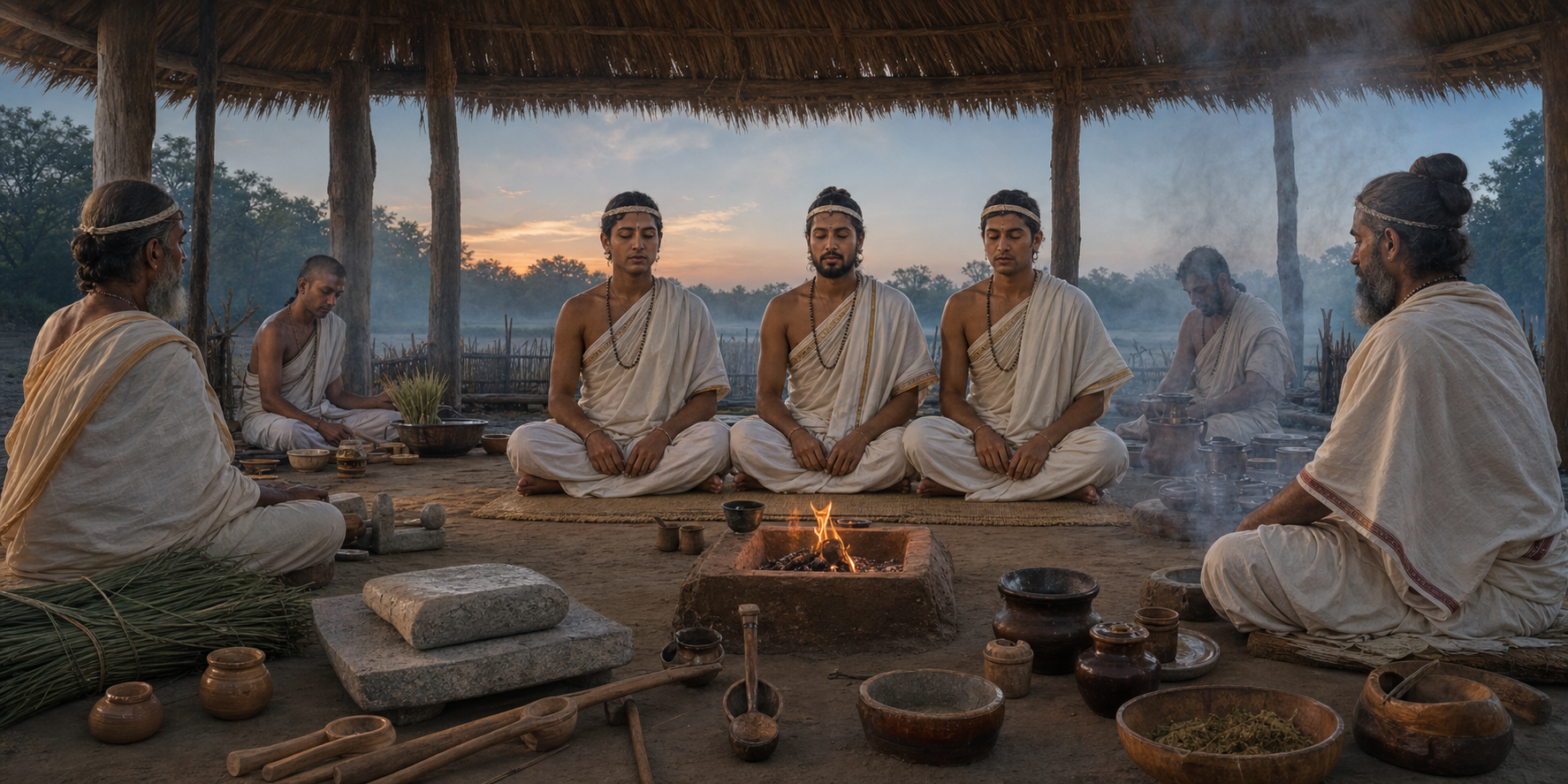
If you have heard nidhana mentioned during a Somayaga and wondered whether it means the final notes, the end of a chant, or the completion of a ritual act, your confusion is understandable. The word operates at more than one level, but those levels should not be collapsed.
The practical answer is this: nidhana is the concluding part of a Sāma Veda chant, and that musical conclusion also gives the officiants a clear ritual handoff. Once you know where it stands in the five-part chant, you can follow Agnistoma with much greater precision.
The shortest correct answer: nidhana closes at two levels
In the performance of a sāman, nidhana is the terminal component of the melody. It gathers the preceding musical movement into a recognizable resolution. It is therefore not merely the instant at which the singers stop producing sound. The silence comes afterward; nidhana itself is a performed conclusion.
At the ritual level, the same conclusion marks a prescribed chant unit as complete. Other officiants can then proceed to the next due action without having to guess whether the singing has merely paused. Nidhana thus closes both a melodic movement and the ritual interval governed by that movement.
The underlying sense of the word is helpful. Nidhana can convey a placing down or depositing. A completed chant is, as it were, set down securely within the sacrificial sequence. This image explains why the term suggests more than an abrupt ending: something carefully carried through sound has reached its appointed resting point.
Keep the scale of that closure clear. Nidhana does not necessarily announce that the entire Somayaga is over. It closes the designated sung unit or chant-linked segment in which it occurs. Since Agnistoma contains an extended sequence of recitation, singing, offerings, and transitions, such local endings are essential to the order of the whole.
Find nidhana inside the five-part architecture of a sāman
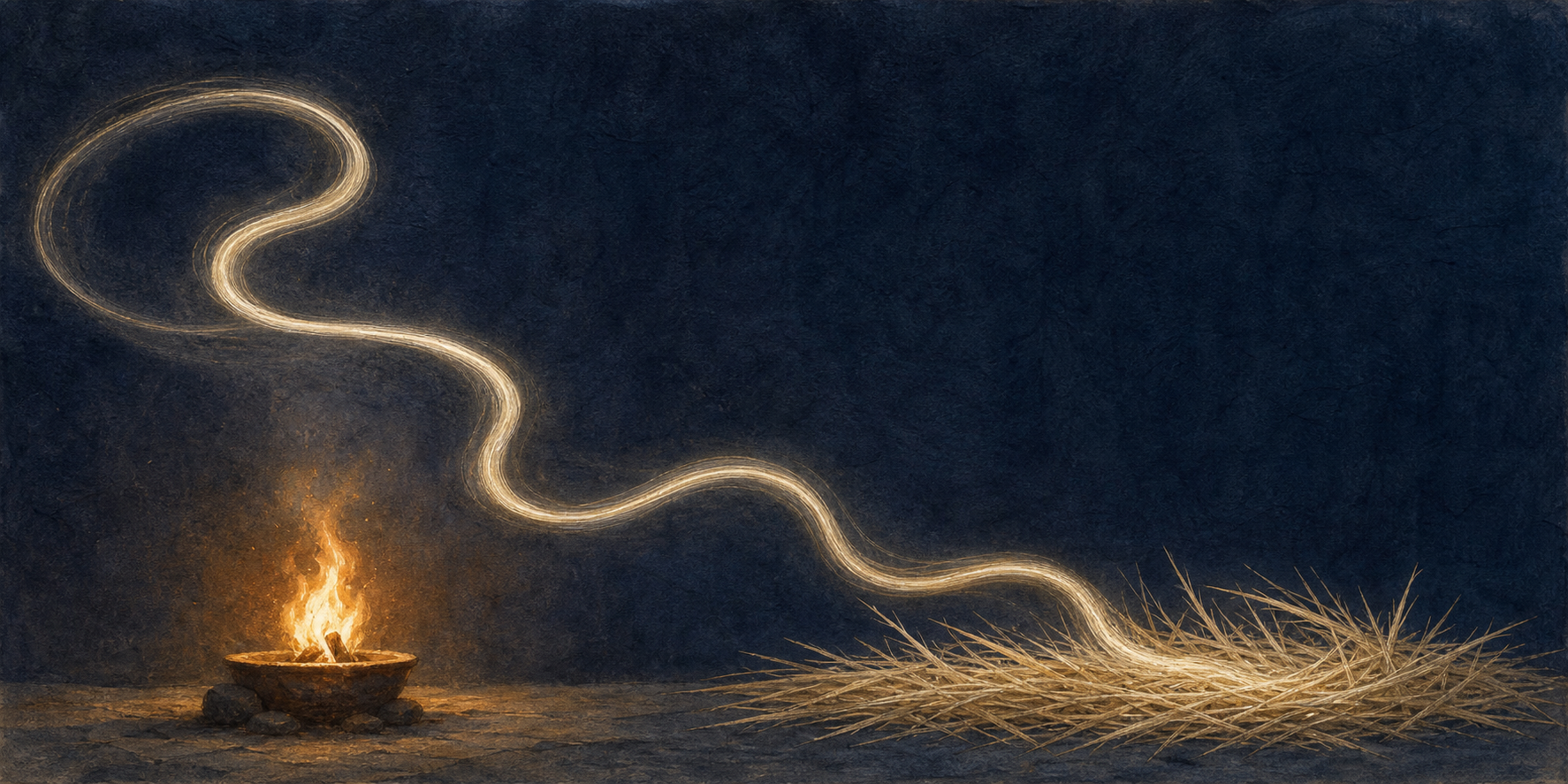
You will understand nidhana more accurately when you listen for the entire progression rather than isolating its final sound. In the relevant ritual architecture, a sāman unfolds through prastāva, udgītha, pratihāra, upadrava, and nidhana. Each part has a functional place in the movement from entry to expansion, response, preparation, and resolution.
| Chant part | Function in the sequence | What you should notice |
|---|---|---|
| Prastāva | Initiates the chant | The thematic and tonal entry into the sāman |
| Udgītha | Forms the principal, expansive body | The melody opening into its main development |
| Pratihāra | Answers and links portions of the chant | An interposed response or bridge rather than a final resolution |
| Upadrava | Refines the phrasing and transition | A movement preparing the chant for its concluding turn |
| Nidhana | Concludes the sāman | A definite cadence that settles the melodic movement |
This sequence corrects a common listening mistake. A pause after pratihāra or a change of melodic direction during upadrava should not automatically be labelled nidhana. The decisive question is not simply, “Did the sound stop?” It is, “Has the five-part movement reached its formal terminus?”
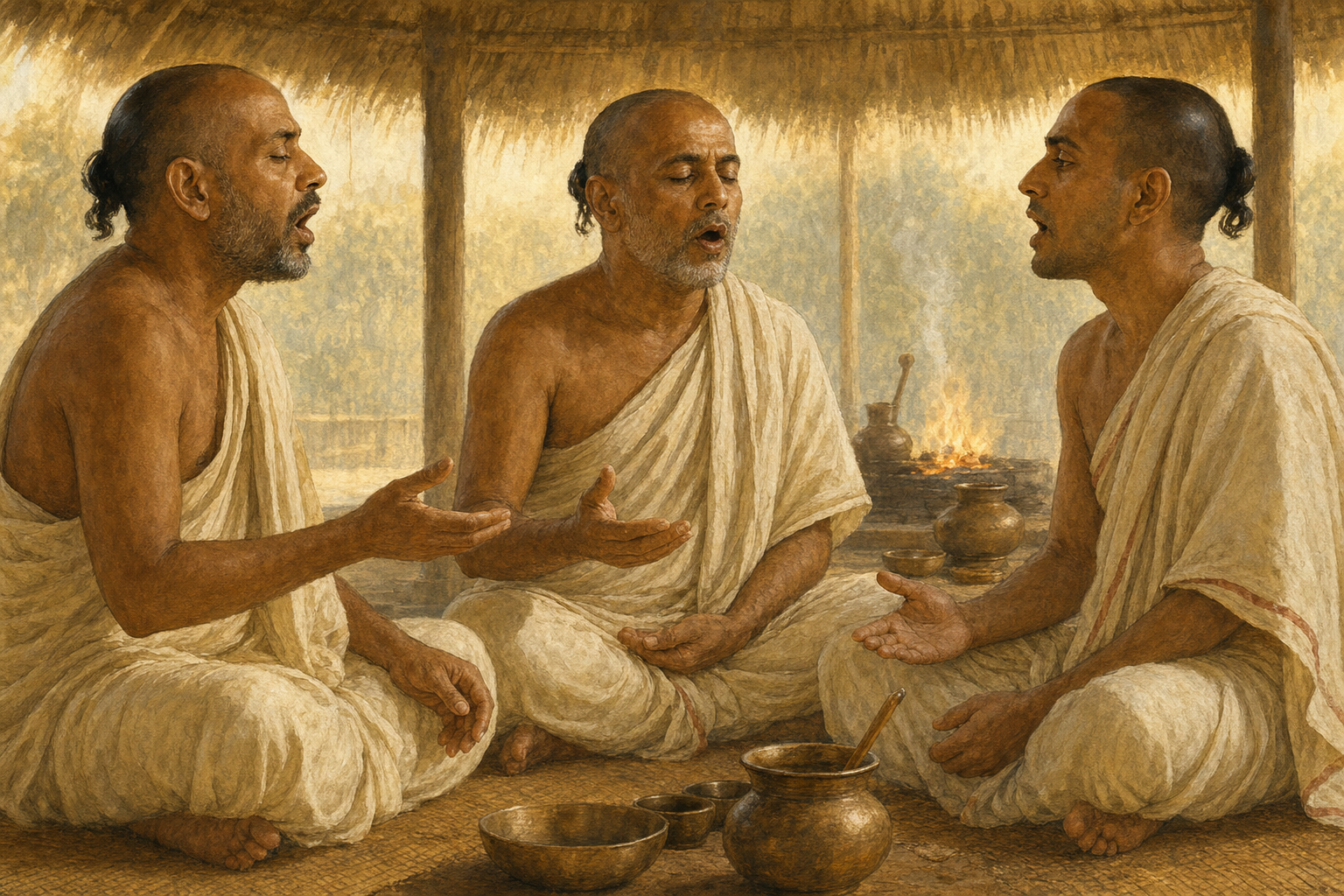
The Udgātṛ group carries this architecture through the coordinated work of the Udgātṛ, Prastotṛ, and Pratihartṛ. Responsibility for the chant portions is distributed among one or more of these singers. That distribution gives the performance an ordered, responsive character, but the parts still belong to one intelligible progression. Nidhana is where that progression is settled.
If you are studying from a complete recording, write the five names in order before listening. Mark each change you can identify, but leave nidhana unmarked until the terminal cadence is clear. This prevents you from treating every interruption or breath as a formal division.
Why a musical ending governs the next ritual action
Agnistoma is a coordinated Soma sacrifice, not a concert followed by a separate ritual. Its liturgical work draws together priestly functions associated with the four Vedas. The Hotṛ recites Ṛg Veda verses. The Adhvaryu directs ritual action and uses Yajur Veda formulae. The Udgātṛ group sings the Sāma Veda chants. The Brahman supervises the rite and addresses ritual slips.
Because these functions interlock, the end of a chant has procedural consequences. The Adhvaryu must know when a chant-governed interval has been completed; recitation, offering, and transition cannot be allowed to overlap merely because the musical boundary was indistinct. A clear nidhana supplies an audible point around which the officiants can coordinate.
This is especially important across the morning, midday, and evening Soma pressings. Each pressing contains ordered liturgical activity, and the rite advances through a series of defined units rather than one continuous, undifferentiated performance. Nidhana helps distinguish what has been completed from what is now due.
Think of it as a handoff, but not as an external command inserted into the music. The cadence performs the handoff by completing the music properly. Its ritual force and musical form are therefore not two unrelated meanings attached to the same word. The formal ending is useful procedurally precisely because it is musically recognizable.
This also explains why nidhana should not be dismissed as ornament. If the terminal phrase were treated as optional decoration, the shared boundary between chant and succeeding action would become less clear. Its beauty belongs to its exactness: melody, breath, attention, and ritual timing are brought to repose together.
How to recognize nidhana without inventing a universal tune
You should not expect every lineage to render nidhana with an identical melodic contour. Śākhā-based and lineage-specific traditions preserve variations in melody and micro-timing while retaining the same functional requirement: the terminus of the sāman must remain intelligible. Position and function are therefore safer guides than an imagined universal set of final notes.
- Begin with the ritual context. Confirm that you are hearing a Sāma Veda performance within a stotra sequence, not an isolated recitation or a different form of devotional singing.
- Listen from the prastāva. A short clip of the ending may let you hear a cadence, but it cannot reliably show how that cadence completes the preceding architecture.
- Track the five functions. Follow entry, principal expansion, interposed response, transitional preparation, and conclusion. You do not need to reproduce the melody to notice this ordered movement.
- Watch or listen for the handoff. In a complete ritual record, note whether the resolved chant is followed by the next offering, formula, or prescribed transition. That context helps distinguish formal closure from an internal pause.
- Keep lineage comparisons within their limits. Compare complete, authenticated performances when possible, and do not combine fragments from different traditions to construct a supposedly standard nidhana.
A trained listener may recognize the cadence in detail, while an untrained participant may simply feel that the chant has come to rest. Both responses can register the same structural event, but only the first should be treated as a basis for technical performance. If your aim is to learn the singing rather than understand it as a listener, work with a competent bearer of the relevant oral lineage.
For serious study, use three forms of evidence together: a complete performance by trained ritualists, an authenticated recording that preserves the whole chant sequence, and the relevant Śrauta Sūtra or lineage manual. The performance reveals living timing, the recording permits repeated listening, and the procedural material helps you identify what the singers and other officiants are accomplishing at the boundary.
Key takeaways
- Nidhana is the fifth and concluding component in the sequence prastāva, udgītha, pratihāra, upadrava, and nidhana.
- It is a crafted terminal cadence, not merely the absence of sound after singing stops.
- Its musical resolution also marks a ritual handoff, allowing the next prescribed action to proceed clearly.
- It closes a designated chant-linked unit; it should not automatically be read as the end of the entire Somayaga.
- Lineages may differ in melodic contour and micro-timing, so identify nidhana by its position and function before comparing its sound.
The next time you hear an Agnistoma recording, do one concrete thing: follow the chant from prastāva instead of jumping to the last syllable. Mark nidhana only when the melody resolves and the ritual context confirms the transition. That small discipline turns a vague impression of an ending into an understanding of how Sāma Veda sound orders sacrificial action.

References
