

If you are planning a journey through Bengal’s Shakta temples, a list of addresses solves the least important problem. It tells you where to go, but not why an eye, lip, windpipe, wrist, crown, or toe can disclose a different way of knowing the same Divine Mother.
Read the peethas as one sacred body rather than ten disconnected destinations. That single change will help you choose a meaningful circuit, understand apparently conflicting traditions, and recognize the theology already present in each shrine’s name, image, ritual mood, and surroundings.
The sacred map is Sati’s body, not a temple checklist

The foundational narrative begins with the Daksha Yajna and Shiva’s grief after the death of Sati. As Shiva carried her body through the worlds, limbs and ornaments descended at different places. Each descent established a locus of Shakti: not merely a memorial to something that happened, but a place where the Mother’s power could be approached through worship, pilgrimage, mantra, and inherited memory. The Devi Bhagavata Purana, Kalika Purana, regional traditions, and Tantric compendia preserve this geography of embodied divine presence.
The theological result is striking. The body is dispersed, yet the Goddess is not divided into fractions. Every peetha presents a complete encounter with Shakti while emphasizing a particular mode of her power. Sacred authority is therefore distributed across the land without requiring a single shrine to exhaust the Mother’s identity. Bengal’s cluster makes this especially visible because several bodily associations can be encountered within one regional pilgrimage culture.
You should not expect every traditional inventory to match. Some reckon four principal peethas, some eighteen maha-peethas, and others fifty-one or fifty-two sites. The body part, the name of the Goddess, and the paired Bhairava can also differ between recensions and local accounts. These variations belong to the tradition’s transmission; they are not a problem that a pilgrim must solve by declaring one modern checklist victorious.
A useful way to approach any peetha is to hold three levels together:
- The pan-Dharmic narrative: Sati, Shiva, the Daksha Yajna, and the sanctification of place through the descent of Shakti.
- The regional pattern: Bengal’s shrines form a network in which vision, speech, breath, action, support, movement, and sovereignty become complementary expressions of the Mother.
- The local memory: the temple’s own name, sthala-purana, deity form, Bhairava association, festivals, and ritual customs tell you how that community inhabits the larger narrative.
At the shrine, therefore, do not ask only, “Which body part fell here?” Also ask, “What does this community understand that body part to reveal about Shakti?” Record variant accounts respectfully when you encounter them. A living sacred geography is layered memory, not a standardized museum catalogue.
Ten peethas offer ten ways to notice the Mother
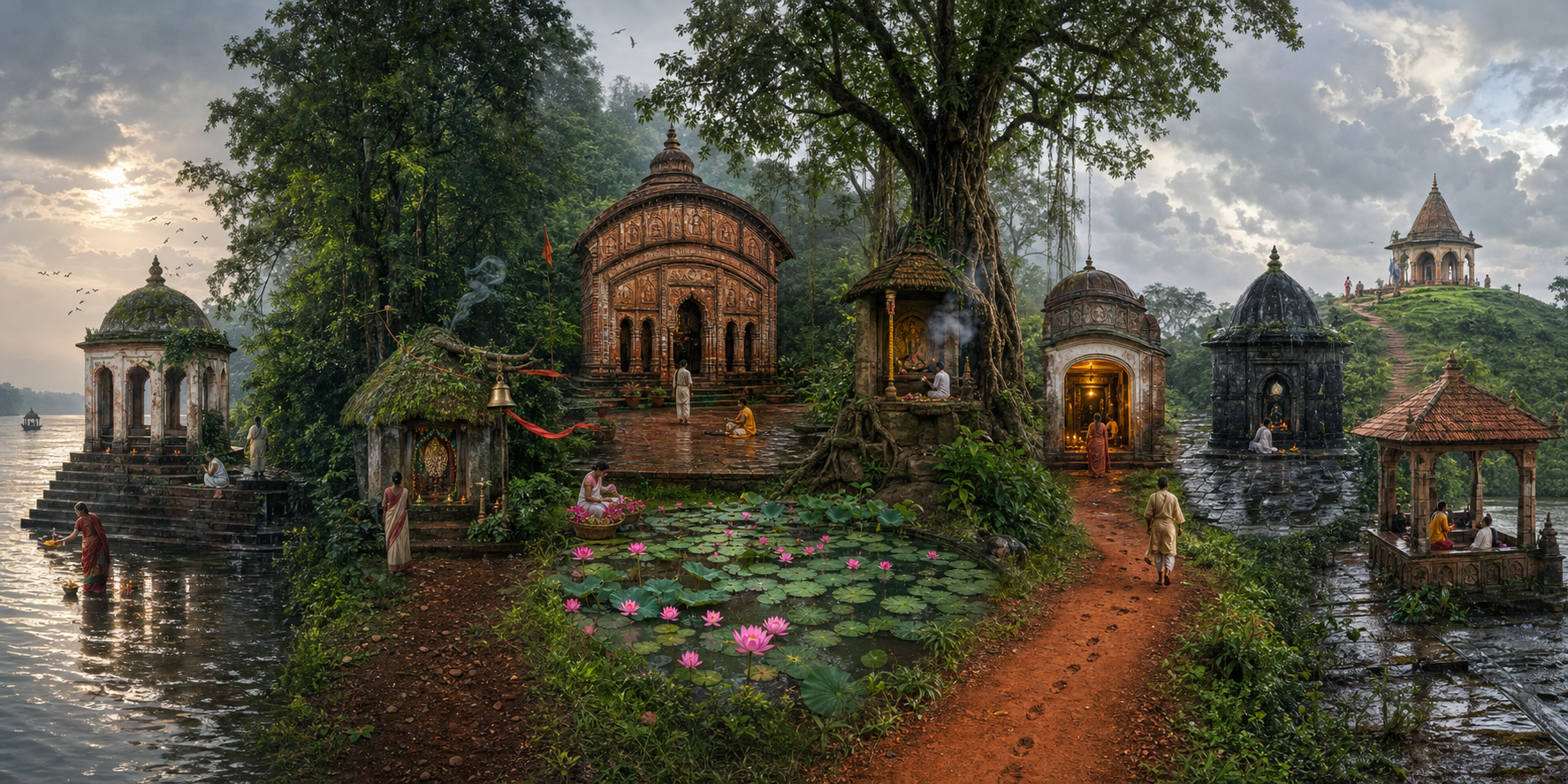
The bodily associations below are best used as contemplative lenses, not as mechanical promises that a particular temple will produce a particular result. They follow widely observed traditions in West Bengal while preserving uncertainty where local and textual accounts differ.
| Shrine and traditional association | Form or setting | A theological lens | What you can notice |
|---|---|---|---|
| Kalighat, Kolkata: right toe | Kalika beside the historic Adi Ganga channel | Movement, immediacy, and fierce compassion | Notice how an intense urban temple remains part of an embodied sacred map rather than standing apart from ordinary city life. |
| Tarapith, Birbhum: eye or netra | Tara, the temple, and the adjacent maha-shmashana | The Mother’s gaze, mortality, and redemptive presence | Hold worship and cremation-ground awareness within one field. The maha-shmashana is a place of serious contemplation, not occult spectacle. |
| Attahas at Labhpur, Birbhum: lower lip or adhara | Phullara in a comparatively quiet setting | Expression, sound, and cosmic laughter | Notice the contrast between the name Attahas, or great laughter, and the shrine’s contemplative rhythm, as well as its connection with regional folk culture. |
| Kankalitala near Bolpur-Shantiniketan, Birbhum: back, spine, or skeletal portion | A protective form of Shakti | Structure, endurance, and support | Read the skeletal association as what holds the embodied being upright, not merely as a frightening image. |
| Nandikeshwari at Sainthia, Birbhum: throat, neck, or necklace | A shrine with a pronounced Shaiva association | Voice, mantra, and spiritual articulation | Listen to how bells, recitation, names, and spoken prayers make sound part of the sacred environment. |
| Nalateshwari at Nalhati, Birbhum: windpipe or nala | A black-stone form commonly adorned with red vermilion | Breath, life-force, and the passage of sound | Observe how breath and voice are implied by the bodily association while dark stone and red adornment hold fierceness and benevolence together. |
| Bahula at Ketugram near Katwa, East Bardhaman: left arm or bahu | A quieter regional shrine | Strength, work, and the capacity to uphold dharma | Ask what steady action, rather than momentary emotion, your own obligations require. |
| Ujani near Kandi, Murshidabad: right wrist or manibandha | A local form associated with Mangalchandi | Agency, skill, and the keeping of a vow | Use the wrist association to examine how intention becomes action through the hand. |
| Kiriteswari at Kiritkona near Kandi, Murshidabad: crown or kirit | Kiriteswari within Murshidabad’s layered historical landscape | Sovereignty, judgment, and responsibility | Think beyond status. A crown asks whether authority is governed by discernment and service. |
| Bhramari Devi at Trisrota, Jalpaiguri: left leg or a related limb | The Bee Goddess amid streams connected with the Teesta landscape | Protection, coordinated power, and movement | Attend to the riverine and forested setting. The bee image presents power not only as individual force but as harmonized multiplicity. |
Several currents appear when you look across the table. Attahas, Nandikeshwari, and Nalateshwari form a vocabulary of lip, throat, and windpipe. Expression depends upon voice; voice depends upon breath. If your concern is truthful speech, mantra, teaching, music, or restraint in language, this cluster gives you a coherent line of contemplation without claiming that the three shrines are interchangeable.
Bahula, Ujani, and Kiriteswari move from arm to wrist to crown. Strength alone is incomplete. It must become skillful action and then submit to discernment. A pilgrim carrying family, professional, or civic responsibility can use these three associations to examine whether capacity, execution, and judgment are aligned.
Tarapith, Kankalitala, Kalighat, and Bhramari provide another sequence: seeing, being supported, taking a step, and continuing to move. This is not a secret code imposed upon the temples. It is a disciplined way to let their traditional bodily associations question you. The peetha gives your attention a focus; it does not turn devotion into a vending machine for guaranteed outcomes.
Kali’s darkness and Shweta Kali’s radiance belong together
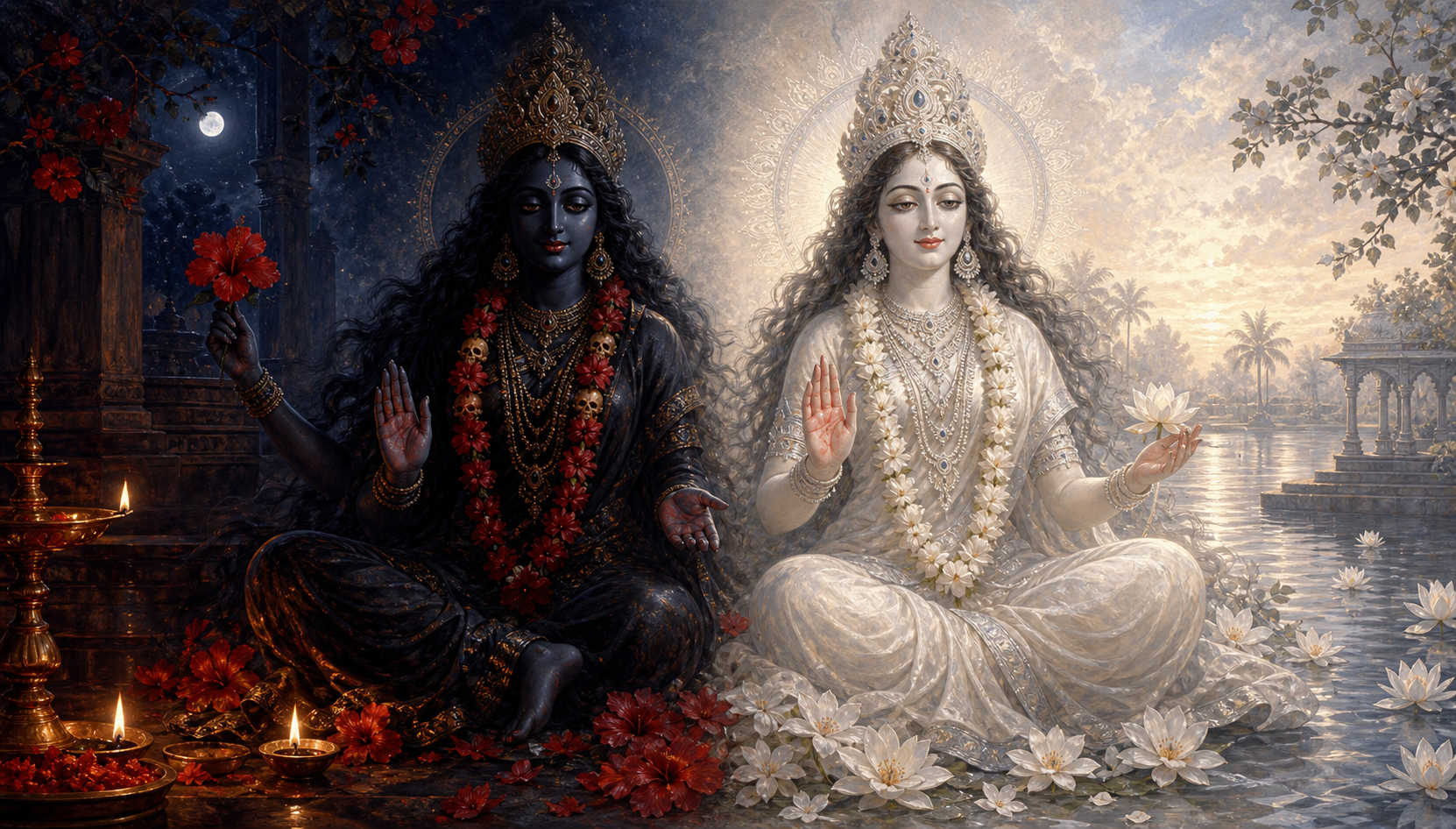
A common misunderstanding reduces Kali to a frightening black image and then treats every gentler form as a dilution of her power. Bengal’s Shakta inheritance is subtler. Shweta Kali, the white or luminous Kali preserved especially in domestic and initiatory settings, shows that serenity and ferocity can be modalities of one cosmic power rather than rival deities.
Shveta signifies brightness, purity, and revelation, while Kali carries the resonance of time, limit, darkness, and the power that brings forms forth and gathers them back. Their conjunction is deliberately paradoxical. Shweta Kali unites luminous emergence with transformative return: life appears, matures, dissolves, and returns to ash, while awareness is not exhausted by the passing form.
The philosophical language of prakasha and vimarsha sharpens the point. Prakasha is luminosity, the capacity for reality to be manifest. Vimarsha is self-aware power, the capacity to know and articulate that manifestation. Light without power would reveal nothing; power without awareness would not be the conscious Shakti revered by the tradition. In simpler terms, what illuminates and what acts are not finally separate.
Shweta Kali’s iconography can include a white or moonlike complexion, three eyes, four arms, a sword, a skull-cup, and hands displaying abhaya and varada, the gestures of fearlessness and grace. White or ash-grey clothing, silver-toned ornaments, a crescent moon, a white lotus, or a cremation-ground background may appear according to lineage. Some representations invert the familiar contrast by placing a luminous Goddess against a dark support. None of these details should be isolated from the whole image.
When you encounter a Kali image, read it in this order:
- Look at the relationship between the deity’s colour and the background. White and black may be complementary, not morally opposed.
- Read all the hands together. A sword and skull-cup can coexist with fearlessness and generosity; clarity is not passivity, and force is not the whole identity of the Goddess.
- Notice the ground or seat. Cremation-ground ash, a lotus, Shiva’s stillness, or a dark mandala changes how the form’s mood is understood.
- Attend to ritual mood as well as visual form. Flowers, lamps, fragrance, mantra, the lunar day, and the worshipping community help disclose whether the prevailing bhava is peaceful, fierce, protective, or transformative.
Large public temples may foreground Dakshina Kali or Bhadrakali even where households and initiated lineages preserve Shweta Kali upasana. Do not mistake low public visibility for theological insignificance. It often means that the practice is transmitted through family custom, a guru, or a particular paddhati rather than through a large public festival.
For respectful non-initiatory remembrance, publicly shared formulas include oṁ krīṁ kālikāyai namaḥ and oṁ hrīṁ shaktiyai namaḥ. Lineage-specific auxiliary mantras, nyasa, and advanced Tantric procedures belong under qualified guidance. That boundary is not needless secrecy. It preserves the relation between mantra, ethical preparation, method, and initiation that gives Tantric practice its integrity.
Tara also helps you approach shared Dharmic resonances without erasing differences. She is central in both Shakta Tantra and Buddhist Vajrayana, while white deity forms in Vajrayana can express pacification and healing. Jain uses of white as a sign of purity and Sikh affirmation of the timeless One offer further points of resonance. These parallels can open respectful conversation, but they do not make distinct mantras, metaphysics, or ritual authorities interchangeable. Shared vocabulary should deepen attention to each lineage, not flatten it.
Plan a pilgrimage around one theological question
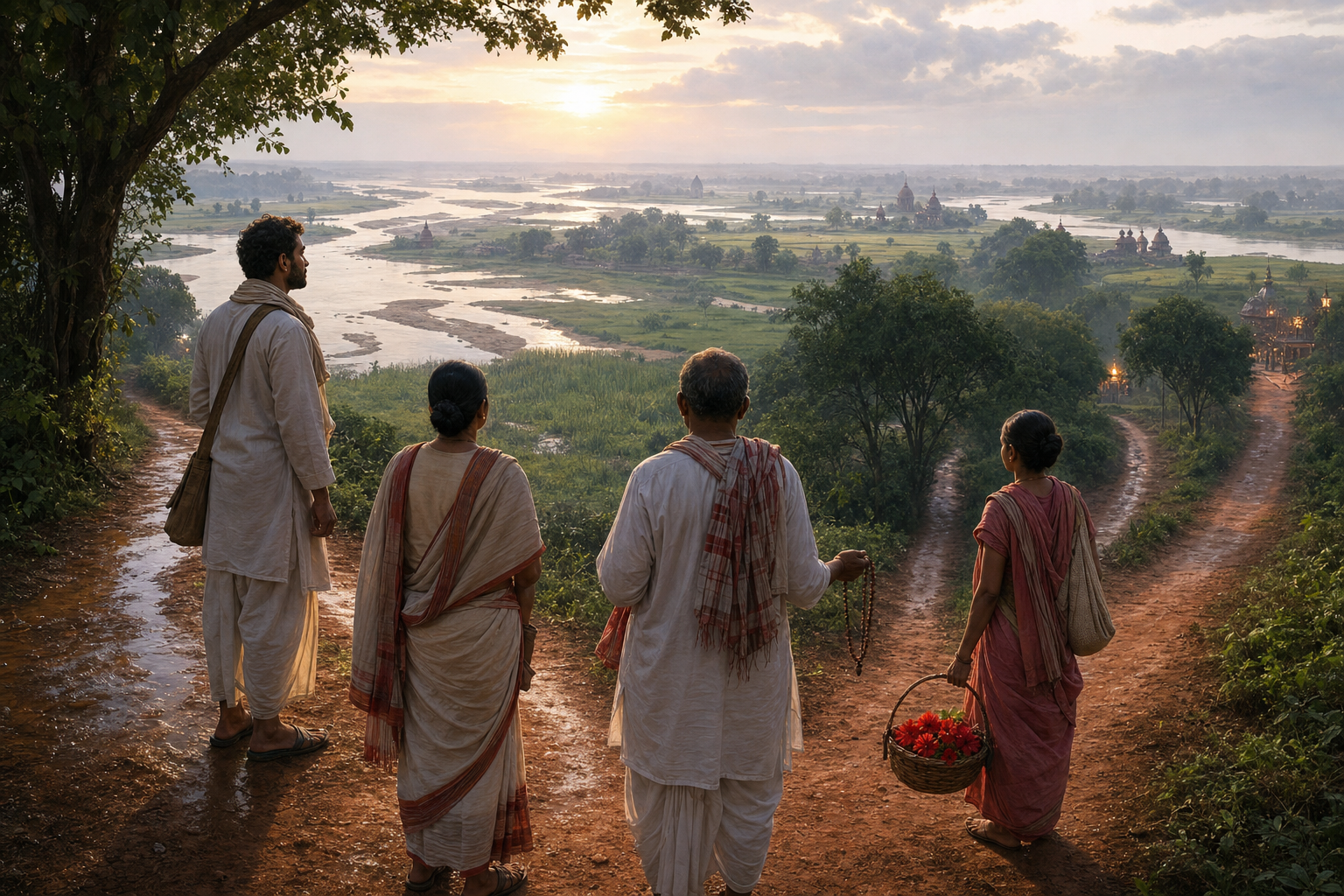
A rushed attempt to collect all ten names will give you less than a focused visit to two or three shrines. Decide first what you need to understand. Then let geography determine a manageable circuit.
Choose the circuit that fits your purpose
- For a first urban encounter, begin at Kalighat. Its accessibility and intensity make it a strong point of entry, but do not assume one metropolitan shrine represents the full range of Bengali Shaktism.
- For voice, breath, and mantra, use the Birbhum cluster. Nandikeshwari, Nalateshwari, and Attahas establish the main thread; Tarapith and Kankalitala add vision, mortality, and support.
- For action and responsibility, link Bahula’s arm, Ujani’s wrist, and Kiriteswari’s crown. The sequence moves from capacity through execution to judgment.
- For a broad regional arc, begin in Kolkata, continue through the Birbhum shrines, include Bahula in East Bardhaman, pair Ujani with Kiriteswari in Murshidabad, and reserve Bhramari at Trisrota for the North Bengal leg. The Kalighat-Birbhum-Bardhaman-Murshidabad-North Bengal sequence is a framework, not a fixed timetable.
Bhramari deserves separate time because the Himalayan foothill and Teesta-connected setting contributes materially to the encounter. Murshidabad likewise invites historical exploration, while Kankalitala can be paired with the cultural landscape around Shantiniketan. Let those contexts deepen the pilgrimage, but do not turn darshan into a hurried stop between sightseeing appointments.
Use the same discipline of attention at every shrine
- Write one question before you enter. “What should I ask for?” is usually less revealing than “What must I learn about speech, action, mortality, courage, or responsibility?”
- Record the local triad: the Goddess’s name, the body-part association, and the Bhairava or Shaiva association given at that shrine. If another account differs, place it beside the first instead of silently replacing it.
- Choose your level of ritual density. Early morning and twilight arati can provide an immersive temple rhythm. Sharadiya Navaratri, Kali Puja on Kartik Amavasya, Maghi Purnima, full-moon observances, and local anniversaries can bring much larger congregations. Choose a festival if collective intensity is your purpose; choose a quieter period if sustained contemplation matters more.
- Keep public practice simple. Darshan, a locally accepted offering, recitation of the Devi Mahatmya, a straightforward panchopachara observance, or a public nama-mantra is sufficient. Do not imitate specialized Tantric acts merely because a shrine is associated with Tantra.
- Give the setting time to speak. At Kalighat, notice the urban current and the Adi Ganga. At Tarapith, approach the cremation-ground dimension with sobriety. At Trisrota, listen to water, insects, and the forested approach. Sacred geography includes the land around the sanctum.
- End with one concrete vow of conduct. A throat shrine might call for more truthful speech; an arm shrine, for work you have delayed; a wrist shrine, for fidelity to a promise; a crown shrine, for a decision governed by discernment rather than prestige.
The same principle should govern offerings. Shweta Kali observances may use white flowers, sandalwood, milk, coconut, kheer, bananas, and a ghee lamp, while other Kali traditions employ a different visual and ritual vocabulary. Follow the shrine or household lineage in front of you. Do not impose one form’s offerings upon every manifestation of the Goddess.
Key takeaways
- Bengal’s Shakti Peethas are best understood as one distributed sacred body, with each place revealing a distinct aspect of complete Shakti.
- Differences in the number of peethas, body-part associations, deity names, and Bhairava names are normal features of textual and local transmission.
- The body parts offer a practical vocabulary: lip, throat, and windpipe illuminate expression; arm and wrist illuminate action; crown illuminates discernment; eye illuminates vision; spine illuminates support.
- Shweta Kali prevents a shallow opposition between peaceful white and fierce black. Luminosity, time, creation, dissolution, fearlessness, and grace belong to one theology.
- A meaningful pilgrimage follows one question through a manageable cluster instead of treating the shrines as items to be collected.
- Simple public devotion and initiated Tantric sadhana are not the same. Respect the boundary around lineage-specific mantra, nyasa, and ritual procedure.
For your next visit, carry one page with four headings: site and body part, form of the Goddess, local variation, and one change in conduct. Complete it before moving to the next shrine. When the map begins to change how you speak, act, decide, or face impermanence, sacred geography has become sadhana rather than tourism.
References
- DharmaRenaissance Blog — 10 Sacred Shakti Peethas of Bengal: Definitive Guide to Legends, Deities, and Pilgrimage
- DharmaRenaissance Blog — Shweta Kali Unveiled: The White Radiance of Kali, Creation’s Source and Ash’s Return
