
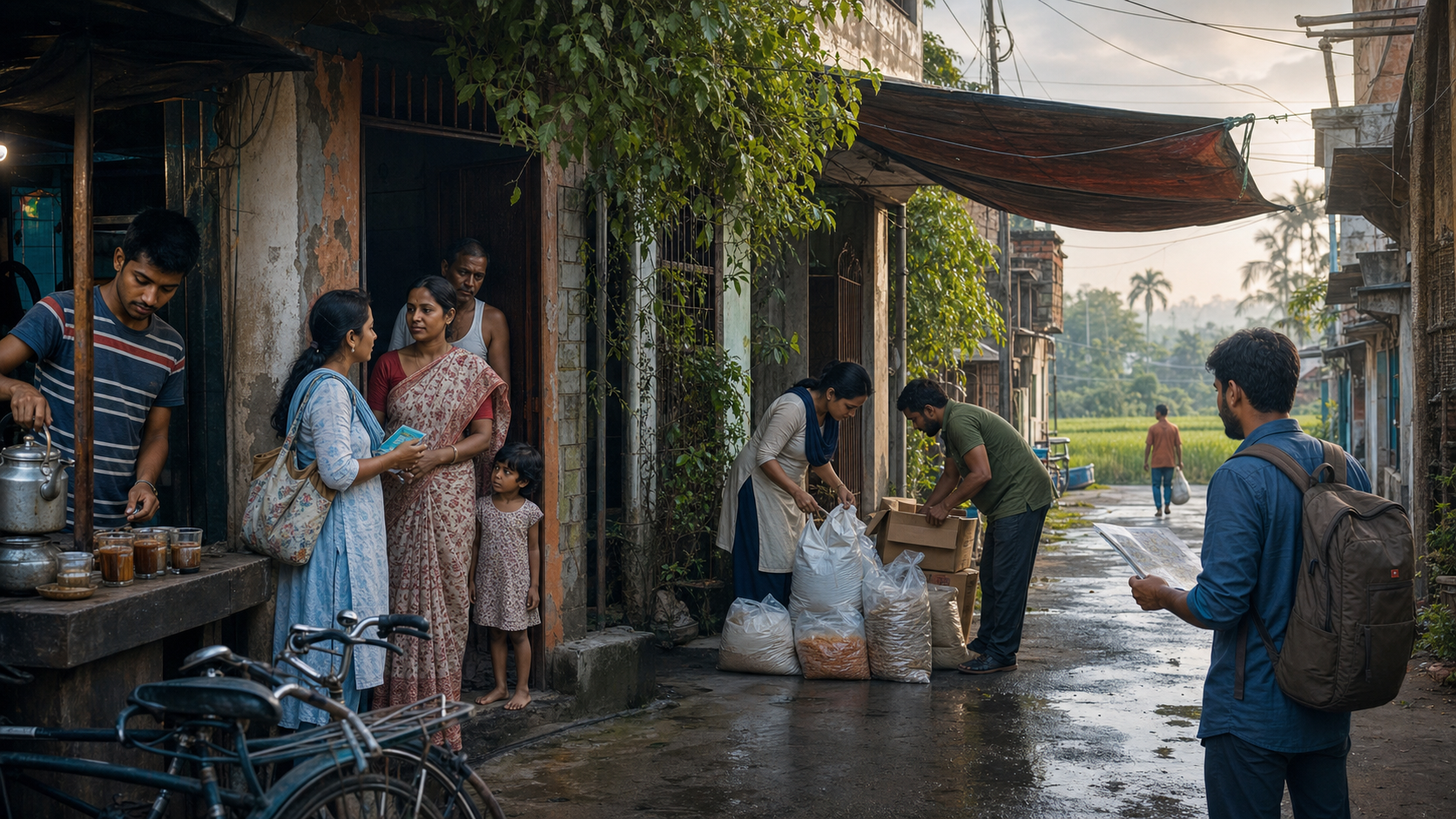
If you are trying to decide whether RSS activity can really alter West Bengal’s electoral balance, do not start with rally footage, television arguments, or the volume of slogans online. The more useful question is whether a neighbourhood network can turn repeated service and cultural contact into trust, turn trust into political preference, and then convert that preference into turnout and seats.
That distinction matters because Bengal has already moved from a largely one-sided contest to a sharper rivalry. The BJP rose from the periphery to become the principal challenger, but the TMC retained its primacy in the 2021 Assembly election, while the 2024 Lok Sabha result forced both sides to reassess their strengths. The quiet mobilisation associated with the RSS is an attempt to change the contest below the level at which most political commentary looks.
The real test is conversion, not visibility
The RSS and the BJP occupy related but different organisational spaces. A shakha is not a booth committee. A relief team is not an election office. Seva Bharati, the Vishwa Hindu Parishad, student organisations, labour fronts, and other parts of the wider Sangh ecosystem may build relationships that later help political mobilisation, but their social presence does not automatically become a BJP vote.
To judge the strategy honestly, follow the entire chain rather than stopping at its most visible link:
- Presence: Are volunteers active in the locality outside election periods, festivals, and emergencies?
- Credibility: Do residents regard them as dependable people who return after the first meeting or relief effort?
- Political translation: Does goodwill extend to the BJP’s local leadership and programme, or remain attached only to a respected social worker?
- Turnout capacity: Can supporters maintain lawful voter contact, correct confusion, and help people participate without intimidation or collective pressure?
- Seat efficiency: Is the support growing in constituencies where a modest shift can affect the result, or merely deepening in places already politically settled?
A large cultural gathering proves that an organisation can convene an audience. It does not prove that the audience will vote together. A well-run flood or cyclone response proves operational capacity. It does not establish permanent loyalty. Even a growing volunteer roster can mislead if the same names appear in several committees, activity fades after recruitment, or local workers cannot resolve ordinary grievances.
TMC’s ward machinery, welfare relationships, local intermediaries, and festival-season presence set a high conversion threshold. Quiet organisational growth can therefore be real without being electorally decisive. When you hear that the RSS is expanding, ask three follow-up questions: How many volunteers remain active after several months? How often does the organisation return to the same households? Can local residents name a credible second line of leadership, rather than only a prominent state figure?
This is also why the prominence of Suvendu Adhikari cannot settle the organisational question. A recognised opposition leader can give the challenge a public face, but constituency outcomes still depend on mandal- and ward-level people who are accessible when there is no camera nearby.
The neighbourhood network matters more than the slogan
Silent mobilisation is best understood as low-visibility, high-frequency work. It includes shakha routines, mentoring, civic service, cultural programmes, volunteer recruitment, household contact, page-level voter organisation, turnout preparation, and closed digital groups carrying hyperlocal information. None of these activities is dramatic on its own. Their force comes from repetition and coordination.
The strongest network has several layers. A respected local organiser brings social memory. Younger volunteers provide energy and digital reach. Women volunteers can hear concerns that may never surface in a male-dominated political meeting. Occupational and neighbourhood links help distinguish a trader’s municipal problem from a student’s transport concern or a farming family’s irrigation worry. A network becomes politically significant when information can travel upward and a useful response can travel back down.
You can assess that network without access to internal membership figures. Look for observable behaviour:
- Local meetings produce named follow-up responsibilities rather than another round of speeches.
- The same households receive repeat contact, but people who decline political engagement are treated respectfully.
- Service continues after an emergency leaves the news cycle.
- Women and younger volunteers hold real responsibilities rather than appearing only as an audience.
- Local organisers can explain which problem belongs to a municipality, the state government, the Union government, or a voluntary body.
- Digital messages point residents toward verifiable procedures instead of relying on outrage, rumours, or anonymous claims.
Seva requires an additional dharmic test. Service may create goodwill, but it should not be reduced to disguised voter acquisition. A family receiving food, medical help, or emergency assistance does not incur a political debt. When volunteers serve people without testing their party preference, caste, sect, or community, they build the moral credibility that makes long-term social cooperation possible. When aid is treated as leverage, both seva and politics are diminished.
Closed digital channels also have two edges. They can correct a local rumour quickly and coordinate volunteers efficiently. They can just as easily recycle an unverified allegation inside a trusting group. If you participate in such a network, pause before forwarding claims about violence, citizenship, religious communities, or electoral procedure. Ask for a named authority, a complete document, or a verifiable local contact. Message discipline is valuable only when it includes factual discipline.
Bengali cultural fluency is the strategic hinge
Bengal does not need its civilisational inheritance explained to it through borrowed political theatre. A successful Hindutva vocabulary in the state must sound at home in Bengali language, memory, devotional life, and social manners. That is why Vivekananda, Bankimchandra, Ramakrishna, and Sarada Devi appear so naturally in this political register. They connect spiritual thought, cultural confidence, service, and national belonging to a recognisably Bengali experience.
But invoking revered names is not the same as absorbing their meaning. Cultural fluency can be tested in three ways.
- Roots rather than costume: Does a local leader speak naturally about Bengali concerns and traditions, or insert a few familiar names into an otherwise imported script?
- Pride without antagonism: Does the message affirm Hindu dignity and constitutional rights without assigning collective guilt to another community?
- Principle joined to practice: Does an appeal to Vivekananda’s service-centred patriotism lead to concrete commitments on schools, skills, health, or youth opportunity?
The second test is especially important. Bengal’s Hindu life contains Shakta, Vaishnava, Shaiva, and folk traditions with different practices and local histories. Buddhist institutions in the hills, Jain mercantile traditions, and Sikh seva institutions also belong to the state’s wider social fabric. A dharmic unity worthy of the name protects this plurality. It does not flatten every tradition into one political style.
For a pro-Hindu movement, restraint is not ideological weakness. It is evidence that cultural confidence does not depend on humiliating a neighbour. A mobilisation that rejects demonisation, collective blame, and religious provocation can defend Hindu interests while remaining faithful to constitutional citizenship. It also denies opponents an easy path to defensive consolidation among voters who might otherwise be open to a governance alternative.
The practical question to ask after any culturally framed speech is simple: what follows the invocation? If the answer is a credible plan for employment, school access, primary healthcare, municipal reliability, or safer public space, culture is anchoring a programme. If nothing follows but sharper identity language, symbolism is being asked to carry more electoral weight than it can bear.
The same message will not travel across Bengal
West Bengal is not one political market. Organisational presence, local leadership, and welfare access can carry particular weight in northern districts and the Junglemahal belt. Kolkata and its peri-urban surroundings place greater pressure on any challenger to speak credibly about jobs, transport, civic amenities, and everyday governance. Border districts add migration histories, documentation fears, and citizenship debates that cannot be handled safely through slogans.
This geographic variation changes what a serious local conversation should contain. In an urban or peri-urban ward, ask who is responsible for an unreliable civic service, what remedy is proposed, and how progress will be measured. In a farming locality, ask what an employment slogan or cultural programme means for irrigation stability, input pressure, and access to services. In the north, test whether a visiting leader is strengthening durable local leadership or merely passing through.
The Matua-Namasudra question joins displacement, dignity, documentation, and policy. It therefore demands procedural clarity rather than rhetorical maximalism. A responsible organiser should be able to distinguish a political promise from an enacted rule, explain where reliable legal information can be obtained, and avoid presenting uncertain individual outcomes as guaranteed. People facing documentation questions need accurate procedures, not pressure to display loyalty.
Women voters create another test that cuts across geography. TMC’s welfare ecosystem has made continuity and reliability central electoral concerns. An alternative cannot answer that reality by treating welfare as an afterthought or dismissing recipients as politically dependent. It must establish comparable credibility on safety, healthcare, scholarships, and household cash flow.
When you hear a new women-centred promise, do not judge it only by the headline benefit. Ask who qualifies, whether an existing benefit continues, which office administers it, how payment or service failure is challenged, and whether the local organisation can explain the process consistently. A larger promise with an unclear delivery chain may be less persuasive than a familiar benefit that arrives predictably.
Younger voters need the same level of specificity. General claims about development are weak substitutes for a visible path from education to work. In Siliguri or another urban centre, the meaningful questions concern campus safety, internships, transport reliability, and employment access. An organiser who can discuss these matters concretely is doing more valuable political work than one who can only repeat a national slogan.
The small trader, student, farmer, and welfare-dependent household do not leave identity behind when they assess politics. They combine identity with risk. They ask whether a change in power will make routine life more predictable or disrupt something on which the household relies. RSS mobilisation becomes competitive when local volunteers can address both sides of that calculation without pretending one cancels the other.
Key takeaways: the signals that deserve your attention
- Count durable relationships, not public events. Repeat visits, completed follow-ups, and active second-line leaders reveal more than rally attendance.
- Separate social reach from electoral conversion. Respect for a relief worker, shakha organiser, or cultural body does not automatically transfer to the BJP or its candidate.
- Test cultural language for Bengali depth. Vivekananda, Bankimchandra, Ramakrishna, and Sarada Devi should lead into service and governance, not function as decorative references.
- Watch women-voter confidence closely. Safety, health, scholarships, cash-flow reliability, and continuity of existing welfare can outweigh a poorly explained alternative.
- Demand job and governance mechanisms. Employment corridors, support for small enterprises, teacher recruitment, primary healthcare, and urban transport matter only when voters can see how delivery would work.
- Treat border and citizenship questions with constitutional care. Legal literacy and procedural transparency build trust; exaggeration and communal blame create fear and backlash.
- Reject the false choice between Hindu confidence and social harmony. A durable dharmic politics can defend rights while preserving the dignity of every citizen.
These signals point toward three broad outcomes. An ascendancy path opens if culturally fluent mobilisation joins disciplined local organisation, credible women-centred commitments, and a serious employment programme. A stalemate follows if volunteer growth remains incremental while welfare loyalty and TMC’s ward presence absorb the challenge. A backlash becomes likely if cultural overreach revives the outsider charge, alienates Bengal’s plural sensibility, or encourages defensive voting.
Silence itself is not a strategy. It is only a mode of operation. Without public policy commitments, a quiet network can be mistaken for hesitation. Without Bengali leadership, it can look externally directed. Without organisational discipline, it becomes scattered activity. Without constitutional restraint, it can magnify the very polarisation that limits its reach.
Your most reliable assessment will therefore come from the ward, not the headline. Notice who returns after making contact, who can explain a policy without changing the subject, who serves without demanding allegiance, who speaks to Bengali cultural memory without reducing it to a campaign prop, and who corrects a rumour even when the rumour helps their side. Those habits will reveal whether RSS mobilisation is building durable civic trust or only another layer of election-season noise.

References
