
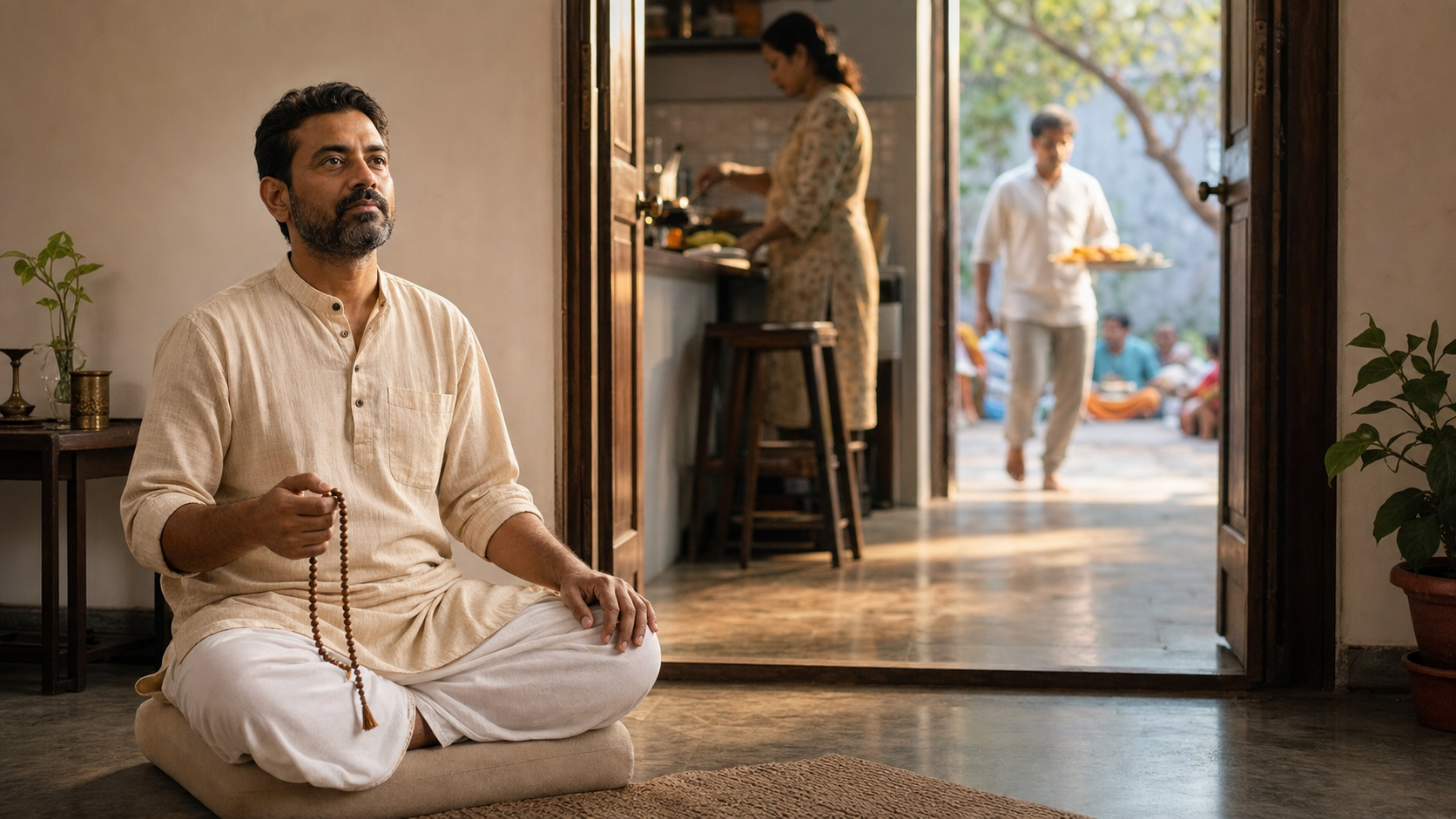
If you are wondering whether japa, meditation, simran, prayer, seva, or breath practice changes anything beyond how you feel in the moment, start with a narrower question: what capacity are you trying to train? A racing mind, reactive speech, grief, moral confusion, loss of meaning, and isolation do not call for exactly the same practice.
Dharmic spirituality becomes useful when you treat it as repeated training rather than a label. Its practical promise is not a life without pain. It is a steadier way to meet pain: regulate arousal, see a situation more clearly, choose an ethical response, and remain connected to a purpose larger than the immediate crisis.
What evidence can establish, and what it cannot
Evidence-based does not mean that every spiritual teaching has been experimentally proved. Contemplative methods can be assessed through changes in attention, perceived stress, sleep, emotional recovery, social behavior, stress biomarkers, and autonomic measures such as heart rate variability. Experiments cannot settle questions about moksha, nirvana, karma, rebirth, divine reality, or the ultimate nature of consciousness.
Keeping those domains distinct protects both science and spirituality. You do not need to reduce dharma to physiology in order to value physiological evidence. Nor should a peaceful meditation experience be treated as proof of every metaphysical claim associated with a tradition.
The practical evidence is most meaningful when a specific method is matched to a specific outcome. Slow breathing is relevant to arousal. Focused repetition trains attentional return. Compassion practice works on hostile or avoidant habits. Ethical commitments guide conduct. Seva turns values into action. Sangha, satsang, and sangat address isolation and accountability. These practices are associated with outcomes ranging from lower perceived stress and better sleep to clearer attention, emotional steadiness, and stronger social connection, but no practice guarantees the same result for every person.
Key takeaways
- Choose a practice for the capacity you need to develop, not because the practice is fashionable or sounds advanced.
- Look for functional change: quicker recovery after stress, less impulsive speech, better sleep, clearer decisions, and more reliable ethical action.
- Combine inner practice with ethics, service, and community. Calm without responsibility is not the full Dharmic aim.
- Use spiritual practice alongside appropriate medical or psychological care, never as a reason to avoid it.
The benefits appear across body, mind, conduct, and community
A calmer nervous system gives you room to respond
Stress narrows attention and prepares the body for rapid action. That response can be protective, but it becomes costly when it remains active after the danger has passed. Slow, comfortable pranayama or anapanasati can shift autonomic balance toward rest and recovery. Japa and simran add a stable attentional object, reducing the number of openings through which worry keeps re-entering.
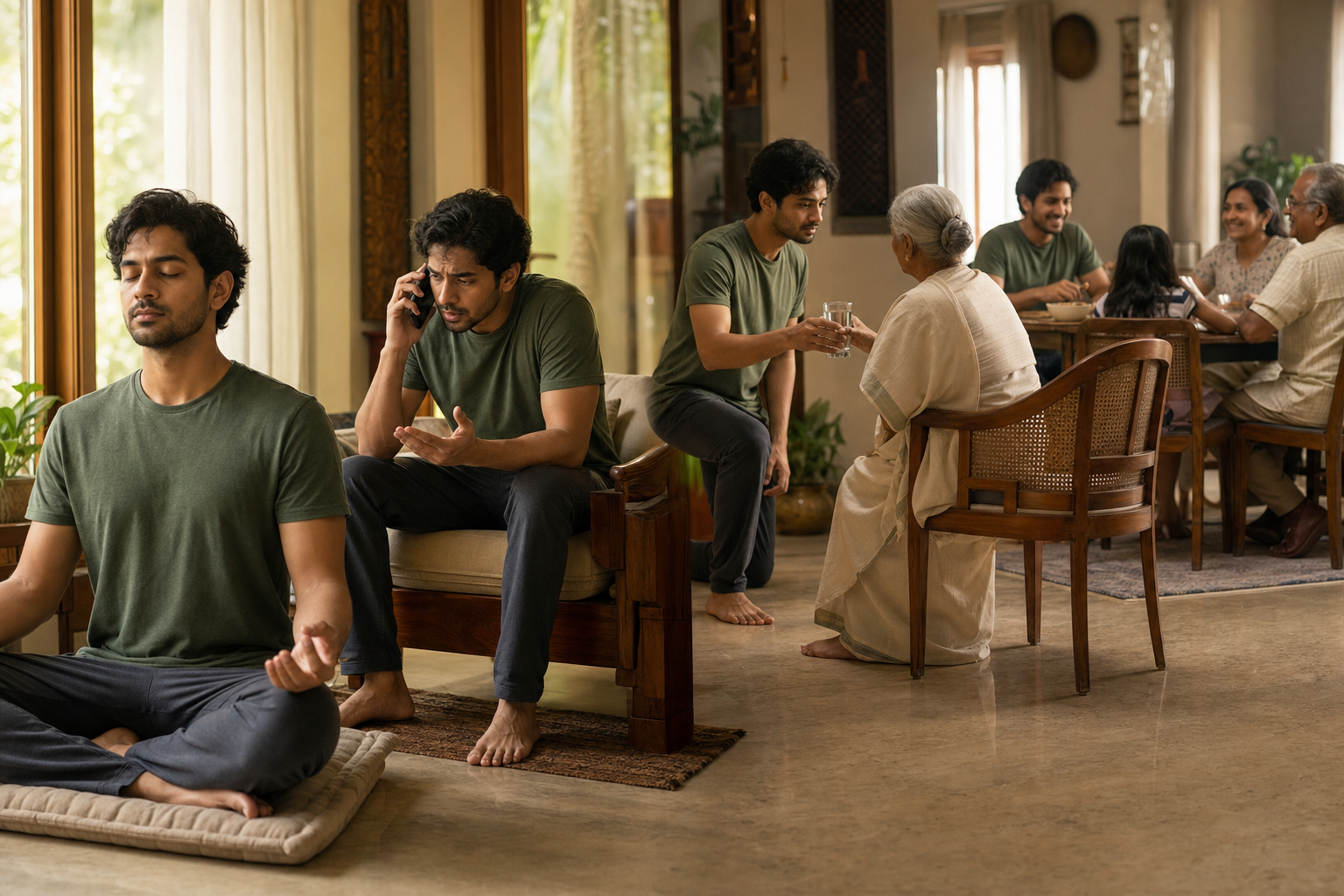
The aim is not sedation. It is enough space between stimulus and response to prevent the first surge of fear or anger from making the decision for you. After practice, notice whether your jaw and shoulders release, whether your breathing becomes less hurried, and whether you can return to the task in front of you. Those are more useful signs than trying to manufacture an extraordinary state.
Heart rate variability can provide an additional autonomic marker when it is available, but it is not a spiritual score. Devices, measurement conditions, sleep, illness, and individual physiology affect the reading. Compare your own measurements under reasonably consistent conditions rather than comparing yourself with another practitioner.
Attention training improves perspective and decisions
Meditation does not stop the mind from producing thoughts. It trains you to notice a thought before automatically obeying it. That capacity is metacognition: awareness of what the mind is doing while it is doing it. In Dharmic language, it supports viveka, or discernment.
Several traditions provide complementary ways to widen a constricted perspective. The Bhagavad Gita’s teaching on action without attachment to results asks you to give full attention to duty without pretending to control every consequence. Buddhist reflection on impermanence asks what is changing rather than what must remain fixed. Jain anekantavada asks which side of a complex reality you have not yet seen. Sikh reflection on hukam places personal control inside a larger order while preserving the obligation to act with courage and service.
Use these teachings as questions rather than slogans. When you feel trapped, ask: What action remains mine even if the result is uncertain? What part of this situation is already changing? Which perspective am I excluding? What can I accept without abandoning my responsibility? The benefit is not abstract wisdom. It is less tunnel vision at the moment a consequential choice has to be made.
Ethics converts inner calm into trustworthy conduct
Ahimsa, daya, karuna, maitri, truthfulness, restraint, and seva function as decision rules. When anger, fear, or self-interest makes every option look defensible, a prior ethical commitment reduces confusion. You can ask which action causes the least avoidable harm, which statement is truthful, which desire requires restraint, and whose welfare is missing from your calculation.
Compassion and forgiveness practices can also reduce the mental burden of rehearsing a grievance. That does not require denying the harm, cancelling accountability, restoring an unsafe relationship, or surrendering a necessary boundary. Jain pratikraman is especially instructive here because reflection includes one’s own conduct: what was done, what harm followed, what requires repair, and what should not be repeated.
Karma yoga and seva are equally practical during prolonged uncertainty. Focusing on ethical effort rather than total control of the outcome can protect leaders, caregivers, and volunteers from the exhaustion of treating every result as a personal verdict. Ahimsa, aparigraha, Buddhist interdependence, and the Sikh aspiration of sarbat da bhala also lengthen the decision horizon. Before buying, discarding, consuming, or leading, you begin to consider effects on other beings, shared resources, and those who will live with the consequences later.
Community supplies support that solitary practice cannot
Sangha, satsang, and sangat give spiritual discipline a social structure. A healthy community notices when you withdraw, offers practical help during hardship, provides occasions for service, and places your private interpretation in conversation with others. That matters because belonging is not merely pleasant; social connection supports mental health and recovery.
Choose community by its fruits. A sound group should make you more truthful, compassionate, responsible, and capable of respecting difference. It should have ethical boundaries and allow sincere questions. Dharmic pluralism does not require the traditions to become interchangeable. Hindu Ishta permits personal devotional orientation, while Jain anekantavada disciplines certainty by recognizing the partial character of any single viewpoint. Unity here means cooperation without erasure.
Match the practice to the difficulty in front of you
A common mistake is to accumulate practices without identifying the problem each one is meant to address. Use the following map as a starting point, then remain within the guidance and ethical framework of your own tradition.
| What you are facing | A suitable starting practice | What to notice |
|---|---|---|
| Physical agitation or stress | Comfortable slow pranayama or anapanasati | Breathing becomes less hurried and you regain room to choose your response |
| Rumination or scattered attention | Mantra japa, simran, or a mindfulness anchor | You notice wandering sooner and return without turning the lapse into self-criticism |
| Anger, resentment, or harsh judgment | Metta or maitri, compassionate remembrance, or pratikraman | You can distinguish accountability from the desire to punish |
| Moral confusion | Svadhyaya with an ethical vow, sila, or the yamas and niyamas | The decision becomes clearer when tested against non-harm, truth, restraint, and responsibility |
| Helplessness or loss of purpose | Seva or karma yoga | You identify a useful action that does not depend on controlling the entire outcome |
| Isolation | Regular participation in sangha, satsang, or sangat | You receive support, accept accountability, and contribute to someone else’s welfare |
| Rigid certainty or conflict | Reflection on anekantavada, interdependence, or impermanence | You can state another viewpoint fairly without abandoning ethical discernment |
Do not turn this map into a spiritual buffet driven by novelty. Choose a primary contemplative anchor and practice it consistently. Let ethical observance, study, service, and community support that anchor. If you already belong to a lineage, learn the method in its proper context rather than detaching the technique from the discipline that gives it direction.
Build a routine you can evaluate in ordinary life
A demanding routine that disappears when life becomes difficult is less useful than a modest one you can maintain. Begin with a brief sequence and use the same general order each day.
- Settle the body with a few minutes of slow, comfortable nasal breathing. Do not force the breath or compete with an imagined ideal.
- Choose a single attentional anchor: a mantra for japa, the Divine Name for simran, or the natural breath for anapanasati. When attention wanders, return without argument.
- Bring to mind someone who is suffering and cultivate maitri or karuna. Include yourself when self-contempt, rather than accountability, is obstructing repair.
- Name the duty in front of you. Ask what a truthful, non-harming, and proportionate next action would be.
- Complete a concrete act of seva without making recognition the condition for doing it.
Set aside time each week for svadhyaya and participation in community. Study helps prevent a practice from becoming a collection of private assumptions. Community keeps service, humility, and accountability in view.
Track function, not spiritual status
Before beginning, write a brief baseline describing the problem in behavioral terms. Instead of “I want inner peace,” write “After criticism, I replay the exchange and speak sharply at home.” The second description can be observed and revisited.
Keep a compact log containing the trigger, the practice used, the immediate effect, your later behavior, and sleep quality. At the end of the week, look for tendencies: Did you notice reactivity sooner? Did you return to baseline more readily? Did your conduct align more closely with your stated values? Did the practice improve engagement with responsibilities, or merely postpone them?
Change only a single element when the routine is not working. If you replace the breathing method, mantra, schedule, teacher, and community at once, you will not know what helped or what created difficulty. Progress can be uneven, so judge the practice by repeated patterns in daily functioning, not by one unusually calm or difficult session.
Know when practice needs adjustment or professional support
Spiritual practice can support health, but it is not a substitute for medical treatment, psychotherapy, crisis care, or prescribed medication. If you are dealing with significant trauma or an acute mental-health concern, integrate contemplative practice with qualified professional care. If a method repeatedly produces panic, dissociation, destabilizing memories, severe distress, or impaired daily functioning, stop intensifying it and seek guidance from an appropriate mental-health professional. If breathwork causes dizziness or distress, return to normal breathing rather than forcing the technique.
Watch for spiritual bypassing as carefully as you watch the breath. Impermanence should not be used to dismiss grief. Karma should not become a way to blame someone for suffering. Nonattachment should not excuse neglect of duty. Forgiveness should not erase boundaries. Calm should not become indifference to injustice. A practice has gone off course when it makes you less willing to face facts, repair harm, or perform the work that dharma requires.
A qualified guide can help with technique, context, and ethical safeguards, but a title alone is not evidence of trustworthiness. Look for respect for boundaries, transparency about authority, freedom to ask questions, and conduct consistent with the virtues being taught. Leave situations in which spiritual language is used to demand secrecy, excuse exploitation, or suppress legitimate medical and psychological care.
Begin with the difficulty that is actually present, choose the corresponding discipline, and identify the change you need to notice in daily conduct. Then practice gently enough to continue and honestly enough to adjust. If greater calm also makes you more responsible, compassionate, and capable of wise action, the benefit is reaching beyond the meditation seat.


References
