
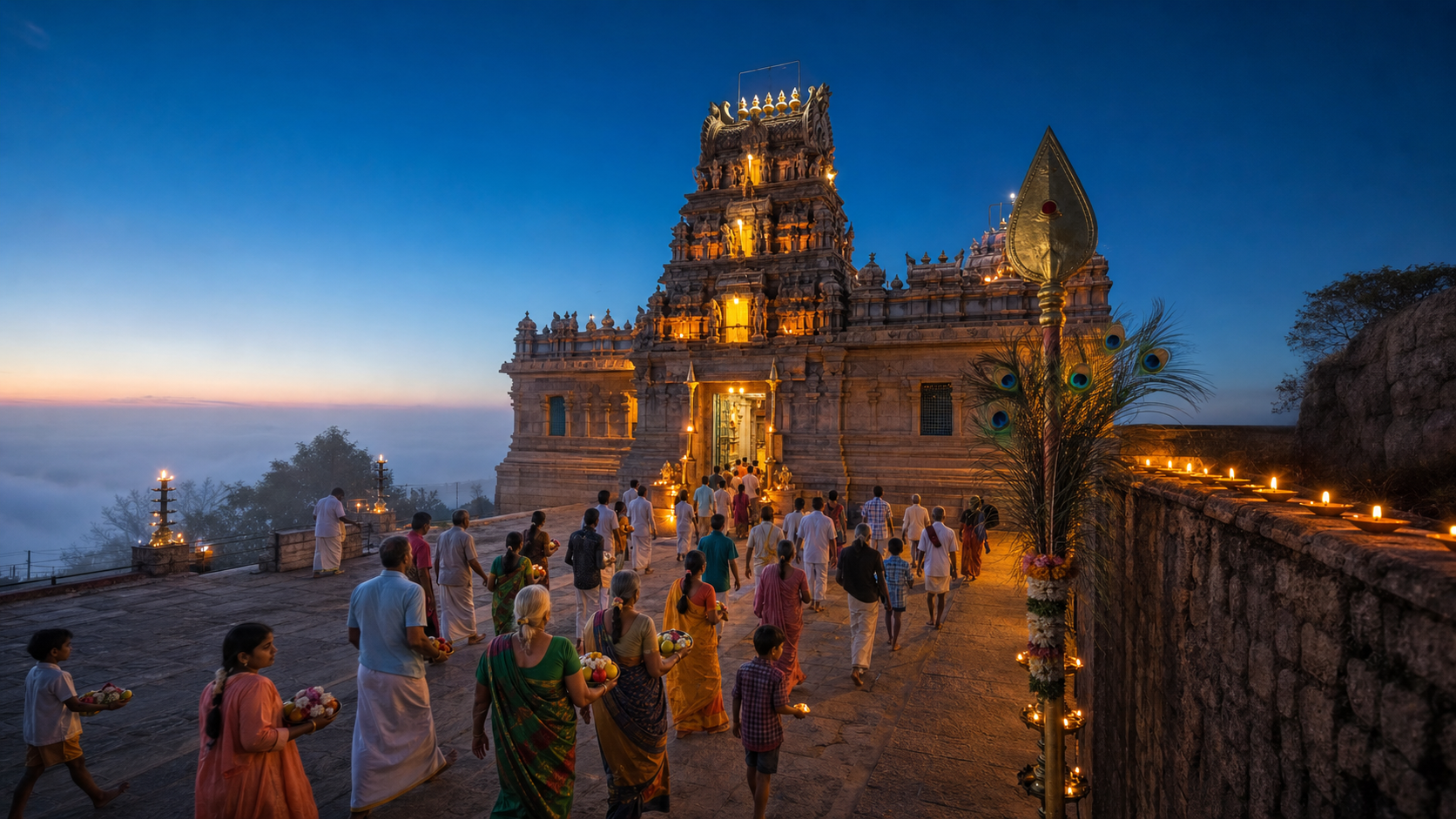
If you are going to Skandagiri for Panguni Uthiram in 2026, decide first what kind of worship you intend to undertake. An early-morning place in the liturgical observances, a vow offering such as Kavadi or Palkudam, and a straightforward visit for darshan each require a different plan.
The festival falls on Wednesday, 1 April 2026. Skandagiri is likely to receive thousands of devotees, so the most important preparation is simple: choose your form of participation before you enter the crowd, arrive with time to spare, and let the temple coordinate any ritual offering.
Key details to settle before 1 April
- Venue: Skandagiri Subramanya Swamy Temple in Padmarao Nagar, Secunderabad, Hyderabad.
- Festival date: Wednesday, 1 April 2026, when Uthiram, also known as Uttara Phalguni, occurs in the Tamil month of Panguni.
- Early observances: Ganapati Homam and Mahanyasam are both listed for 7.30 AM. Do not assume that one follows the other; plan to be present before that time if either matters to you.
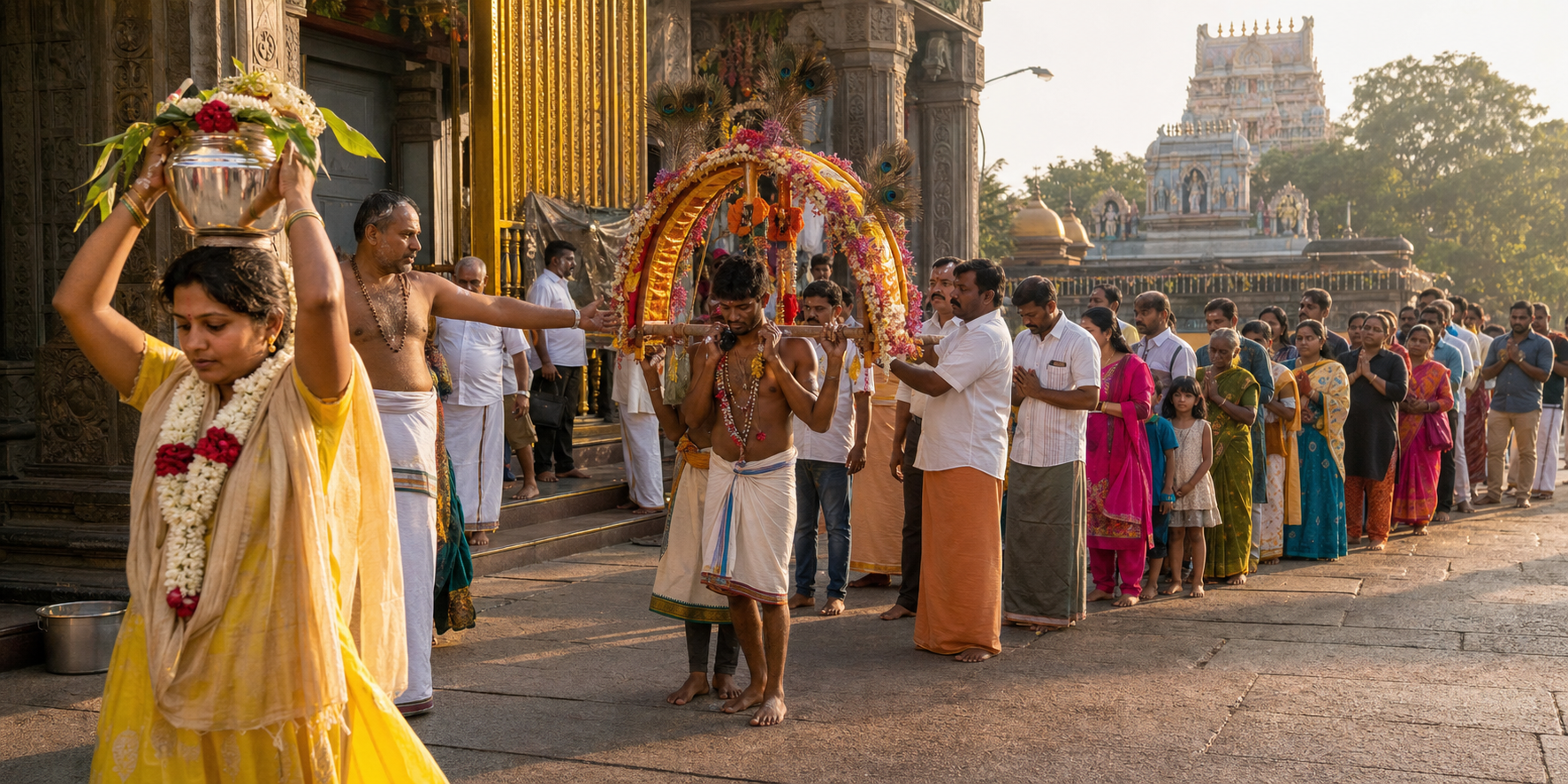
- Vow offerings: Kavadi and Palkudam participation is coordinated in batches through the day. Report to the designated temple counter rather than joining a group on your own.
- What to confirm: If the Kalyanam is the main reason for your visit, ask the temple directly for its ceremonial timing. The fixed times available here establish the morning rites, not a separate hour for the wedding observance.
- What to carry: Use only milk pots, Kavadi materials, flowers or other offerings accepted by the temple. Choose modest clothing and minimise disposable plastic.
The two 7.30 AM entries are especially important. Ganapati Homam and Mahanyasam are distinct rites, even though they share the announced time. If you hope to follow a particular liturgical stream closely, ask a volunteer where it is taking place as soon as you arrive.
Choose darshan, Palkudam or Kavadi deliberately
You do not need to undertake the most physically demanding offering to participate meaningfully. The right observance is the one that matches your sankalpa, your established practice and your ability to carry it through with steadiness.
- Choose ordinary darshan and prayer if you want to attend the festival without making a specific carrying vow. Arrive early, keep a short mantra or stotra ready, and leave enough room in your plan for the queue. Tiruppugazh, Kandar Anubhuti and Skanda stotras are especially suited to the devotional setting.
- Choose Palkudam if your sankalpa is specifically connected with offering milk for Subrahmanya’s abhishekam. The pot should be clean and sealed in the manner directed by the temple. Go to the counter before entering a batch; do not assume that any container or independently procured milk will be accepted.
- Choose Kavadi when you are consciously fulfilling a vow through disciplined physical worship. Kavadi is traditionally approached with vrata, japa and tapas. The balanced yoke, commonly adorned with peacock feathers, flowers and offerings, is not a festival prop. Its weight and balance turn bodily effort into concentration.
- Choose a longer stay if you want to experience the movement from homam and mantric purification to abhishekam, alankaram and evening deepa aradhana. This requires more time, but it reveals the internal shape of the festival more clearly than a hurried darshan.
If you already observe a family, sampradaya or guru-directed vrata, keep that discipline faithfully. Otherwise, a simple sattvic regimen, prayerful attention and honest restraint are better than inventing an extreme austerity for a single day. Do not fast or carry a load in a way that endangers your health; devotion is not measured by avoidable harm.
Follow the ritual arc instead of treating each event separately
Panguni Uthiram at Skandagiri is best understood as a movement from preparation to surrender. Knowing the purpose of each stage helps you remain attentive even when queues, announcements and crowd movement make the day feel fragmented.
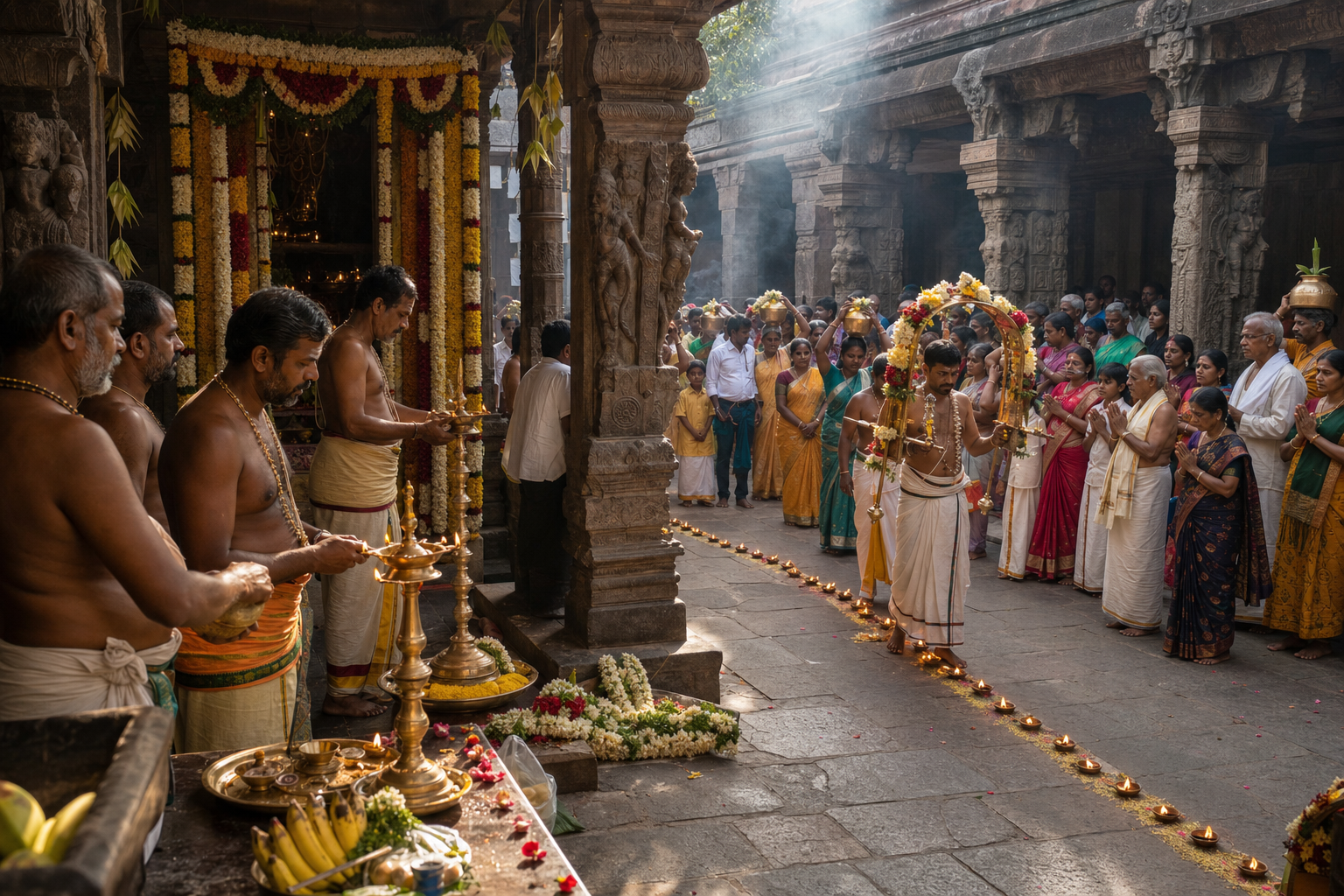
Ganapati Homam clears the ritual threshold. The sankalpa gives the worship a defined intention; invocation and offerings of ghee and prescribed samidhas establish a consecrated field. In Murugan worship, beginning with Ganapati is not a detachable preliminary. It is the deliberate surrender of vighnas, or obstacles, before the main observance.
Mahanyasam turns purification inward. Through Shaiva mantras and forms of nyasa, including installation upon the hands and limbs, the body is ritually approached as a temple of Rudra. Mahanyasam commonly prepares the way for Rudrabhishekam, but it should not be confused with the abhishekam itself. Its presence is especially resonant at a Subrahmanya shrine because Murugan is revered as Shiva-kumara.
Kavadi and Palkudam embody the sankalpa. One makes discipline visible through a balanced burden; the other carries a cool, sattvic substance toward abhishekam. Milk poured over the murti signifies the yielding of aham, the possessive ego, into bhakti. For you, that meaning begins before the procession: the offering should be handled cleanly, quietly and under temple direction.
Abhishekam and alankaram reveal two complementary modes of worship. Abhishekam may employ panchamrita ingredients such as milk, curd, ghee, honey and sugar, along with fragrant water, vibhuti and sandal paste. The bathing strips attention back to consecrated simplicity. Alankaram then restores colour, form and iconographic detail.
Notice the vel and the peacock when the adorned form of Murugan is revealed. The vel signifies jnana-shakti, the penetrating power of knowledge. The peacock, Murugan’s vahana, points to mastery over pride and ignorance. These are not merely decorations to admire; they give you a precise question to carry into darshan: what confusion must knowledge pierce, and what pride must discipline bring under control?
The evening deepa aradhana gathers that movement into light, sight and communal prayer. If you remain for it, resist the urge to treat the final arati as an isolated climax. Its force comes from everything that preceded it: cleared obstacles, purified attention, fulfilled vows, abhishekam and the renewed vision of the deity.
Prepare for the crowd without losing the vrata
Festival logistics can either protect your devotional attention or consume it. A few decisions made before leaving home will reduce the number of choices you must make inside the temple.
- Write your sankalpa in one sentence. Name the prayer, gratitude or discipline you are bringing to Murugan. A clear intention is easier to remember in a crowded queue than a long mental list of wishes.
- Choose your participation level. Decide whether you are coming for the 7.30 AM rites, a Kavadi or Palkudam batch, general darshan, evening deepa aradhana, or a longer combination.
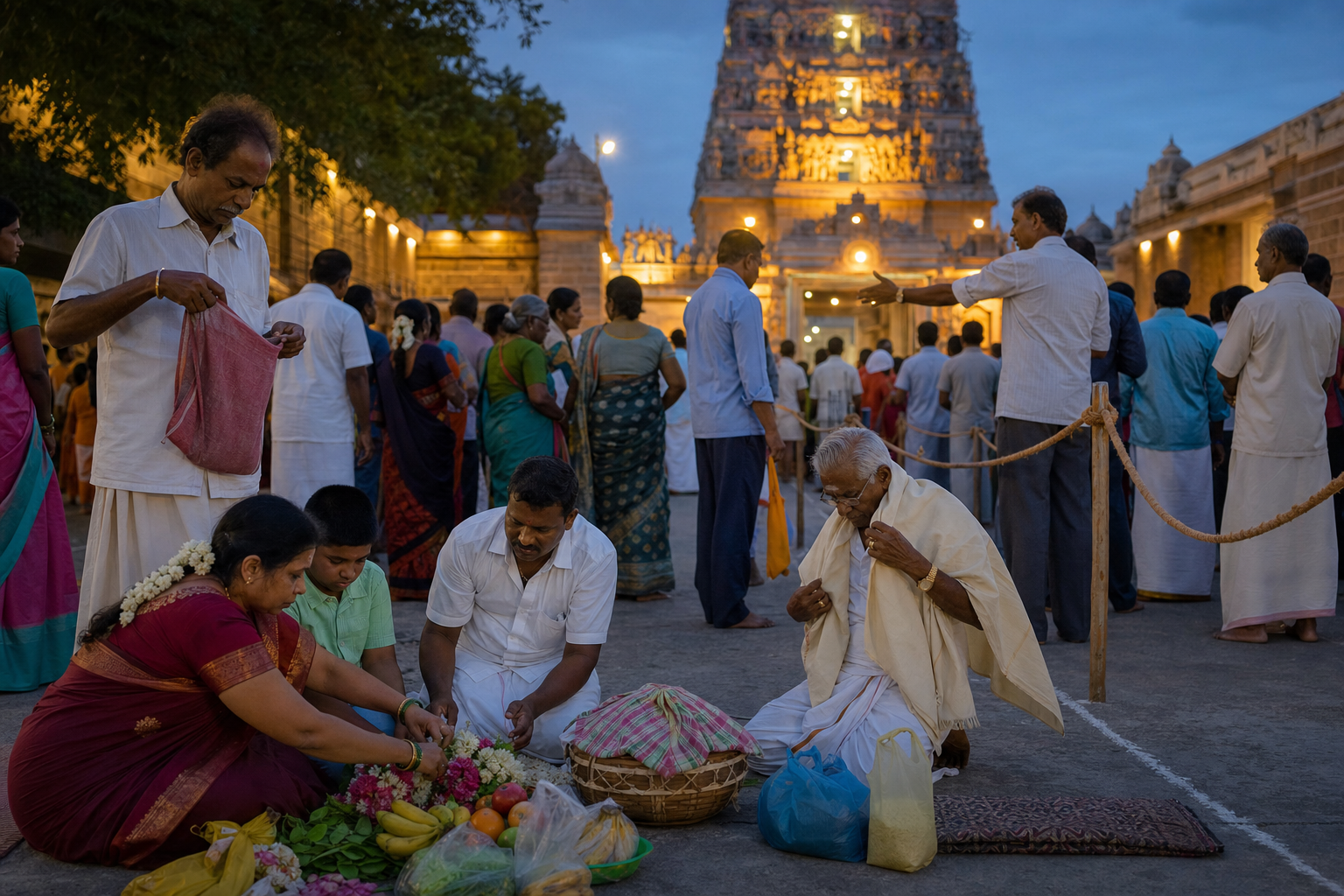
- Allow time before the announced event. If you want the morning rites, aim to be inside the temple complex before 7.30 AM rather than arriving at 7.30 AM. The announced time is when worship begins, not an arrival recommendation.
- Visit the counter first for a carrying offering. Confirm the approved material, batch and route before lifting a Kavadi or presenting a milk pot. Priests and volunteers must coordinate the offerings so that abhishekam remains orderly, hygienic and consistent with temple practice.
- Follow the assigned batch. Maintain silence or soft chanting, preserve the line and avoid overtaking another devotee. The restraint shown while waiting is part of the vrata, not dead time before it.
- Keep family safety simple. Keep children, elders and anyone needing assistance close, agree on a meeting point, and follow volunteer instructions if the crowd is redirected.
- Leave the sacred space cleaner. Minimise plastic, place remnants only where directed, and do not abandon flowers, containers or packaging along the procession route.
Seva is also a valid way to participate. Helping as directed, making space for someone who needs it, disposing of offerings correctly and moving without agitation all express the same discipline sought through more visible vows. In a festival crowd, consideration for another devotee is not separate from worship.
Carry the meaning of Panguni Uthiram beyond the queue
Panguni Uthiram occurs when the Moon passes through Uthiram, or Uttara Phalguni, during Panguni, the Tamil month spanning the latter part of March and the earlier part of April. In 2026, the observance also carries the devotional intensity associated with Pournami. This conjunction has long made the day a setting for vrata, sacred unions and renewed religious commitments.
For Murugan devotees, the central sacred image is the divine marriage of Subrahmanya and Devasena, with Valli also honoured in many regional traditions. Wider South Indian observances connect Panguni Uthiram with other sacred pairings, including Shiva and Parvati, and Andal and Ranganatha. Kalyanam in this setting is more than a ceremonial wedding scene. It expresses right relationship: shakti joined with purpose, devotion joined with responsibility, and an individual vow restored to the order of family and community.
This is why the physical symmetry of Kavadi matters. The offering asks you to balance effort with humility. Palkudam asks you to carry something pure without claiming it as your own. The homam asks you to surrender obstacles, Mahanyasam to sacralise embodied life, and abhishekam to let the hardened sense of self become fluid before the divine.
Skandagiri gives this Tamil Murugan festival a distinctly Hyderabad setting, bringing Tamil, Telugu and other South Indian devotional traditions into one temple space. You may hear Vedic recitation alongside Tamil hymns and see families with different customary practices sharing the same darshan. The unifying principles are recognisable across the dharmic world: self-discipline, truthfulness, generosity, compassion and reverence.
Before 1 April, choose one practice that will continue after you leave the temple: a daily Murugan mantra, a regular reading from Tiruppugazh or Kandar Anubhuti, a restrained habit, or a concrete act of seva. Carry that commitment to Skandagiri as your sankalpa. Then the festival will not end when your batch disperses or the final lamp moves out of sight.
References
