
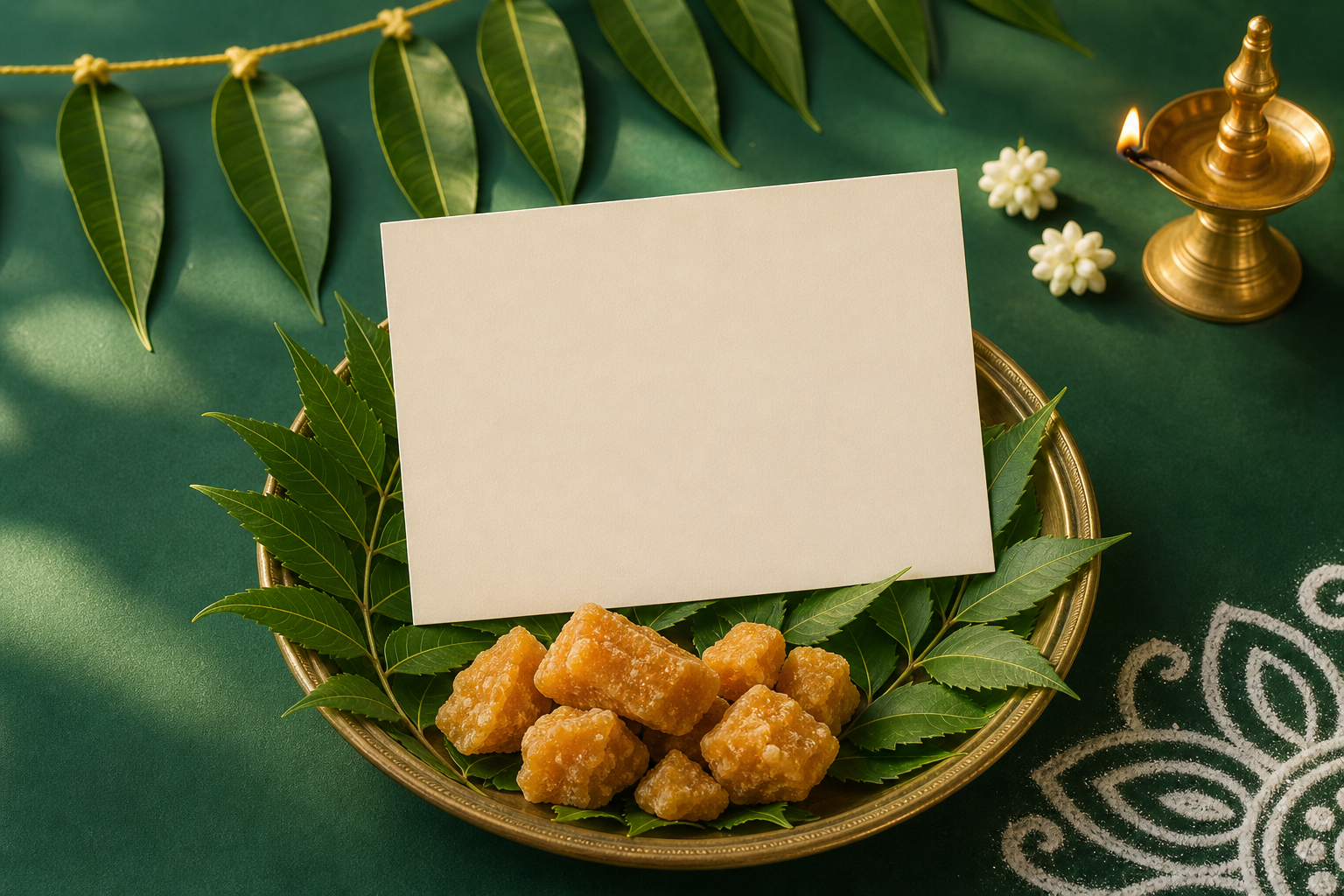
You need the greeting to do three things at once: look unmistakably like Ugadi, display Kannada correctly, and remain readable on the screen or paper your recipient will actually use. A beautiful composition cannot rescue a broken ligature, an unverified calendar date, or a message buried beneath festival ornaments.
The reliable order is simple: settle the words, choose a clear cultural focal point, build for the final format, and test the exported file. Follow that order and you can create one coherent Ugadi 2026 identity for a family card, community announcement, WhatsApp greeting, Instagram Story, email, or short animation.
Lock the Kannada wish before you arrange the artwork
Start with one primary Kannada sentence. If you begin with decoration and add the message later, the type usually ends up too small or awkwardly broken across lines. Choose the wording first, place it at the intended reading size, and let the remaining space determine how much ornament the design can carry.
These copy-ready versions suit different levels of formality:
- Short and universal: ಉಗಾಡಿ ಹಬ್ಬದ ಶುಭಾಶಯಗಳು
- Warm family wish: ಹೊಸ ಸಂವತ್ಸರವು ಆರೋಗ್ಯ, ಐಶ್ವರ್ಯ ಮತ್ತು ಆನಂದ ತಂದುಕೊಡಲಿ
- Reflective wish: ಬೇವು-ಬೆಲ್ಲದಂತೆ ಜೀವನದ ಎಲ್ಲ ರಸಗಳಲ್ಲೂ ಸಮತೋಲನ ಲಭಿಸಲಿ
- Traditional wish: ಪಂಚಾಂಗ ಶ್ರವಣದ ಆಶೀರ್ವಾದಗಳು ಸದಾ ನಿಮ್ಮೊಂದಿಗಿರಲಿ
For a compact card, use the first line as the headline and one longer line inside. For a community or temple greeting, the traditional reference to Panchanga Shravanam can work as supporting copy, but only if it fits the occasion. A greeting does not become more authentic merely by accumulating ceremonial terms.
For a multigenerational or diaspora audience, keep Kannada visually primary and put a concise English paraphrase beneath it. For example: May the new year bring health, prosperity and joy. This preserves the Kannada identity of the greeting while allowing younger family members and non-Kannada well-wishers to understand it immediately.
Be careful with the date. Ugadi is determined by Chaitra Shukla Pratipada as it prevails at local sunrise, so a date used in Karnataka should not be copied automatically into a greeting for every country. If the card will circulate globally, either confirm the observance through the recipient’s local Panchang or write Ugadi 2026 without a day and date. Keep the date in an editable text field until that check is complete.
Apply the same discipline to the Samvatsara name and any Saka-year notation. Regional almanacs assign and present these details according to their conventions. Verify the exact form you intend to print; omitting an uncertain almanac detail is better than turning it into a decorative error.
Make one Ugadi symbol lead the visual hierarchy
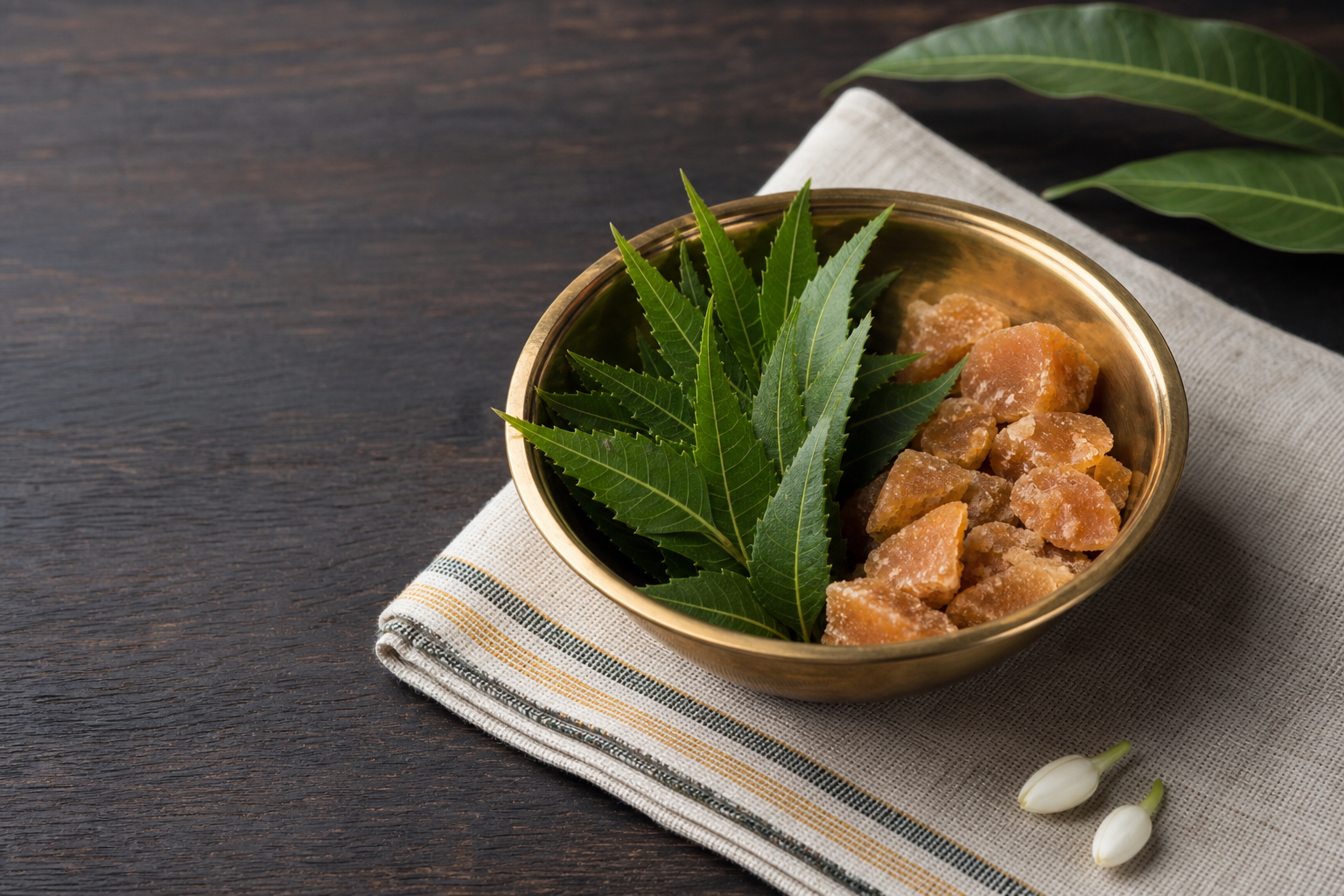
A generic lamp-and-flowers composition may look festive, but it does not necessarily say Ugadi. The most useful cultural anchor for a Kannada greeting is ಬೇವು-ಬೆಲ್ಲ, neem and jaggery. Its contrasting tastes give the design a human meaning: the new year is received with balance, not with the expectation that life will contain only sweetness.
Build the composition around a simple hierarchy:
- Use a bevu-bella bowl or pairing as the principal Ugadi-specific image.
- Frame the upper edge with a mango-leaf torana to establish an auspicious threshold.
- Add either a rangoli, deepa, or kalasha as a secondary element rather than giving all three equal prominence.
- Leave a calm area around the Kannada wish so the greeting remains the first thing the recipient reads.
These elements carry distinct associations: mango leaves suggest prosperity, the deepa and rangoli signal auspiciousness, and the kalasha evokes abundance and sanctity. Their meaning is clearest when they support the message. If every motif is enlarged, outlined, shadowed, and saturated, the result becomes visual inventory rather than a greeting.
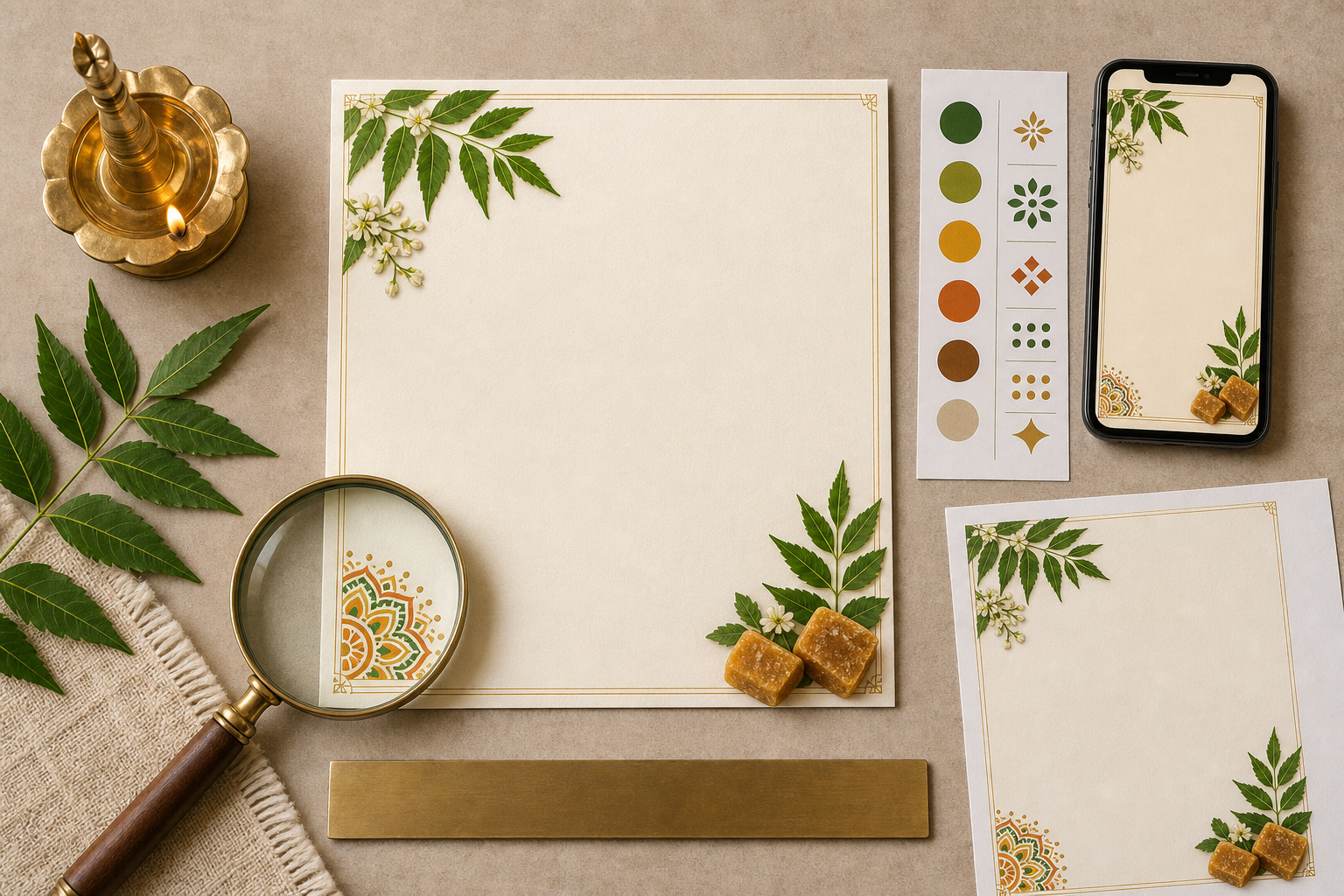
A restrained festival palette can draw from mango-leaf green, turmeric yellow, kumkum red, and warm brass. Useful screen approximations are green #2E7D32, yellow #F1C40F, red #C0392B, and brass #B58E56. Use yellow as a field or accent rather than small text on white. Dark green or deep red text on a pale, quiet background will usually remain easier to read.
Hex values belong to the screen version. For print, convert the design using the CMYK profile requested by the printer rather than assuming the printed sheet will match an sRGB display. Turmeric yellow and leafy green can shift noticeably through an unmanaged conversion, so approve them on a physical proof.
If you are designing for a mixed Hindu, Buddhist, Jain, and Sikh circle, you do not need to erase the greeting’s Kannada Hindu character. Keep Ugadi and bevu-bella specific, while framing the accompanying wish through renewal, gratitude, courage, balance, compassion, and communal harmony. That is more respectful than presenting every Dharmic tradition as though it observes an identical festival.
Build separate masters for print and digital delivery
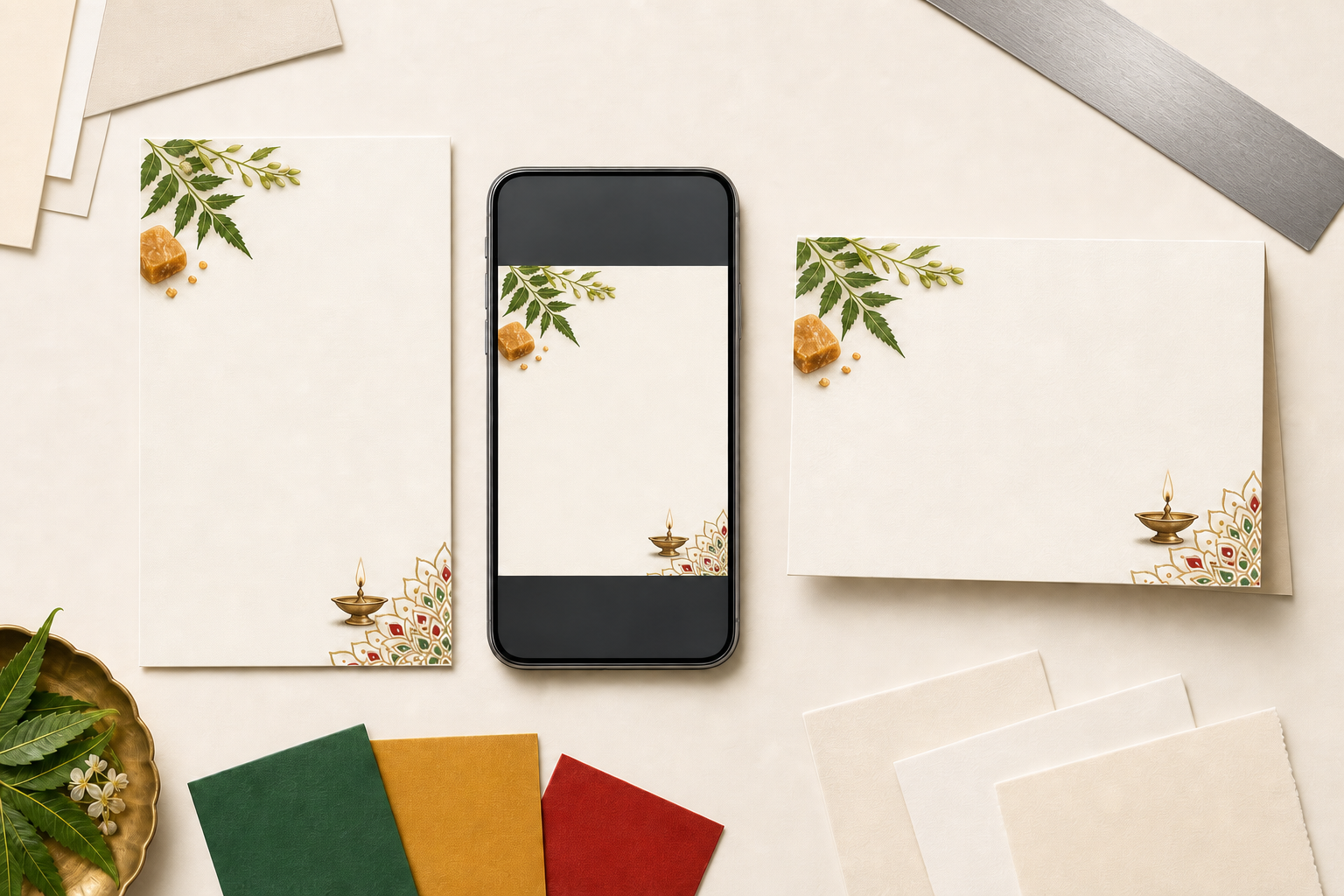
A single artwork rarely survives every destination without compromise. A vertical phone composition becomes cramped when cropped to a square, while a print card with delicate body text becomes illegible in a messaging preview. Decide where the greeting will be encountered first, then make deliberate variants from the same copy, palette, and symbol set.
| Output | Working format | Export target |
|---|---|---|
| Printed card | 5 × 7 inches, or A5 folded to A6; 300 DPI; CMYK; 3 mm bleed; 5–7 mm safe margin | PDF/X-1a or PDF/X-4 with fonts embedded |
| WhatsApp or Instagram Story | 1080 × 1920 px, 9:16, sRGB | PNG under 2 MB |
| Square feed or messaging image | 1080 × 1080 px, sRGB | PNG under 2 MB |
| Landscape greeting | 1920 × 1080 px, sRGB | PNG or platform-appropriate image |
| Email greeting | 1200 px wide | Optimized sRGB image with readable live-email context |
| Animated greeting | 1080p, 10–15 seconds | MP4 using H.264, under 10 MB |
For print, establish the bleed and safe margin before placing the torana or border. Background colour and artwork may extend through the bleed, but names, wishes, dates, and logos must remain inside the safe area. A border that sits too close to the cut line will make even a small trimming variation look like a crooked design.
A stock between 200 and 300 GSM gives a greeting card a substantial feel. Uncoated or lightly textured paper suits traditional linework and reduces glare in indoor light. Recycled or FSC-certified stock and water- or soy-based inks are sensible choices when available through the printer.
For phone formats, check the composition at the size at which it will actually appear, not only while it fills a large design monitor. Keep the headline away from areas covered by Story interface controls. On WhatsApp or Telegram, sending the finished image as a document can preserve its resolution when image compression would soften Kannada letterforms.
If you animate the greeting, use one or two quiet movements: a rangoli drawing itself, a mild shimmer around the deepa, or a gentle torana sway. The complete wish must still make sense with sound turned off. Avoid flashing transitions, rapid text changes, and motion behind the Kannada copy.
Make Kannada type survive export, printing, and sharing
Kannada typography is not the place to improvise with a decorative font of uncertain origin. Use Unicode text and a font known to support the script. Suitable choices include Noto Serif Kannada, Noto Sans Kannada, Baloo Tamma 2, and Tiro Kannada. Keep the working text editable even if the final PNG turns it into pixels.
For a printed card, a Kannada headline around 24–30 pt gives the script room to breathe. Set supporting text around 12–14 pt with generous line spacing. Do not force a long blessing into a narrow ornamental frame by shrinking it; shorten the message or move the secondary wish inside the card.
Use this production sequence:
- Enter or paste the Kannada as Unicode text. Do not rely on a legacy font that maps Kannada shapes onto Latin character positions.
- Proof the actual words, including compounds and punctuation, before adjusting line breaks.
- Inspect difficult clusters in words such as ಸಂವತ್ಸರವು, ಬೇವು-ಬೆಲ್ಲದಂತೆ, and ಶುಭಾಶಯಗಳು at high zoom and normal reading size.
- Keep line ornaments as SVG or EPS where possible. Any raster photograph or texture intended for print should be high resolution and free of visible compression blocks.
- Embed the Kannada fonts in the print PDF. Use PDF/X-1a or PDF/X-4 according to the printer’s workflow, and flatten transparency when the vendor requires it.
- Open the exported PDF or image on another device. Do not treat a correct appearance inside the design application as proof that the delivered file is correct.
- Print one physical copy and inspect it in daylight and warm indoor light. Check glyphs, small text, border alignment, contrast, and colour balance.
Accessibility should shape the composition, not be added after export. Keep text off busy photographs, maintain strong foreground-background contrast, and do not encode essential meaning through colour alone. A bilingual caption can help both elders and younger readers when language fluency differs across the family.
Add alt text when the platform supports it. A usable description would be: Kannada Ugadi 2026 greeting with a mango-leaf torana, a lit deepa, rangoli, and a bowl representing bevu-bella; the message wishes the recipient health, joy, and prosperity. Describe the meaningful objects and message rather than listing decorative colours.
Use only original, licensed, or public-domain images and ornaments. A temple photograph found through an image search is not automatically free to reuse. Sacred geometry and ritual imagery also deserve context; do not reduce them to texture or place text carelessly across a murti, shrine, or ceremonial object.
Key takeaways before you export
- Write and proof the Kannada wish before decorating the canvas.
- Confirm any date, Samvatsara, or Panchang detail for the recipient’s location; do not guess from a card made for another region.
- Let bevu-bella establish the Ugadi identity, then use the torana, rangoli, deepa, or kalasha as supporting elements.
- Create print and digital variants with the correct colour mode, dimensions, margins, and export format.
- Use Unicode Kannada fonts, embed them in PDFs, and test the final file on another device.
- Inspect the real delivery format: a physical proof for print, a normal-size phone preview for social sharing, and a mute viewing for animation.
Begin with the smallest complete version: one Kannada headline, one bevu-bella illustration, one torana, and one restrained colour palette. Prove that version in its real destination. Once the words remain clear and the Ugadi symbolism reads immediately, adapt the system for the other sizes instead of redesigning the greeting from scratch.
References
