
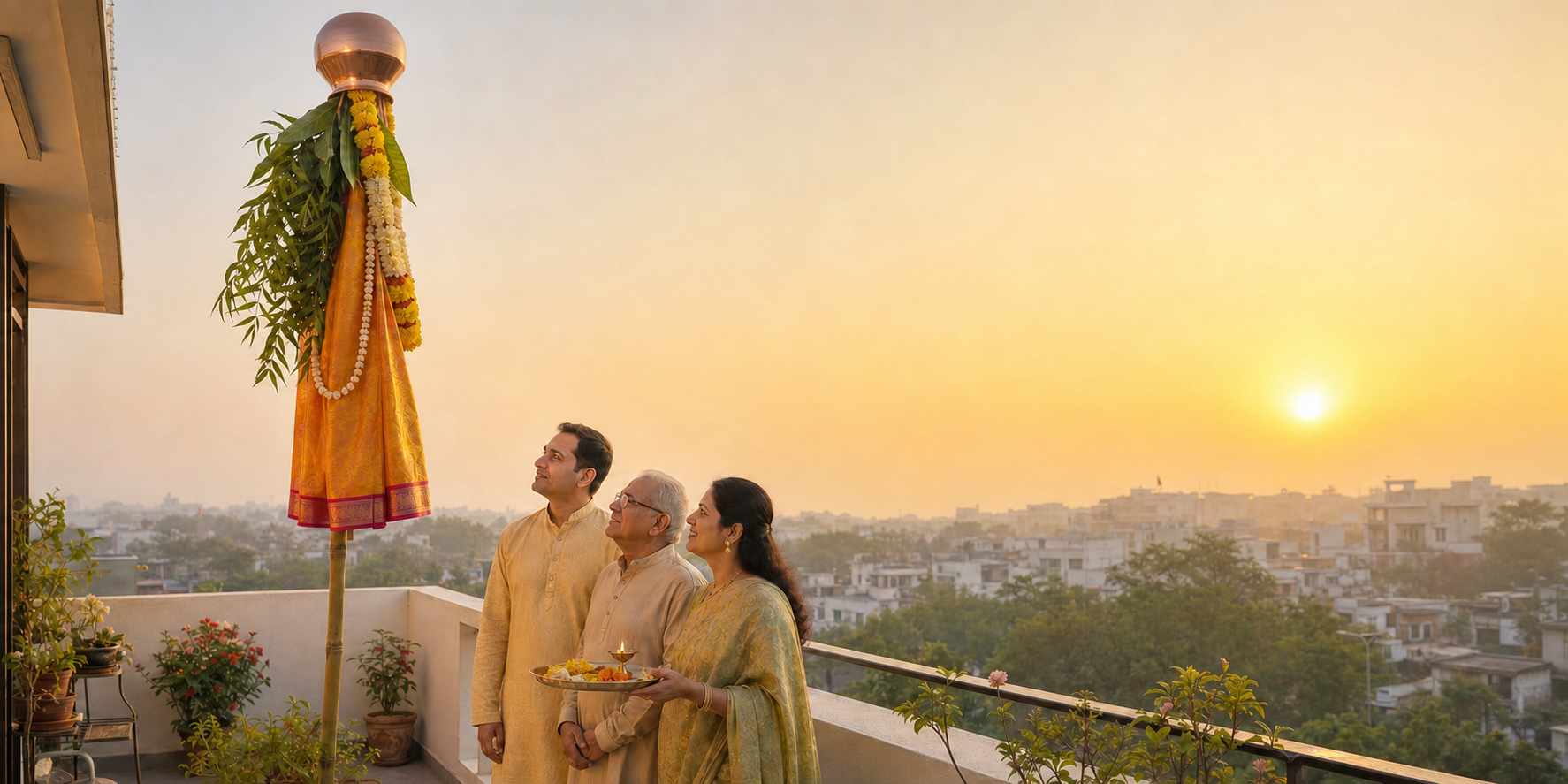
If you are arranging leave, inviting family, or gathering puja materials for Gudi Padwa 2026, mark March 19 on your calendar. That is the observance date across India. If you live elsewhere, use a panchang calculated for your own city before fixing the ritual time.
The day asks for more than a decorated pole at the doorway. The raised Gudi declares that a household intends to begin again under dharma: with gratitude for what it has received, steadiness before what it cannot control, and a clear commitment to right action.
Fix the date by sunrise, not by a copied clock time
Gudi Padwa falls on March 19 in India in 2026. It is Chaitra Shukla Pratipada, the first lunar day of the bright fortnight of Chaitra, and it begins the Marathi and Konkani lunisolar year. The same day also opens Chaitra Navratri and is observed as Ugadi or Yugadi in several southern regions.
A tithi is not a twenty-four-hour date beginning at civil midnight. It is determined by the changing angular relationship of the sun and moon, so it can begin or end at any clock time. Festival observance normally follows udaya tithi: the tithi present at local sunrise governs the day. This is why two websites can display different-looking times without either necessarily changing the festival’s underlying rule.
The national festival date and your household muhurta are therefore two different pieces of information. India has a clear 2026 date, but local sunrise and tithi boundaries should determine the time of observance. A Mumbai time should not be applied unchanged in Toronto, London, Singapore, or another city.
- Select your actual city in a trusted regional panchang rather than using a national search result alone.
- Confirm that Chaitra Shukla Pratipada is operative at local sunrise.
- Look for the morning period given for raising and worshipping the Gudi; an India-wide clock time is not required.
- If two almanacs disagree, follow the panchang, temple, or priest associated with your family’s sampradaya and location.
- Plan abhyanga snana, cleaning, and preparation before the intended puja period so that the Gudi can be raised without haste.
The lunisolar system keeps lunar months connected to the seasons through intercalation when needed. Gudi Padwa consequently remains a spring renewal near the vernal equinox without being locked to one Gregorian date every year. In many Indic almanacs it also opens a new samvatsara in a sixty-year cycle. Several southern traditions identify the 2026 transition as Parabhava Nama Samvatsaram, but you should use the year-name printed in your regional panchang rather than assuming every tradition applies the same nomenclature.
A Dharmic season of renewal does not require one uniform calendar
Calling Gudi Padwa a Dharmic New Year is meaningful when it points to a civilizational pattern of renewal. It becomes misleading if it implies that every Hindu region, or every Hindu, Buddhist, Jain, and Sikh community, begins the year on March 19. Dharmic unity does not depend on erasing calendrical difference.
| Observance | Community or region | Relationship to the spring New Year |
|---|---|---|
| Gudi Padwa or Samvatsar Padvo | Maharashtra and the Konkan | Chaitra Shukla Pratipada; March 19 in India in 2026 |
| Ugadi or Yugadi | Andhra Pradesh, Telangana, and Karnataka | The same lunar day, expressed through regional ritual and food traditions |
| Navreh | Kashmiri Hindus | Often observed on the same Chaitra lunar day |
| Puthandu, Vishu, and Vaisakhi | Tamil Nadu, Kerala, much of northern India, and Sikh communities in their respective traditions | Solar and seasonal observances arriving a few weeks later |
| Regional Buddhist New Years | Several communities in South and Southeast Asia | New Year observances commonly cluster around the middle of April |
| Jain New Year | Jain communities | Observed after Diwali in Kartik rather than on Chaitra Shukla Pratipada |
The connection lies in a shared moral grammar, not a mandatory shared date. Hindu sadhana and seva, Sikh devotion and community service, Buddhist mindfulness and dana, and Jain ahiṁsā and aparigraha each give renewal a disciplined form. Truthfulness, restraint, compassion, gratitude, and responsibility are recognizable across these paths even when their theology and calendars remain distinct.
This distinction also helps you greet people accurately. Use “गुढी पाडव्याच्या हार्दिक शुभेच्छा” or “Gudhi Padwa cha Hardik Shubhechha” for Gudi Padwa; “Ugadi Subhakankshalu” in a Telugu setting; “Yugadi Habbada Shubhashayagalu” in a Kannada setting; and “Navreh Mubarak” for Navreh. A regional greeting shows unity through attention, not by replacing every tradition with one generic label.
Raise a Gudi that your household can understand
The Gudi is an elevated victory standard, also understood in many traditions as Brahmadhwaja. Some narratives associate it with Brahma and creation; others remember Shri Rama’s victorious return, Indra’s banner, or local histories of courage and restored order. These accounts need not be forced into one literal historical claim. Their common demand is practical: overcome disorder through dharma, beginning with the disorder within your own habits and home.
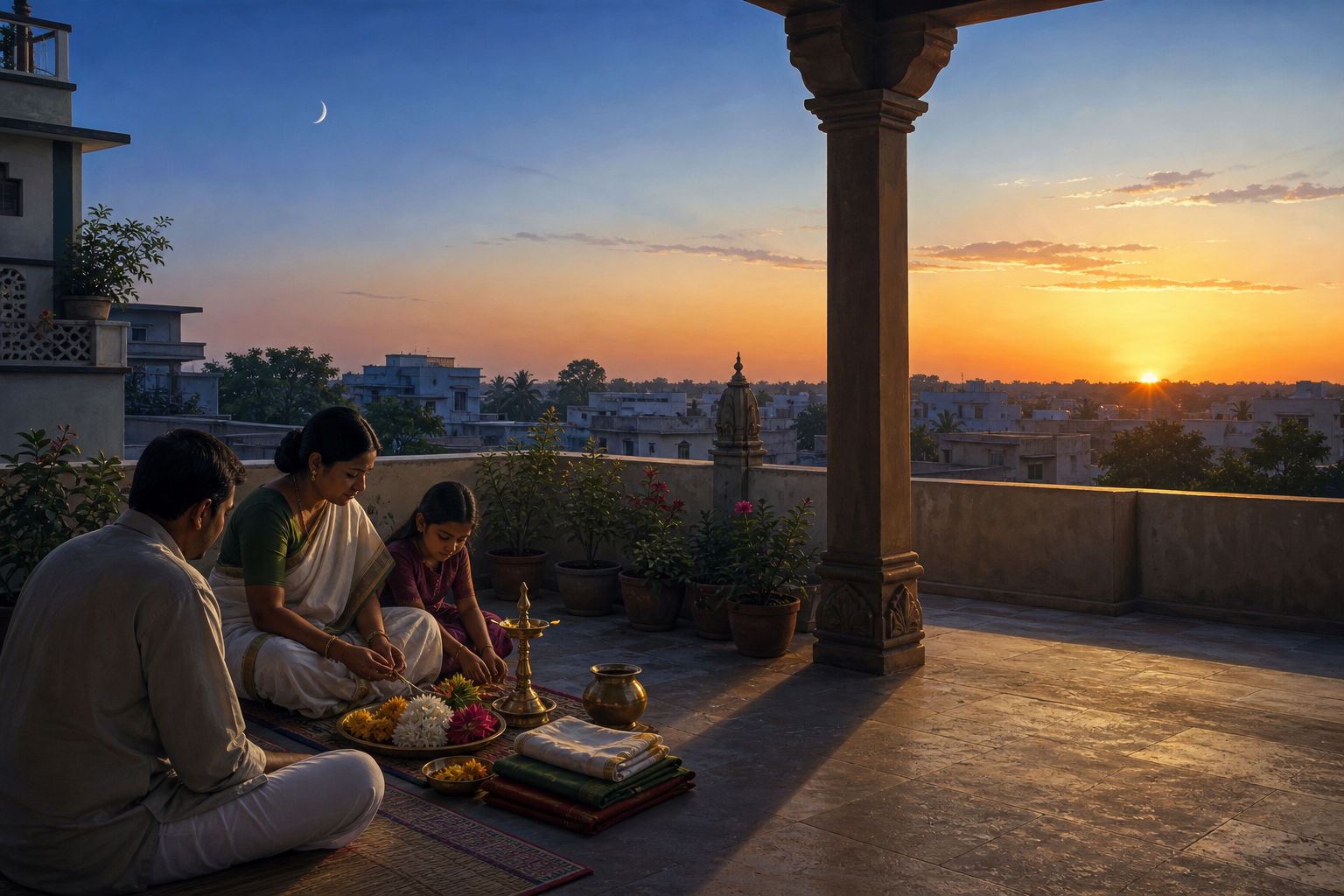
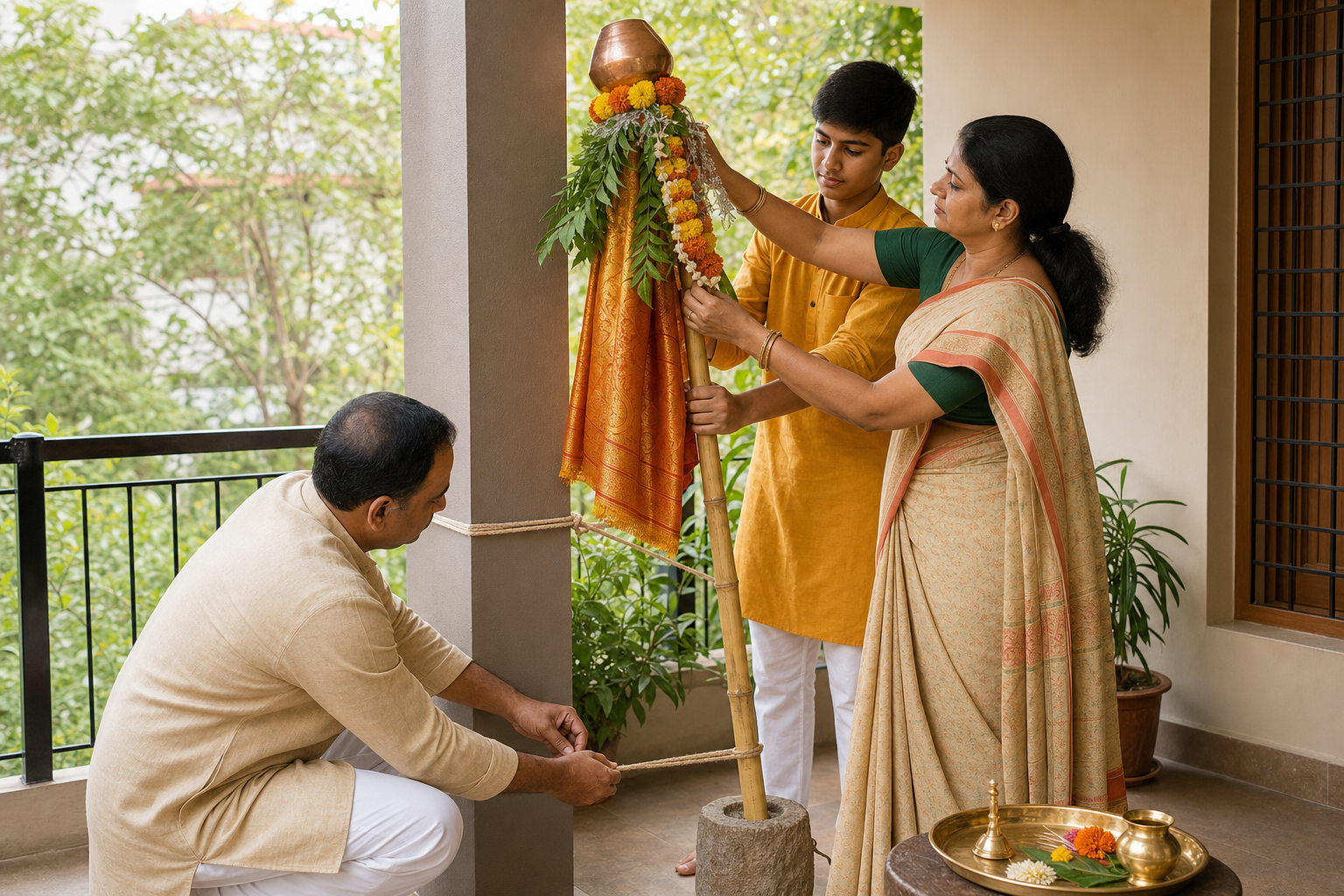
Gather the materials beforehand: a long bamboo or neem pole; a clean silk or zari-bordered cloth, commonly saffron, yellow, or green; a reusable copper, silver, or steel kalash; fresh neem and mango leaves; marigold flowers; and a sugar garland called gathi. Keep rangoli powder, a mango-leaf toran, flowers, akshata, incense, a lamp, turmeric, and kumkum ready for the threshold and puja.
- Rise early, perform abhyanga snana, and wear fresh, clean clothing.
- Clean the entrance and puja area. Draw rangoli at the threshold and place the mango-leaf toran above the doorway.
- Lay the pole down on a clean surface. Drape and secure the cloth near its upper end so that it opens visibly when the pole is raised.
- Attach the neem and mango leaves, marigolds, and gathi. Turmeric and kumkum may be added according to family practice.
- Place the kalash upside down at the top, forming the recognizable crown of the Gudi.
- Raise the Gudi upright after sunrise while Pratipada is operative, normally within the morning muhurta shown by your local panchang.
- Install it prominently on the right side of the entrance or on a balcony, preferably oriented toward the east where the home permits.
- Offer flowers, akshata, incense, and the light of a lamp. Recite the stotra, mantra, nama-japa, or family prayer that belongs naturally to your practice.
- Offer and distribute prasad, including the traditional mixture of tender neem and jaggery where that custom is followed.
If the Gudi stands on an exposed balcony, secure the pole and kalash well enough that wind cannot dislodge them. Ritual care includes ordinary responsibility; a precariously balanced metal vessel does not become safer because it is part of a sacred arrangement.
Each part of the Gudi carries an ethical cue. The upright pole calls for firmness without arrogance. The luminous cloth represents dignity and auspicious prosperity. The inverted kalash suggests fullness and blessings descending into the household. Neem joins purification and resilience; mango leaves and flowers bring living, seasonal auspiciousness; the gathi places sweetness at the summit, as a fruit of disciplined effort rather than an entitlement.
Neem and jaggery make the lesson edible. A serious New Year does not promise uninterrupted pleasure. It asks you to receive bitterness without surrendering to bitterness, and sweetness without losing restraint. Ugadi Pachadi develops the same teaching through a wider range of tastes, combining such ingredients as neem, jaggery, tamarind, chilli, salt, and raw mango. The point is equanimity, not the denial of either difficulty or joy.
Let the festive meal remain regional and familial. Maharashtrian homes may prepare puran poli, shrikhand, puri, batata bhaji, and seasonal vegetables. An Ugadi household may center its table on Ugadi Pachadi and its own customary dishes. Civilizational kinship becomes more convincing when each community can retain its proper form.
Turn the morning ritual into a year-long sankalpa
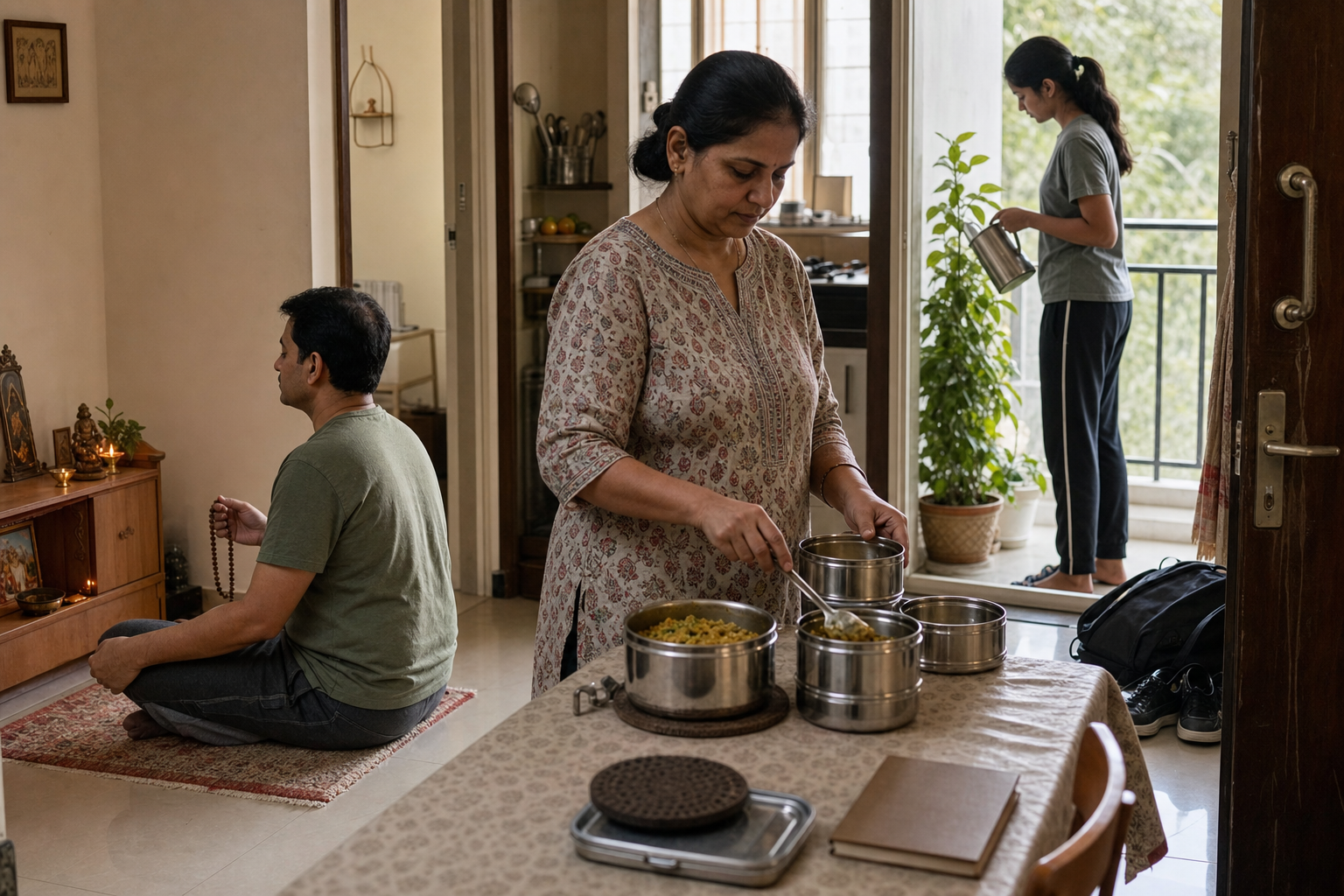
Once the puja is complete, resist the temptation to let the day dissolve into photographs and forwarded greetings. The traditional practice of panchanga shravana, listening to the new almanac, moves the household from celebration to preparedness. Tithis, nakshatras, yogas, festivals, agricultural concerns, travel, health, and community plans can be considered as parts of an ordered year. This is not a command to become fatalistic. It is an invitation to pay attention before acting.
Use the occasion for a short household discussion and write a sankalpa that is specific enough to guide conduct. A useful sankalpa answers these questions:
- Sadhana: What practice will you protect from distraction? Name the practice and the part of the day in which it belongs.
- Seva: Whom will your household serve consistently? Choose a real responsibility rather than a vague intention to be generous.
- Satya: Where has convenience begun to displace honesty in speech, work, or family life? State the correction plainly.
- Restraint: What consumption, resentment, or digital habit is taking more than it gives? Decide what boundary will now apply.
- Learning: Which scripture, language, art, history, or practical discipline will receive sustained attention during the year?
- Stewardship: What household, study, work, or financial plan needs to be reviewed before it becomes a crisis?
A sankalpa such as “we will be more spiritual” cannot tell you what to do on an ordinary, tiring day. “Nama-japa comes before the morning phone check” can. “We will help the community” is admirable but undefined. Assigning a recurring seva duty makes the intention visible and accountable. The New Year becomes useful when its values survive contact with the calendar.
The victory symbol also gives you a test for success. Prosperity without integrity is not the victory proclaimed by the Gudi. Neither is public pride joined to private indiscipline. Ask whether your chosen goals strengthen clarity, courage, compassion, family responsibility, and social harmony. If a resolution requires adharma to achieve it, the right response is not a more auspicious muhurta but a different resolution.
Let the materials embody renewal too
An environmentally responsible Gudi does not need to look less traditional. Reuse the pole, metal kalash, and suitable cloth. Prefer local leaves, natural flowers, edible gathi, and plant-based rangoli colours. Avoid plastic decorations that outlast the occasion, and compost floral and leaf remnants where possible. Materials that can return harmlessly to the earth express renewal more coherently than disposable imitation greenery.
If a traditional leaf or flower is unavailable where you live, do not conceal plastic beneath a claim of authenticity. Follow trusted family or temple guidance, use the closest responsible local arrangement your practice permits, and preserve reusable components for the next year. Fidelity is shown through reverence and care as well as visual exactness.
Gudi Padwa 2026 questions answered
When is Gudi Padwa in 2026?
Gudi Padwa is observed on March 19, 2026, across India. People outside India should verify the applicable date and morning period with a panchang calculated for their local city because sunrise and tithi boundaries are location-dependent.
When should the Gudi be raised?
Raise it after local sunrise while Chaitra Shukla Pratipada is operative, normally within the morning muhurta. If published times conflict, give priority to a trusted local panchang and your sampradaya’s established observance rule.
Is Gudi Padwa the New Year for every Dharmic tradition?
No. It is specifically the Marathi and Konkani lunisolar New Year, while Ugadi or Yugadi marks the same lunar day in parts of southern India and Navreh is often observed by Kashmiri Hindus. Other Hindu, Sikh, Buddhist, and Jain communities follow different seasonal or calendrical New Years. The broader Dharmic connection is a shared commitment to ethical and spiritual renewal, not a single compulsory date.
Must the pole, cloth, and kalash be newly purchased?
No general rule in these traditions requires you to discard sound ritual materials annually. A clean pole, suitable cloth, and reusable metal kalash support an observance rooted in stewardship. Use fresh natural leaves and flowers where available, and let family custom determine details that vary by lineage or region.
Before March 19, settle the local panchang, assemble the reusable materials, and decide who will lead the prayer and panchanga shravana. After the Gudi is raised, place one written sankalpa where the household will continue to see it. The banner stands at the threshold for the festival; the dharma it announces has to cross the threshold with you.
References
- DharmaRenaissance Blog — Celebrate Gudi Padwa with Purpose: Symbolism, Ritual Steps, Wishes and WhatsApp Status
- DharmaRenaissance Blog — Gudi Padwa 2026 (March 19): Rituals, Panchang, History, and Dharmic New Year Harmony
