
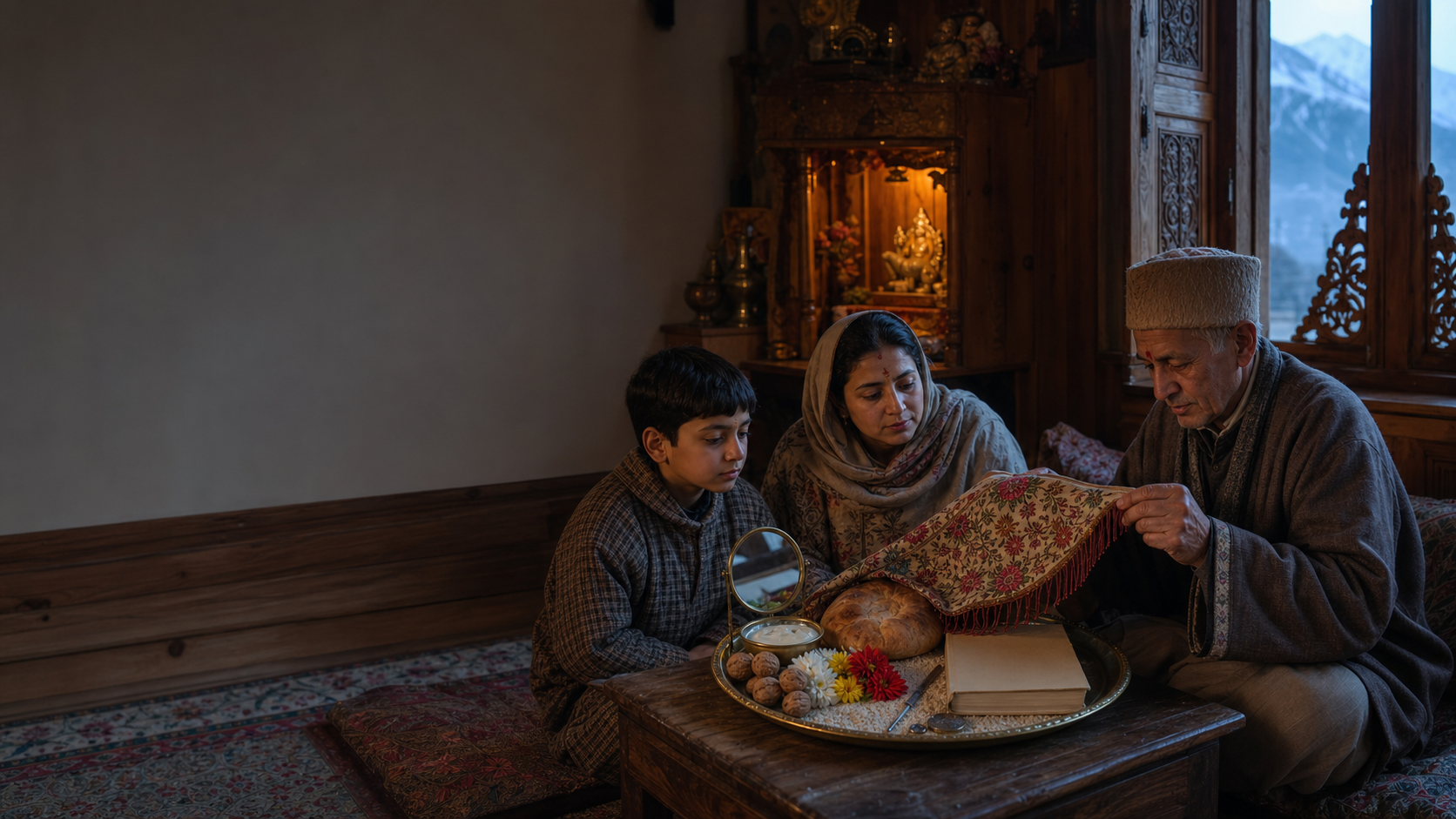
If your family calendar places Navreh on March 19 while another marks Chaitra Shukla Pratipada around March 20, you do not necessarily have a bad calendar. In March 2026, Navreh’s Kashmiri observance sequence and the wider Chaitra calendar use adjacent dates for related but distinct purposes.
If you are arranging household worship, the useful move is to stop asking one Gregorian date to answer four different questions. The lunar tithi, the regional month, the community observance and the correct local muhurta must each be identified separately. Once you do that, March 18, 19 and 20 form a coherent sequence rather than a calendar dispute.
Why March 18, 19 and 20 can all be correct
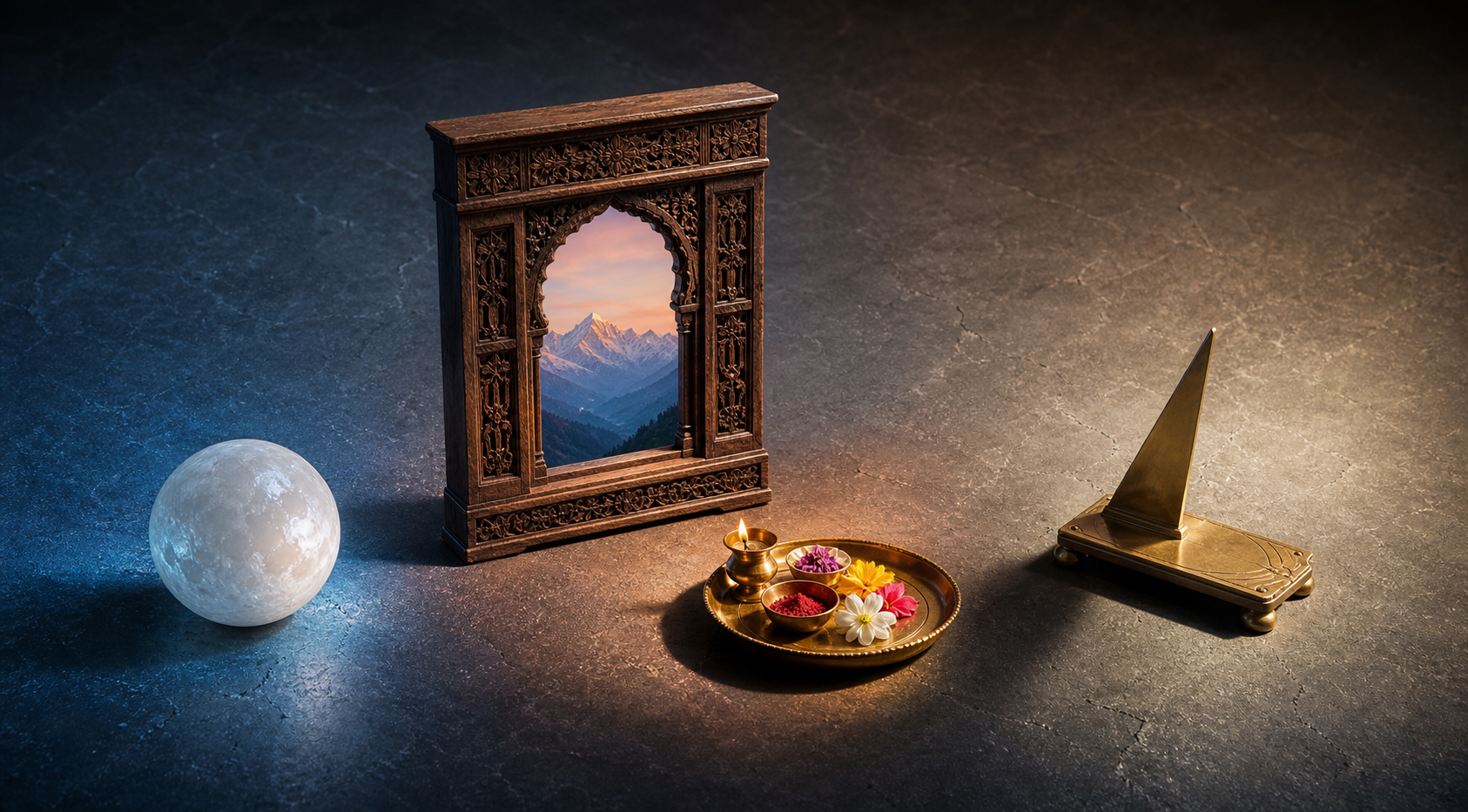
A tithi is not a midnight-to-midnight date. It measures each 12-degree increase in the angular separation of the Moon and Sun. Their relative motion is not uniform, so one tithi can last roughly 19 to 26 hours, beginning or ending at almost any civil hour. The tithi present at sunrise, the tithi prevailing during a prescribed ritual period and the name printed beside a Gregorian date may therefore point you toward different parts of the same lunar transition.
On Wednesday, March 18, 2026, many regional calculations begin the day in Krishna Paksha Chaturdashi and change to Amavasya at about 07:30 local time. That time is a planning marker, not a universal muhurta. Longitude, local sunrise, astronomical conventions and the almanac’s calculation method can shift the published boundary.
Month naming adds a second layer. An Amanta calendar ends the month at Amavasya and starts the next month afterward. A Purnimanta calendar closes its month at Purnima. Gujarat follows the Amanta structure, yet its civil year begins after Deepavali; Chaitra is consequently the sixth Gujarati month rather than the first. The Gujarati Chaitra interval for 2026 is March 19 through April 17, while Chaitra Shukla Pratipada falls on or around March 20 in many Indian locations.
Navreh has its own inherited Kashmiri Pandit observance grammar. One community track for 2026 places Thaal Barun on the night of March 18 and Navreh darshan the next morning. That should not be silently moved to March 20 merely to make it identical to Ugadi, Gudi Padwa or another regional new-year practice. Shared Chaitra symbolism does not erase each tradition’s rule for keeping the day.
Key takeaways
- Treat March 18 as a lunar threshold: Krishna Paksha Chaturdashi gives way to Amavasya at about 07:30 in many local calculations.
- If your Kashmiri Pandit lineage follows the stated 2026 community sequence, prepare the Navreh thaal on March 18 and take its first darshan on March 19.
- Mark Chaitra Shukla Pratipada, Chaitra Navratri, Ugadi and Gudi Padwa on or around March 20, then confirm the date by city and tradition.
- Use a city-specific Panchang for clock times. Use your family, temple or community calendar to decide which observance rule applies.
Your working calendar for the March observances
The schedule below is a household planning layer. It tells you what to prepare and which distinctions matter. It does not replace the local tithi boundaries required for a vrata, sankalpa or formal muhurta.
| Date or window | Calendar meaning | What you can plan | What still needs confirmation |
|---|---|---|---|
| March 13 evening | Thaal Barun for Sonth in the stated Kashmiri seasonal sequence | Prepare the spring thaal if this observance belongs to your household tradition | Whether your family keeps a separate Sonth thaal |
| March 14 | Sonth, the Kashmiri welcome to spring | Hold the seasonal darshan and family observance | Local or lineage-specific additions |
| March 18, before the local transition | Krishna Paksha Chaturdashi; the final portion of the waning fortnight before Amavasya | Shiva japa, quiet meditation, a simple lamp offering and restraint | The exact Chaturdashi ending time in your city |
| March 18, after about 07:30 in many calculations | Amavasya | Ancestral remembrance where customary, dana, scriptural reading and a quiet evening | Local tithi boundary and the procedure followed by your family |
| March 18 evening | Thaal Barun before Navreh in the stated 2026 community track | Clean and arrange the thaal, make a sankalpa and prepare the family for dawn darshan | Your household’s objects, mantras and lamp practice |
| March 19 morning | Navreh in that Kashmiri Pandit sequence; also the beginning date assigned to Gujarati Chaitra in 2026 | Take thaal darshan, share prasad, read the new Panchang and set the year’s intentions | The Navreh convention adopted by your local community |
| On or around March 20 | Chaitra Shukla Pratipada in many Amanta calendars | Begin Chaitra Navratri and observe Ugadi or Gudi Padwa where these belong to your tradition | The tithi present at the locally prescribed observance time |
| Around March 28 | Chaitra Shukla Navami and Ram Navami | Plan Rama-katha, mantra japa, temple darshan or annadanam | The Navami tithi decision for your location |
The first two rows matter only to households that keep the Sonth sequence. The two Thaal Barun dates in 2026 serve different thresholds: March 13 prepares for the seasonal arrival of spring, while March 18 prepares specifically for Navreh. You do not have to force both into one ceremony or assume that every Kashmiri family observes both.
How to use the March 18 Panchang without misreading it
March 18 needs more care than an ordinary festival date because its early tithi, weekday restrictions and Amavasya observances overlap. Divide the day by purpose. Do not take a favorable label from one Panchang limb and use it to ignore an unfavorable or inapplicable condition elsewhere.
Before the Chaturdashi boundary
Krishna Paksha Chaturdashi is associated with the monthly Masik Shivaratri rhythm. It should not be confused with Maha Shivaratri, which is the particular Magha Krishna Chaturdashi celebration. Because the March 18 Chaturdashi portion is brief, the simplest workable practice is to rise early, bathe, make a modest sankalpa and reserve the pre-dawn period for Shiva mantra japa, meditation or deepa-pradipana.
Check the ending time before committing to a tithi-bound rite. The widely cited approximation of 07:30 is local and can move. If your Panchang shows that Chaturdashi ends earlier or later in your city, follow the city calculation rather than adjusting your clock to an India-wide estimate.
After Amavasya begins
Shift the emphasis from the Chaturdashi Shiva observance to Amavasya’s inward discipline. A practical household program can include a sattvic meal, reduced noise and entertainment, a lamp at dusk, quiet reading from the Bhagavad-Gita or Upanishads, and dana such as grain, sesame or clothing. Pitru-tarpana belongs here only when it is part of your family practice and you know the procedure; it should not be improvised merely because the calendar says Amavasya.
Many Hindu traditions defer new commercial or material beginnings on Amavasya while treating prayer, study, remembrance and remedial rites as appropriate. That is a distinction of purpose, not a claim that the entire day is unusable. Routine work can continue. If you must schedule an initiation, signing or launch, use a locally calculated muhurta rather than assuming that an attractive clock time overrides the lunar context.
A mixed Dharmic family can honor the contemplative quality without pretending that distinct traditions have identical rites. New-moon Uposatha may guide a Buddhist family member toward precepts and meditation; Jain practice may emphasize pratikramana, ahimsa and dana; a Sikh family member may choose simran, paath or seva without making these dependent on the Hindu lunar rule. The shared ethical current is self-discipline and remembrance, not ritual uniformity.
Wednesday Rahu Kalam and the noon problem
Rahu Kalam on Wednesday occupies the fifth of eight equal daylight segments. To estimate it, take the time from local sunrise to local sunset, divide that duration by eight, and count forward to the fifth segment. If sunrise were 06:00 and sunset 18:00, the fifth segment would be approximately 12:00 to 13:30. That example is not the March 18 time for every city.
Abhijit Muhurat is centered on true local noon, so on Wednesdays it can nearly coincide with Rahu Kalam. This is why simply choosing Abhijit from a generic chart can produce a conflict. For a beginning, first exclude your locally calculated Rahu Kalam and any Durmuhurtam, then check whether the remaining period satisfies the tithi and purpose of the act.
Choghadiya can provide a secondary filter. Amrit, Shubh and Labh periods are commonly preferred, while Rog, Kaal and Udveg are generally avoided for launches or travel. They also depend on local sunrise and sunset. A favorable Choghadiya does not turn an unsuitable tithi into the right one for every undertaking.
For a formal selection, remember all five limbs of Panchang: tithi, vara, nakshatra, yoga and karana. Moon Rashi supplies another layer of context but is not one of those five limbs. Nakshatra, Rashi, Yoga and Karana can change within the civil day, so obtain their actual city-specific values instead of filling them in from a neighboring date.
Prepare the Navreh thaal as a household commitment
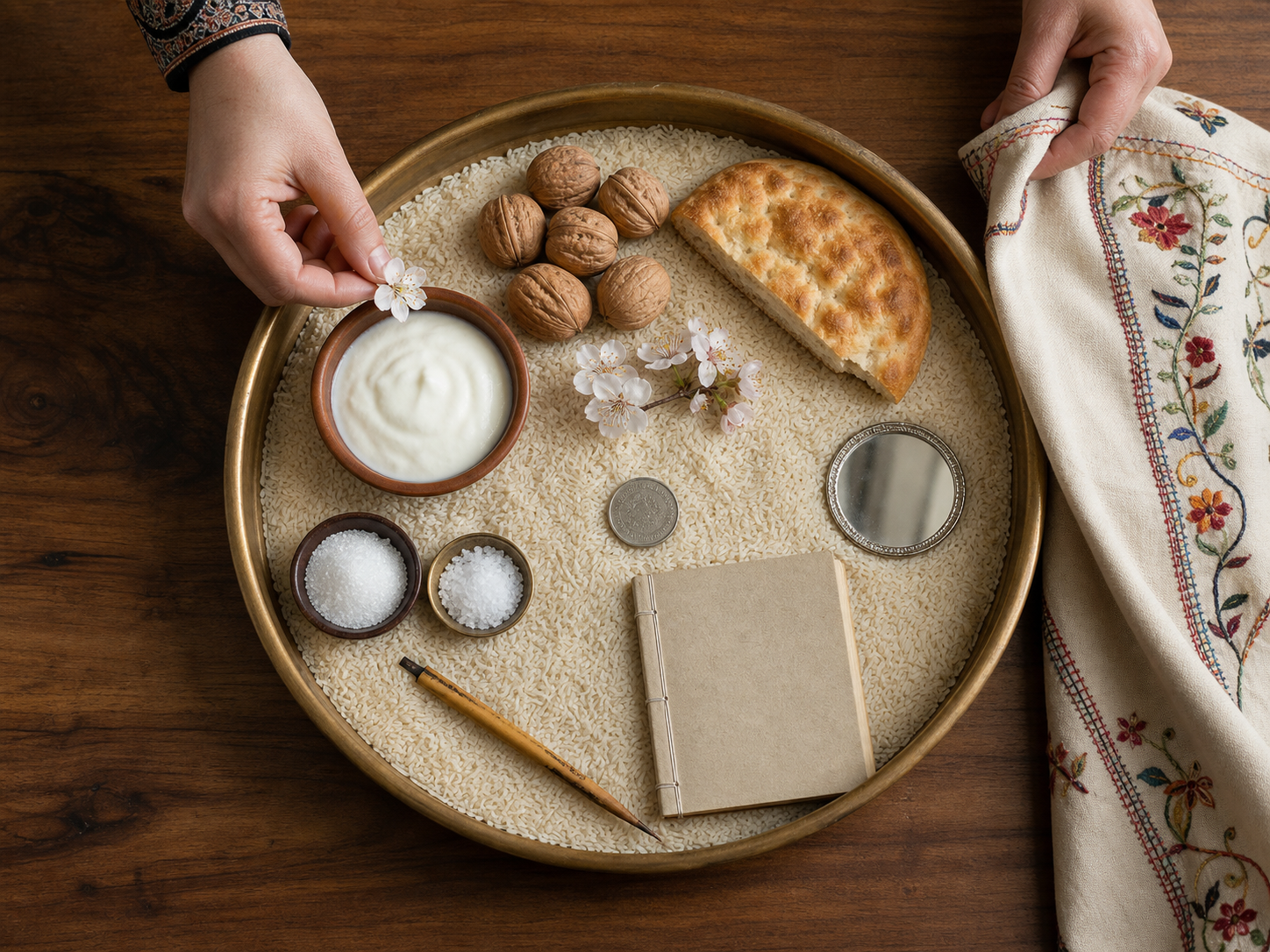
Thaal Barun works best when the tray is treated as a compact statement of what the household intends to nourish. It is not a decorative checklist. Food, light, learning, livelihood, self-examination and memory are gathered into one first sight for the new year.
- Confirm which threshold you are observing. March 13 is the stated 2026 preparation night for Sonth; March 18 is the preparation night directly preceding Navreh. Ask an elder, priest, temple or community body if your family record is unclear.
- Clean the tray and its setting. Choose a stable, clean surface where the arrangement can remain undisturbed. The act of preparation should itself be calm and deliberate.
- Lay down uncooked rice. The rice forms the base and represents nourishment, abundance and the fertility on which household life depends.
- Add the central objects. Place fresh curd for purity and continuity; coins or currency for honest livelihood; a new pen and notebook for learning and conscientious record-keeping; flowers for beauty and impermanence; and seasonal fruit or nuts for well-being. Walnuts, or akhrot, carry a particular association with strength and wholeness.
- Include the calendar and the mirror. Add the new Panchang or an almanac page if available. Set the mirror so that dawn darshan includes honest self-recognition rather than only the sight of material plenty.
- Make a short sankalpa. Name one duty the family wants to strengthen: regular study, responsible earning, care for elders, dana, environmental restraint or another concrete expression of dharma. A brief shanti mantra or silent prayer is enough when no longer family recitation has been prescribed.
- Complete the arrangement with jyoti. The lamp signifies knowledge and the removal of ignorance. Never leave an open flame unattended. If an overnight flame cannot be supervised safely, follow your household or priestly guidance for extinguishing and relighting it at dawn.
At dawn, family members traditionally bathe and approach the thaal before the ordinary rush of the day. Take darshan in silence or with a soft recitation, apply tilak where customary, share a little curd, fruit or sugar as prasad, and read the Panchang together. The notebook can then become practical: let each participating family member record one duty for the year and the first action needed to honor it.
Household variation is legitimate. Some lineages include a kalasha, a family deity’s image or a remembered verse. Diaspora families can use locally available fruit and flowers. Freshness, cleanliness and meaning matter more than importing an out-of-season object merely for appearance. Reusable lamps, durable trays and minimal plastic also keep the rite aligned with ahimsa and care for the living world.
In some Kashmiri Pandit lineages, walnuts later connect the domestic rite to a shrine, spring or river. Do not reproduce a water offering without knowing your family’s custom and the ecological rules of the place where you live. The deeper continuity lies in honoring Kashmir’s sacred memory without leaving waste in a local waterway.
Carry the plan from Navreh into the full Chaitra month
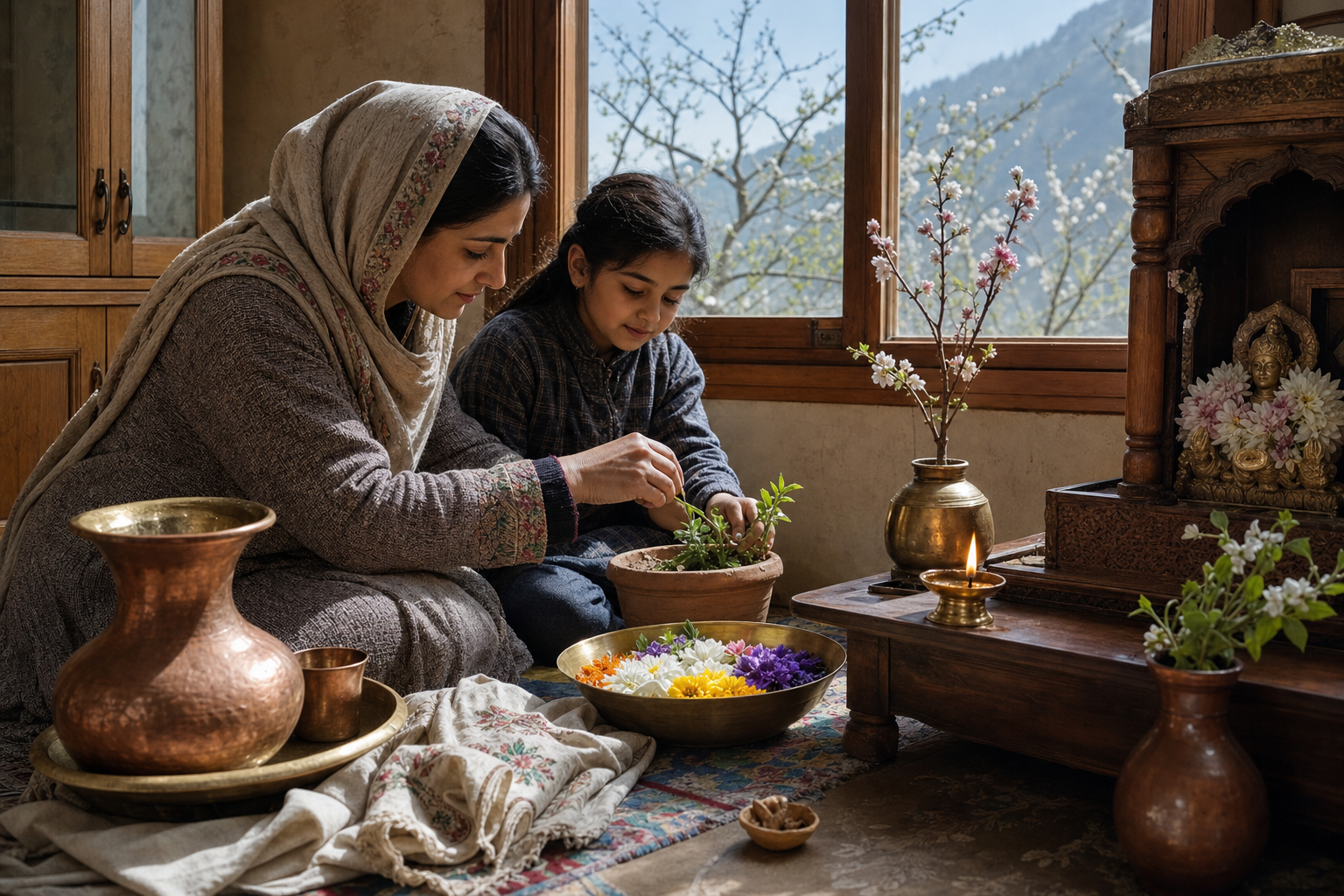
The calendar continues after Navreh, and this is where year numbering can create another avoidable argument. March and April 2026 fall in Vikram Samvat 2082 in the Gujarati convention because the Gujarati New Year began after Deepavali 2025. Regions beginning their Vikram Samvat year at Chaitra Shukla Pratipada enter VS 2083. Both labels can be internally correct because they start the civil year at different points.
For Gujarati households, Chaitra runs from March 19 to April 17 in 2026. Its being the sixth Gujarati month does not diminish Chaitra’s new-beginning character elsewhere. Keep the regional New Year and the lunar month’s devotional opportunities as separate entries in your calendar.
- On or around March 20: Chaitra Shukla Pratipada opens Chaitra Navratri and anchors Ugadi and Gudi Padwa in the regions that observe those new years. Confirm the locally governing tithi before a formal vrata or kalasha-sthapana.
- Around March 28: Ram Navami falls on Chaitra Shukla Navami. Plan Rama-katha, Sri Rama mantra japa, temple darshan or annadanam, but verify the local sunrise rule before publishing a community time.
- Around April 1: Chaitra Shukla Trayodashi brings Mahavir Jayanti in many locations. Jain observances of Bhagavan Mahavira’s birth commonly emphasize ahimsa, satya, compassion, prabhavana and seva.
- Around April 5: Chaitra Shukla Purnima carries Hanuman Jayanti in several North Indian traditions. Other regions keep Hanuman Jayanti in another month, so label the regional custom rather than presenting one date as universal.
- April 17: The next Amavasya closes Gujarati Chaitra and prepares the transition into Vaishakh.
You can reserve family time, gather puja materials and organize seva before every minute has been calculated. Exact tithi decisions, vrata boundaries, temple programs and muhurta-sensitive acts must wait for a Panchang computed for your city. For relatives outside India, that local check is especially important because a tithi can cross midnight differently and move the civil-date observance by one day.
Before March 13, decide whether your household keeps the separate Sonth sequence. Before March 18, write one shared schedule naming your city, calendar system, family lineage and purpose of each rite. Then keep the transitions in order: contemplation at the waning Moon, deliberate preparation for Navreh, dawn renewal with the thaal, and sustained sadhana through Chaitra. That is enough structure to prevent date confusion while leaving room for the tradition your family actually inherited.
References
- DharmaRenaissance Blog – March 18, 2026 Panchang: From Krishna Paksha Chaturdashi to Amavasya Tithi, Nakshatra and Rashi
- DharmaRenaissance Blog – Chaitra Maas 2026 in Gujarati Panchang: Auspicious Dates, Sacred Rhythms, and Festival Guide
- DharmaRenaissance Blog – Thaal Barun before Navreh 2026: A Definitive Guide to Dates, Ritual Steps, and Symbolism
