
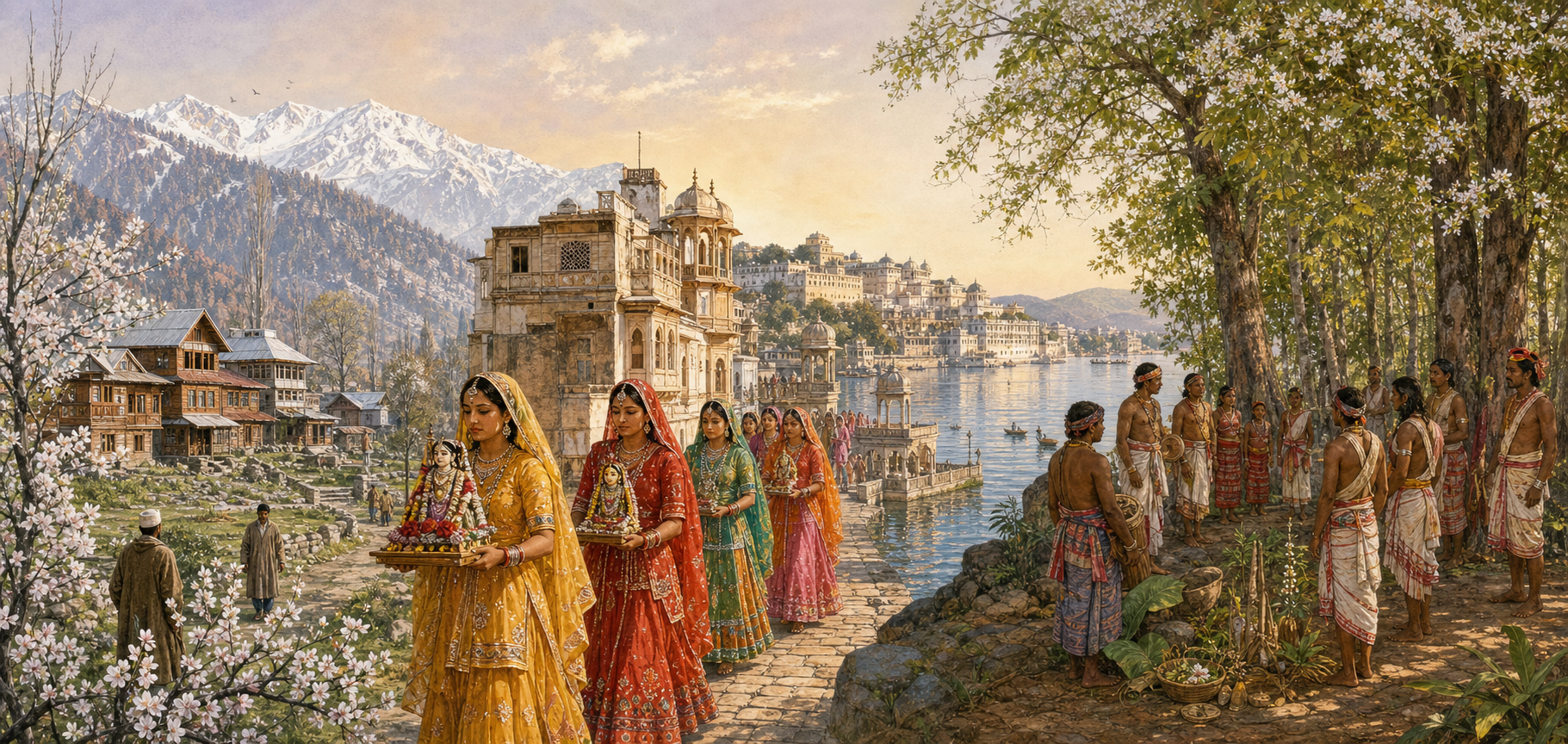
If you are trying to place India’s spring festivals on one neat calendar, the dates can seem contradictory. Kashmir welcomes a new solar month in mid-March, Udaipur carries Gauri and Isar toward Lake Pichola during Gangaur, and Adivasi communities may wait for the sal tree itself to announce the season.
The contradiction disappears once you ask three better questions: Which clock does the community follow? What local sign confirms the season? Is renewal being enacted in the household, the city, or the sacred grove? Sonth, the Mewar Festival, and Sarhul offer three precise answers. Understanding them will help you plan an observance, explain the festivals to your family, or attend as a respectful guest without reducing regional traditions to interchangeable spring pageantry.
One spring season can be read through several clocks
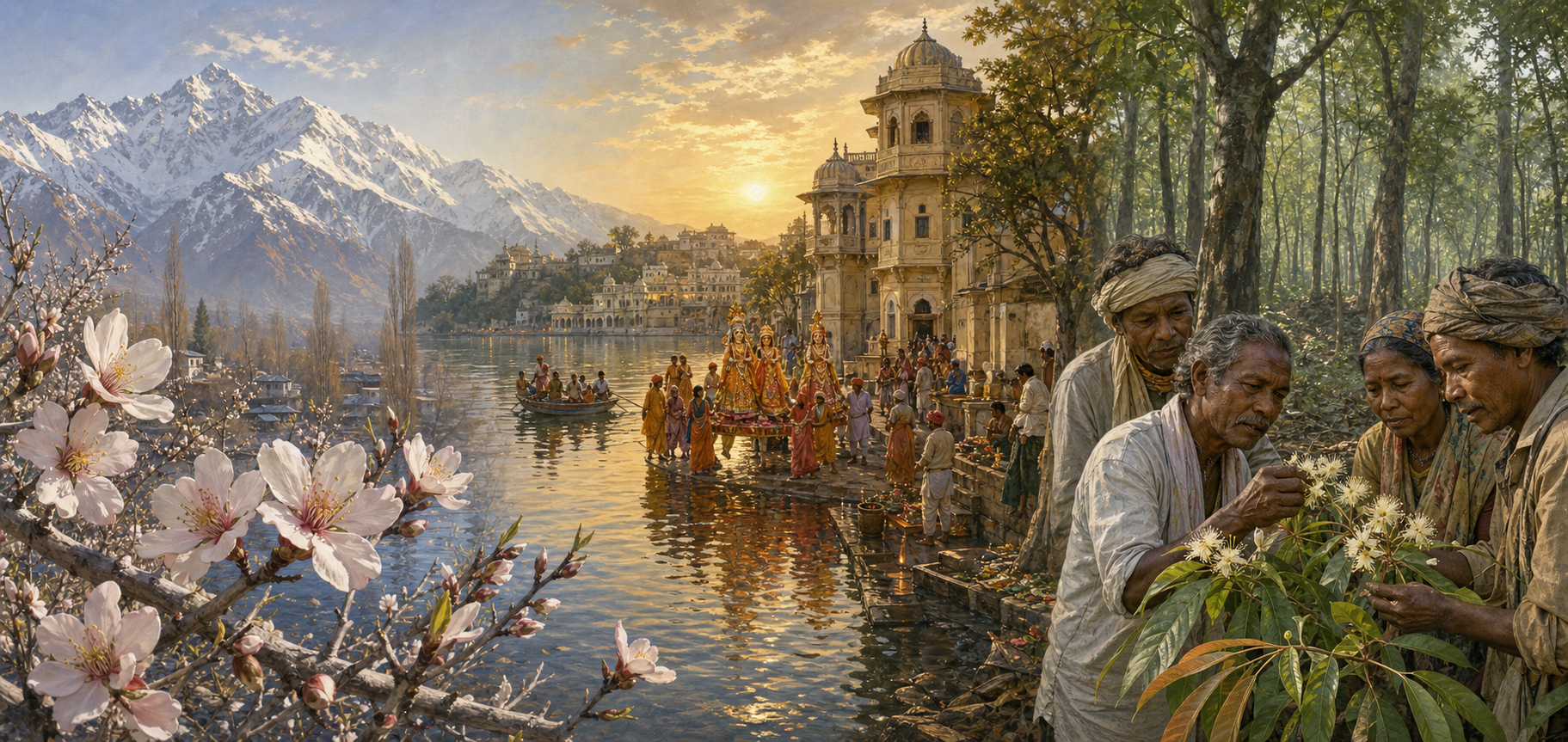
Indian sacred time does not force every region to enter spring through the same doorway. A festival may be governed by a solar ingress, a lunisolar tithi, a sequence of household rites, or an ecological event such as flowering. Local practice may combine more than one of these.
In Kashmir, Sonth or Chaitr Sankrat marks the start of Chaitra in the solar Saptarshi Panchang. The threshold occurs when Surya enters Meena in a nirayana, or sidereal, reckoning. In 2026, that transition falls on 14 March in India. Exact clock times can vary with the ayanamsha and computational convention used, so a household should follow its established local panchang rather than combining timings from unrelated calendars.
Udaipur’s Mewar Festival follows the Gangaur observance and unfolds as a ritual sequence rather than a single astronomical instant. Its 2026 celebration runs from 21 to 23 March. Household worship of Gauri and Isar develops into neighborhood activity, old-city processions, and a lakeside ceremony. Here, the calendar tells you when the observance occurs, but the movement from home to street to ghat tells you what the festival is doing.
Sarhul adds a different kind of precision. Many communities place it in the early bright fortnight of Chaitra, often near Chaitra Shukla Tritiya, but the first sal flowers remain a decisive seasonal sign. Numerous community bodies in Bihar and Odisha identified 21 March as the principal 2026 date, while allowing local variation based on bloom conditions and customary reckoning. A date announced for one district should therefore not be imposed on every village.
| Festival | Regional setting | 2026 marker | Primary seasonal clock | Main ritual setting |
|---|---|---|---|---|
| Sonth or Chaitr Sankrat | Kashmiri Hindu tradition | 14 March in India | Solar ingress into Meena in the Saptarshi Panchang | Household altar and dawn thaal |
| Mewar Festival and Gangaur | Udaipur and the Mewar region of Rajasthan | 21-23 March | Gangaur ritual cycle in Chaitra | Home, old-city procession, and Gangaur Ghat |
| Sarhul | Adivasi communities in Bihar, Odisha, and adjoining regions | 21 March for many 2026 observances, with local variation | Customary lunar timing confirmed by the sal bloom | Sarna sthal or other community sacred space |
This distinction changes how you plan. For Sonth, confirm the sankranti with the panchang used by your family or temple. For the Mewar Festival, confirm the day’s procession and cultural program because the celebration extends across several days. For Sarhul, ask the local community association or village custodians; a generic festival listing cannot tell you whether the flowers, rites, and local calendar have aligned.
Each festival renews a different relationship
Sonth brings cosmic order into the household
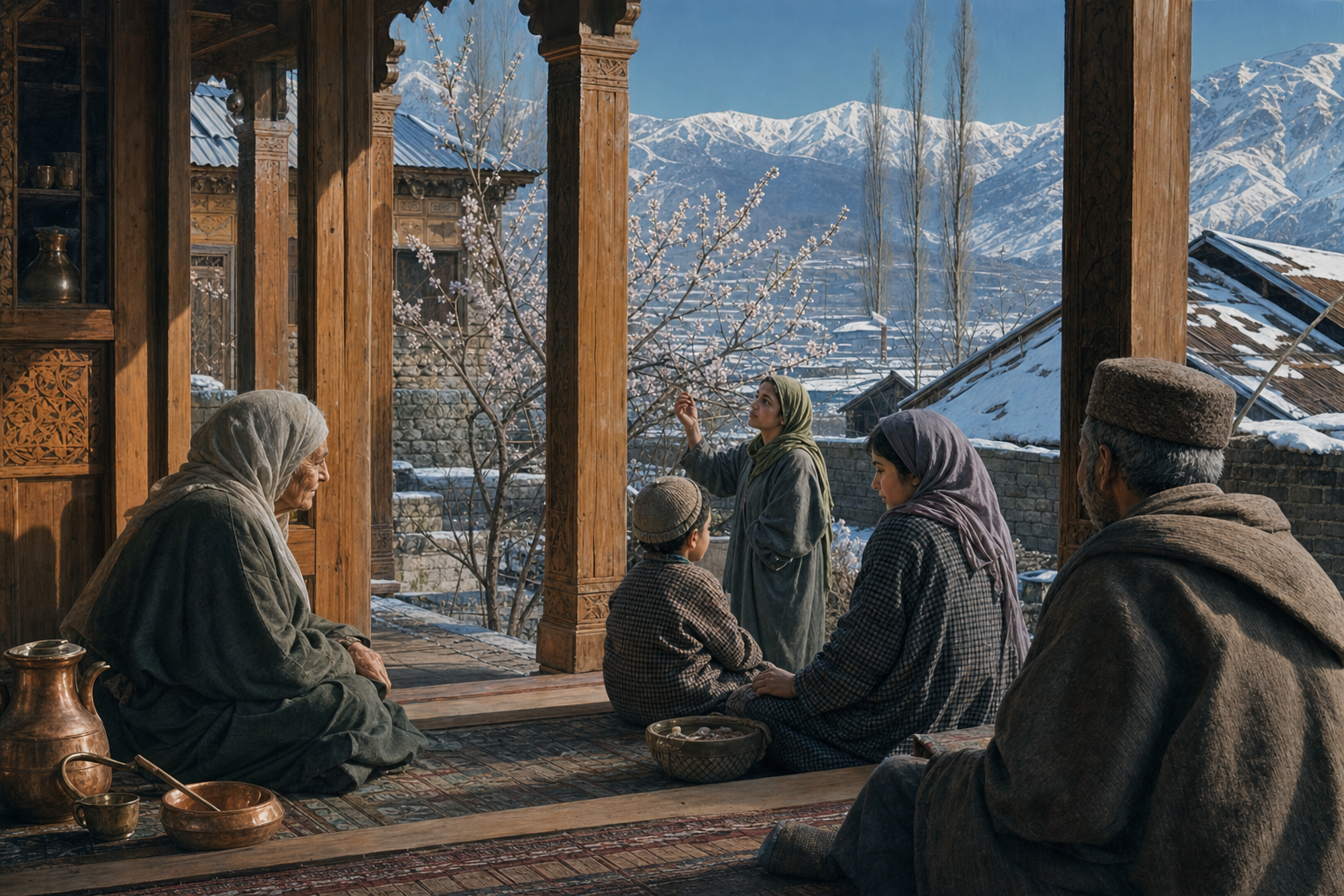
Sonth asks a family to begin the month by seeing the right things. On the previous evening, household members prepare a ceremonial thaal so that it can be viewed at dawn. The arrangement turns familiar objects into a compact statement of priorities:
- Grain, often rice, represents nourishment and continuity.
- Curd signifies purity.
- A coin directs attention toward material sufficiency and responsible prosperity.
- A pen or book places learning inside the family’s vision for the new season.
- A mirror calls for self-examination rather than mere outward display.
- Flowers or a fresh sprig make new growth visible.
- A lamp brings luminosity to the threshold of the month.
- The new panchang locates household intention within sacred and astronomical time.
The exact contents can vary by lineage. That variation is not a defect to be corrected with a standardized online checklist. If your elders use a particular grain, text, flower, or order of viewing, preserve the family practice unless your own tradition directs otherwise.
At dawn, the practical sequence is simple: clean the space, bathe, kindle the lamp, view the thaal, open the panchang, and offer a brief prayer, stotra, japa, or period of contemplation. Reverence to the Kula Devata and elders connects the new intention to inherited responsibility. A shared sattvic meal and modest daan can carry the morning’s resolve into conduct.
Do not casually rename Sonth as the Kashmiri New Year. Sonth is the solar opening of Chaitra in the Saptarshi system. Navreh is associated with Chaitra Shukla Pratipada in a lunisolar reckoning. The observances may sit close together and may share elements of the thaal tradition, but they mark different calendrical thresholds.
If you live outside India, do not assume that 14 March automatically supplies the correct local ritual time. Time-zone changes can move a sankranti relative to local sunrise. Use a panchang calculated for your location, or follow the calendar formally adopted by your temple or community. Unity of practice within a sampradaya matters more than chasing minute-level precision across several competing calculations.
Mewar carries devotion from the home into the city
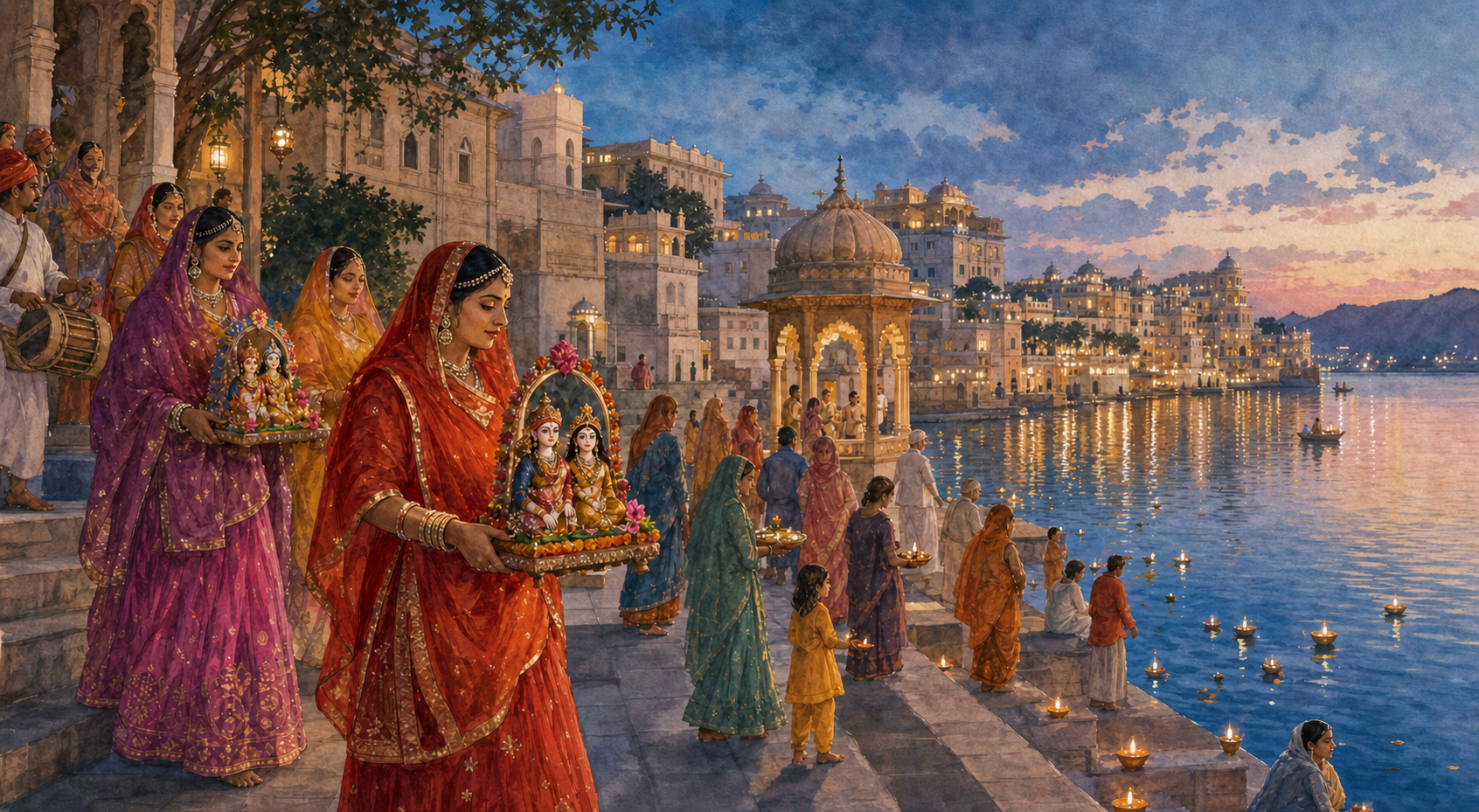
The Mewar Festival renews the relationship between intimate devotion and civic life. Gauri, or Parvati, and Isar, or Shiva, are worshipped in homes and neighborhood shrines. Decorated clay or wooden images may be anointed with turmeric and vermilion, adorned with flowers, and honored through songs, offerings, and aarti. Married women traditionally pray for the well-being of spouses and households, while unmarried women seek blessings for a harmonious future.
The public procession does not replace those rites. It gives them a shared urban form. Images of Gauri and Isar travel in decorated palanquins through Udaipur’s old city amid shehnai, dhol, folk performers, and gathered families. Routes commonly move through areas such as Jagdish Chowk and Bada Bazar toward Gangaur Ghat on Lake Pichola. The lakeside presentation, sometimes including ceremonial boats, joins deity, community, water, palace, and cityscape in one field of attention.
If you attend, plan according to that progression. Morning is better suited to darshan and quieter ritual observation. Late afternoon and evening bring the processions, cultural programs, and the most crowded approaches to the ghat. Families with children can divide the day into morning darshan, an afternoon rest, and an evening return. That is more realistic than keeping children in warm, congested lanes for an uninterrupted day.
Walking is often the most dependable way through the narrow old-city streets because closures and diversions can affect the City Palace, Jagdish Temple, and Gangaur Ghat approaches. Arrive before the procession reaches the tightest corridors. Gangaur Ghat offers proximity to the rites; Ambrai Ghat offers a more panoramic view across the lake. Choose between immersion and distance before the crowds make the decision for you.
Ghoomar, Kalbelia, puppet theatre, folk singing, miniature painting, block textiles, silverwork, and lac bangles extend the festival beyond the procession. Treat these arts as living livelihoods, not decorative background. Buying locally made work at a fair price supports the people who keep the cultural vocabulary of Mewar alive. When photographing, ask before taking close portraits and avoid flash during aarti. A clear view is never worth obstructing a palanquin, ritual participant, or local family.
Sarhul renews the covenant between community and forest
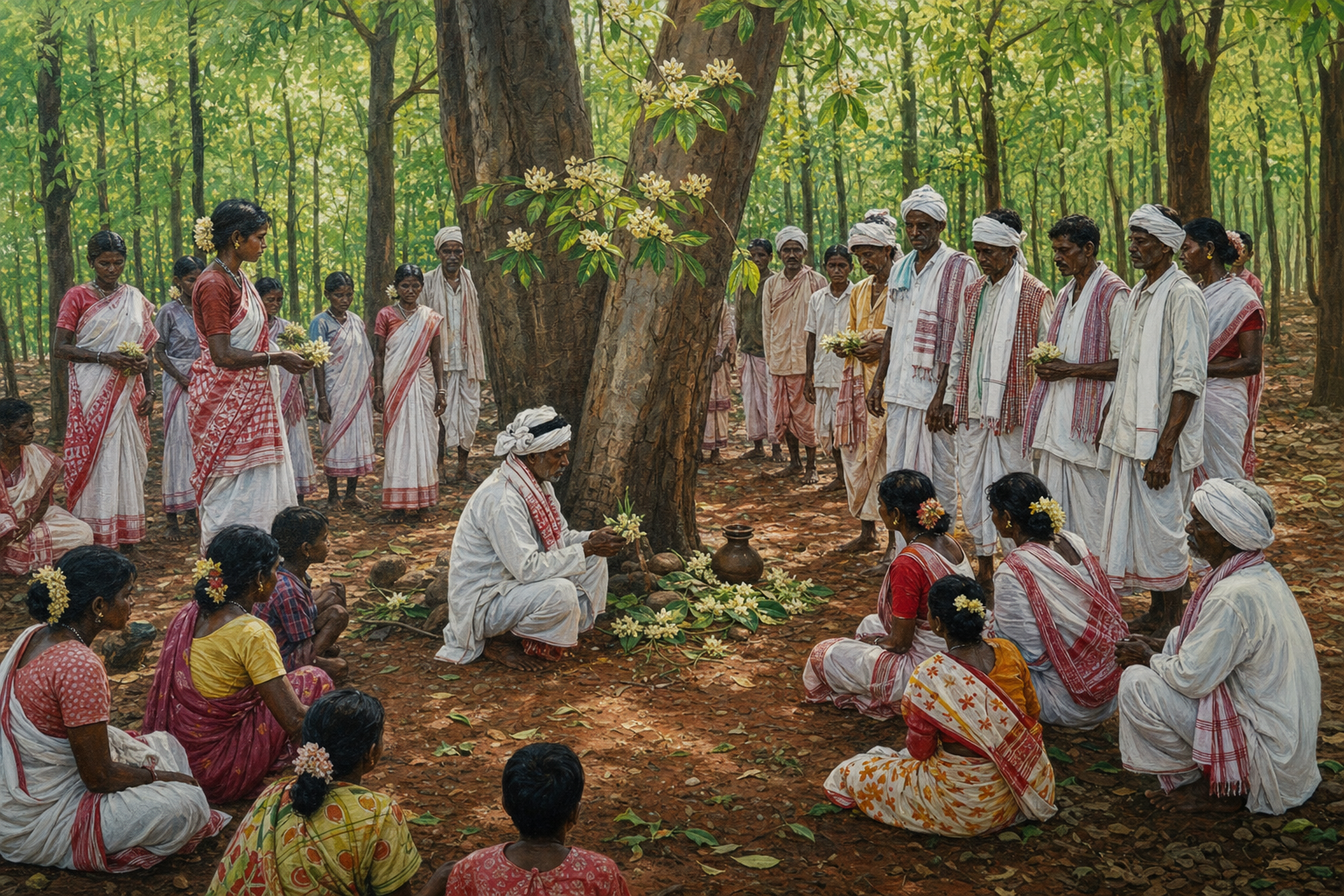
Sarhul begins with a fact that urban festival calendars can easily miss: the forest is not scenery. The sal tree participates in determining ritual time, supplies the flower at the center of worship, and stands within a wider relationship joining rainfall, soil, crops, animals, ancestors, and village well-being.
Among Munda and Oraon communities, the rites are led at the Sarna sthal by a Pahan or Dehuri, according to local tradition. Santhal communities maintain their own ritual order at the Jaher than under the Naeke. Names such as Singbonga or Dharmes may identify a supreme sky- or sun-associated divinity, while protective village and forest deities express the community’s obligations to a particular place.
Purification of the sacred space is followed by prayers and offerings of sal flowers, grain, water, seasonal produce, and locally prepared hadia. Petitions concern timely rain, fertile soil, the health of people and animals, and the balance on which a future harvest depends. Three earthen pots filled with water may be placed near the sacred tree or post. Their water levels and surface cracks are read as inherited indicators of the coming monsoon. The practice joins observation, agrarian memory, and ritual responsibility rather than separating ecological knowledge from sacred life.
Mandar and nagara drums accompany circle dances and processions, while songs carry clan memory, origin narratives, and lessons about gratitude and reciprocity. Public celebrations in towns may make these arts more visible, but the sacred-grove rite remains under community authority. Attendance at a cultural stage program does not grant automatic access to every invocation or protected space.
Sarhul and the Santhal Baha Parab should not be treated as two labels for an identical event. Baha has its own custodians, timing, instruments, and ritual grammar. It may occur earlier in Phalgun-Chaitra, including February or early March in some 2026 village calendars, depending on local ecology. What the observances share is a spring flower, renewed social bonds, and concern for ecological and agricultural balance; what distinguishes them belongs to the communities that practice them.
If you are invited, ask before entering the Sarna sthal or Jaher than, and ask again before photographing an invocation. Follow the Pahan, Dehuri, Naeke, elders, or community volunteers rather than assuming general temple etiquette covers every situation. A greeting such as Johar, patient listening, and fair support for local craft are more respectful than collecting flowers or staging a photograph inside a sacred space.
Shared dharma appears in the pattern, not in identical rites
These celebrations belong to different communities, calendars, and ritual worlds. Their unity lies neither in a single date nor in a claim that every deity, sacred specialist, and ceremony means the same thing. It lies in a recognizable movement from attention to responsibility.
First, the season must be noticed. Sonth notices Surya’s movement and the new month’s dawn. Mewar notices the Gangaur cycle and brings its deities into the city’s shared spaces. Sarhul notices the sal bloom and reads the condition of land and water. Renewal begins by receiving a sign, not by declaring a convenient date.
Second, the world is put in order. A Kashmiri family cleans the home and arranges the thaal. Mewar households prepare and adorn images of Gauri and Isar before the procession. Sarhul custodians purify the sacred grove and prepare communal offerings. The celebratory crowd comes after acts of attention that are usually quieter and more disciplined.
Third, abundance is treated as relational. Grain on a thaal is not merely private food. Lake, ghat, household, and market all contribute to Mewar’s public celebration. Sal flowers and water cannot be detached from rain, animals, cultivation, and the health of the village. Prosperity is therefore received with gratitude and bound to obligations beyond the individual.
Finally, renewal must enter conduct. Learning, daan, family harmony, fair exchange with artisans, shared food, care for sacred groves, and restraint in consumption are not optional moral decorations added after ritual. They are ways the ritual becomes socially and ecologically consequential.
This pattern creates genuine bridges across the dharmic family. Hindu prakriti-upasana gives language to reverence for the living world. Jain ahimsa sharpens the demand to reduce harm. Buddhist teachings on interdependence help us notice that no harvest or household flourishes alone. Sikh seva and sarbat da bhala direct renewal toward service and the welfare of all. These are points of ethical resonance, not licenses to absorb Sarna, Kashmiri Hindu, Rajasthani, Buddhist, Jain, or Sikh identities into one generic ritual.
If you are teaching a child or introducing these festivals to a community group, preserve four details every time: the local name, the community custodian, the seasonal cue, and the central act. Say that Sonth uses the Saptarshi solar calendar and a dawn thaal. Say that Mewar’s Gangaur devotion moves toward Lake Pichola. Say that Sarhul is led through community institutions and responds to the sal bloom. Specificity is what allows civilizational kinship to remain respectful rather than flattening.
How to observe without turning living tradition into spectacle
Your role determines the right form of participation. A lineage member maintaining a household observance has different responsibilities from a traveler at Gangaur Ghat or a guest invited to a Sarna celebration. Use this sequence before you make plans:
- Name your relationship to the festival. If it is your family tradition, begin with elders, the household panchang, and inherited practice. If you are a visitor, begin with the local host or organizer. Curiosity does not create ritual authority.
- Verify the clock that matters. Use a location-specific panchang for a solar threshold such as Sonth, the announced daily program for a multi-day civic festival such as Mewar, and local community confirmation for a bloom-sensitive observance such as Sarhul.
- Choose the correct layer of participation. A public dance, craft market, or procession may welcome broad attendance. A household puja, sacred-grove invocation, or offering led by a designated custodian may require an invitation or explicit permission.
- Let worship govern photography. Ask before close portraits, do not use flash during aarti, and do not enter a restricted space for a better angle. If people lower their cameras or volunteers clear a path, follow their lead immediately.
- Prepare for the physical setting. Carry water and wear comfortable footwear for warm March processions. Walk where old-city closures make vehicles impractical. At a forest-centered celebration, follow local instructions about paths, plants, offerings, and waste.
- Make your spending consistent with the festival’s ethic. Choose locally made crafts, pay fairly, use a refillable bottle where practical, and dispose of waste responsibly. Do not take sal flowers, ritual materials, or other natural objects as souvenirs.
- Carry one obligation home. A new book for study, daan to a real local need, support for an artisan, service to elders, or care for a neighborhood tree gives the season a consequence beyond photographs and greetings.
Key takeaways
- India’s spring festivals differ in date because communities use different combinations of solar movement, lunar tithi, ritual sequence, and ecological signs.
- Sonth is a solar Chaitra threshold centered on the household, the dawn thaal, and conscious alignment with the panchang.
- The Mewar Festival carries Gangaur devotion from home and neighborhood into Udaipur’s streets and the ceremonial setting of Lake Pichola.
- Sarhul is governed by community custodians and the sal bloom; its timing and sacred spaces must be confirmed locally.
- Shared values such as gratitude, restraint, service, family responsibility, and ecological reciprocity connect these traditions without making their rites interchangeable.
- The most respectful participation begins with the right calendar and the right custodian, not with a generic festival itinerary.
Choose one regional festival this spring and learn it at full resolution. Write down its clock, seasonal sign, custodian, and central act. Then verify the local practice before you prepare a thaal, reserve a vantage point, or accept an invitation. That small discipline will let you encounter India’s unity where it is strongest: through traditions distinct enough to remain alive and generous enough to illuminate one another.
References
- DharmaRenaissance Blog – Mewar Festival 2026 in Udaipur: Dates, Gangaur Processions, Rituals, Routes & Visitor Guide
- DharmaRenaissance Blog – Sonth (Chaitra Sankranti) 2026: Meaning, Timing, and Rituals for Kashmir’s Spring Renewal
- DharmaRenaissance Blog – Sarhul 2026 in Bihar & Odisha: Date, Baha Parab, Rituals, and Eco-Spiritual Significance
