
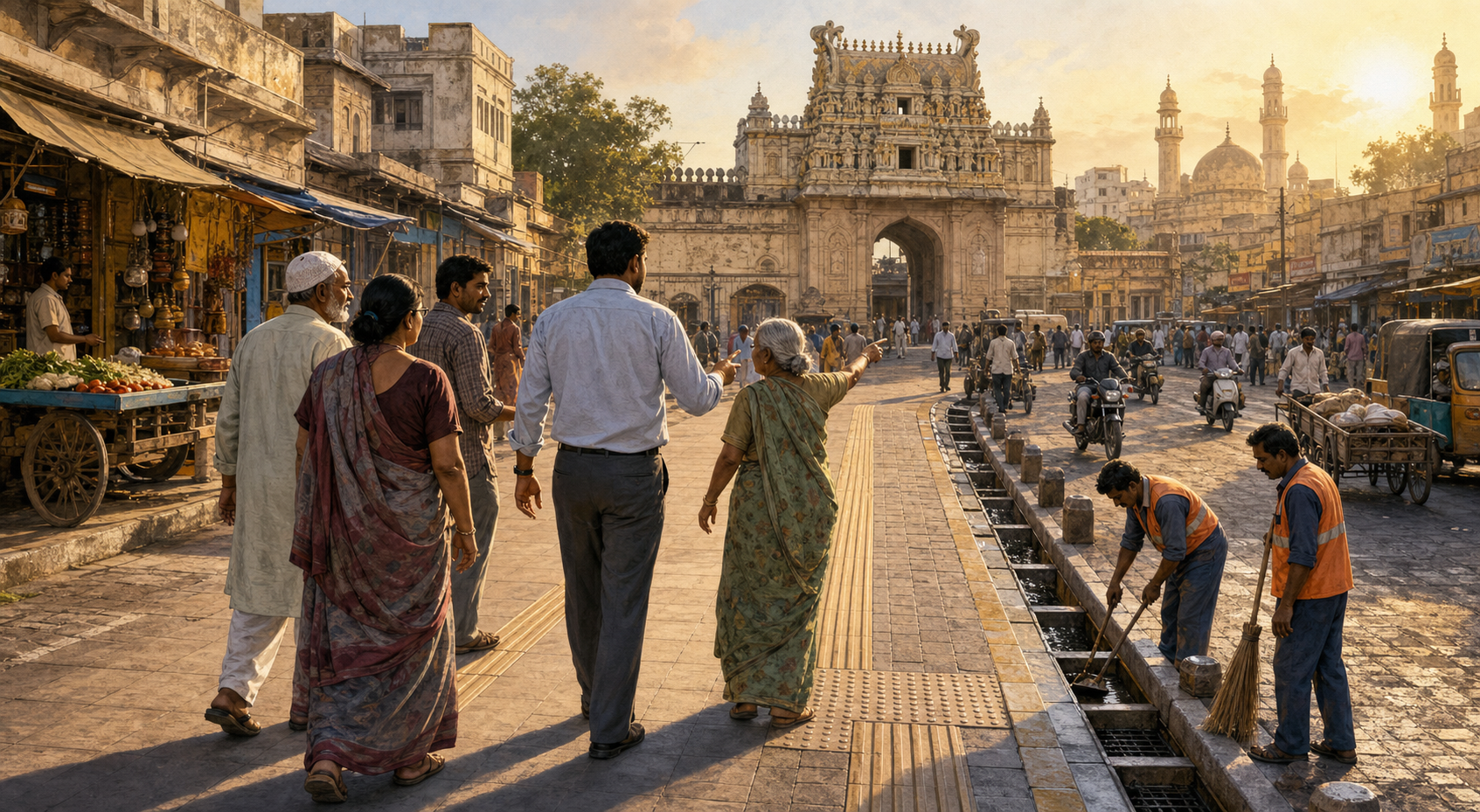
If you have encountered S. Raja Singh mainly through a party label, a speech, or a contentious public debate, you still lack the information needed to judge his service in Goshamahal. The useful questions sit closer to the street: Was a resident’s grievance resolved? Was a sacred precinct kept accessible and safe? Were traders treated fairly? Can the result be verified?
Those questions also offer a fair way to examine Hindu-rooted politics in a plural city. Dharmic values become public ethics only when they produce lawful safety, dependable civic services, cared-for heritage, shared opportunity, and accountability. You can assess Raja Singh’s public-service model without either dismissing his cultural commitments or treating political loyalty as proof of performance.
Start with the constituency, not the political slogan
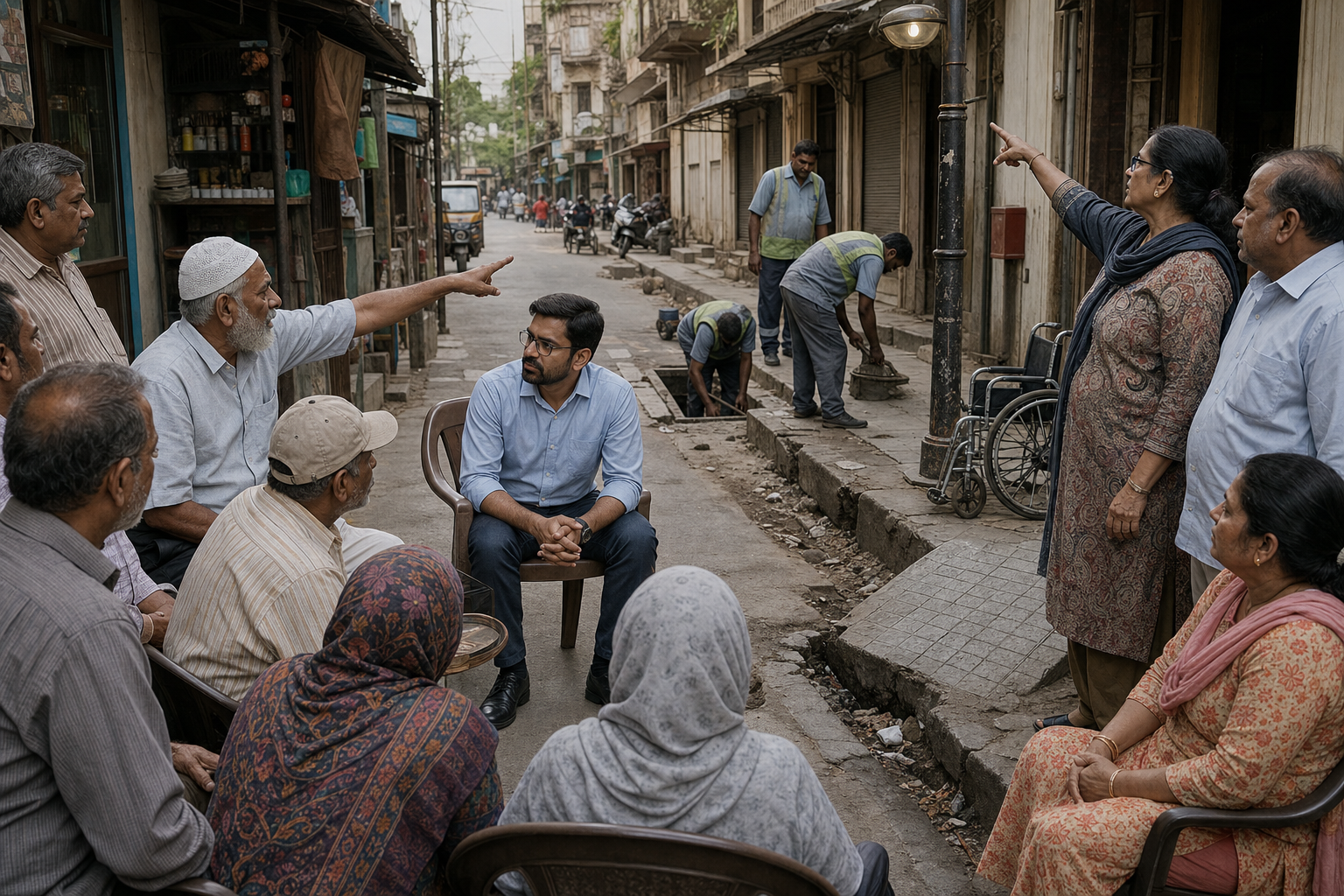
Raja Singh’s movement from grassroots municipal politics to service as a BJP MLA for Goshamahal, along with repeated electoral confidence, establishes a durable political relationship with the constituency. It does not establish that every grievance was resolved or every policy claim fulfilled. A mandate and a performance audit answer different questions.
In an old, dense part of Hyderabad, constituency work is rarely glamorous. It means identifying whether a complaint belongs with the Greater Hyderabad Municipal Corporation, the police, another public authority, or more than one of them. It includes sanitation, water resilience, traffic bottlenecks, pedestrian movement near sacred places, festival arrangements, public safety, and the regulation that shapes vendor livelihoods. An elected representative may press, coordinate, and escalate, but the responsible institution must still execute the work.
A useful way to test Singh’s public messaging is the four-part framework of seva, suraksha, samskara, and samriddhi. Each word should lead to a question that a resident can answer with evidence:
- Seva: Can residents submit a problem, receive a traceable response, and see whether it was closed?
- Suraksha: Is public safety pursued for everyone through lawful policing, careful planning, and time-bound follow-up?
- Samskara: Are sacred places, festivals, local memory, and traditional practices protected with competent management rather than occasional symbolism?
- Samriddhi: Do small traders, artisans, flower vendors, musicians, young workers, and other local livelihood groups gain fair access to opportunity?
When you raise a local problem, keep a simple case record: the locality, the exact issue, the authority responsible, the complaint date, the escalation date, the current status, and visible evidence of closure. “The office looked into it” is not an outcome. A cleared obstruction, restored service, documented decision, or written explanation is.
Treat heritage as the management of a whole precinct
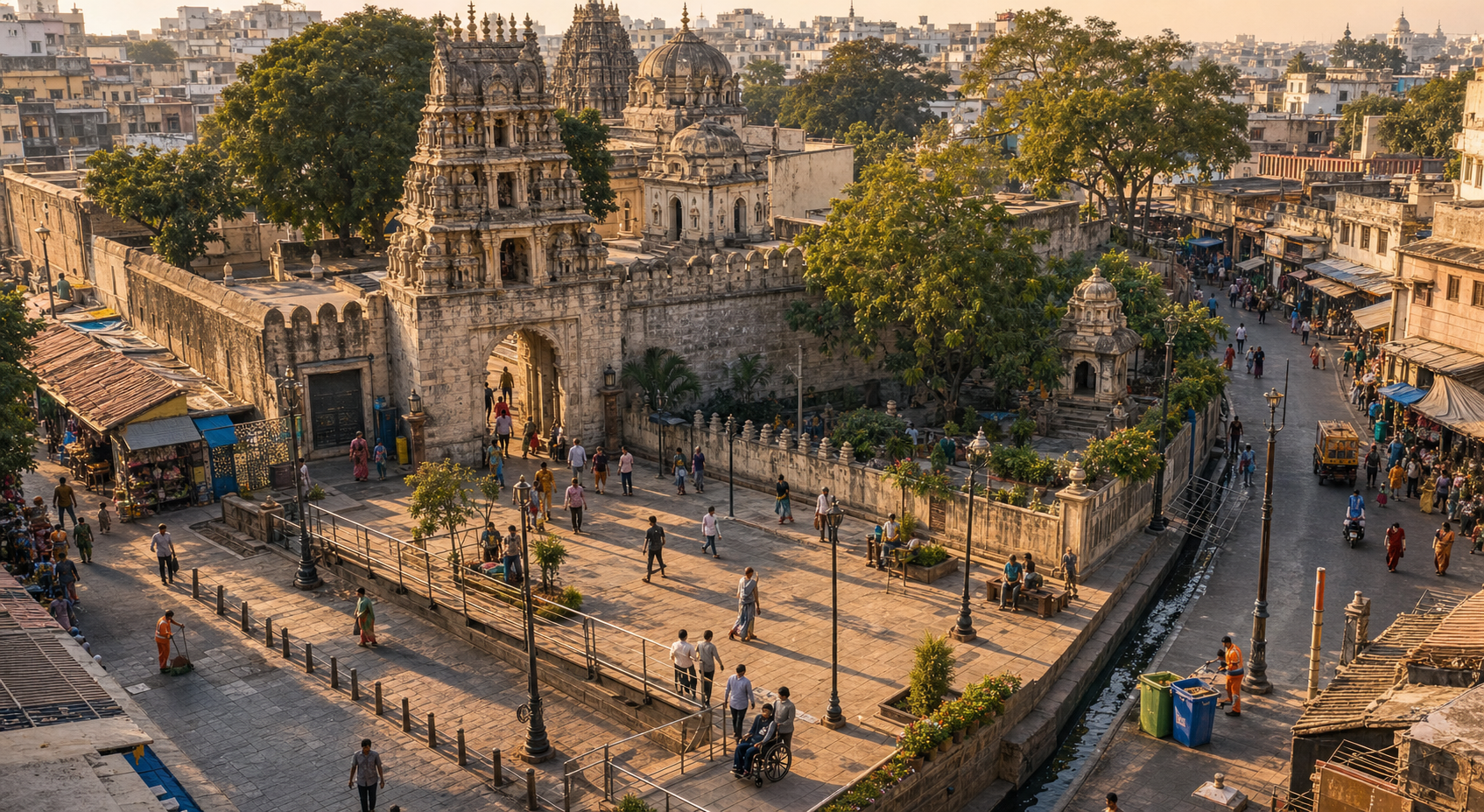
Hyderabad’s heritage does not stop at the wall of a shrine. A temple, gurudwara, derasar, or vihara depends on its approach road, drains, pedestrian access, crowd movement, surrounding commerce, sanitation, and emergency access. These places can also function as community-service centres, which makes their civic condition a daily public concern rather than a ceremonial issue.
This is why conservation, festival management, crowd safety, inclusive access, and coordination with local trusts and heritage professionals belong in the same conversation. Repairing architecture while leaving the approach lane unsafe is incomplete preservation. Organising a large utsavam without a sanitation or movement plan transfers the cost to residents, devotees, workers, and nearby traders.
A five-part audit you can use before a festival or heritage project
- Walk every public approach to the precinct. Note pedestrian conflicts, blocked access, traffic pressure, and any point where an emergency vehicle could be delayed.
- Check the operating plan for waste, sanitation, water, queues, entry, exit, and coordination with the relevant public authorities.
- Ask which features require conservation expertise. Structural or architectural work should not be confused with routine decoration or arbitrary remodelling.
- Identify the people whose livelihoods depend on the precinct. Vendor regulation should protect safety and access while using clear, fair rules.
- Record responsibility before the event or project begins: the trust, civic body, police contact, contractor, or elected office handling each issue.
The timing matters. An access problem found during the procession is already a crowd-management failure. The walk-through, assignments, and escalation route need to exist beforehand. Afterward, organisers should record what failed so the same obstruction does not return at the next celebration.
India’s constitutional framework supplies an important boundary. Articles 25 to 28 protect freedom of conscience and religious practice while making that freedom subject to public order, morality, and health. Heritage protection therefore cannot mean exemption from safety rules, arbitrary use of public space, or unequal treatment. Nor should neutral administration become an excuse to neglect sacred places. The practical task is to protect worship, life, property, access, and lawful civic order together.
Make dharmic unity visible through shared service
Dharmic unity should not require Hinduism, Buddhism, Jainism, and Sikhism to be presented as doctrinally identical. Their differences are real. Their civic vocabularies nevertheless offer strong points of cooperation: seva and lokasangraha in Hindu thought, karuna and metta in Buddhism, ahimsa and anekantavada in Jainism, and seva and sarbat da bhala in Sikh tradition. In public life, these ideas direct attention toward service, compassion, non-violence, many-sided understanding, and the welfare of all.
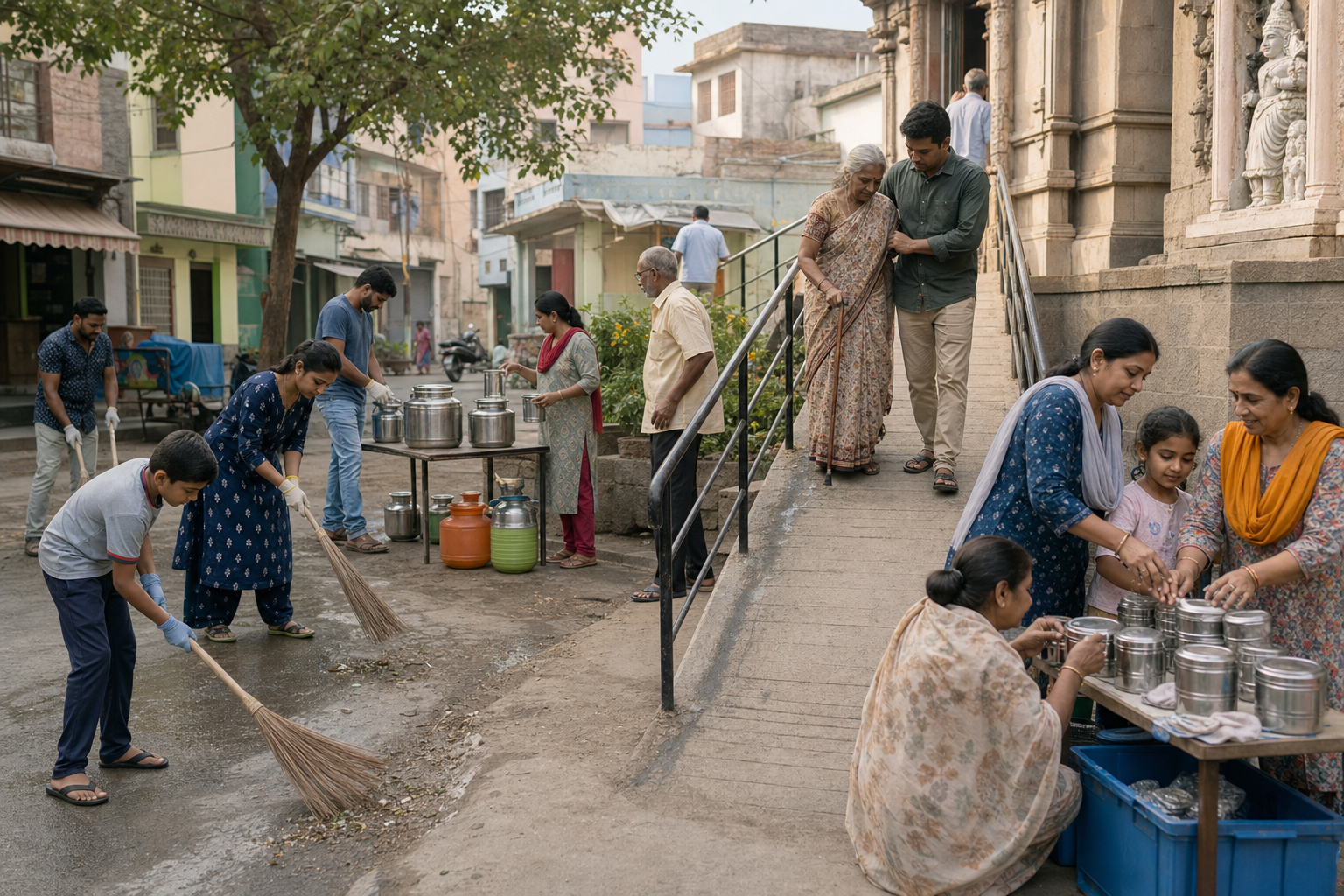
The strongest demonstration of that unity is a completed civic task. A temple, gurudwara, derasar, and vihara do not need to erase their identities to cooperate on a community meal, a blood-donation drive with a qualified medical partner, disaster-response preparation, a heritage walk, or a civic-literacy clinic. A modest project with named responsibilities and a public outcome does more for trust than a large gathering that produces only photographs.
- Choose one shared need, not a broad declaration of harmony.
- Name the participating institutions and one coordinator from each.
- Assign a qualified partner wherever the activity involves health, safety, or emergency response.
- Identify the municipal or police contact needed for permissions, public space, traffic, or safety.
- Publish the scope, place, time, responsible organisers, and result.
- Record complaints and lessons before repeating or expanding the activity.
Community vigilance needs an equally clear boundary. Residents can report hazards, support women’s safety, preserve evidence, and maintain contact with police. They should not become an unofficial enforcement force. Confrontation, collective suspicion, and punishment outside the law place both public safety and dharmic credibility at risk.
Youth participation also needs a defined purpose. Young volunteers can map access problems, help residents understand grievance channels, document local traditions under informed supervision, or support approved preparedness programmes. Employment initiatives should connect skill centres to actual apprenticeships, small manufacturers, traders, or other identifiable work. Attendance at a programme is an input; a credible pathway to work is the intended result.
Demand evidence that can survive political disagreement
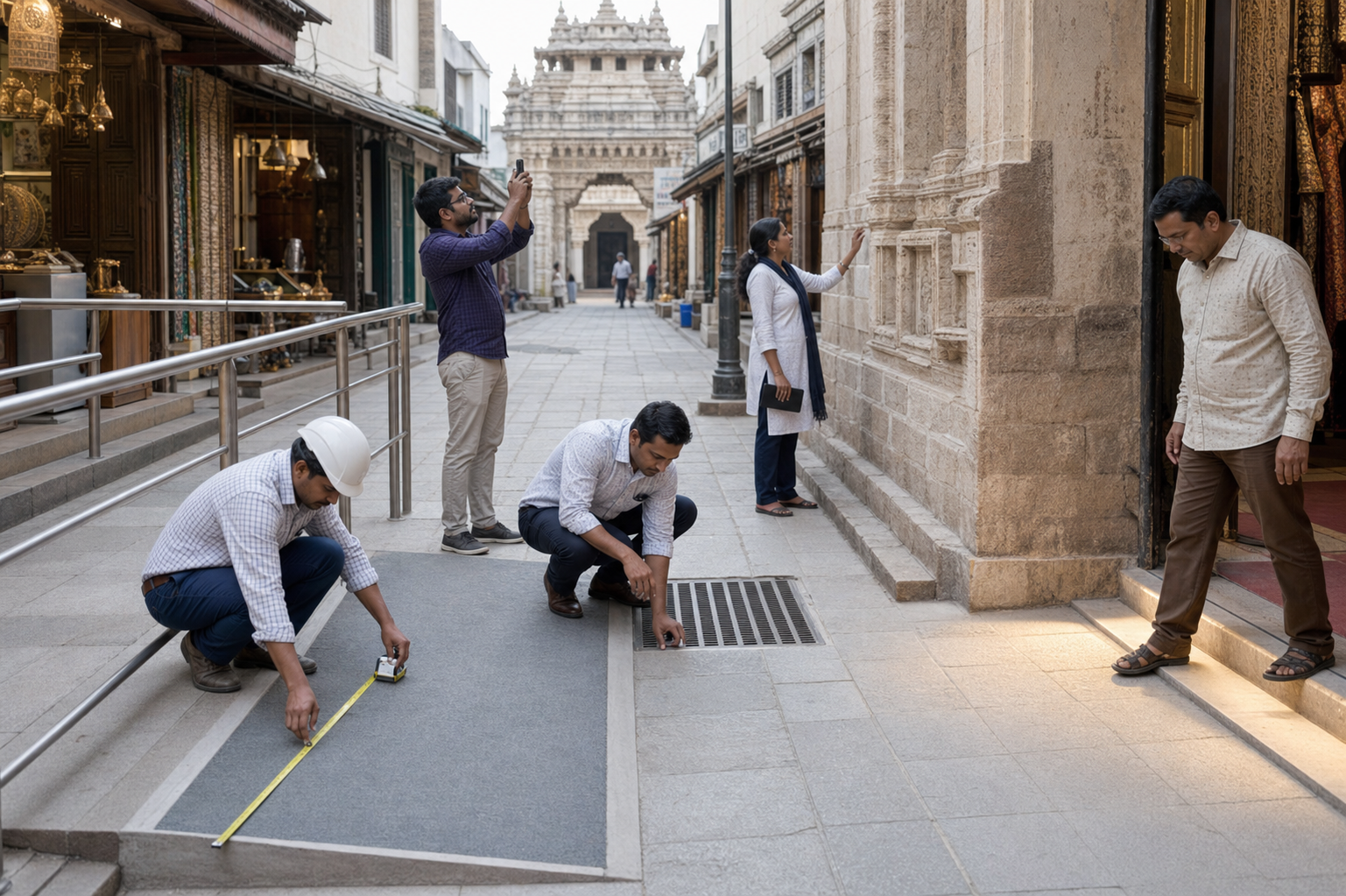
A public representative’s supporters and opponents may never agree on rhetoric. They can still ask for the same administrative evidence. The most useful indicators are tied to a defined place, responsibility, reporting period, and observable outcome.
| Area of service | Evidence to request | Weak substitute |
|---|---|---|
| Grievance redressal | Cases received, responsible authority, current status, resolution time, and closure evidence | Office visits or verbal assurances |
| Public safety | Identified hot spots, preventive coordination, complaint follow-up, and recorded corrective action | General claims of toughness |
| Festival management | Access plan, sanitation condition, authority assignments, reported failures, and post-event correction | Crowd size or ceremonial visibility |
| Heritage stewardship | Condition record, professional input, permissions, completed work, and maintenance responsibility | Announcements without a conservation trail |
| Local livelihoods | Clear vendor rules, documented grievances, fair access, and participation by affected workers | Photographs with selected traders |
The most relevant measures include grievance-resolution speed, safety around heritage clusters, sanitation during major festivals, participation in shared service, and the condition of traditional livelihoods. A public dashboard co-created with resident groups would make such work easier to inspect. Its entries should define what “resolved” means; otherwise, forwarding a complaint can be counted as success even when nothing changed on the ground.
The absence of a dashboard does not prove that no work occurred. It does mean that residents must depend more heavily on testimonials, office claims, and scattered records. That weakens institutional memory and makes it easier for every new dispute to become a contest of loyalties.
Accountability also applies to political language. Kshatra Dharma, understood as duty-bound courage, does not authorise aggression or collective blame. In democratic civic life, firmness means identifying the alleged conduct, using the lawful remedy, protecting people and property, and correcting an error when the facts demand it. A leader can be uncompromising about lawlessness without degrading an entire community.
This distinction is especially important when assessing Raja Singh. Many supporters value his emphasis on Hindu identity, safety, and cultural protection. The responsible test is whether that emphasis produces precise action within the rule of law. Ask whether a statement names a specific problem and remedy or merely intensifies hostility. Ask whether the same safety standard is defended for every resident. Ask whether criticism leads to evidence and correction rather than a harder slogan.
Key takeaways
- Repeated electoral support establishes a mandate, not proof of every performance claim.
- Judge seva, suraksha, samskara, and samriddhi through traceable outcomes rather than symbolic activity.
- Protect a heritage precinct as a complete civic environment: shrine, access, safety, sanitation, conservation, and livelihoods.
- Test dharmic unity through lawful, well-run service shared by Hindu, Buddhist, Jain, and Sikh institutions.
- Demand evidence with a location, responsible authority, status, reporting period, and observable result.
- Expect cultural firmness to remain precise, constitutional, and free of collective blame.
You do not have to surrender political conviction to apply this standard. Choose one claim connected to one Goshamahal locality, heritage precinct, or recurring civic problem. Find the responsible authority, preserve the complaint trail, check the physical outcome, and make unresolved items visible. That is how support becomes participation, criticism becomes useful, and Hyderabad’s heritage becomes a public duty rather than a campaign theme.
References
