

You may know that Akka Mahadevi Jayanti belongs on the festival calendar, yet still wonder what a meaningful observance should contain. The answer is not a longer ceremonial programme. It is an encounter with the question running through Akka’s life and Vachanas: what still governs you when you say the Divine comes first?
In 2026, the Jayanti is widely observed on 1 April, coinciding with Chaitra Purnima. Use the occasion to combine Shiva bhakti, careful reading, silence, honest self-examination, and seva. That combination honours Akka more faithfully than admiration without practice.
Key takeaways
- Akka Mahadevi Jayanti falls on Chaitra Purnima; local panchang calculations can shift the civil date by a day, especially across regions and time zones.
- A Vachana is not merely a memorable quotation. Its imagery, inner opposition, rhythmic speech, and concluding ankita work together as a spiritual challenge.
- Akka’s renunciation should direct you toward freedom from possession, approval, and outward performance. It should not be copied as spectacle or used to excuse the abandonment of legitimate duties.
- A fitting observance joins Vachana recitation with Om Namah Shivaya japa, dhyana, discussion, and a concrete act of service.
- Her teachings resonate with Jain aparigraha, Buddhist attention to direct insight, and Sikh simran, while remaining distinctly rooted in devotion to Shiva as Cennamallikarjuna.
Fix the date without mistaking the calendar for the purpose
Akka Mahadevi Jayanti commemorates a renowned Kannada poet-saint of the 12th-century Veerashaiva Bhakti movement. Karnataka remembers her simply as Akka, meaning elder sister. The intimacy of that name matters: she is not held at a safe distance as a literary monument but approached as a spiritual elder whose words still demand an answer.
Chaitra Purnima, also called Chaitra Pournami in much of South India, provides the lunar setting. The full moon’s association with illumination suits a saint who repeatedly turned attention from public appearance toward inner clarity. Yet a lunar observance cannot always be transferred mechanically onto a fixed Gregorian date.
Purnimanta and Amanta month reckoning, the local beginning and ending of the tithi, sunrise-based observance, and time-zone differences can produce a legitimate shift. If your temple or regional panchang places the Jayanti a day apart from the widely listed date, that difference is not automatically an error.
- For personal worship: follow the panchang convention already used in your home or sampradaya.
- For a temple programme: confirm the date with the officiating temple before circulating an invitation.
- For a diaspora gathering: use the local tithi rather than assuming that the Indian civil date transfers unchanged to your time zone.
- For a cultural event: state both the local date and Chaitra Purnima so participants understand why regional announcements may differ.
The date coordinates the community; it does not complete the commemoration. What you are remembering is a life ordered around Cennamallikarjuna, Akka’s signature name for Shiva. Traditional accounts place her early life in present-day Karnataka, describe a radical severing of worldly claims, and connect her later journey with Srisailam, where the Akka Mahadevi Caves remain part of local sacred memory.
Akka also belongs to the larger sharana world associated with Basavanna, Allama Prabhu, and the culture of spiritual dialogue represented by the Anubhava Mantapa. That world brought metaphysical reflection and social criticism into everyday Kannada. It placed direct devotion, ethical conduct, experiential understanding, and the dignity of the devotee community above hereditary prestige and empty formalism.
Read a Vachana as a spiritual instrument, not a slogan
Akka’s Vachanas are brief enough to be quoted easily, but brevity can mislead you. They are not isolated motivational sayings. A Vachana typically moves through an image or conflict, overturns an ordinary assumption, and brings the movement of thought before the Divine through the ankita Cennamallikarjuna.
Notice what the form is doing
Vachana literature loosens conventional metrical restrictions so that spiritual speech can remain direct, urgent, and close to spoken Kannada. Akka uses metaphor, antithesis, rhythmic repetition, and alliteration to make the reader feel the instability of worldly attachment. Outer and inner, passing and enduring, display and experience, social claim and divine belonging repeatedly confront each other.
The concluding ankita is therefore more than a signature attached after the thought. It is the point toward which the thought has been moving. When Cennamallikarjuna appears, the preceding image is gathered into relationship: the seeker is no longer discussing detachment in general but speaking before the beloved Lord.
Across anthologies, approximately 430-470 Vachanas are attributed to Akka Mahadevi. The range is important because manuscript transmission and later compilation do not produce a completely uniform count. Treat confident claims about a single definitive total with care. Later collections, including the Shunyasampadane tradition, helped transmit the vachana heritage, but attribution still requires textual judgement.
Use a close-reading sequence
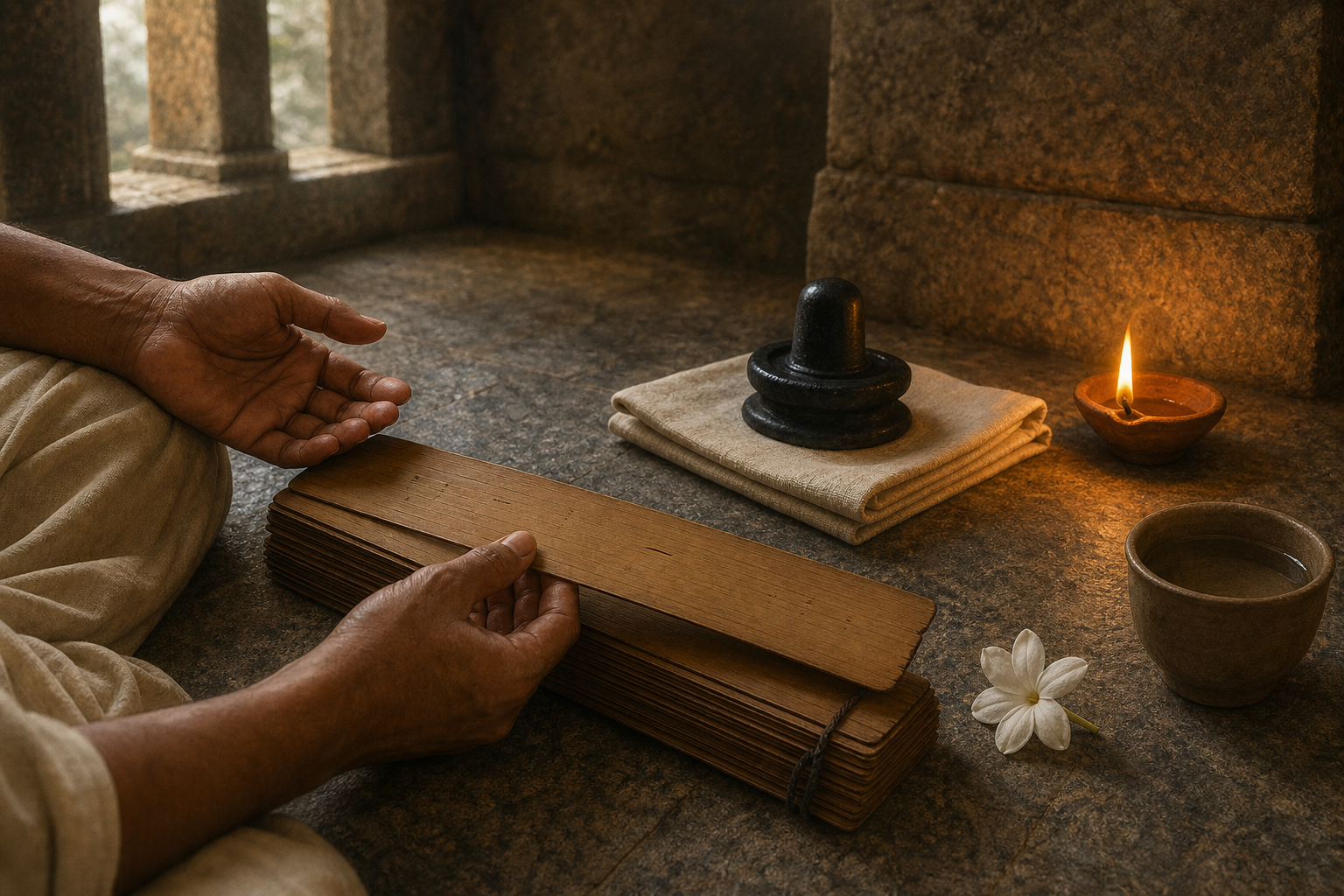
Choose a short cluster of Vachanas rather than racing through an anthology. Read each one aloud and work through the following sequence:
- Identify the concrete image. Notice the body, ornament, garment, household object, natural image, or human relationship through which the spiritual claim is carried. Do not replace it immediately with an abstract doctrine.
- Mark the opposition. Ask what the Vachana sets against what: appearance against inward truth, temporary attachment against enduring union, ritual display against anubhava, or social approval against devotion.
- Find the exposed attachment. Complete the prompt This Vachana exposes my dependence on… Name a real possession, status marker, fear, habit, or source of approval.
- Pause at Cennamallikarjuna. Read the ankita as an address to Shiva, not merely as the poet’s label. Ask how invoking the Lord changes the force of everything that came before it.
- Choose a response. Translate insight into an act that can be performed: tell the truth where image-management has taken over, release an unnecessary possession, end a display-driven ritual, or serve someone without seeking recognition.
If you can read Kannada, keep the original beside the translation and listen for sound as well as meaning. If you rely on English, use a dependable translation and retain the Kannada ankita. When translations diverge, return to the image, the opposition, and the devotional movement rather than choosing whichever wording feels most agreeable. A translation can carry the teaching, but it should not erase the Vachana’s Kannada voice.
This reading method also prevents a common mistake: treating viraha-bhakti as ordinary sadness. Akka’s longing is spiritually directed. Separation intensifies remembrance of Shiva, tests every rival attachment, and turns desire toward union with Cennamallikarjuna. Read the ache and the discipline together.
Read her renunciation in its direction, not its spectacle
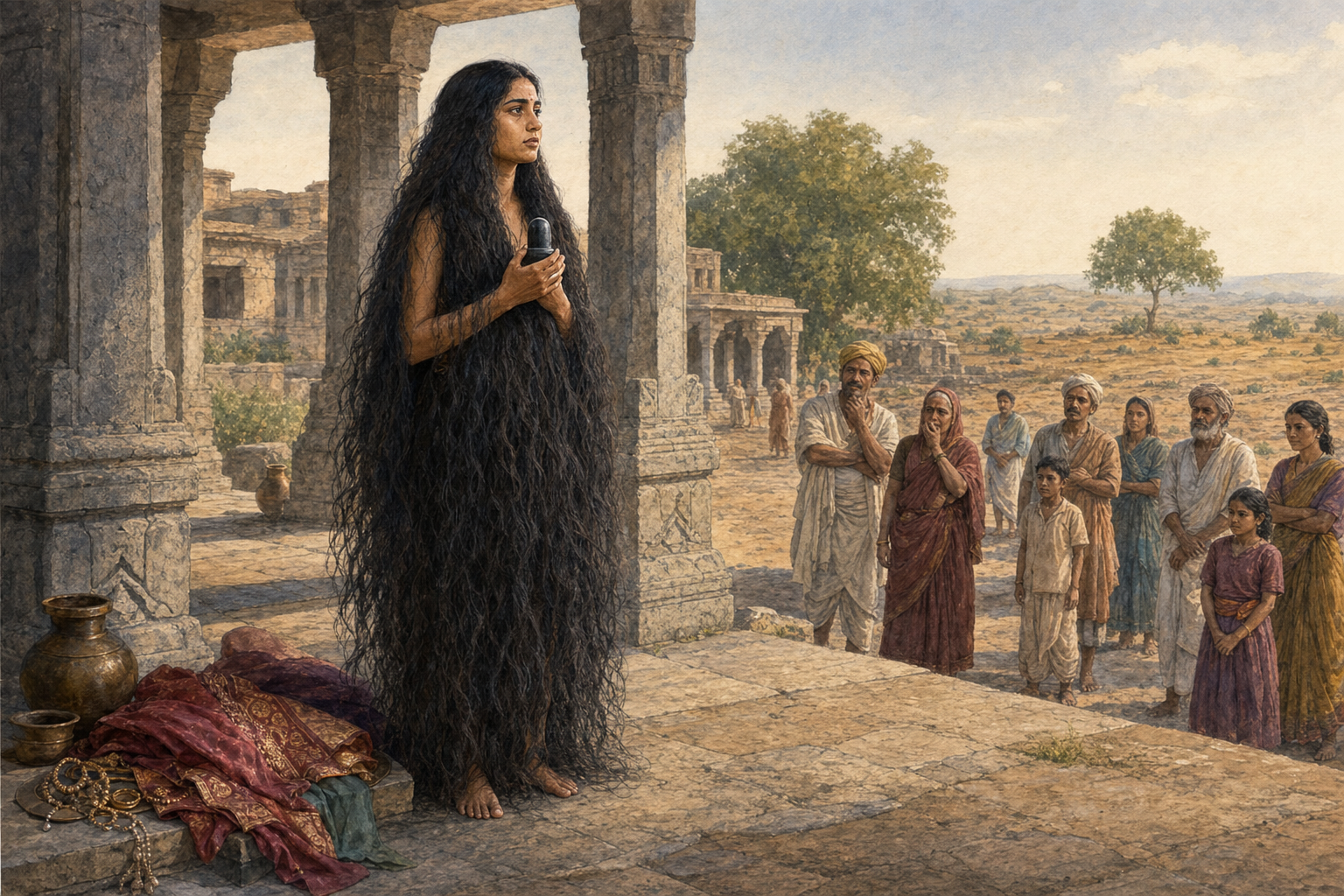
Akka Mahadevi’s life is often approached through the most visually radical element in her traditional biographies. Some accounts describe unclothed asceticism, presenting it as complete transparency before the Divine and a rejection of the social markers by which the world claims a person. That image deserves neither embarrassment nor sensationalism.
Hagiography communicates sanctity through spiritually charged episodes, so it should be read with attention to both historical setting and theological purpose. In Akka’s case, the central claim is clear: no ornament, status, contract, or public identity can possess the soul that belongs wholly to Cennamallikarjuna. The outer action points toward undivided allegiance.
Applying that claim does not require theatrical imitation. It requires a more difficult inventory of the self. Ask where possession has moved beyond use and become identity:
- Which object would make you feel socially diminished if you no longer owned it?
- Which title or relationship do you use to avoid an honest examination of your conduct?
- Which religious practice continues mainly because other people can see it?
- Where do you remain silent because approval matters more than truth?
- What do you call duty when it is actually fear of losing status?
Select the attachment that has the clearest ethical consequence and loosen it through a proportionate act. Give away what is genuinely excess, correct the dishonest impression, simplify the performative practice, or perform needed service anonymously. Do not abandon a dependent person, livelihood, or legitimate obligation impulsively in the name of renunciation. Akka’s radical life is not permission to evade dharma; it is a demand to stop disguising attachment as dharma.
This is also where her relevance extends beyond an exceptional medieval biography. Most readers will not reproduce her manner of ascetic life, but every reader can test whether comfort, reputation, and ritual identity have displaced anubhava. The decisive question is not how little you own. It is what owns your attention and obedience.
Make the Jayanti itself reflect the Vachana legacy
A programme can mention Akka all evening without giving participants any encounter with her voice. Build the observance around the movement of her sadhana: remembrance, hearing, reflection, inward testing, and ethical response.
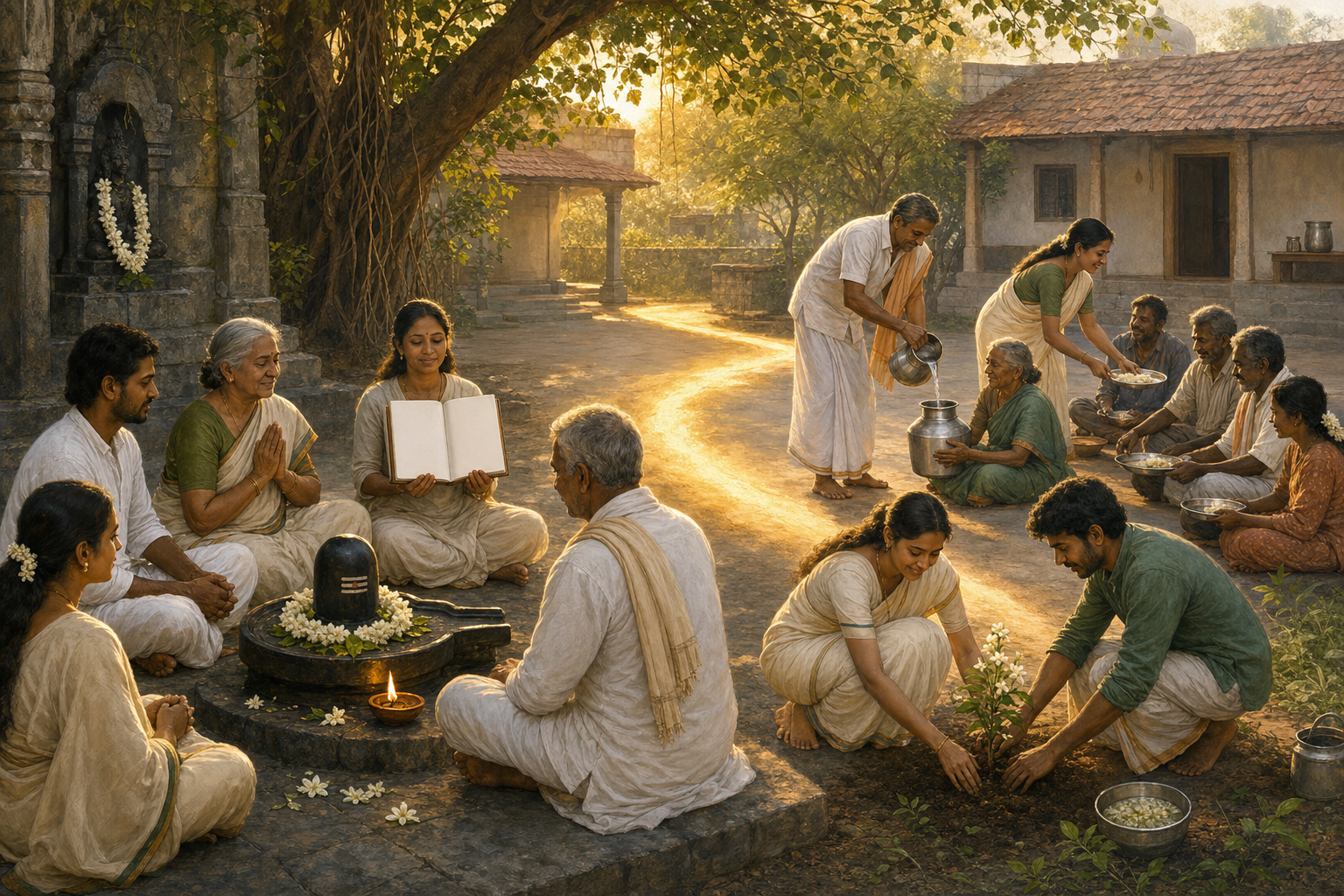
A sequence for home or temple
- Form a sankalpa. Name the attachment or outward performance you are willing to examine. A specific resolve keeps the worship from becoming ceremonial autopilot.
- Begin with Shiva remembrance. Use Om Namah Shivaya japa to collect the attention. Let the Name establish the devotional centre before analysis begins.
- Recite the Vachanas aloud. Give Kannada its proper place, followed by translation where needed. Musical renderings can reveal rhythm and emotional movement that silent reading misses.
- Practise svadhyaya. Work through image, opposition, attachment, ankita, and response. Keep the discussion close to the words rather than turning it into a general speech about empowerment or spirituality.
- Sit in dhyana. Allow silence after recitation. The point is not to generate commentary without end but to let the Vachana examine the listener.
- Complete the observance with seva. Choose service that protects another person’s dignity. Quiet, useful action fits the sharana emphasis on ethical life better than public declarations without follow-through.
Design a community gathering around participation
The sharana inheritance becomes visible in how a gathering is arranged. If dignitaries speak while everyone else remains a passive audience, the form of the event can contradict its subject. Make room for Kannada recitation, accessible translations, reflective silence, questions, and responses from participants of different ages and social backgrounds.
Brief historical framing should locate Akka beside Basavanna and Allama Prabhu within the 12th-century devotional and reformist environment, but biography should lead into Vachana engagement. A cultural programme may include music, yet performance should serve the words rather than displace them. End by naming the seva that will follow the event and how participants can take part.
Recognise Dharmic resonances without erasing differences
Akka’s Vachanas can open a serious conversation across Dharmic traditions. The safest method is to name the resonance, preserve the difference, and avoid claiming that similar disciplines make distinct paths interchangeable.
| Dharmic resonance | What you can notice | What you should preserve |
|---|---|---|
| Jain aparigraha | Non-possessiveness exposes how objects and status bind conduct. | Akka frames renunciation through personal Shiva bhakti and belonging to Cennamallikarjuna. |
| Buddhist direct insight | Experiential awakening takes priority over outward performance and inherited assumption. | Akka’s anubhava is expressed through longing, devotion, and union with Shiva, not generic introspection. |
| Sikh simran | Remembrance of the Divine Name orders attention and daily life. | A meaningful resemblance does not collapse the distinct teachings, histories, or devotional vocabularies of the traditions. |
This precision strengthens Dharmic solidarity. Unity does not require us to blur difference. It asks us to recognise shared disciplines – truthfulness, compassion, non-possessiveness, remembrance, direct spiritual effort, and service – while allowing each tradition to speak in its own theological voice.
When the Jayanti programme ends, keep the question you wrote during svadhyaya where it can meet your ordinary decisions. The next time possession, status, or approval competes with truth, answer Akka’s challenge through an act. That is how a commemorative date becomes a living Vachana legacy.
References
