
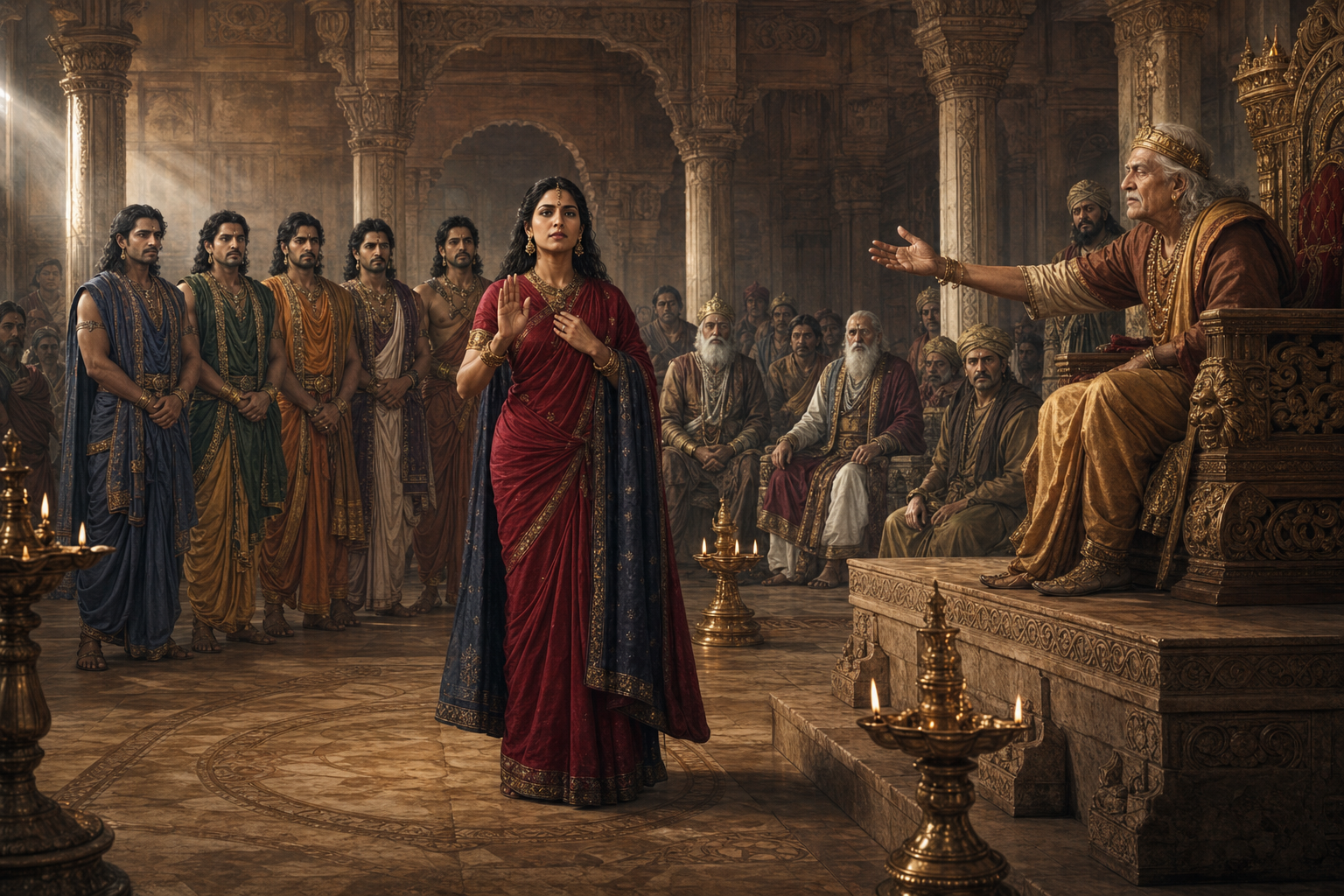
If you remember the Kuru court chiefly for its cruelty, look again at what happens when Draupadi finally receives a measure of power. Dhritarashtra invites her to ask for boons, effectively allowing her to name the terms of immediate relief. She does not demand the kingdom, wealth, punishment, or revenge. She makes two limited requests and stops.
Why stop when the court owes her far more? The answer lies in the structure of her reasoning. Draupadi distinguishes freedom from compensation, justice from royal generosity, and a rightful claim from a profitable opportunity. That distinction turns her refusal of the third boon into the moral center of the episode.
Draupadi asks the question the court wants to avoid

The order of Yudhishtira’s losses matters. He loses his wealth, his brothers, himself, and then Draupadi. Draupadi therefore does not begin by pleading for sympathy. She asks whether a man who has already forfeited his own freedom still possesses the independent capacity to stake another person.
This is a tightly framed dharmic challenge. The disputed issue is not simply whether gambling is wise or whether Draupadi deserves compassion. It is whether Yudhishtira had any authority left at the moment he purported to wager her. If losing himself ended his svatantrya, or independent agency, his later act could not acquire validity merely because powerful men wanted to enforce it.
Capacity and consent are different questions, but both expose the court’s failure. Capacity asks whether Yudhishtira could perform the act at all after becoming bound. Consent asks how Draupadi’s status and dignity could be disposed of without her participation. The court tries to move directly from a throw of dice to coercive possession, while Draupadi forces it back to the missing question in between: what made the purported transfer lawful?
You can use modern legal vocabulary as an analogy here, but not as a claim that the Kuru court operated under a modern legal code. In contemporary terms, the issue resembles standing, capacity, consent, and whether an act was invalid from its inception. Within the epic’s own world, it is a crisis of dharma and vyavahara: substantive right and proper adjudication have both been displaced by factional power.
Bhishma acknowledges that dharma is subtle. That admission reflects the genuine difficulty of dharmic judgment, but it does not settle the case or relieve the assembly of responsibility. When uncertainty concerns the legitimacy of coercion, uncertainty should slow enforcement and compel deliberation. In the Kuru Sabha, it instead becomes shelter for inaction. Vidura’s censure shows that moral difficulty and moral paralysis are not the same thing.
The attempted disrobing is narrated with variations across recensions and later traditions. Most familiar tellings preserve Draupadi’s dignity through divine grace and the inexhaustible garment. That sacred dimension is central to devotional memory, but it should not eclipse her forensic achievement: before relief is granted, she makes the assembly confront the validity of the act on which its violence depends.
The two boons form a sequence of principled repair
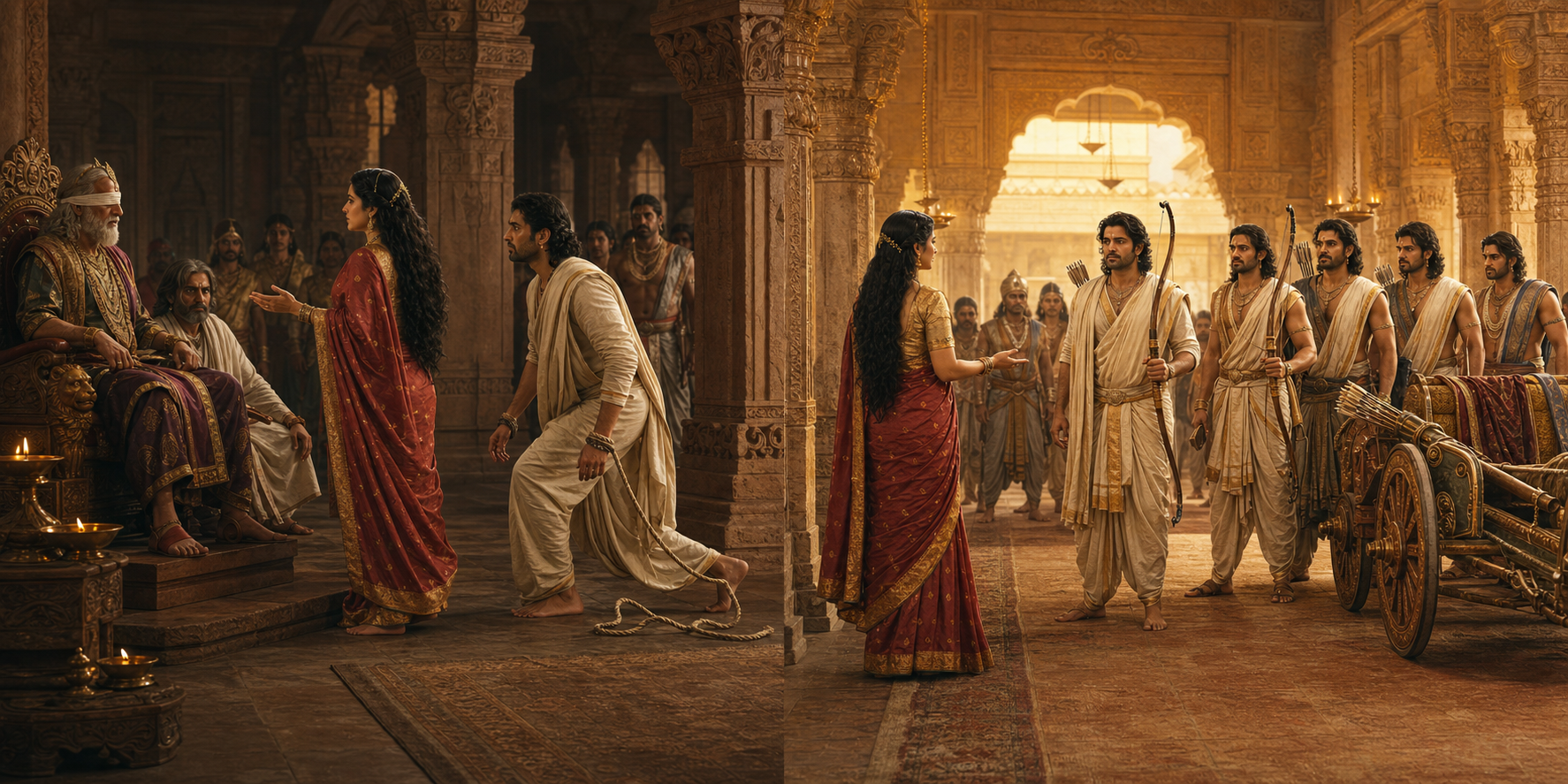
Dhritarashtra intervenes after Vidura’s warnings, ominous signs, and the court’s deepening recognition that the outrage threatens the Kuru order itself. His offer of boons creates an unusual opening. Draupadi can now seek restoration, but she must decide what kind of restoration will remain consistent with the very dharma the assembly has violated.
Her first request is the release of Yudhishtira from bondage. Her second secures the freedom of Bhima, Arjuna, Nakula, and Sahadeva, together with the restoration of her own liberty and dignity. The ordering is deliberate in effect, whether you approach it spiritually, ethically, or politically:
- Freedom comes before property. Draupadi first repairs the status of persons rather than asking for possessions.
- Agency comes before advantage. The Pandavas must cease to be captives before they can resume responsibility for their lives and duties.
- Dignity comes before retaliation. Her requests remove the immediate condition of domination without using the boon to impose a new humiliation on the other side.
- The remedy stays connected to the wrong. The dice game produced bondage and an assault on personal status; her requests directly undo that condition.
Accepting release does not mean conceding that the original bondage was lawful. This distinction is easy to miss. A person may accept an immediate remedy while continuing to expose the injustice that made the remedy necessary. Draupadi does not allow the court to rewrite its wrongdoing as benevolence simply because Dhritarashtra eventually offers relief.
Nor should Dhritarashtra’s later restoration of the Pandavas’ status and property be mistaken for a third boon requested by Draupadi. She asks for two boons and declines another; Dhritarashtra then goes further in an effort to avert immediate conflict. The distinction matters because the additional restoration is his decision, not evidence that Draupadi quietly accepted a third favor.
Her two requests therefore establish a minimum sufficient remedy. Minimum does not mean trivial. She secures the human freedom without which no later pursuit of justice, duty, or political right would be possible. She repairs the ground on which righteous action can resume.
Refusing the third boon protects justice from becoming a favor

When Dhritarashtra offers another boon, Draupadi refuses. She rejects the impropriety and avarice of continuing to ask, and she leaves wealth and political recovery to the Pandavas’ righteous effort and kshatra dharma. This is not passivity, timidity, or satisfaction with what happened. It is disciplined self-limitation at the moment when overreach would have been easiest to justify.
A third request for the kingdom or accumulated wealth could have produced a material advantage, but it would also have changed the moral shape of the exchange. The court might then portray Draupadi as a beneficiary of Dhritarashtra’s largesse rather than the person whose reasoning exposed its failure. By stopping after freedom and dignity are restored, she refuses to let justice be repackaged as a profitable settlement bestowed by a generous ruler.
Her restraint also separates two kinds of claim. One concerns what must be restored immediately because persons are being held in an intolerable condition. The other concerns property, sovereignty, and political rights that the Pandavas must uphold through dharmic action. Draupadi does not renounce those larger claims. She refuses to obtain all of them through an unlimited personal favor.
This is why the refusal should not be reduced to a generic lesson about wanting less. Dharmic restraint is not the abandonment of rightful claims. It is the refusal to exploit an opening beyond what principle presently warrants. Draupadi neither submits to injustice nor tries to convert suffering into a blank cheque.
Several Dharmic traditions offer illuminating parallels, provided we treat them as resonances rather than identical doctrines. A Hindu reading sees fidelity to dharma over windfall gain. Jain aparigraha clarifies the power of refusing accumulation when more has become available. The Buddhist Middle Way helps us notice that Draupadi avoids both capitulation and excess. The Sikh ideal of nishkam seva similarly directs attention to action not governed by greed for personal reward. Across these lenses, restraint is not weakness; it is mastery over the temptation to make power serve appetite.
There is also a restorative quality to her choice. She seeks the conditions necessary for agency and dignity to return, rather than making punishment the price of resolution. That does not absolve the perpetrators, erase accountability, or prevent later consequences. It means that her immediate objective is to stop the degradation and restore moral standing. Retribution would not by itself answer the legal question she raised.
The second dice game exposes the court’s deeper failure
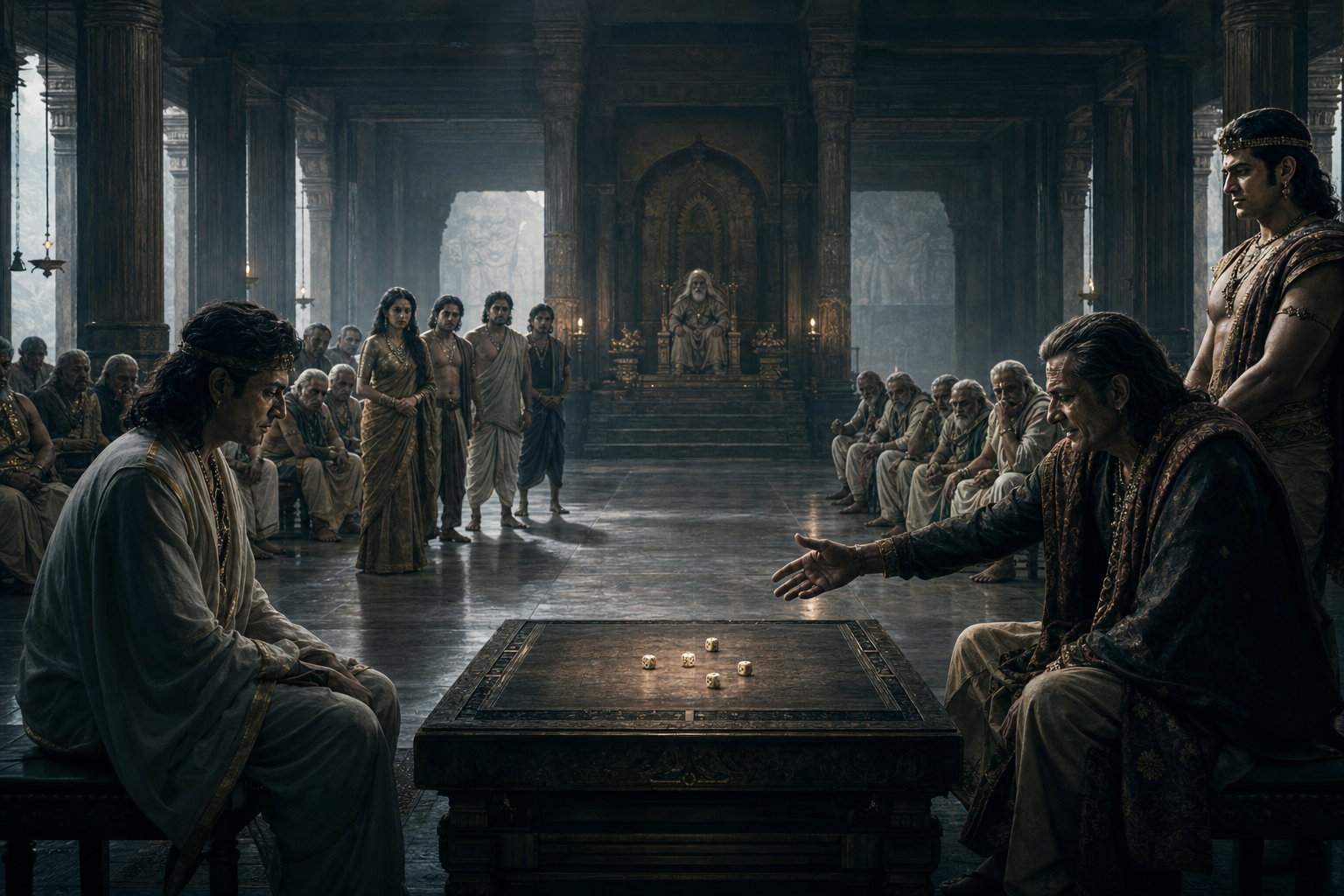
The Kuru Sabha obtains a temporary reprieve, not a durable settlement. Dhritarashtra reverses the immediate effects of the disaster, yet the court never converts that reversal into a stable principle capable of restraining the next act of factional ambition. A second invitation to gamble follows. The Pandavas are then sent into twelve years of exile and one year of ajnata-vasa, life in concealment.
This sequence tells you how to evaluate the court’s conduct. Do not measure an institution only by what its leader promises when a crisis has become unbearable. Ask whether it identifies the violated rule, establishes a binding standard, restrains the offenders, and prevents repetition. Dhritarashtra’s discretionary generosity does none of those things securely. The next dice game is possible because the underlying machinery of adharma remains intact.
That machinery includes more than Dushasana’s violence or Duryodhana’s obstinacy. It includes the silence of guardians, Dhritarashtra’s vacillation, favoritism within the ruling family, and the court’s willingness to treat a procedural spectacle as lawful merely because it benefits the dominant faction. The loudest offenders depend on respectable people declining to decide.
Bhishma’s statement about the subtlety of dharma deserves a careful reading in this setting. Dharma can indeed be subtle because duties, relationships, promises, and consequences may conflict. But subtlety is a demand for more disciplined judgment, not an excuse for neutrality between coercion and its victim. An elder’s honest uncertainty becomes an institutional failure when it leaves the weaker party exposed while the stronger party continues acting.
Vidura embodies the missing requirement of rajadharma: counsel must be courageous enough to interrupt power. Dhritarashtra’s eventual intervention shows that a ruler can still arrest an immediate wrong. His later failure shows why personal intervention is insufficient. Justice cannot depend on whether a frightened ruler happens to feel generous at the final moment.
For any council, family, organization, or state facing a serious dispute, the Kuru test is concrete. Was the wrong actually adjudicated, or merely quieted? Was the remedy grounded in a rule, or granted as a favor? Was the injured person’s agency restored? Was the mechanism that enabled the abuse removed? If the answer to the final question is no, the settlement is an interval, not a resolution.
Key takeaways for reading and applying the episode
- Begin with the exact disputed act. Draupadi asks whether Yudhishtira could stake her after losing himself. She does not let outrage blur the decisive question of authority.
- Check capacity at the moment of action. A title, relationship, or earlier freedom does not automatically prove that someone retained the power to make a later decision.
- Separate remedy from validation. Accepting release from an unjust condition does not concede that the condition was ever legitimate.
- Restore persons before possessions. Draupadi uses her two boons to recover freedom, agency, and dignity before material or political advantage.
- Do not confuse restraint with surrender. Refusing the third boon preserves the Pandavas’ larger claims while denying greed control over the remedy.
- Judge authority by follow-through. The return to dice and the resulting exile reveal that a dramatic intervention is not enough when an institution leaves its original corruption untouched.
The next time this scene is presented only as a contest between cruelty and miraculous rescue, return to Draupadi’s sequence: identify the invalid act, demand restoration of agency, take no more than dharma permits, and leave rightful claims to rightful action. That sequence is how she refuses both helplessness and greed, even while surrounded by a court that has surrendered to both.
References
