
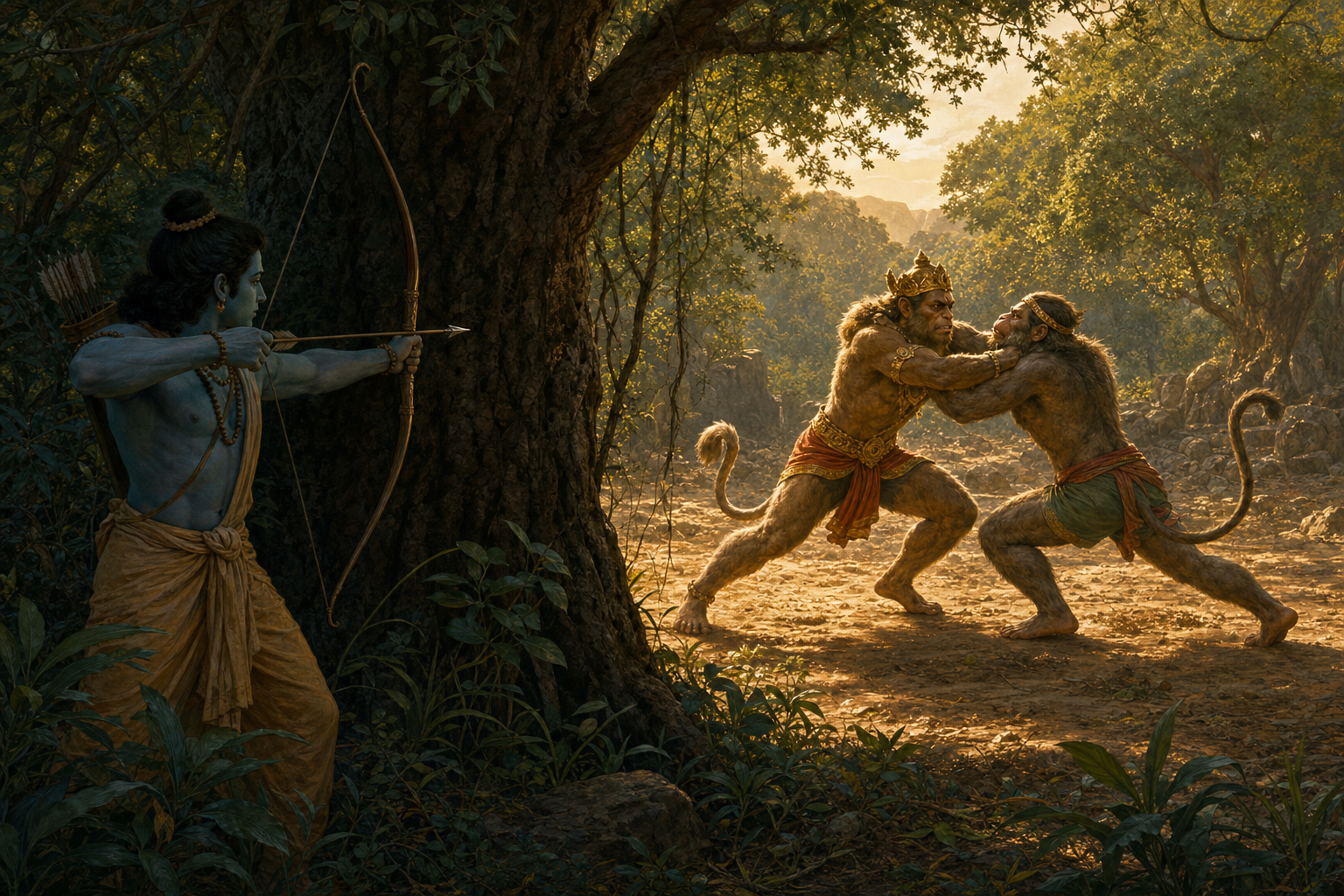
If someone asks whether Rama killed Vali “from behind a tree,” a one-word answer creates more confusion than clarity. Yes, the widely received Valmiki account has Rama release the fatal arrow from concealment while Vali is fighting Sugriva. No, that fact alone does not settle whether the act is adharmic.
The useful question is not whether we can make the concealment disappear. We cannot. It is why different Ramayana traditions preserve, defend, reinterpret, or morally reframe it. Once you separate the event from the arguments surrounding it, the episode becomes a serious inquiry into royal authority, protection, unequal power, violence, and the ranking of competing duties.
The shortest accurate answer: concealment is the common core
The received narrative begins with Rama promising to help Sugriva recover what Vali has taken from him. Sugriva challenges Vali, but the first fight ends without Rama shooting because the brothers look too similar in combat. Sugriva is then marked with a garland. During the second encounter, Rama can identify him and mortally wounds Vali with a single arrow.
When comparing Ramayanas, “concealed shot” is more precise than turning the entire controversy into a dispute about one tree. A tree may be prominent in visual retellings or familiar descriptions, but the important textual feature is that Rama is not standing before Vali as an openly declared opponent in a conventional duel. The Northern and Southern recensions preserve that basic feature with notable stability.
This immediately rules out one weak defense: claiming that the concealed shot is merely a late invention hostile to Rama. Regional poets and performers inherited a difficult scene and interpreted it. They did not need to manufacture the difficulty.
Key takeaways
- The widely received Valmiki sequence places Rama in concealment when he shoots Vali.
- Vali contests both the method of the killing and Rama’s authority to punish him.
- Rama answers as a bearer of rajadharma and as the protector of someone who sought refuge, not merely as a warrior joining a private duel.
- Vali’s extraordinary combat advantage explains the strategy in many retellings, but the boon should not be treated as the only ethical defense in every version.
- Devotional, regional, Jain, Buddhist, and Southeast Asian traditions retain different parts of the conflict because they rank violence, kingship, grace, and liberation differently.
Vali’s objection is stronger than “Rama hid”
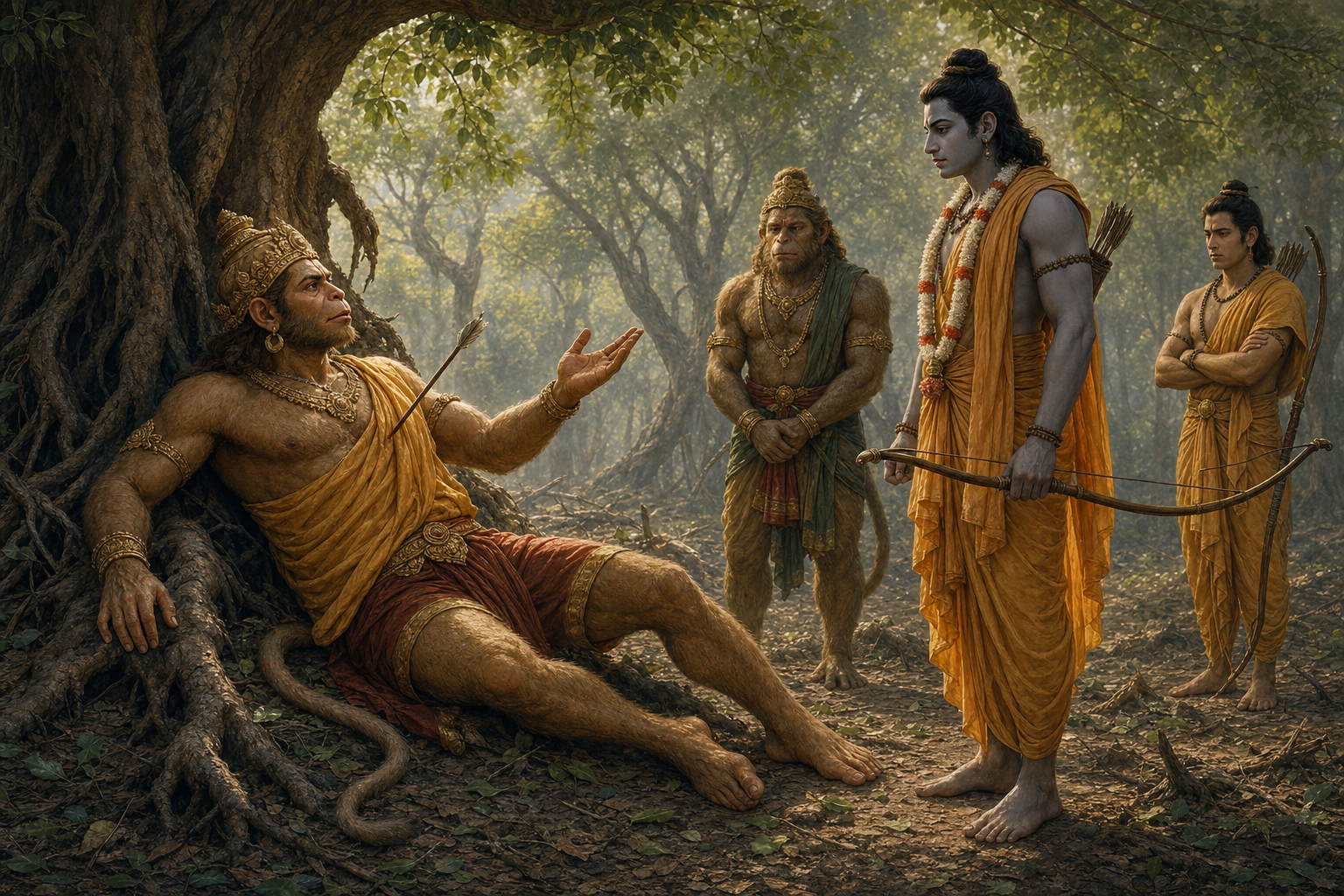
The moral argument begins after the arrow lands. Vali does not die as a voiceless obstacle removed for the plot. He challenges Rama, and the narrative allows his protest enough space to become the ethical center of the encounter.
His first objection concerns method. He was engaged with Sugriva, not facing Rama in declared combat. Judged only by the etiquette of a duel between warriors, the intervention appears unequal: one combatant can see the opponent before him, while another person strikes from outside his field of engagement.
His second objection concerns jurisdiction. Even if Vali has wronged Sugriva, why may Rama punish him? That is a different question from whether concealment was tactically necessary. A method can be effective without being authorized, so an adequate defense must address both.
This distinction matters whenever you hear the episode debated. If one person is discussing martial fairness and another is discussing a ruler’s duty to punish wrongdoing, they are applying different ethical frameworks. Repeating “war is war” or “a warrior must fight face to face” will not resolve the disagreement. First identify whether Rama is being judged as a duel participant, a protector, an executor of royal punishment, or an avatara restoring order.
Vali’s protest should not be dismissed as the speech of a defeated wrongdoer. Preserving it forces Rama’s position to answer the strongest available challenge. In a dharmic reading, that is not an embarrassment to be edited out. It is how the narrative teaches: a consequential action must be defended before the person who bears its cost.
Rama’s answer ranks three duties above duel etiquette
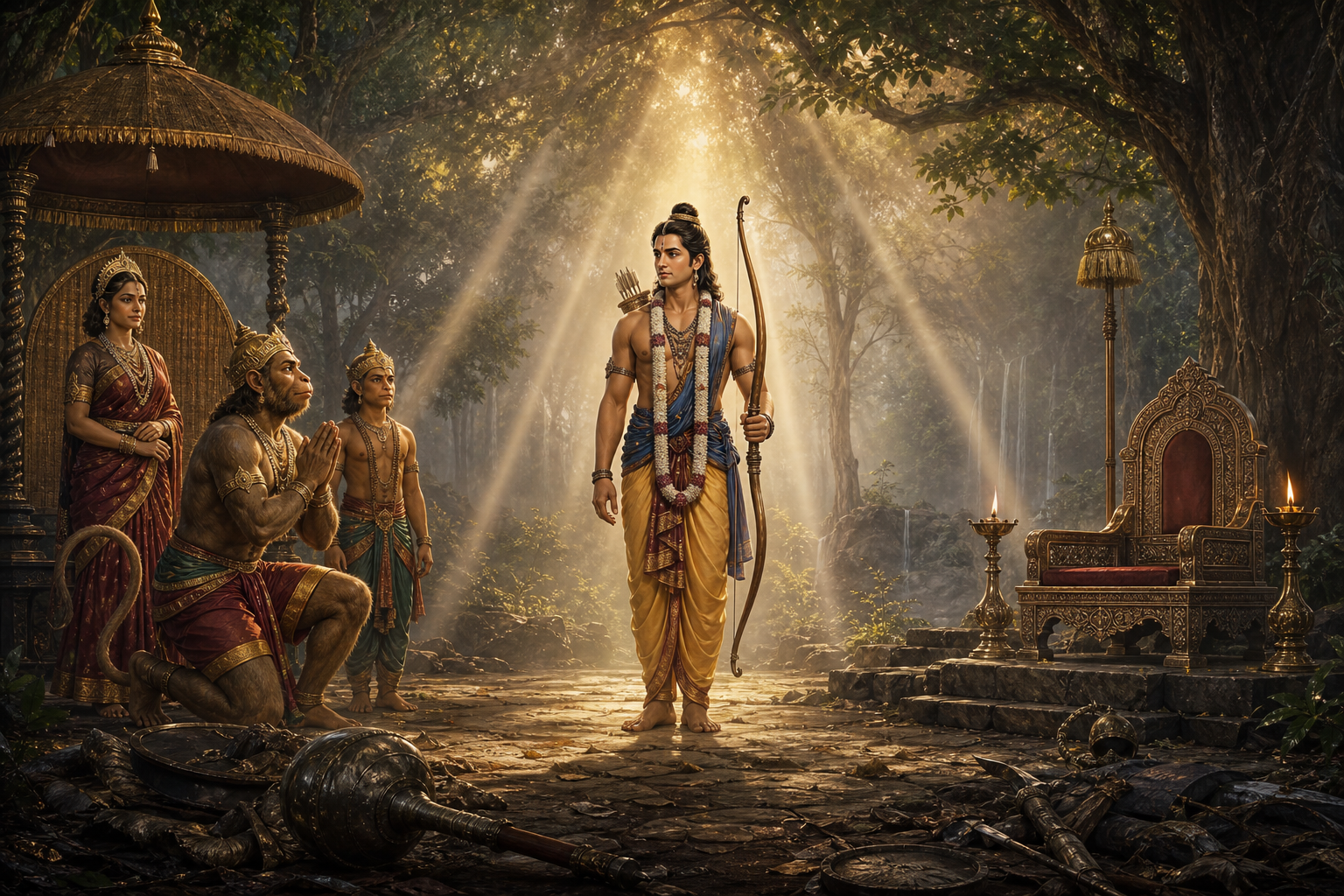
Rajadharma: wrongdoing is not protected by a border
Rama’s first line of defense is rajadharma joined to danda-niti, the ruler’s responsibility to restrain serious wrongdoing. Vali has taken Ruma, Sugriva’s consort, after expelling his brother. Rama therefore treats the conflict as more than a quarrel over a throne. It has become a breach of moral and social order requiring punishment.
Vali’s jurisdictional challenge assumes that Rama’s duty ends at a territorial boundary. Rama’s response treats righteous kingship as a responsibility carried by the ruler: when grave wrongdoing and an appeal for protection meet him, distance from his own capital does not make him morally neutral. The claim is not simply that Rama possesses power, but that power creates an obligation to protect and correct.
You need not assume that every use of force becomes righteous merely because a ruler invokes order. The episode supplies a narrower argument: a specified wrong has occurred, the injured party has sought protection, and the person accepting that appeal undertakes a duty to act. Those conditions are part of the justification. Remove them, and the analogy no longer holds.
Sharanagati: accepting refuge creates a binding obligation
Sugriva does not merely hire Rama for a convenient exchange. He approaches him for refuge and redress. Once Rama gives his word, sharanagati dharma makes protection a binding obligation rather than an optional favor. Failing to act would also have moral content: Rama would have accepted the trust of a vulnerable ally and then left him exposed to the same overwhelming power.
This does not automatically justify every possible means. It explains why non-intervention is not the morally clean alternative it can appear to be. Rama must weigh at least two duties: the ordinary preference for open combat and the promise to protect someone unable to defeat his oppressor. The narrative ranks the latter more heavily.
The boon: a tactical reason, not a universal shortcut
A widely circulated explanation gives Vali an extraordinary advantage: he draws strength from an opponent who confronts him directly. The boon is associated in different tellings with Brahma or Indra. On that premise, an open challenge would not create a fairer contest. It would activate the very asymmetry that makes ordinary combat ineffective.
Concealment then functions as a way of neutralizing an exceptional advantage. Kamba’s Tamil tradition and several Southeast Asian adaptations make this logic especially prominent. Justice reaches Vali by denying his boon the conditions under which it operates.
Still, “Vali had a boon” is too easy as a complete answer. The boon addresses tactics: why Rama does not fight face to face. It does not by itself establish jurisdiction, prove Vali’s wrongdoing, or explain Rama’s obligation to Sugriva. Those questions are answered through rajadharma and sharanagati. If your defense depends entirely on the boon, you have answered only one part of Vali’s challenge.
The underlying conflict is therefore not courage against cowardice. It is one rule of warrior conduct against a larger combination of duties: punish a grave wrong, honor refuge, keep a promise, and overcome a power that cannot be checked by ordinary confrontation. Whether you accept Rama’s ranking or continue to feel Vali’s objection, that is the argument you must evaluate.
Each Ramayana moves the ethical center of gravity
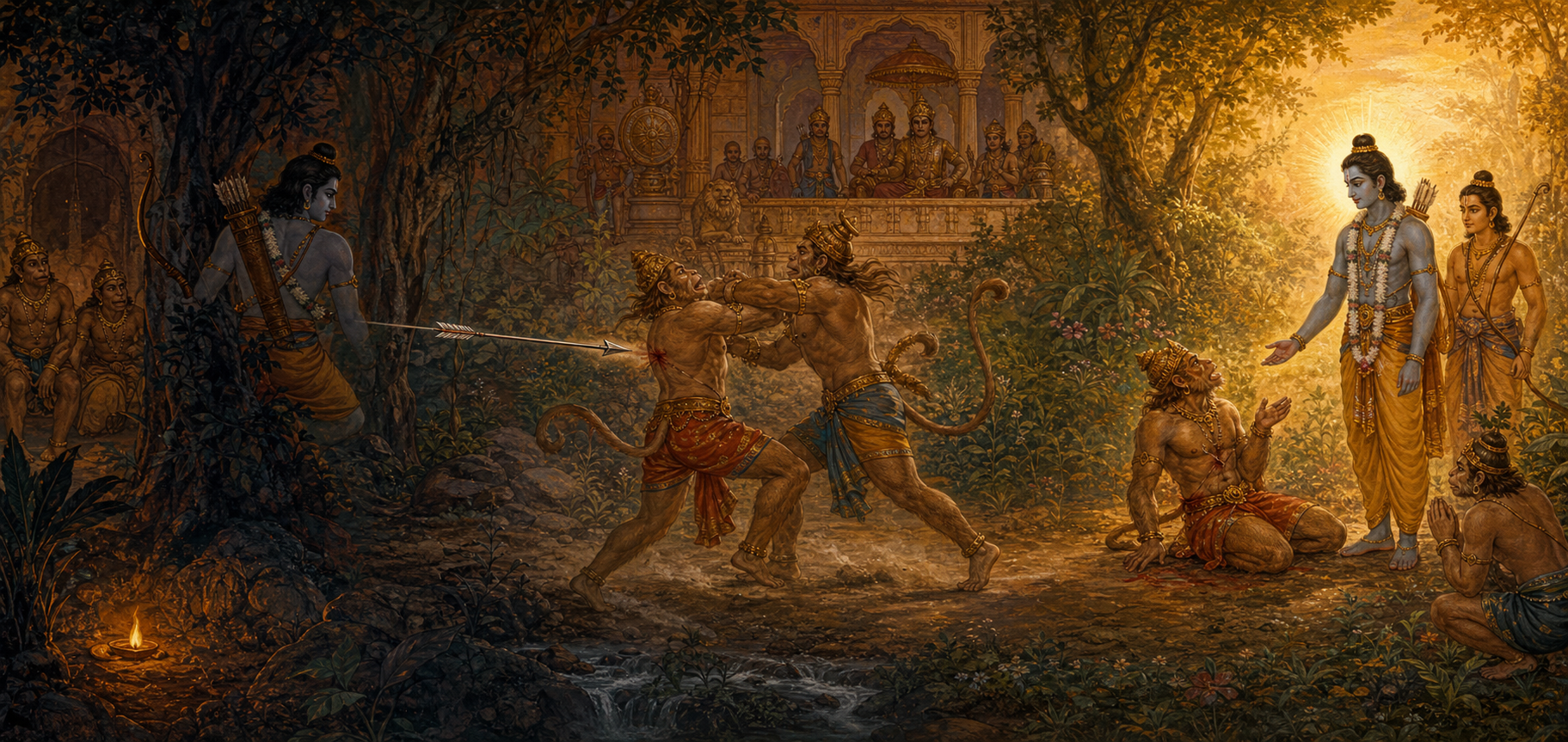
Ramayana traditions do not merely switch minor plot details. They decide which moral fact should dominate your attention. Some make the debate between Vali and Rama central. Others interpret death through divine grace, dwell on Tara’s grief, adjust lethal agency under ahimsa, or turn concealment into a theatrical image of justice outwitting unequal strength.
| Tradition or setting | What remains in view | Primary ethical emphasis | Best reading discipline |
|---|---|---|---|
| Valmiki Ramayana | The concealed arrow and the extended challenge after it | Rajadharma, punishment, refuge, and the fairness of combat | Read Vali’s accusation and Rama’s defense together; neither is disposable. |
| Adhyatma Ramayana and Ezhuthachan’s Malayalam Adhyatma Ramayanam | Vali’s death within Rama’s divine purpose | Grace, liberation, and restoration of cosmic order | Do not isolate the tactic from the avatara theology governing the telling. |
| Ramcharitmanas | Rama ends Vali’s injustice and fulfills his commitment to the one seeking help | Maryada, lawful correction, compassion, and fidelity to a vow | Judge the action through Rama’s obligations, not only through duel etiquette. |
| Kamba Ramayanam | The strategy against Vali’s advantage, the demands of aram, and the grief following his fall | Context-sensitive dharma and the human cost of restoring order | Do not mistake justification for emotional indifference; Tara’s grief still matters. |
| Bengali, Odia, Assamese, and Kannada retellings | The concealed strike commonly remains, while debate and moral pedagogy expand in different ways | The weighing of conflicting duties for a regional audience | Identify the particular text instead of treating “the regional Ramayana” as one voice. |
| Jain Ramayana traditions, including the Paumacariya | The Vali-Sugriva conflict remains structurally important, but lethal roles or justifications may change | Ahimsa, karmic consequence, right conduct, and reduction of harm | Do not import an avatara-centered solution where non-violence controls the moral architecture. |
| Buddhist analogues and Jataka-related narrative families | The episode may be softened, displaced by another moral scene, or absent | Compassion, patience, restraint, and renunciation | Absence is not evidence that every tradition tells the same event differently; it may reflect a different selection of ethical problems. |
| Thai, Khmer, Javanese, and Balinese adaptations | Concealment, the overpowering boon, illusion, or divine agency can become highly visible in performance | Cosmic balance expressed through local kingship and theatrical idioms | Treat choreography and stagecraft as interpretation, not as decoration around a fixed meaning. |
Performance traditions make this plurality especially easy to notice. Yakshagana can give Tara’s lament and the Vali-Rama dispute extended stage time. Koodiyattam and Kathakali can slow the action into abhinaya, forcing an audience to remain with majesty, grief, and the burden of kingship. Javanese and Balinese wayang can heighten illusion and divine agency around Subali and Sugriwa. In each case, duration, gesture, and spectacle tell you what the community believes deserves contemplation.
This is why a single screenshot of Rama behind a tree cannot represent the whole tradition. It captures the tactical moment but not necessarily the moral argument, theological resolution, sorrow, or karmic concern that gives the moment meaning. If you are evaluating a painting, televised serial, dance drama, or local recitation, ask what happens after the arrow. The treatment of Vali’s speech and Tara’s grief will often reveal more than the placement of the tree.
A disciplined way to judge the episode
You do not have to suspend moral judgment because many versions exist. You do have to make the judgment precise. Before defending or condemning Rama’s action, run the interpretation through these six checks.
- Name the tradition. If someone says, “The Ramayana says,” ask which Ramayana, recension, translation, or performance. Valmiki, Kamba, Tulsidas, a Jain telling, and the Ramakien do not place identical weight on the same facts.
- Separate the event from its explanation. The concealed strike is a stable feature in the widely received Valmiki narrative. The boon, divine grace, royal punishment, and karmic reframing are explanations or interpretive frames whose prominence varies.
- Identify Rama’s role in that telling. Is he being presented mainly as a warrior, a protector under sharanagati, a bearer of royal authority, or Vishnu’s avatara? Each role carries a different set of duties.
- Keep Vali’s two charges distinct. The method question asks why Rama did not confront him openly. The jurisdiction question asks why Rama could punish him at all. A sound answer must not use tactics to evade authority or authority to evade tactics.
- Rank the duties explicitly. Put face-to-face combat, protection of the refuge-seeker, punishment of wrongdoing, fidelity to a vow, restoration of order, and minimization of harm on the table. Then say why one duty should prevail in this situation.
- Read the aftermath. Vali’s reasoning, Tara’s grief, Sugriva’s restoration, and the possibility of liberation show how a telling accounts for the cost of justice. An interpretation with room only for triumph has probably stopped too early.
These checks lead to a firm but appropriately narrow conclusion. The mainstream Valmiki tradition does not deny concealment; it asks whether a concealed strike can be justified when an agent of royal protection confronts grave wrongdoing backed by an extraordinary combat advantage. Devotional traditions more readily resolve the question through Rama’s divine and moral sovereignty. Performance traditions often preserve the unease by making Vali and Tara impossible to ignore. Jain and Buddhist narrative worlds reweight the problem according to ahimsa, karma, compassion, and restraint.
The next time this episode appears in a family discussion, classroom, temple discourse, or online argument, do not let “tree or no tree” become the final question. Ask which version is being cited, whether the defense depends on the boon, what authority Rama is exercising, which promise binds him, and how the telling acknowledges the death’s cost. Do not rescue Rama by deleting Vali’s question, and do not indict Rama by deleting the duties Rama has accepted. Dharma is being tested in the tension between them.
References
