

If deathless dharma sounds like a promise that tapas can make the body invulnerable, begin with a clean refusal. Disciplined practice does not cancel physical mortality. Ariṣṭanemi matters because his example moves the question from how long you can preserve the body to what you refuse to betray when fear threatens your comfort, identity, or life.
Your more useful question is this: can you live so that fear of loss no longer sets the terms of your conduct? The Dharmic answer is yes, but the method is neither miraculous protection nor punishing austerity. It is a life gathered around ahiṃsā, satya, restraint, compassion, and clear attention.
Deathless means that mortality no longer dictates your dharma

The image of death’s arrow works at two levels. The first is abhayam: freedom from being governed by fear. The second is mokṣa: release from the causes that keep a being bound to becoming. This two-stage understanding of deathlessness is much more demanding than a claim about bodily longevity.
Abhayam is not recklessness. A fearless person can recognise danger, protect dependants, leave an unsafe place, seek treatment, and prepare responsibly for death. What falls away is fear’s authority to command falsehood, cruelty, hoarding, humiliation of others, or abandonment of duty. You still feel the force of a threat; you no longer grant it permission to decide who you will become.
Mokṣa goes deeper. It is not the indefinite continuation of your present personality. It concerns the ending of the clinging and ignorance through which mortality becomes an existential master. Hindu, Jain, Buddhist, and Sikh paths describe that liberation in distinct theological languages. They need not be made identical to share a practical diagnosis: grasping gives fear a place to fasten.
This is also the sober meaning of the principle dharmo rakṣati rakṣitaḥ, commonly rendered as dharma protects the one who protects dharma. It is not a guarantee that a righteous person will avoid illness, violence, bereavement, or accident. Protecting dharma means guarding your attention and conduct with vows. Those vows, in turn, protect you from the confusion that makes a crisis morally ruinous.
Precision matters here. The extant Sanskrit recensions of the Mahābhārata do not stage a literal duel in which Ariṣṭanemi defeats an arrow fired by Yama. The arrow is an interpretive image for mortality and for the smaller darts that precede it: anxiety, compulsion, despair, and the fear of losing status or possession. Turning that image into a miracle claim would obscure the ethical work it is meant to illuminate.
The Mahābhārata repeatedly makes fearlessness visible without pretending that bodies do not die. Sāvitrī meets Yama with fidelity, intelligence, and command of dharma. Bhīṣma lies on a bed of arrows without surrendering his discernment. Śuka moves through the world without becoming entangled in it. Their strength is not exemption from mortality but presence within it.
When fear presses on a decision, use this short audit before you act:
- What loss am I imagining: physical safety, livelihood, relationship, reputation, possession, or control?
- What harmful or dishonest act is fear asking me to excuse?
- What real duty remains even if the feared loss occurs?
- What is the most truthful and least harmful action available now?
The point is not to suppress fear. It is to prevent fear from impersonating dharma.
Keep Ariṣṭanemi’s Jain and epic horizons distinct
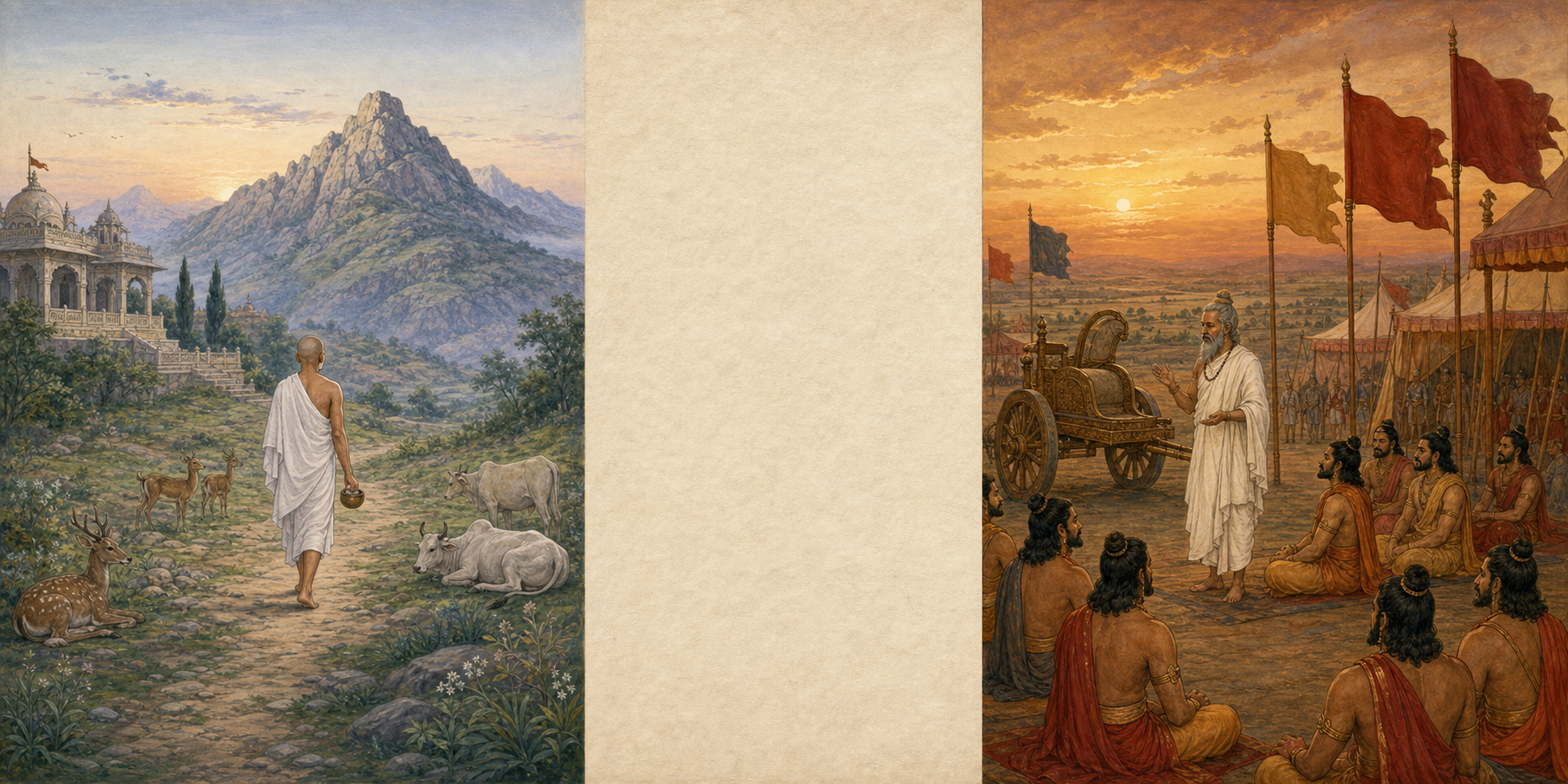
Ariṣṭanemi stands at a genuine meeting point in the Dharmic inheritance, but careful reading must preserve the shape of each tradition. In Jain remembrance, Neminātha, also known as Ariṣṭanemi, is a Yādava and a kinsman of Kṛṣṇa. At the threshold of marriage, he encounters animals prepared for slaughter as part of the celebration. Compassion breaks the momentum of ceremony, and he abandons royal splendour for renunciation.
That sequence deserves close attention: he notices suffering, refuses to let custom make it invisible, and accepts the personal cost of withdrawing his consent. His renunciation therefore confronts mortality at its psychological root. Participation in violence breeds fear because the world one helps make violent is also the world in which one must live.
The Mahābhārata provides a broad theology of tapas, ethical power, and freedom from fear; it does not provide that Jain wedding narrative. The Harivaṃśa preserves overlapping Yādava genealogical and geographical memories associated with the cultural world of Dvārakā, while Jain tradition binds Neminātha closely to Girnar. This is meaningful civilizational resonance, not permission to collapse Jain and Hindu accounts into one interchangeable theology.
Anekāntavāda offers a disciplined way to inhabit this relationship. Many-sidedness does not mean that every claim is identical or that contradictions do not matter. It means you ask what facet of liberation a tradition is bringing into focus. Jain practice places uncompromising emphasis on ahiṃsā, aparigraha, and vigilance. The epic world gives sustained attention to tapas, duty, bhakti, and the testing of dharma amid competing obligations. Each can sharpen your understanding without being absorbed into the other.
Ariṣṭanemi’s name itself can serve as a contemplative mnemonic. Ariṣṭa carries the sense of being unharmed or inviolate, while nemi is the rim of a wheel. The compound evokes an unbroken circumference. This is not proof of a biography hidden inside an etymology. It is a useful image for practice: when pressure arrives, does the rim of your vow remain intact?
You can apply Ariṣṭanemi’s example at any consequential threshold. Before you send the retaliatory message, complete the purchase, accept the flattering compromise, or follow a custom whose cost has been concealed, ask:
- Which beings will bear the cost of this choice?
- Am I calling harm necessary merely because plans are already in motion?
- Which attachment makes withdrawal feel impossible?
- Can I refuse the harmful part without hatred toward the people still participating?
The last question is crucial. Renunciation that turns into contempt has escaped an object but not the ego that clung to it.
Tapas must concentrate your life, not injure it

Tapas is often translated as heat or austerity, but pain by itself has no spiritual authority. In the Mahābhārata’s moral universe, tapas is calibrated spiritual intensity: disciplined energy that clarifies the mind, restrains destructive impulses, and directs the whole person toward dharma.
This changes how you evaluate a demanding practice. Difficulty is not the test. Ask what the difficulty produces. A vrata that makes you more truthful, less possessive, more attentive, and less willing to harm has begun to generate useful heat. A practice that makes you vain, brittle, secretive, cruel, or negligent toward legitimate responsibilities is burning the wrong fuel.
The classical yogic sequence explains the mechanism without requiring a supernatural claim. Yama reduces the conflicts created by harmful conduct. Niyama gives practice a stable rhythm. Āsana and unforced regulation of breath steady the body and attention. Pratyāhāra interrupts constant sensory capture. Dhāraṇā and dhyāna gather a mind that is normally scattered among desires and aversions. Samādhi represents the deep consolidation of that awareness.
This sequence is a map of practice, not a clinical measurement. Ojas and tejas should not be marketed as quantities that can be proved by theatrical displays. In ethical terms, tejas is the potency of an undivided life. A truthful person spends less attention defending lies. A practitioner of ahiṃsā does not continually rehearse retaliation. Brahmacarya redirects vitality away from compulsion. Aparigraha reduces the anxiety of acquiring, comparing, and guarding. The resulting attention is available when a difficult decision actually arrives.
That is why tejas can be described as subtle armour. It does not prevent every hostile event. It denies adharma some of its easiest openings: panic, vanity, appetite, resentment, and moral confusion. Brahmavarcasa, or spiritual authority, arises from the same coherence. It is recognised in the steadiness of conduct, not in charisma, costume, or claims of invulnerability.
Several Dharmic correctives help you detect counterfeit tapas:
- The Buddhist Middle Way asks whether exertion has deteriorated into self-torment.
- Sikh wisdom asks whether tap remains rooted in nām, humility, and sevā rather than becoming a private monument to the ego.
- Jain discipline asks whether ahiṃsā is guarded by apramāda, the vigilance that keeps a noble sentiment from becoming careless conduct.
- The Mahābhārata asks whether inner substance matches outer display and whether austerity remains answerable to dharma.
These are not interchangeable doctrines. They are distinct warnings against the same practical failure: intensity without moral orientation.
Do not use starvation, dehydration, forced breath retention, deliberate sleep loss, untreated pain, or neglect of medical needs as proof of seriousness. If a bodily austerity harms your health or destabilises your mind, stop that form of austerity and obtain qualified care. Keep the ethical vrata while choosing a safer embodiment of it. Neither tapas nor meditation is a substitute for medical or mental-health treatment.
Unusual sensations, visions, or bursts of confidence are not reliable evidence that a practice is liberating you. Patañjali’s caution concerning siddhis remains useful: side effects can become new objects of attachment. Judge practice by what happens to greed, fear, falsehood, anger, and your treatment of other beings.
Build your vrata around a threshold you actually face

You do not need to imitate a renunciant’s external life to learn from Ariṣṭanemi. The Mahābhārata repeatedly places householder dharma and renunciant dharma in conversation. Your vow may be narrower than an ascetic mahāvrata, but it must be precise enough to govern a real choice. A vague intention to be peaceful will disappear under pressure; an observable restraint can survive it.
Use this sequence to create a workable practice:
- Find the recurring threshold. Choose one place where fear or appetite regularly outruns discernment: an argument, a purchase, a meal, a social performance, a work compromise, or a stream of digital distraction.
- Write an observable restraint. State what you will do when that threshold appears. For example: when provoked, you will let the body and breath settle before replying; when tempted to exaggerate, you will give the plain account; when acquisition is driven by comparison, you will leave the purchase unfinished.
- Pass the choice through the five-vow audit. Ahiṃsā asks what harm is reduced. Satya asks what truth you are avoiding. Asteya asks whether you are taking time, credit, labour, attention, or resources that are not rightly yours. Brahmacarya asks whether energy is directed or compulsively dispersed. Aparigraha asks what you could release without compromising duty.
- Gather attention every day. Sit steadily, allow the breath to become natural, notice the pull of desire and aversion, and return to your chosen anchor. Do not force breath retention. The aim is to recognise an impulse before it becomes speech or action.
- Give the saved energy a compassionate use. Add sevā, practical care, or maitrī. If restraint only produces private pride, the practice remains enclosed within the self. Ariṣṭanemi’s austerity begins with attention to another being’s suffering.
- Review the breach without theatre. Ask where the vow broke, what fear or reward was present, whom the breach affected, and what repair is now possible. Honest repair generates more tapas than hiding failure behind spiritual language.
Keep the same narrow vrata long enough to see its pattern. Constantly replacing the vow with a more impressive one prevents you from learning where the rim actually breaks. Repetition is abhyāsa; non-attachment to performance is vairāgya.
When fear arises, first determine what kind of situation you are facing:
- Actual danger calls for protection, distance, assistance, or treatment. Do not spiritualise a safety problem.
- A tangible future loss calls for preparation, consultation, and fulfilment of duty. Aparigraha does not forbid prudent action.
- A threat to status, possession, or control is often the direct field of tapas. Here the work is to tell the truth, reduce harm, and accept the cost of not feeding the attachment.
This distinction keeps surrender from becoming passivity. Deathless dharma does not ask you to pretend that consequences are unreal. It asks you to meet real consequences without manufacturing additional suffering through deception, violence, and grasping.
If panic, despair, or intrusive fear persistently impairs your ability to function, treat that as a matter deserving qualified support, not as evidence that your tapas is weak. Spiritual discipline can accompany appropriate care; it should not be used to delay it.
Key takeaways
- Deathless dharma is not bodily invulnerability. It is freedom from allowing mortality and loss to command adharma.
- Abhayam is morally lucid fearlessness; mokṣa is release from the causes of bondage. The first can shape your next decision even while the second remains the horizon of the path.
- Ariṣṭanemi’s Jain renunciation and the Mahābhārata’s theology of tapas illuminate one another, but their distinct narratives and doctrines should not be collapsed.
- Authentic tapas reduces harm, possession, distraction, and self-deception. Pain, spectacle, and unusual experiences do not prove attainment.
- Tejas is most usefully recognised as the potency of coherent conduct and gathered attention, not as a promise that calamity cannot occur.
- Your practical starting point is one precise vrata applied at a recurring threshold, supported by meditation, compassion, sevā, and honest repair.
At your next threshold, pause before momentum becomes consent. Notice who bears the cost, name the attachment demanding obedience, and choose the truthful action that causes the least harm. That is where Ariṣṭanemi’s unbroken wheel becomes more than a beautiful name. It becomes the shape of your dharma.
References
