
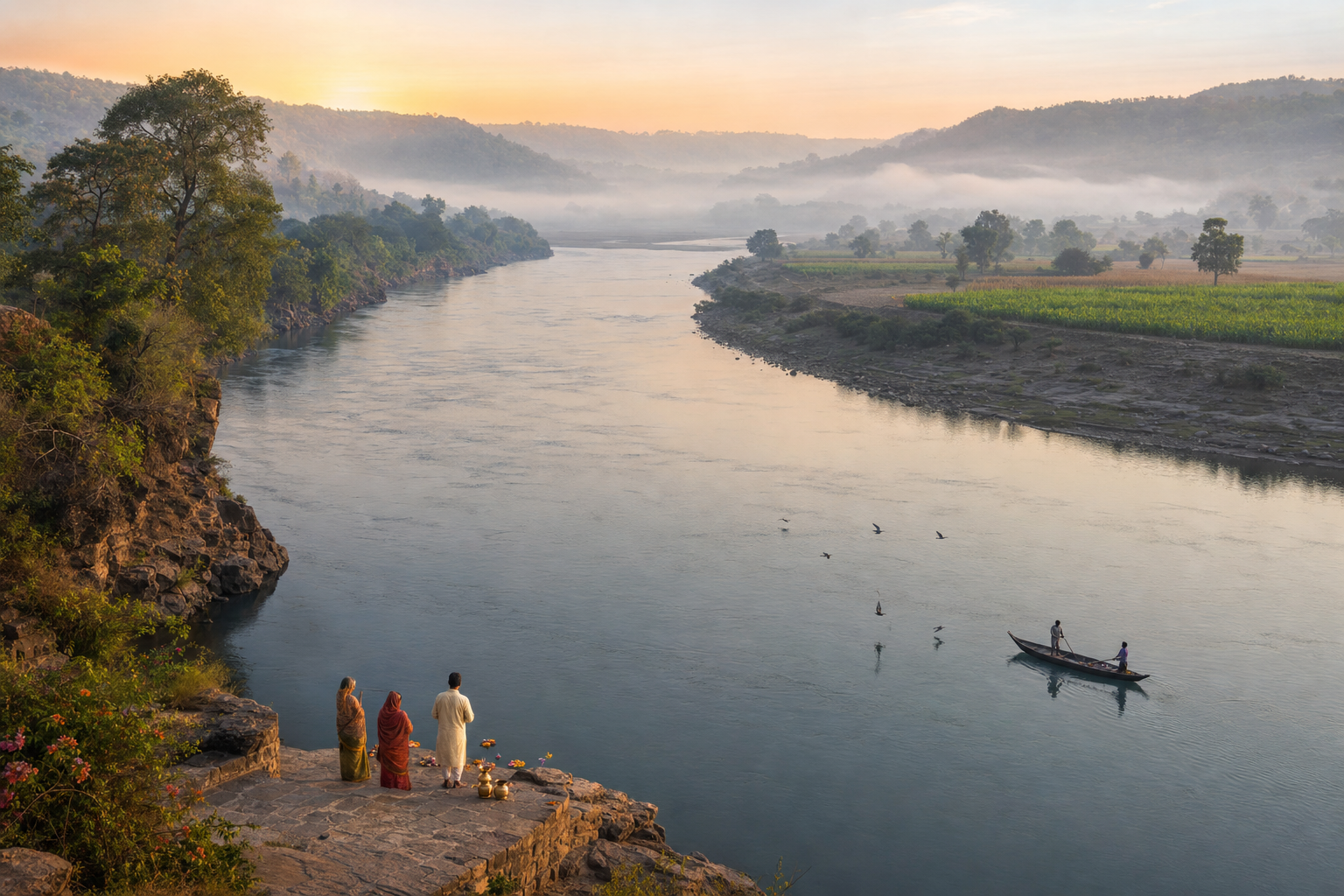
You may approach the Narmada with two questions: Why is this river sacred, and what does that sacredness require you to do? The first question leads to Shiva, Reva, tirthas and parikrama. The second leads to environmental flows, fish, sediment, farms, ghats and the waste left after worship.
These are not separate conversations. Narmada’s sacred geography joins spiritual memory to a real watershed. Once you read the river that way, pilgrimage becomes more attentive, ritual becomes more restrained, and conservation becomes a Dharmic obligation rather than somebody else’s technical project.
Key takeaways
- Narmada is not a collection of isolated holy places. Its sacred geography runs from the headwaters at Amarkantak through tributaries, gorges, settlements, temples and dams to the Arabian Sea.
- The account of Narmada arising from Shiva’s tapasya conveys a theological and ethical truth; it does not need to compete with geology or hydrology.
- Narmada Parikrama turns reverence into discipline through walking, simplicity, ahimsa, hospitality and sustained attention to both banks.
- Modern river protection must address the timing of water releases, fish movement, sediment continuity, riparian habitats and the participation of river-dependent communities.
- A pilgrim’s first ecological duty is straightforward: leave no ritual packaging, synthetic material, soap, detergent or other waste in the river or on its banks.
One river has physical, sacred and civilizational maps
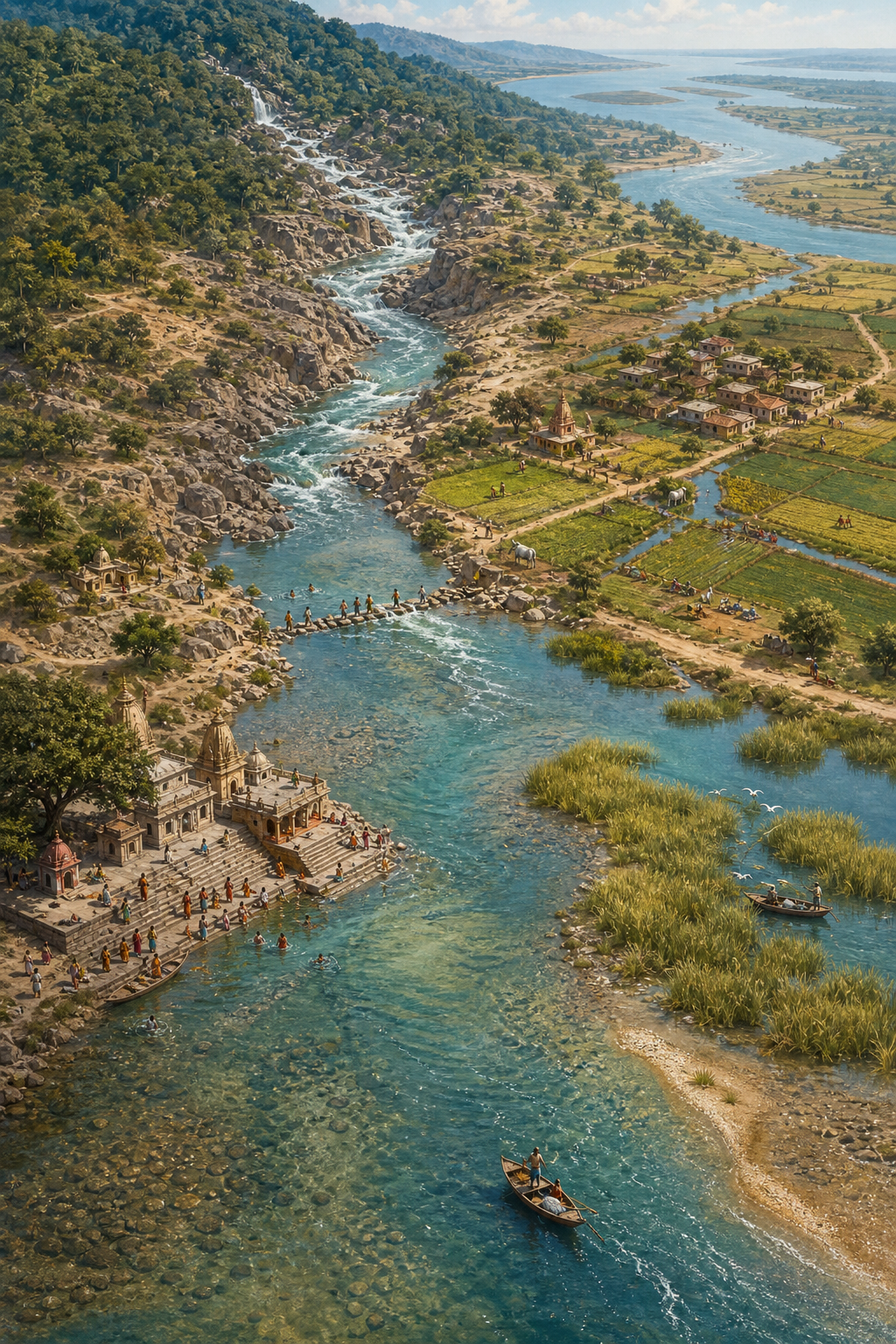
Start at Amarkantak, not at the nearest famous ghat. Narmada rises on that plateau in present-day Madhya Pradesh and flows west for roughly 1,312 kilometres through the valley between the Vindhya and Satpura ranges. It eventually enters the Gulf of Khambhat near Bharuch. Its basin covers approximately 98,000 to 99,000 square kilometres, receiving monsoon water through tributaries that include the Tawa, Shakkar, Sher, Hiran and Banjar.
That physical map corrects a common mistake: what happens to the main channel is not caused only beside the main channel. A tributary carries the condition of its own catchment into Narmada. A dam changes conditions beyond the wall that holds the water. A disturbed bank can affect habitat, erosion and local access. If you want to understand the river, trace connections rather than looking only at the water directly in front of you.
The land itself carries a geological narrative. Narmada follows the linear rift system known as the Narmada-Son lineament. Deccan Trap basalts underlie portions of the basin, while the Marble Rocks at Bhedaghat display the effect of flowing water cutting through a distinctive formation. Sacred geography does not erase these processes. It gives you a reason to approach them with wonder and restraint.
The sacred map adds another layer. Moving downstream from Amarkantak brings you through the celebrated landscape of Bhedaghat, the riverfront of Narmadapuram, the Jyotirlinga at Omkareshwar on Mandhata island, the ghats and temples of Maheshwar, and finally the estuarine world near Bharuch. Each location reveals a different relationship between land, water and worship. A source is not a gorge, an island shrine is not a floodplain, and an estuary is not merely a wider version of an upstream channel.
Maheshwar deserves particular attention because its riverfront demonstrates that sacred architecture can serve public life. Under Ahilyabai Holkar, temples, ghats, pilgrim facilities, water access and local livelihoods were woven into a coherent civic landscape. The Ahalyeshvara Mahadeva Temple complex and the tiered ghats therefore invite a practical question for every sacred town: does the built environment help people approach the river responsibly, or does it merely concentrate crowds beside it?
The valley’s human record extends much further back than its surviving temples. The Narmada hominin discovered at Hathnora and Paleolithic stone-tool traditions attest to deep antiquity. Gravel beds and river terraces may therefore be cultural records as well as physical features. Do not remove an unusual object because it looks ancient. Leave possible archaeological material where it is and bring it to the attention of an appropriate local authority.
On your next journey, read all three maps together. Mark the landforms and tributaries on the physical map, the tirthas and pilgrimage routes on the sacred map, and the farms, settlements, fishing communities and heritage structures on the living civilizational map. At every stop, ask: What changed in the river here? What form of worship arose here? Who depends on this reach of water now?
Shiva’s tapasya turns sacred origin into ethical instruction

The sacred account begins with Mahadev in profound tapasya at Amarkantak. Divine perspiration generated by the intensity of that austerity descends and becomes Narmada, also revered as Reva. The image is powerful because it moves from heat to water, concentration to generosity, and inward discipline to life given outwardly.
You do not have to turn that account into a literal hydrological proposition to take it seriously. Nor should you dismiss it because geology describes the rift valley and hydrology describes monsoon runoff. These modes answer different questions. Physical inquiry asks how water moves through rock and terrain. Sacred narrative asks what the river means, how human beings should meet it, and what kind of conduct its presence demands.
The Reva-khanda of the Skanda Purana, commonly known as the Narmada Mahatmya, develops this sacred landscape through tirthas, vows and praise of the river. The Mahabharata and Smriti traditions also remember Reva among the purifying rivers. In this devotional understanding, Narmada is not simply the setting for darshan. The flowing river is itself encountered as a moving tirtha.
That status raises the standard of conduct. If tapasya becomes life-supporting water, devotion cannot mean taking without restraint. The relevant virtues are not decorative: ahimsa asks whether our presence harms beings; aparigraha asks how much we really need to carry, consume and discard; seva asks whether our worship leaves the place more capable of sustaining life.
This ethical vocabulary can be recognised across the Dharmic family without pretending that every tradition teaches identical theology. Shaiva, Vaishnava, Shakta and Smarta practitioners meet along Narmada. Jain ascetic and lay traditions are drawn to the valley’s disciplined ethos, while Buddhist and Sikh visitors can recognise compassion, restraint and service as meaningful grounds for reverence. Unity here does not require doctrinal sameness. It begins with shared responsibility toward water, habitat and community.
Use one test whenever you hear Narmada’s sacred story: ask what discipline follows from it. If an interpretation magnifies the holiness of the river but permits careless consumption, litter or damage at the bank, it has separated praise from dharma. The proper response to a life-giving river is not sentiment alone. It is conduct that allows the river to continue giving life.
Parikrama teaches you to see the whole river
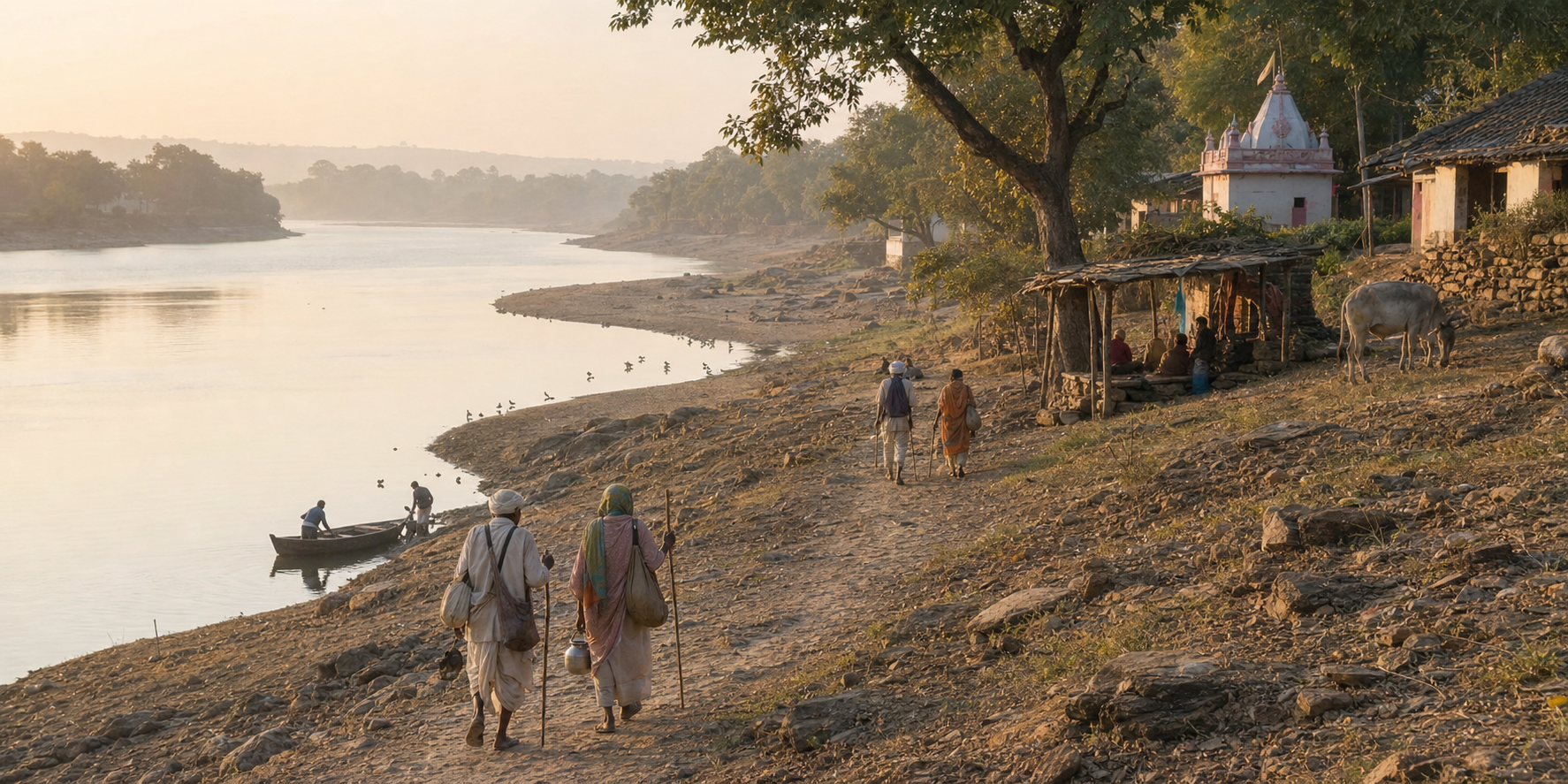
Narmada Parikrama is among Bharat’s most demanding forms of river pilgrimage. The traditional journey follows the river from its source toward the sea and returns along the opposite bank. Observants commonly avoid crossing the river except in relation to the passage at its mouth, while accepting disciplines of simplicity, non-violence, humility and hospitality. Exact vows and procedures vary, so anyone contemplating the full observance should learn from a trustworthy lineage, ashram or experienced local guide rather than assemble a private rulebook from fragments.
The full circuit matters because it resists selective vision. A short temple visit can hide the relationships between an upstream release, a downstream fishing reach, a tributary, an agricultural belt and a pilgrimage town. Walking beside both banks exposes difference. The river is narrow and broad, quiet and impounded, rocky and alluvial, devotional and commercial. Parikrama makes the pilgrim remain with those changes instead of consuming one picturesque view and leaving.
You need not imitate a full parikrama to learn from its discipline. On a one-day visit or a shorter yatra, adopt five practices:
- Arrive with a vow you can keep. It may be as simple as producing no disposable ritual waste and carrying away everything you brought.
- Walk part of the bank slowly. Notice inflowing drains or tributaries, vegetation, erosion, access paths, fishing activity, ghats and places where the channel has been altered.
- Use the smallest adequate quantity for abhisheka or another water-related rite. More material does not create more bhakti.
- Receive local hospitality without treating it as an entitlement. Support the people and institutions maintaining pilgrim access, but do not pressure residents to perform an idealised version of river life for visitors.
- Record one specific condition that needs attention, such as unmanaged packaging near a ghat or loss of bank vegetation, and direct your donation, volunteer time or civic question toward that condition.
A full parikrama is an arduous vow, not a casual endurance challenge. Physical preparation, seasonal conditions, local guidance and personal health all matter. The deeper point is not to accumulate kilometres. It is to allow the river’s length to correct the pilgrim’s habits. A journey that ends with the bank dirtier than it was before contradicts the grammar of parikrama.
Dams make the duties of reverence measurable
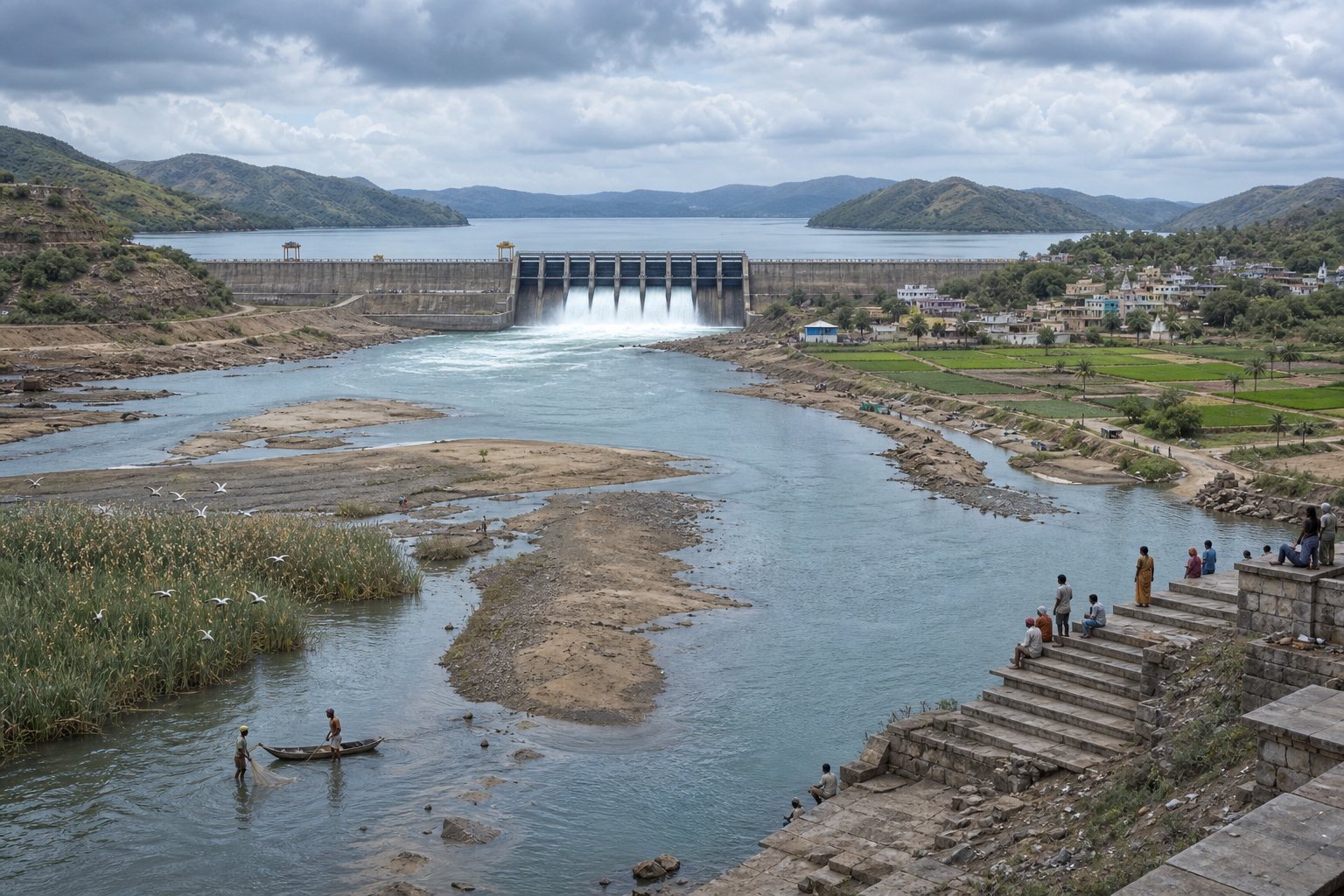
Bargi, Indira Sagar, Omkareshwar and Sardar Sarovar are among the major works that have altered Narmada’s hydrological regime. They contribute to irrigation, electricity generation and water security. They also raise difficult questions about environmental flows, fish migration, sediment movement and the effects of altered water conditions on river-dependent communities.
The honest question is not whether development or holiness should win. That framing hides the real decisions. How much water is released, when is it released, how quickly does the level change, can fish complete necessary movement, does sediment continue downstream, and were affected communities included in stewardship? These operational questions determine whether a managed river retains essential ecological functions.
An environmental flow is more than whatever water remains after other allocations. A river experiences a pattern: seasonal rises and falls, pulses, low-flow periods and connections with banks and habitats. Altering that pattern can affect species even when some water is always visible. Mahseer and other fish do not experience a river as a scenic surface; they depend on connected habitats and suitable flow conditions.
Sediment deserves equal attention. Flowing rivers carry material that helps shape channels, banks and downstream reaches. A structure that interrupts water can also interrupt sediment continuity. Riparian vegetation, meanwhile, occupies the transition between land and water. Restoring that zone can support habitat and bank integrity, but planting alone cannot compensate for every problem created by an unsuitable flow regime.
If you are assessing a river project, a restoration proposal or a public claim about Narmada, use four tests:
- Flow: Does the plan address the timing and variability of releases, or only an annual volume?
- Connectivity: Does it account for fish movement and connections among channel, tributary and bank habitats?
- Sediment: Does it examine what happens to material retained upstream and to reaches deprived of it downstream?
- Community: Are farmers, fishing communities, residents, pilgrims and custodians of sacred sites treated as participants with knowledge, or merely as recipients of a completed plan?
This is where Dharmic restraint and conservation science can work together. Aparigraha supplies a moral challenge to unlimited extraction. Ecological observation shows where limits are being exceeded and which operations can change. Community knowledge identifies seasonal and local conditions that a basin-wide model may miss. None is sufficient alone; together they provide a more responsible basis for stewardship.
A practical code for worship, travel and public action
Before you reach the river
- Decide whether your purpose is darshan, a temple visit, a parikrama segment, historical study or ecological observation. A clear purpose prevents a rushed checklist of unrelated stops.
- Map the reach you will visit. Include the nearest tributary, dam or reservoir, settlement and protected heritage place where relevant. This keeps the famous shrine connected to its landscape.
- Carry a refillable water container, a bag for your own waste and ritual materials without disposable plastic packaging wherever possible.
- If you intend to perform a formal vrata or parikrama discipline, confirm its requirements locally. Do not advertise a casual walk as the traditional vow.
At the ghat or bank
- Use established access points where available instead of trampling vegetation to create a private route to the water.
- Keep soap, detergent, synthetic colour, plastic, foil, cloth, thread and packaging out of the river. Sacred intent does not change the material after it enters the water.
- After deep daan, abhisheka or another rite, retrieve every non-natural component you can safely retrieve and place it in an appropriate collection point.
- Do not leave food or biodegradable material on the assumption that anything natural is harmless in any quantity. Follow local collection and ritual practices that keep offerings out of the active channel.
- Ask permission before photographing worshippers, mendicants, workers or local residents. A sacred landscape is not an unpeopled backdrop.
- Do not chip rock, collect suspected artifacts or disturb habitat for a souvenir.
During festivals and civic discussions
Narmada Jayanti is widely observed in Magha, often on Shukla Saptami, although regional practice varies. Amarkantak, Omkareshwar, Maheshwar and Narmadapuram host prominent observances. Maha Shivaratri has particular resonance at the river’s Shaiva tirthas. If you are travelling for either occasion, verify the local calendar and ritual arrangements rather than assuming that every town follows one schedule.
Large worship gatherings should be judged partly by what remains the next morning. Organisers and temple institutions can provide clearly marked collection points before devotees reach the water, separate reusable ritual objects from refuse, protect public access, and assign responsibility for post-event inspection. Counting attendance while ignoring the condition of the ghat is an incomplete measure of success.
Maheshwar offers a useful civic principle: devotion, public water access, pilgrim shelter, built heritage and livelihoods belong in the same plan. A riverfront should not be beautified by excluding the people whose work sustains it. Nor should heritage conservation stop at stonework while sewage, waste, unsuitable flows or damaged banks are treated as unrelated matters.
The next time you stand beside Narmada, choose one duty that lasts beyond the darshan. Carry your ritual materials back, learn the name of the nearest tributary, support responsible bank care, or ask a precise question about flow and habitat. Sacred geography becomes living dharma when reverence changes what you do.
References
