
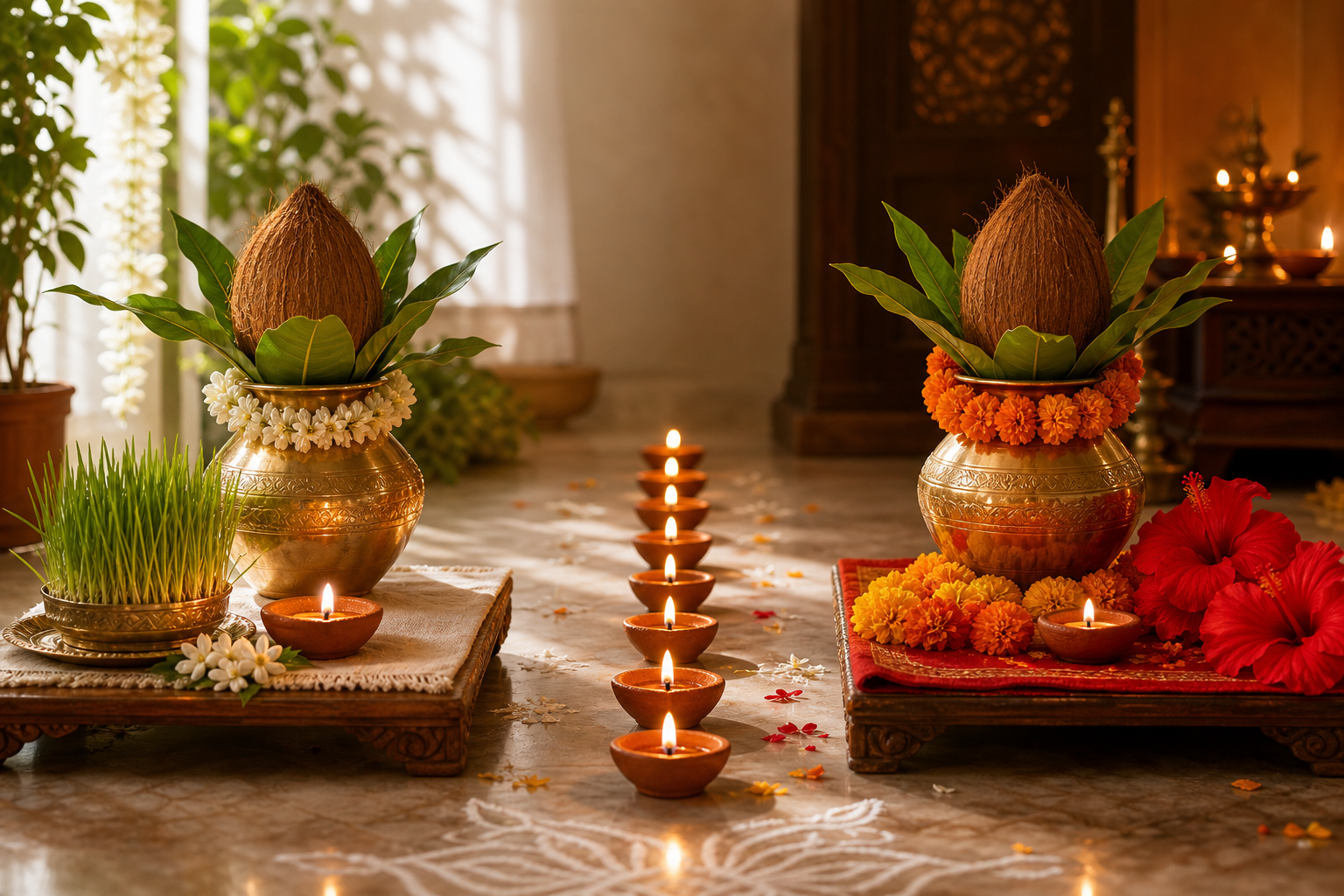
If you are trying to reserve temple time, arrange leave, choose fasting days, or bring relatives together, the first difficulty is that Navratri 2026 does not appear only once on the calendar. Chaitra Navratri falls in spring, while the larger Sharad Navratri observance returns in autumn.
For most Indian panchangs, plan Chaitra Navratri for 19-27 March and Sharad Navratri for 11-19 October. Treat those as planning dates, not as a substitute for your local panchang: the ritual day follows the tithi at local sunrise, so a household outside India may need a different civil date.
Put both Navratri observances on your 2026 calendar
Chaitra Navratri begins on 19 March 2026. The autumn sequence begins on 11 October, with Sharad Navratri Day 2 falling on 12 October. The following table uses the widespread Nava-Durga order and the dates followed by most Indian calendars.
| Day | Widespread Nava-Durga form | Chaitra Navratri 2026 | Sharad Navratri 2026 | Main planning point |
|---|---|---|---|---|
| 1 | Shailaputri | 19 March | 11 October | Ghatasthapana, sankalpa, and the opening of the vrata |
| 2 | Brahmacharini | 20 March | 12 October | Tapas, mantra-japa, and regional Dwitiya observances |
| 3 | Chandraghanta | 21 March | 13 October | Continue the household’s daily puja and recitation |
| 4 | Kushmanda | 22 March | 14 October | Maintain the established vrata without adding unsustainable austerities |
| 5 | Skandamata | 23 March | 15 October | Continue archana, japa, reading, and sattvic meals |
| 6 | Katyayani | 24 March | 16 October | Confirm arrangements for Ashtami or Navami worship |
| 7 | Kalaratri | 25 March | 17 October | Prepare prasad, gifts, and a safe space for Kanya Puja |
| 8 | Mahagauri | 26 March | 18 October | Chaitra Kanya Puja; autumn Mahashtami and the principal autumn Kanya Puja date |
| 9 | Siddhidatri | 27 March | 19 October | Mahanavami; an alternative autumn Kanya Puja day in several traditions |
This order is widespread, but it is not the only living sequence. If your kula, temple, or sampradaya assigns a form differently, keep that inherited practice. A national calendar can tell you the broad dates; it cannot overrule a lineage that has preserved its own liturgical order.
The reason dates sometimes appear to conflict is simple: a tithi does not begin at civil midnight. For most daytime observances, the governing rule is udaya tithi, the lunar day prevailing at local sunrise. A person in Toronto, London, Singapore, or Kathmandu should therefore select a panchang calculated for that location rather than converting an Indian muhurta mechanically.
- Choose a panchang calculated for your city and time zone.
- Confirm which date carries Shukla Pratipada at local sunrise for Ghatasthapana.
- Check the sunrise tithi again for Ashtami and Navami instead of assuming that every day advances at midnight.
- If your household follows a temple, use its published schedule consistently for the full observance.
- When family custom and an online colour or ritual chart disagree, keep the family custom unless your acharya or temple directs otherwise.
Chaitra and Sharad Navratri share the same ritual spine, but they need not have the same social scale. The spring observance often lends itself to renewal, study, and a quieter household vrata. The autumn cycle commonly carries larger temple programs, melas, garba, dandiya, Durga Puja, and Dashain gatherings. You can keep the spring Navratri simply without treating it as an incomplete version of the autumn festival.
Build one home ritual rhythm that will last nine days
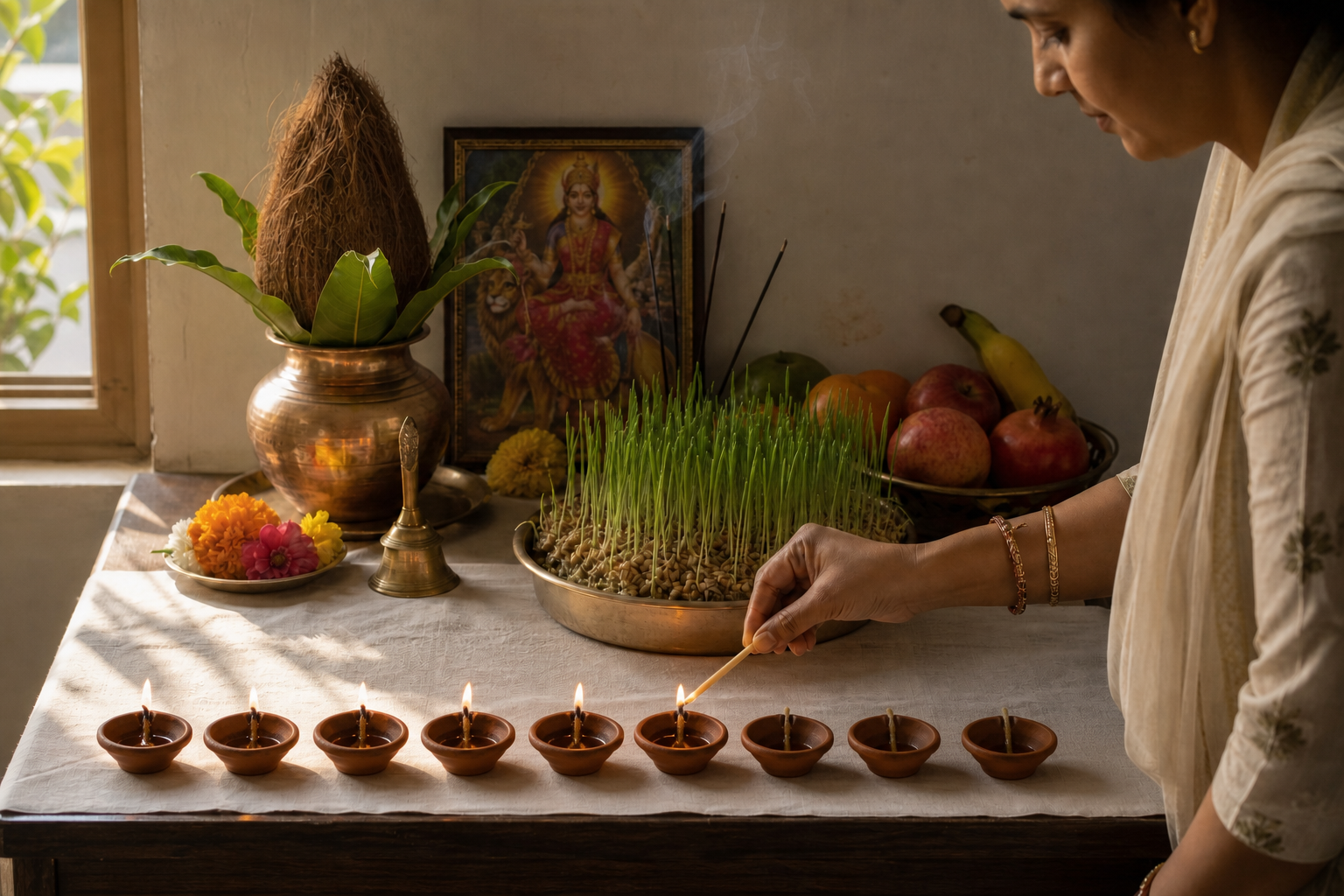
The most workable Navratri practice has a firm beginning and a repeatable daily core. Elaborate decoration on Day 1 is of little value if exhaustion makes the altar irregular by Day 4. Decide in advance what you can maintain: lamp, brief offerings, mantra-japa, a chosen reading, and one realistic form of dietary restraint.
Prepare the altar and supplies before Pratipada
Clean the altar and the surrounding floor before the first morning. Place a red or yellow cloth on a stable surface, and set an asana facing east or north if the room permits. Keep decoration restrained enough that the lamp, kalasha, and offerings remain accessible.
- An earthen or copper kalasha, clean water, unbroken rice, mauli, kumkum, and sandal paste
- A whole coconut and five suitable leaves, commonly mango leaves where they are locally available
- Flowers, fruit or another simple naivedya, incense, cotton wicks, and ghee or sesame oil
- Barley or wheat seeds and a shallow vessel if your family grows jaware or jamara
- A red or yellow cloth, reusable puja utensils, and a fire-safe plate for the diya
- Optional kalasha additions observed in some homes, such as akshata, a coin, cardamom, durva, or a small amount of camphor
Establish the kalasha carefully on Day 1
Ghatasthapana is performed after sunrise while Pratipada prevails, avoiding Amavasya. Chitra Nakshatra or Vaidhriti Yoga can narrow the preferred window in traditions that account for them. If either creates uncertainty, use your city-specific panchang or temple muhurta rather than guessing from a date alone.
- Spread the altar cloth and place the kalasha over a bed of unbroken rice.
- Fill it with clean water and add any customary ingredients used by your household.
- Tie mauli around its neck and mark the vessel with kumkum or sandal paste. The swastika used here is the ancient Dharmic sign of auspiciousness.
- Arrange the leaves at the mouth and place the whole coconut above them, wrapped in red cloth if that is your custom.
- Sow barley or wheat nearby if you keep jaware or jamara. Tend the shoots through the nine days as part of the daily altar care.
- Take a concise sankalpa for inner discipline and the welfare of all. A traditional formulation is Navaratri-vratam karisye, sarva-mangala-siddhyartham.
- Offer water, akshata, flowers, incense, lamp, and naivedya to Shailaputri. Chant Om Devi Shailaputryai Namah according to your capacity.
An akhand jyot represents steady awareness, but it also creates a continuous fire hazard. Keep it on a level, nonflammable surface, well away from curtains, children, pets, and moving air. Assign an adult to check the wick and fuel. If continuous supervision is not possible, light a lamp during puja rather than leaving an unattended flame burning in the name of observance.
Use the same concise sequence every morning or evening
Your daily puja does not need to expand as the week becomes busier. A stable sequence keeps attention on Devi and makes it easier for children, elders, and working family members to participate.
- Wash, settle at the altar, and perform achamana or your customary purification.
- Light the lamp and remember Ganapati and the Guru if that belongs to your tradition.
- Renew the sankalpa and invoke the Nava-Durga form assigned to the day.
- Offer gandha, flowers, dhupa, deepa, and naivedya as a simple panchopachara puja. Use shodashopachara only if you already know and can sustain the fuller sequence.
- Chant the day’s Devi mantra, followed by Om Dum Durgayai Namah or the Ya Devi Sarvabhuteshu refrain. A count of 108 is customary, but steadiness matters more than rushing to complete a number.
- Read the portion of the Devi Mahatmyam or Durga Saptashati assigned by your household. When a complete patha is impractical, use the shorter Saptashloki Durga or another familiar stotra.
- Conclude with aarti, kshamapana, pradakshina where space allows, and distribution of prasad.
- Carry the vrata beyond the altar through measured speech, dana, seva, and one practical reduction in distraction or excess.
Day 2 gives this rhythm a particularly clear purpose. Brahmacharini embodies tapas, study, and disciplined attention. White flowers, sugar or mishri, milk, or a simple milk-based preparation are common offerings. Chant Om Devi Brahmacharinyai Namah, and choose one restraint you can actually keep through Day 9: a fixed japa period, less screen time, calmer speech, or a daily act of service.
Do not treat social-media colour charts as universal ritual law. Yellow or orange is used for Shailaputri in many homes; white is widely associated with Brahmacharini, while some communities use green for renewal. Weekday-based colour lists and regional lists may differ. Wearing the colour kept by your family or local mandir preserves more meaning than chasing a supposedly universal chart.
Choose a vrata your health and duties can support
Common forms include phalahara, a milk-based vrata, one sattvic meal, or a moderated diet without onion, garlic, meat, or alcohol. Depending on family custom, foods may include fruit, milk, nuts, potatoes, sabudana, samak, kuttu, singhada flour, ghee, and sendha namak. Fresh, simple food supports the purpose of restraint better than an elaborate feast made from technically permitted ingredients.
Nirjala fasting is not a test that everyone must pass. Children, elders, pregnant or nursing people, those doing strenuous work, and anyone managing a medical condition should use a gentler observance and seek appropriate clinical guidance where needed. Maintain water, necessary electrolytes, adequate sleep, and prescribed treatment. A no-onion, no-garlic sattvic diet or one moderated meal can preserve the vrata’s discipline without turning it into preventable harm.
Plan Kanya Puja before Ashtami or Navami arrives
Do not wait until the eighth morning to contact families, check allergies, and find appropriate gifts. In 2026, Chaitra Kanya Puja falls on 26 March. The principal autumn date is Mahashtami on 18 October, while traditions that reserve the rite for Mahanavami observe it on 19 October. Follow one date according to your parampara; there is no need to perform the full rite twice merely because both customs exist.
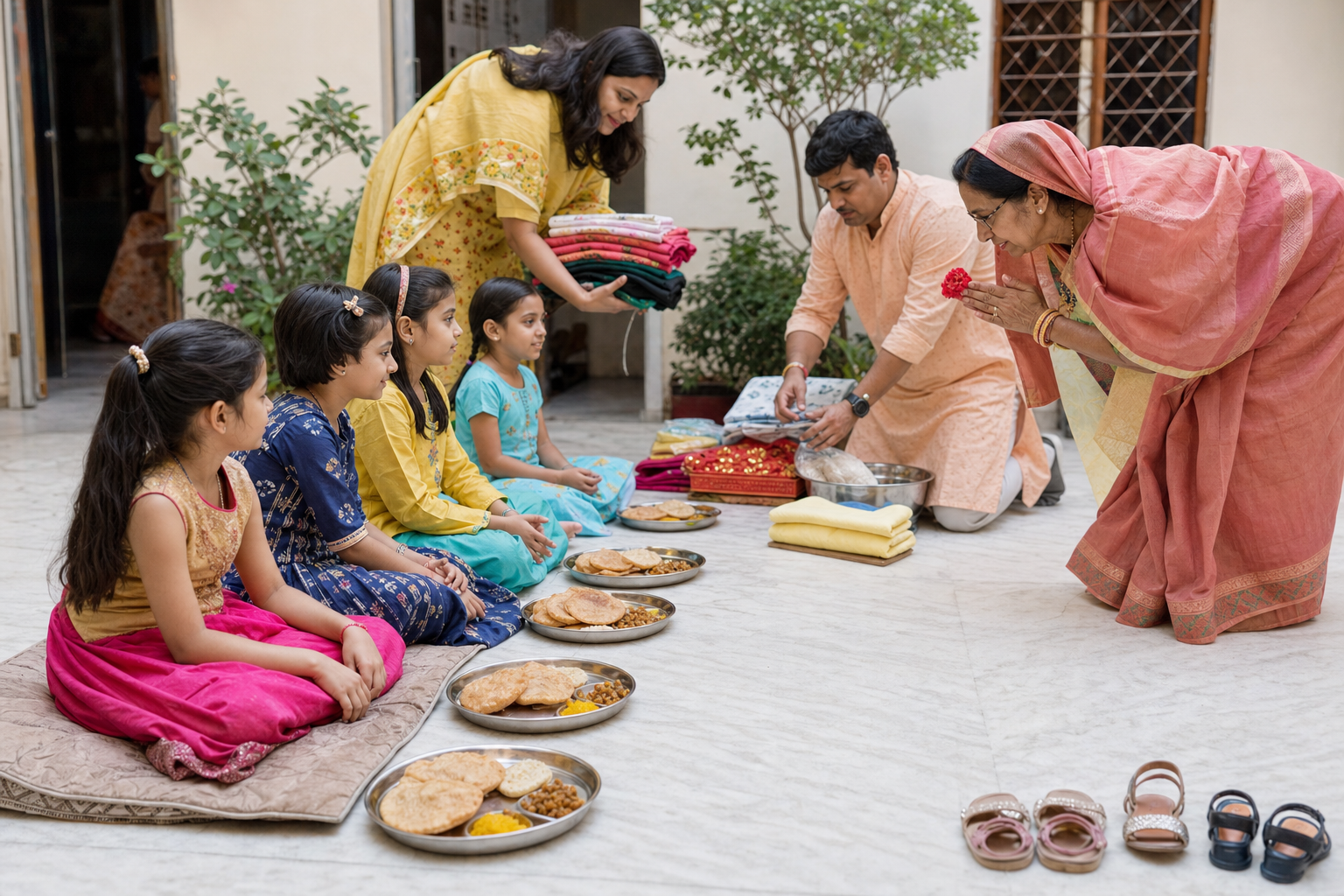
Kanya Puja, Kumari Puja, or Kanjak Puja recognizes prepubescent girls as living manifestations of Devi. Households may invite one, five, seven, or nine girls according to capacity. Some also invite a prepubescent boy in the role of Bhairav. Nine guests are not a requirement when space, safeguarding, or family circumstances make a smaller observance more responsible.
- Speak with parents or guardians in advance. Explain the ritual, confirm that they will be present where appropriate, and ask about allergies or dietary restrictions.
- Prepare a clean, calm seating area and fresh drinking water. Keep the gathering small enough that every child can be welcomed without being rushed.
- Wash the feet gently only when the child and guardian are comfortable. A symbolic sprinkling or respectful welcome is sufficient when touch would cause discomfort.
- Apply kumkum and haldi according to family custom, tie a red thread if welcomed, and offer flowers while remembering Devi.
- Serve fresh prasad patiently. Halwa, puri, and kala chana are customary in much of North India, but allergen-aware and locally appropriate sattvic food is more important than reproducing a menu mechanically.
- Offer a useful, modest gift such as fruit, sweets, notebooks, crayons, clothing, or school accessories. Give dakshina where customary without turning the occasion into display.
- Conclude with aarti and respectfully seek the children’s blessings. Make sure every guest leaves safely with their guardian.
Consent is part of the puja, not an administrative detail outside it. Never pressure a child to accept touch, tilak, food, photographs, or a public role. Ask before taking any image, and do not post a child’s photograph without clear guardian permission. Clean utensils, filtered water, known ingredients, and an unhurried meal express the reverence that the ritual is meant to teach.
If inviting children into your home is impractical, support a well-run community Kanya Puja, annadanam effort, school initiative, or child-focused seva program. The ethical movement remains the same: worship of Shakti must produce tangible dignity, nourishment, education, and protection for children.
Keep the regional observance instead of forcing one template
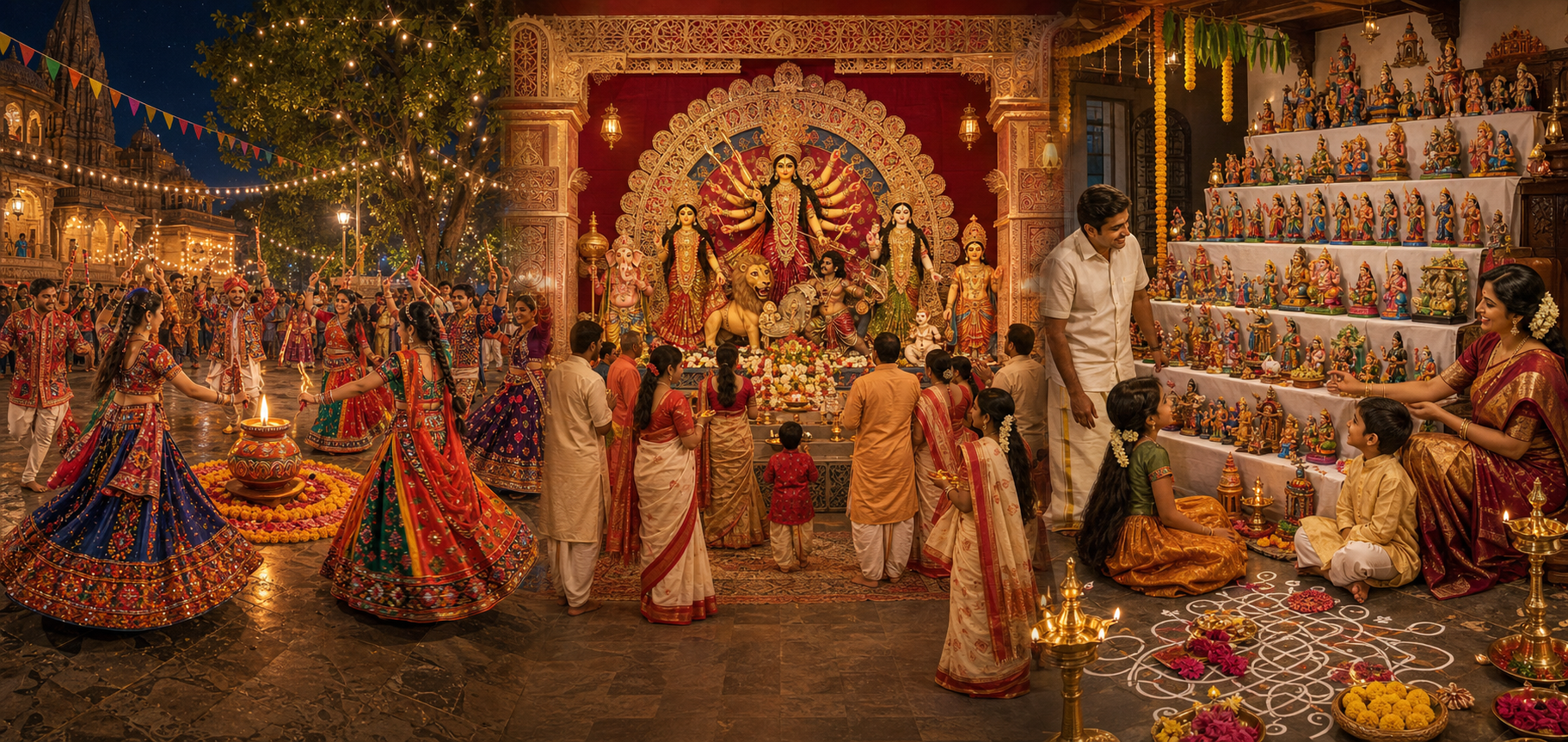
Navratri’s unity does not depend on making every region look alike. The kalasha, vrata, Devi worship, music, hospitality, and final blessings appear in different combinations because families inherited different histories. Before adding a custom from elsewhere, identify which part of your own regional practice already carries the same spiritual purpose.
North India: Kanjak, Sindhara Dooj, and temple gatherings
Delhi, Punjab, Haryana, Uttar Pradesh, Himachal Pradesh, Rajasthan, Uttarakhand, and neighbouring regions commonly centre Kanjak Puja on feeding girls halwa, puri, and kala chana, followed by gifts or dakshina. Household hospitality is the ritual’s centre; the number of guests matters less than feeding and honouring them well.
Navratri Day 2 is also Sindhara Dooj or Gauri Dwitiya on 20 March and 12 October in several North Indian traditions. Families may exchange sindoor, bangles, red chunri, sweets, and other auspicious gifts while praying for household harmony and the well-being of married women. Keep the Brahmacharini worship at the centre: the social exchange should express care, not competition or financial pressure.
Sindhara Dooj is not Bhai Dooj. Sindhara belongs to Navratri’s Shukla Dwitiya and combines Devi-upasana with sowbhagya customs. Bhai Dooj occurs after Deepavali in Kartik and centres the sibling relationship. Keeping the names and lunar settings distinct prevents a common calendar mistake.
Other Day 2 observances include Preethi Dwitiya and Sthana Vriddhi Gauri Vrata in particular communities. They can coexist with Brahmacharini Puja because they add a regional or household intention to the same Dwitiya day rather than replacing Nava-Durga worship.
Bengal and the East: Durga Puja, Kumari Puja, and Sandhi
In Bengal and parts of eastern Bharat, Kumari Puja may form part of a temple or matha’s Mahashtami program. These observances can follow detailed Shakta protocols that are not identical to the simpler North Indian household Kanjak meal. If you are attending such a program, use the temple’s instructions for timing, offerings, dress, and access rather than trying to reproduce its full liturgy independently.
Sandhi Puja belongs to the junction between Ashtami and Navami. Kanya Puja may be held earlier in the daytime so that the children can be welcomed and fed without haste. Do not assume that every Kumari Puja must occur during the Sandhi interval; the temple’s lineage and schedule determine how the two observances relate.
Southern traditions: Golu, alankara, music, and tambulam
Many southern households arrange bommai golu or Bommala Koluvu, perform daily archana and alankara, and make music or devotional recitation part of the evening rhythm. Young girls and suhasinis may be invited for tambulam, Kannika Poojai, food, and respectful gifts.
If you keep golu, plan the display so that worship remains practical for nine nights. Leave a safe route to the altar, keep lamps away from fabric and crowded tiers, and choose a manageable visiting schedule. The display should support daily remembrance and community exchange, not turn the household into a logistical burden that displaces puja.
Nepal and the Himalayan belt: Dashain, jamara, and Shakti Peethas
In Nepal, the Navratri period unfolds as Dashain. Ghatasthapana establishes the sacred vessel and barley jamara, which the household tends during daily Durga worship. Day 2 continues that rhythm through puja and evening aarti, building toward the later Vijaya Dashami blessings. A family following a Nepalese calendar should use Nepal Time and its local panchang rather than importing an IST muhurta.
In Himachal Pradesh, Shakti Peethas such as Chintpurni and Naina Devi draw pilgrims during Navratri. Coconut, red chunri, and sindoor are common offerings, while bhajans, aartis, and melas make the observance communal. If you plan a pilgrimage, follow the temple’s current arrangements and carry only offerings it accepts; reusable containers and minimal packaging keep devotion from becoming litter.
Garba, dandiya, satsang, and bhajan gatherings can be integrated wherever a community keeps them. Preserve their devotional centre, respect neighbours and venue rules, and avoid allowing amplified celebration to eclipse the altar practice that gives the nine nights their meaning.
Navratri liturgy is distinctly Hindu and Shakta, even as its disciplines resonate across the wider Dharmic family. Buddhist right effort and maitri, Jain ahimsa and aparigraha, and Sikh simran, seva, and sangat offer genuine ethical parallels. An inter-Dharmic household can honour those shared values without claiming that mantras, doctrines, or ritual forms are interchangeable.
Key takeaways for a workable 2026 observance
- For most Indian panchangs, Chaitra Navratri runs from 19 to 27 March 2026, and Sharad Navratri runs from 11 to 19 October 2026.
- Use the tithi at local sunrise, not civil midnight or a calendar prepared for another country, to determine your ritual day.
- Perform Ghatasthapana after sunrise while Pratipada prevails, and ask your temple or panchang for help if Chitra Nakshatra or Vaidhriti Yoga complicates the window.
- Keep a repeatable daily core: lamp, invocation, offerings, mantra-japa, a chosen reading, aarti, prasad, and one form of ethical restraint.
- Choose a fast that respects health, work, pregnancy, age, medication, and caregiving duties. Tapas is disciplined conduct, not avoidable injury.
- Plan Chaitra Kanya Puja for 26 March. For Sharad Navratri, follow your parampara on 18 October for Mahashtami or 19 October for Mahanavami.
- Regional differences are not errors. Preserve your family’s Sindhara, Kanjak, Durga Puja, Golu, Dashain, temple, music, or community customs without presenting one regional pattern as universal.
Before the first day arrives, make four decisions: which Navratri cycle you will keep, which local panchang will govern it, what daily vrata you can sustain, and whether your family performs Kanya Puja on Ashtami or Navami. Once those are settled, obtain reusable supplies, contact guests or the temple early, and leave the nine nights themselves free for steady worship rather than last-minute negotiation.
References
- DharmaRenaissance Blog – 10 Sacred Actions for Day 1 of Chaitra Navratri 2026 (19 March): Ghatasthapana, Puja, Vrat Rules
- DharmaRenaissance Blog – Navratri 2026 Day 2: Brahmacharini Puja, Preethi Dwitiya, and Dashain Rituals
- DharmaRenaissance Blog – Kanya Puja 2026: Exact Dates, Ritual Steps, and Deep Significance for Navratri and Durga Puja
- DharmaRenaissance Blog – Sindhara Dooj 2026 (Gauri Dwitiya): Auspicious Dates, Rituals, and Navratri Day 2 Meaning
- DharmaRenaissance Blog – Navaratri Day 2, 20 March 2026: Brahmacharini Puja Steps, Mantras, and Fasting Tips