If you have watched a community praise equality while preserving privileged seats, gatekept committees, or invisible kitchen labour, you already know the problem Guru Amar Das Ji confronted. A principle cannot reshape society when the community’s routine quietly contradicts it.
His answer was not a slogan. He placed seva and equality inside repeatable institutions: the shared meal, local leadership, women’s authority, public infrastructure, congregational learning, and disciplined engagement with shabad. If you want to understand why his work endured, look at how each institution changed what people actually had to do.
Seva trained the leader before it scaled the community
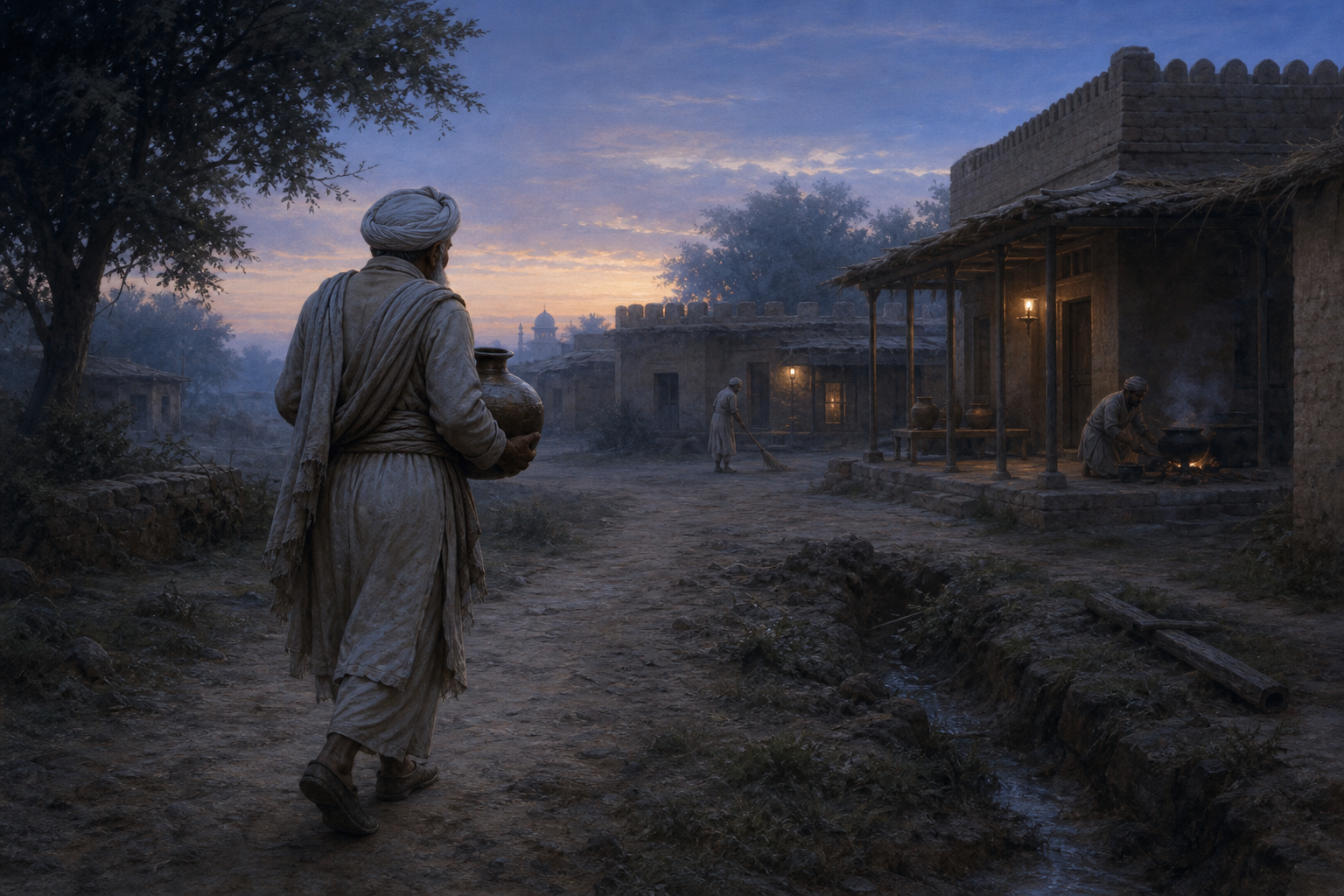
Guru Amar Das Ji’s public leadership began unusually late. Born in 1479 in Basarke near Amritsar, he had spent much of his earlier life as a devout Vaishnav pilgrim. In his seventh decade, hearing Bibi Amro recite Japji Sahib drew him towards Guru Angad and the Sikh path. He then spent roughly twelve years at Khadur Sahib in exacting service, including fetching water before dawn and attending to the needs of the sangat.
When he became the third Sikh Guru in 1552, he was approximately seventy-three. His age matters because it removes two convenient excuses. You are not too old to reorient your spiritual life, and visible authority does not have to precede apprenticeship. His sequence was hearing, submission to discipline, repetitive service, and only then institutional leadership.
This kind of seva is more demanding than occasional volunteering. A public act can strengthen the ego when it earns praise, influence, or a photograph. Repetitive and necessary work exposes that appetite. Carrying water before others wake, preparing food, cleaning after a gathering, or caring for someone who cannot repay you offers little room for performance. The work trains attention away from the self.
If you are selecting a leader for a gurdwara, temple, dharmic association, or service project, examine the person’s relationship with uncelebrated work. Do they remain present when the event ends and the cleanup starts? Do they know the people who cook, carry, translate, teach children, and care for elders? Do they treat such work as spiritual discipline or as labour to be delegated downward? A community that promotes charisma without testing seva eventually builds hierarchy around personality.
Guru Amar Das Ji’s life also corrects a common misunderstanding about humility. Humility does not mean refusing responsibility. Years of disciplined service prepared him to design systems across a growing community. Seva restrained haumai, but it did not produce passivity. It produced the steadiness required to exercise authority without making authority the purpose.
Pangat turned equality into a non-negotiable routine
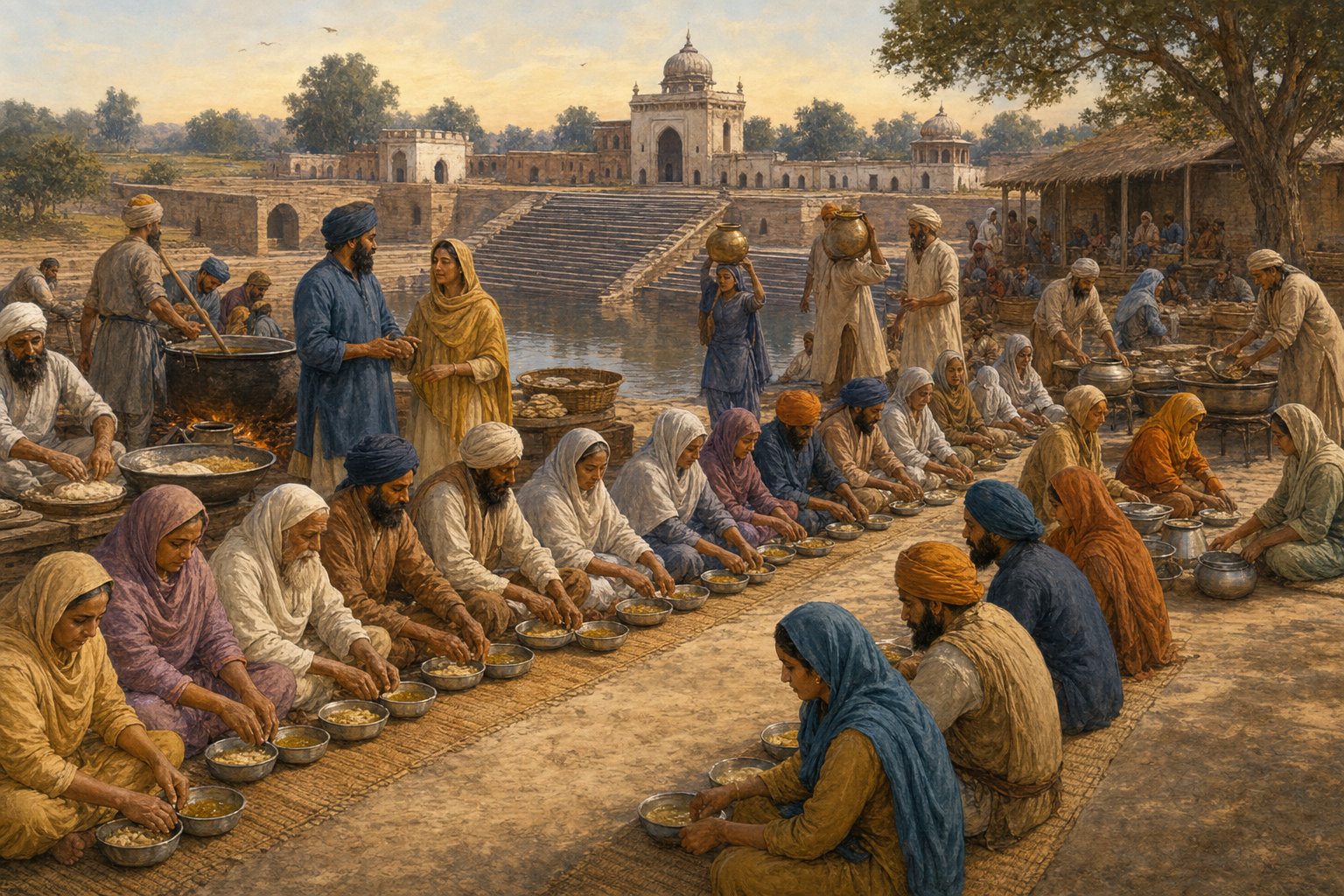
Guru Amar Das Ji expanded langar into more than charitable food distribution. In pangat, people sat in a common row and ate the same meal before entering the formal congregation. The maxim pehle pangat, pachhe sangat, first the shared row and then the congregation, gave equality a physical order.
That order matters. A discourse on the oneness expressed by Ik Onkar can leave inherited status untouched. A shared row forces the body to inhabit the teaching. Caste, wealth, office, lineage, and political rank cannot determine who is spiritually ready to sit together. The meal becomes preparation for listening because it challenges the hierarchy that people might otherwise carry into the sangat.
Tradition remembers Emperor Akbar taking langar before meeting the Guru at Goindwal. The episode should not be read mainly as a ruler honouring a holy man. Its sharper lesson is that royal rank did not suspend the community’s discipline. A rule that applies only to ordinary people is not equality; it is etiquette enforced by power.
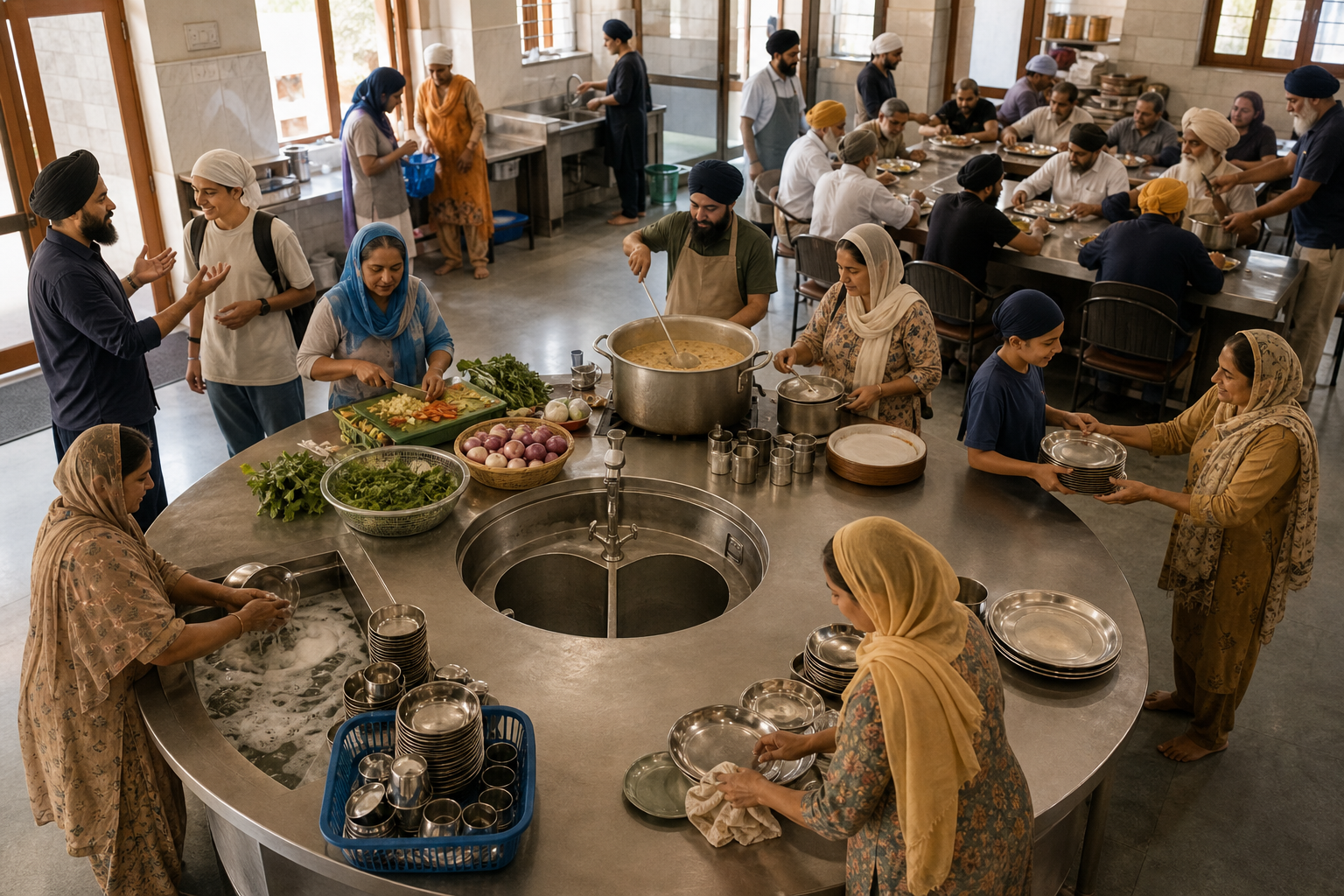
You can test a present-day langar by watching the full path from entrance to cleanup. Who is welcomed personally, and who is merely directed? Does a donor, politician, cleric, or committee member receive an experience designed to announce rank? Do the same people always serve while another group is always served? Are cleaners visible as members of the sangat, or treated as background labour?
Accommodation for age, disability, illness, or another genuine access need is not social privilege. It enables participation. The warning sign is an exception that exists only to display prestige. If someone receives a private meal, separate utensils, a superior place, or exemption from the common order merely because of status, pangat has been converted from a discipline of equality into a ceremonial gesture.
Langar also reveals why seva and equality must remain joined. Service without equality can turn the recipient into an object of the giver’s generosity. Equality without service can remain an agreeable abstraction. In langar, people meet a material need through collective labour while refusing to grade human dignity. Food, hospitality, and the common row do the teaching together.
Manji and Piri made responsibility local and shared
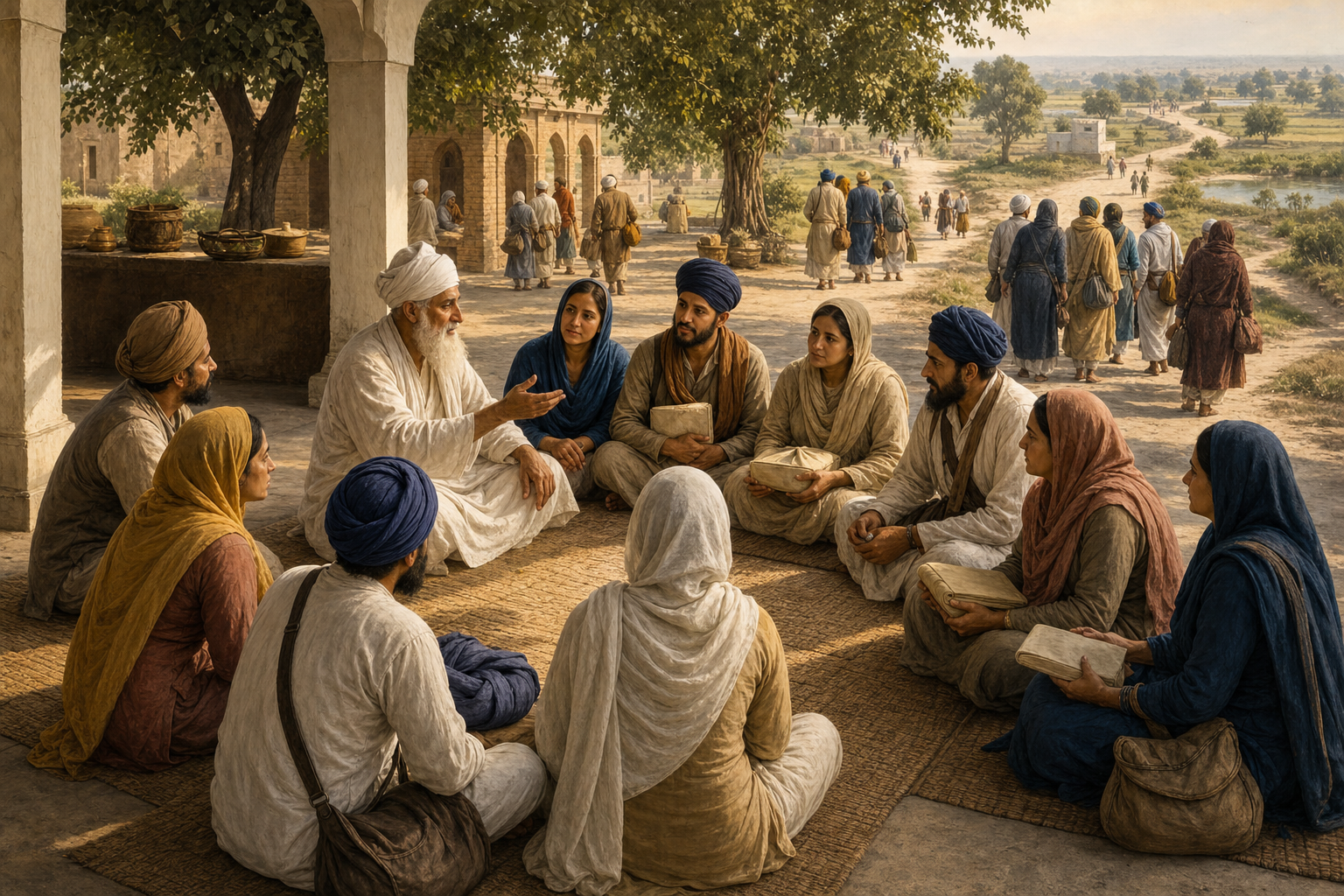
A growing sangat could not depend on every question, teaching, and act of care passing through one location. Guru Amar Das Ji developed the Manji system, a network of twenty-two regional seats led by trained representatives. These representatives taught, organized congregations, and cared for communities. The system carried a shared discipline across distance without making personal access to the Guru the only route to participation.
Decentralization was not abandonment. A Manji was a seat of responsibility, not a private possession. Local leadership remained answerable to the Guru’s teaching and to the needs of the sangat. That distinction still matters: distributing authority can widen access, but vague authority can also create unaccountable local fiefdoms. A sound institution makes the leader’s duty, scope, and moral standard clear.
The Piri system extended this design by creating a parallel space for women’s leadership, instruction, organization, and pastoral care. Guru Amar Das Ji also opposed purdah and sati. These measures belonged to the same moral architecture: women were to exercise spiritual and community authority, not merely receive respectful language while remaining outside decision-making.
This gives you a more exact test than asking whether women are present. Presence can coexist with exclusion. Ask who teaches, interprets, allocates resources, resolves problems, coordinates care, and represents the community. If women prepare meals and festivals but cannot shape teaching or policy, the institution benefits from their labour without sharing authority. The lesson of Piri has not been met.
The Manji and Piri systems also correct the belief that centralized control is the safest way to protect tradition. A center can preserve consistency, but it can also become a bottleneck. Trained, accountable local leaders recognize needs earlier because they live among the people affected. The practical task is to combine proximity with responsibility: define what local leaders may decide, ensure that teaching remains grounded in shabad, make stewardship of resources transparent, and give the sangat a clear way to raise concerns.
Do not copy an old administrative name while retaining a closed circle underneath it. Apply the underlying discipline. Move responsibility close enough to the community that care is real, train people before conferring titles, include women as authorities rather than symbolic participants, and judge leadership by service instead of prestige.
Goindwal united public utility, bani, and sacred memory
A sacred center that also answered a public need
At Goindwal Sahib, Guru Amar Das Ji joined spiritual formation to material infrastructure. The Baoli Sahib, a stepwell with eighty-four steps, provided dependable access to water while supporting a contemplative path associated with recitation. Sacred space and public utility were not competing priorities. The community’s need for water could be met within an environment that directed attention towards shabad.
This is a useful standard whenever a dharmic community raises money for a building. Ask what recurring burden the project will remove. Will it provide food, water, learning, access, shelter, or a dependable place of care? Beauty and symbolism have their place, but a sacred complex that displays devotion while leaving basic community needs outside has separated worship from seva.
The Baoli also shows why infrastructure can teach. A shared facility determines who meets, who waits, who contributes labour, and who gains access to a necessity. Design is therefore never morally neutral. Entrances, water points, kitchens, seating, classrooms, and sanitation either widen participation or quietly sort people by rank and ability. Before approving a project, walk through how an unfamiliar person would actually use it, not merely how the finished structure will look.
Bani kept institutional activity oriented towards transformation
Institutions can distribute meals and authority while still becoming vehicles for ego. Guru Amar Das Ji’s bani supplied the inner discipline that social organization alone could not provide. He composed approximately 907 hymns across multiple ragas. Anand Sahib, with forty pauris, remains central to Sikh liturgical life.
The recurring orientation is practical: remembrance of Naam, surrender of haumai, the transforming company of the sangat, and reliance on the Satguru. The distinction between Gurmukh and Manmukh gives an institution a searching question. Is its conduct being oriented by the Guru’s word, or by the impulses of reputation, possession, faction, and self-importance?
This is why prayer should not be used as ceremonial decoration around an unchanged power structure. Shabad must be allowed to examine the institution. If recitation praises humility while meetings reward domination, or if kirtan gathers everyone while governance excludes them, liturgy and conduct have been separated. Returning to bani should change the decision, not merely bless it.
Learning and memory were institutional responsibilities as well. The expansion of sangat encouraged Gurmukhi literacy and congregational engagement with shabad. The Goindwal Pothis, associated with the Guru’s household and successors, preserved bani of the early Gurus and selected Bhagats. Their textual lineage later contributed to the Adi Granth compiled under Guru Arjan. In this architecture, preserving and transmitting wisdom was itself a form of community care.
A present-day institution should therefore ask whether its knowledge can survive its current office-bearers. Are people being taught to read, sing, understand, and discuss the tradition, or are they expected to depend permanently on a small group? Are teaching materials accessible? Is community memory preserved carefully enough for the next generation to examine and inherit it? Events create attention; literacy creates continuity.
Readers from across the Dharmic family will recognize resonances here. Langar recalls anna-dana and the public duty implied by loka-sangraha. Its concern for dignity meets the ethical worlds of karuna and ahimsa, while devotion over inherited hierarchy resonates with the bhakti inheritance. These affinities should deepen mutual understanding, not erase distinctions. Sikh terms such as Naam, shabad, sangat, pangat, and Satguru carry their own theological and historical specificity. Learn across traditions by recognizing a shared civilizational grammar of service, restraint, truthfulness, and reverence for life without turning every path into the same path.
Key takeaways: use five tests before calling it seva
- The common-rule test: Would a wealthy donor, religious office-holder, or political leader follow the same public discipline as everyone else? Necessary accommodation should protect access, but status alone should not buy an exemption.
- The dignity test: Does the work meet a real material need while allowing the person served to participate without humiliation, segregation, or dependence on a benefactor’s favour?
- The authority test: Is responsibility close enough to the sangat to answer local needs, yet defined clearly enough that leaders remain accountable rather than becoming proprietors of their positions?
- The women’s-leadership test: Are women entrusted to teach, decide, organize, and provide spiritual care, or does the community celebrate their service while withholding authority?
- The inner-orientation test: Does Naam and shabad correct the institution’s conduct, especially when correction costs prestige, convenience, or control?
Use these tests on one recurring practice at your next community meeting. Put the meal queue, seating plan, volunteer rota, teaching program, water facility, or decision process on the table. Trace what an ordinary person experiences from arrival to departure. Identify where rank changes that experience, where essential labour becomes invisible, and where responsibility lacks accountability.
Then change the routine itself. Remove a privilege based only on status. Give a named person or team clear responsibility, with women holding real authority. Connect the work to study or recitation so that service remains answerable to spiritual teaching. Examine the next occurrence for barriers that good intentions missed.
Guru Amar Das Ji’s institutional genius becomes visible when equality can be seen without reading a mission statement: in who sits together, who serves, who teaches, who decides, and whose daily burden the sacred community chooses to carry. Begin at that level, and seva can become a durable discipline rather than an occasional display.