
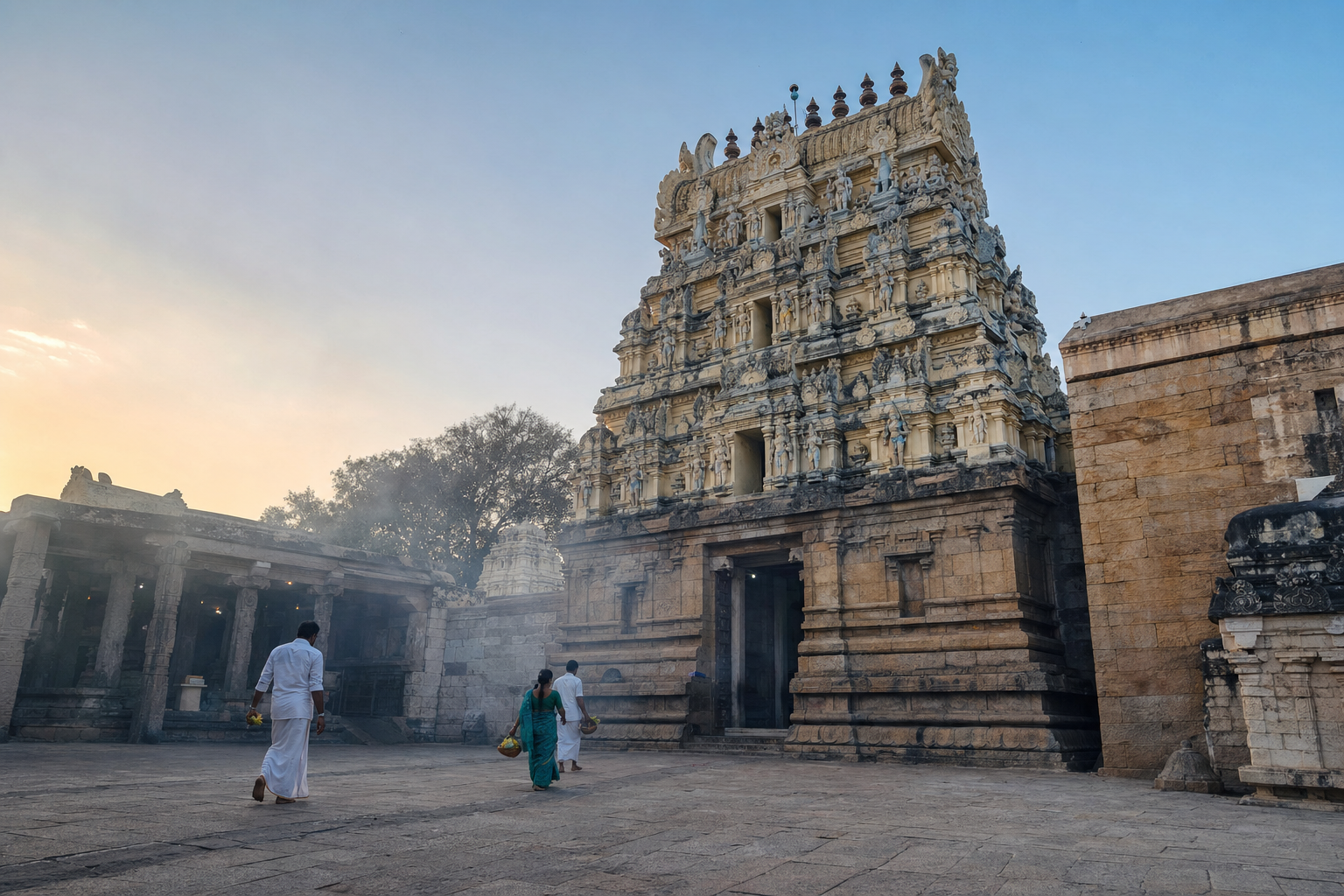
If you are going to Nagalapuram for Matsya Jayanti, decide before you leave whether your non-negotiable is morning seva, unhurried darshan, or the Surya Puja at sunset. Trying to improvise all three can turn a sacred day into little more than queue management.
The better approach is to treat the pilgrimage as one devotional arc: Vishnu awakens in the morning, you contemplate Matsya as the protector of knowledge and life, and the setting sun brings the temple’s theology into its architecture. The 2026 observance was scheduled for 21 March, close to the March equinox. Its timings provide a useful pattern, but they should not be treated as a permanent annual timetable.
Key takeaways
- Sri Vedanarayana Swamy Temple worships Vishnu as Matsya Narayana, the form associated locally with the recovery and preservation of the Vedas.
- For the 2026 observance, Suprabhata Seva was announced for 5:00 AM, followed by Tomala Seva and Archana; morning puja and public darshan were customarily expected from 7:00 AM to 8:30 AM.
- The equinoctial Surya Puja is generally seen across three evenings, not at one guaranteed instant. Weather, the local horizon and atmospheric conditions affect visibility.
- If you can attend only one period, choose the morning for the fuller Matsya Jayanti worship sequence or the evening for the conjunction of worship and solar alignment.
- Carry the vrata beyond the temple through japa, scriptural reading, satvika food, anna-dana, reduced plastic use or support for water conservation.
Why Vedanarayana makes this more than a festival visit
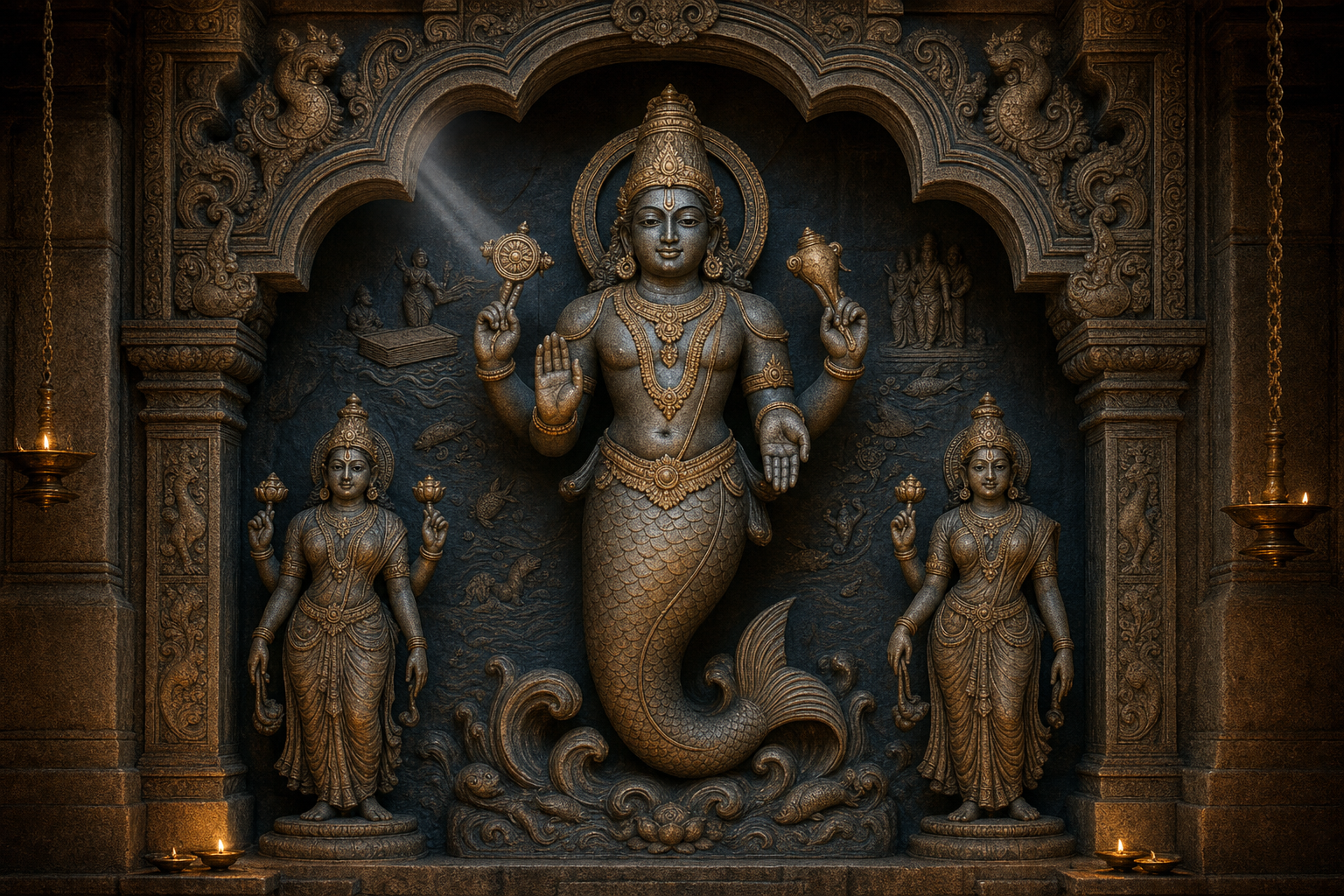
The name Vedanarayana is the key to understanding Nagalapuram. Matsya is not presented merely as the first name in a list of Vishnu’s avataras. Here, the deity embodies the power that prevents sacred knowledge from disappearing when order collapses.
The Matsya tradition has several textual layers. Early forms appear in the Shatapatha Brahmana and the Mahabharata, while the Matsya Purana and Bhagavata Purana develop the narrative further. Across these tellings are the recurring images of Vaivasvata Manu, the approaching flood, a boat bearing life and wisdom, Vasuki joining the boat to Matsya, and the restoration of the Vedas after they have been concealed in the ocean. Not every telling arranges every element identically. You do not need to flatten those layers into one standardized plot to grasp their common concern: what must be preserved when a world passes through disorder?
That question gives your visit a practical center. Before entering the temple, name what you are asking Narayana to help you protect. It may be your family’s knowledge of dharma, a neglected spiritual discipline, an inherited language, the health of a local water body or the integrity required to act correctly during uncertainty. A sankalpa this specific prevents the festival from becoming a sequence of attractive rituals with no claim on your conduct.
If you have time for one preparatory reading, choose Bhagavata Purana, Skandha 8, Adhyaya 24. Read it before the journey, or read it aloud with your family after returning home. Children can follow the flood and boat easily, while older readers can ask a harder question: why does the rescue of life also require the rescue of knowledge?
The temple complex reinforces this local theology. Its epigraphic and architectural character is associated with the Vijayanagara period, when temple design, ritual calendars and institutional patronage were developed together. Nagalapuram should therefore be read as a working sacred space, not as architecture placed around an unrelated ceremony. The corridors, gateways, sanctum and movement of sunlight participate in the meaning of Vedanarayana.
Plan the pilgrimage from the 5:00 AM seva to sunset
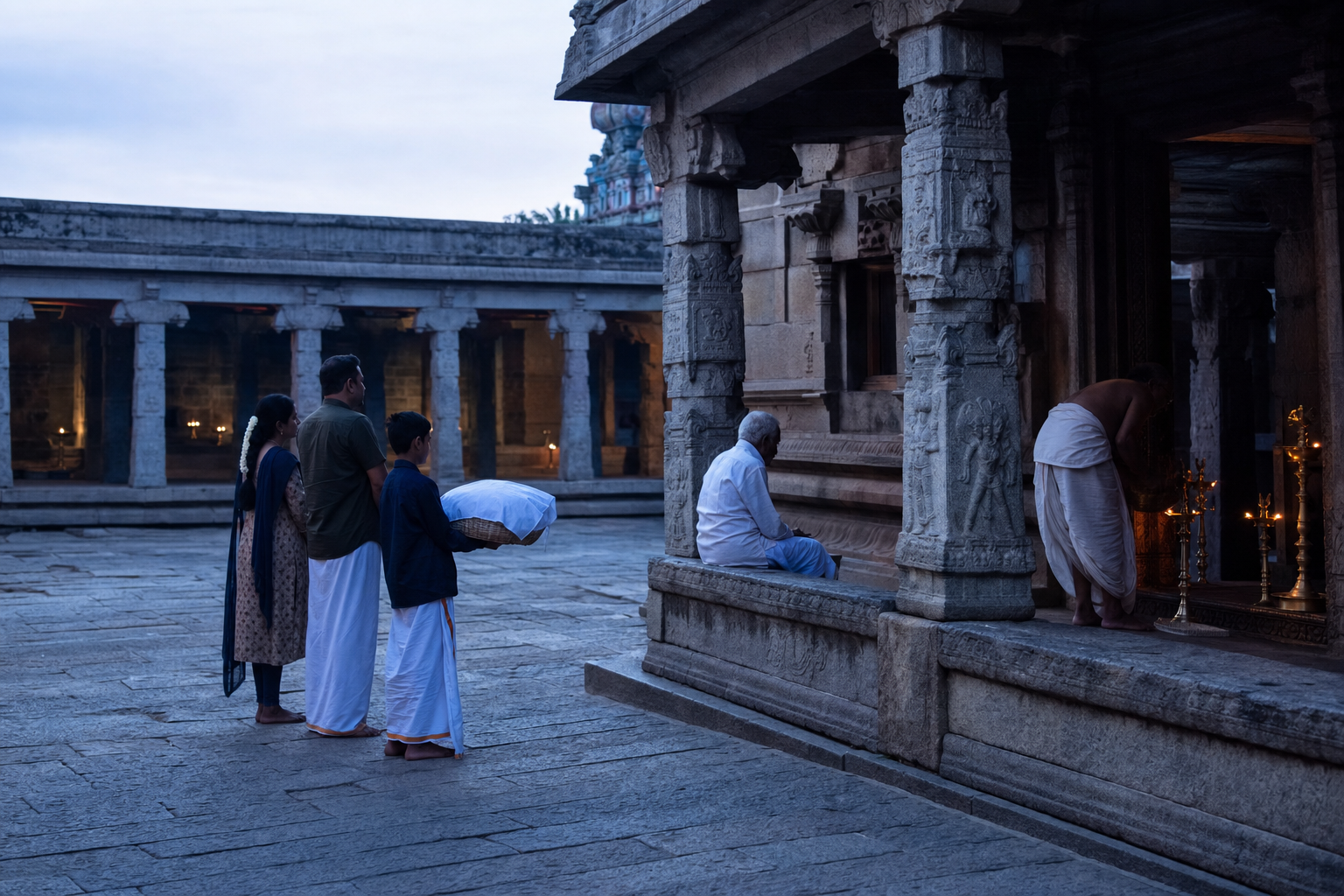
The principal planning difficulty is the long interval between the first morning seva and the evening solar event. Your plan should account for worship, queues, midday heat, food or fasting, rest, and the needs of elders and children. Do not assume that arriving for one event automatically secures access to every other seva.
| Period | Expected observance | What you should decide |
|---|---|---|
| 5:00 AM onward | Suprabhata Seva, followed by Tomala Seva and Archana in the announced 2026 sequence | Choose this window if awakening the Lord and beginning the vrata in the temple are your priorities. |
| 7:00 AM to 8:30 AM | Morning puja and public darshan were customarily expected during this period | This is the more practical morning window if you are not attending Suprabhata, but confirm the actual darshan arrangement locally. |
| Forenoon | Vishesha Alankarana, Sahasranama Archana, Naivedyam and Maha Mangala Harati may form part of the worship | Ask which rites are open to general darshan and which require a seva ticket. |
| Evening | Veda Parayanam, a possible brief utsava within the precincts, sunset Surya Puja and later Ekanta Seva | Separate the solar-viewing window from the temple’s closing worship; local instructions determine access and sequence. |
The table is a planning framework, not a promise that every rite will occur at the same time each year. Exact seva tickets, public darshan windows, utsava arrangements and day-of changes belong to the temple administration. Check on-site notices before committing your family to a particular queue.
You have two sensible ways to shape the day:
- For a full-day pilgrimage: reach the temple early enough for the morning worship you have confirmed, take a quiet midday rest as local access arrangements permit, and return your attention to the temple before the sunset observance. Plan hydration and shade rather than waiting until the heat becomes tiring.
- For a single-window visit: choose the morning if Matsya Jayanti puja is the central purpose. Choose the evening if the Surya Puja is essential to your visit, while accepting that sunlight cannot be guaranteed. In either case, leave enough flexibility for queues and local instructions.
Nagalapuram is accessible by road from Tirupati and from the Chennai side, with local transport and basic amenities available. Basic amenities should not be mistaken for a complete plan. Arrange drinking water, midday rest and whatever elders or children require before joining a long queue. If you are fasting, decide in advance how you will maintain safe hydration and when you will conclude the vrata.
Follow the temple’s posted dress requirements rather than relying on assumptions from another kshetra. Keep the queue orderly, observe silence near the garbhagriha, carry as little plastic as possible, and dispose of offerings only where instructed. These are not secondary courtesies. They are part of worship in a place where many people must seek darshan together.
How to receive Surya Puja without mistaking the calendar
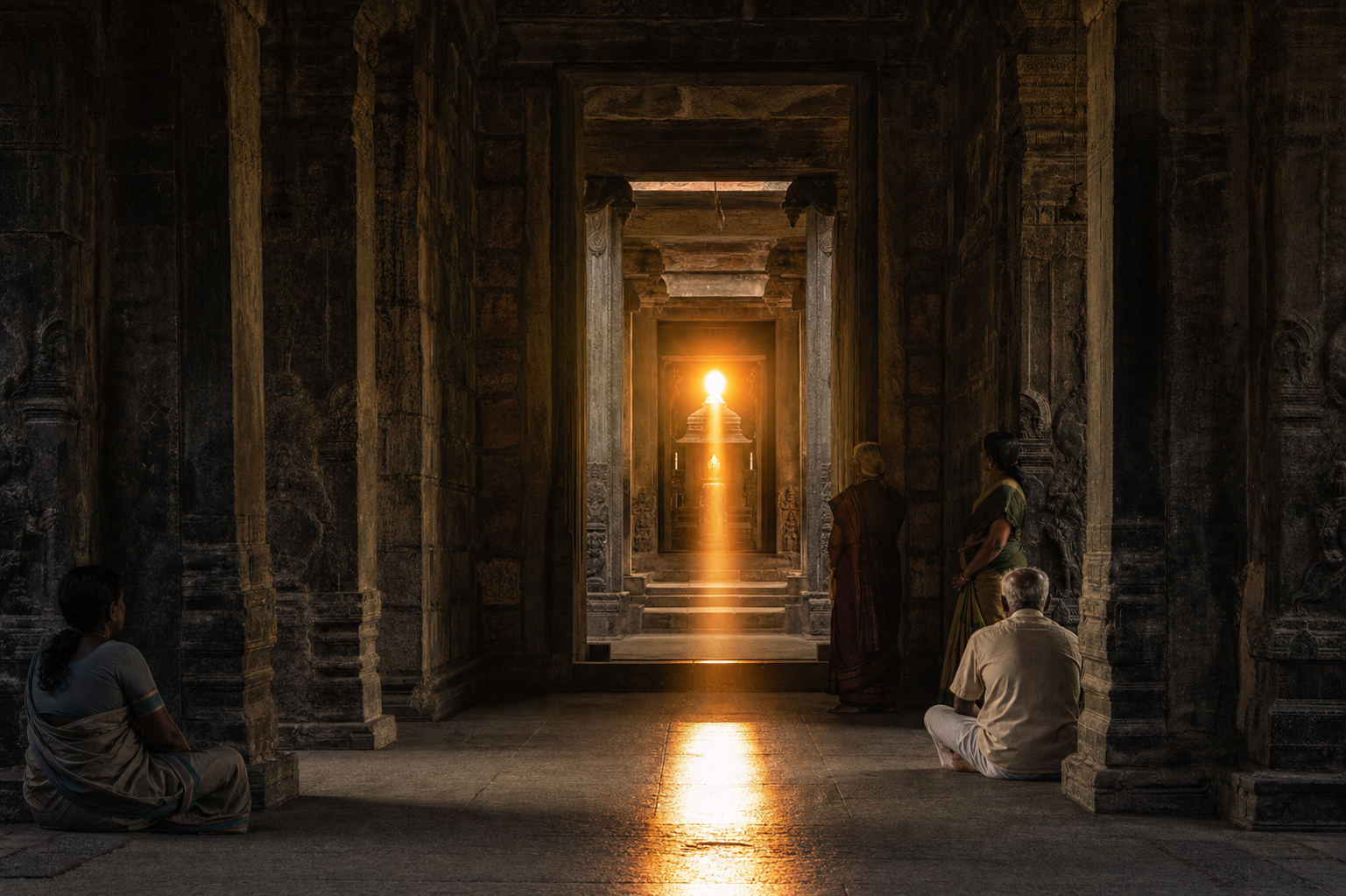
The popular phrase equinox sun miracle can create the wrong expectation. The sun does not switch on at one guaranteed festival minute. Around the March equinox, a shaft of setting sunlight enters through the temple’s aligned gateways and corridor axes and reaches the sanctum. The phenomenon is traditionally described as unfolding over three successive evenings, with the light touching the Lord’s feet, then the chest or navel, and then the forehead.
That progression should not be assigned to fixed dates unless the temple announces them for the year of your visit. The visible window can move slightly to either side of the astronomical equinox because atmospheric refraction, the local horizon and the temple’s longitudinal position affect the ray path. Clouds can hide the beam even when the geometry is otherwise favorable.
This distinction matters because the ritual calendar and the solar alignment answer different kinds of time. Matsya Jayanti follows the Hindu calendar in Chaitra, while the temple’s illumination follows the apparent motion of the sun and the built axis of the complex. Their proximity in 2026 created a particularly vivid conjunction, but one should not be used as a mechanical guarantee of the other.
When the beam appears, watch more than the final patch of gold on the murti. Notice the distance it has crossed through constructed space. The effect depends on a sequence of aligned openings, so the corridor is as important to the event as the last illuminated surface. This is what makes Nagalapuram a lesson in cultural astronomy: celestial observation has been translated into architecture and then returned to the devotee as ritual experience.
Keep photography secondary to darshan and obey whatever instructions temple staff give. A screen can record brightness while missing the movement from outer gateway to inner sanctum. If clouds intervene, do not treat the pilgrimage as a failed transaction. The vrata, archana, Veda Parayanam and your sankalpa remain complete forms of participation; sunlight is grace, not a ticketed performance owed to the visitor.
Give the Matsya vrata a form you can actually keep
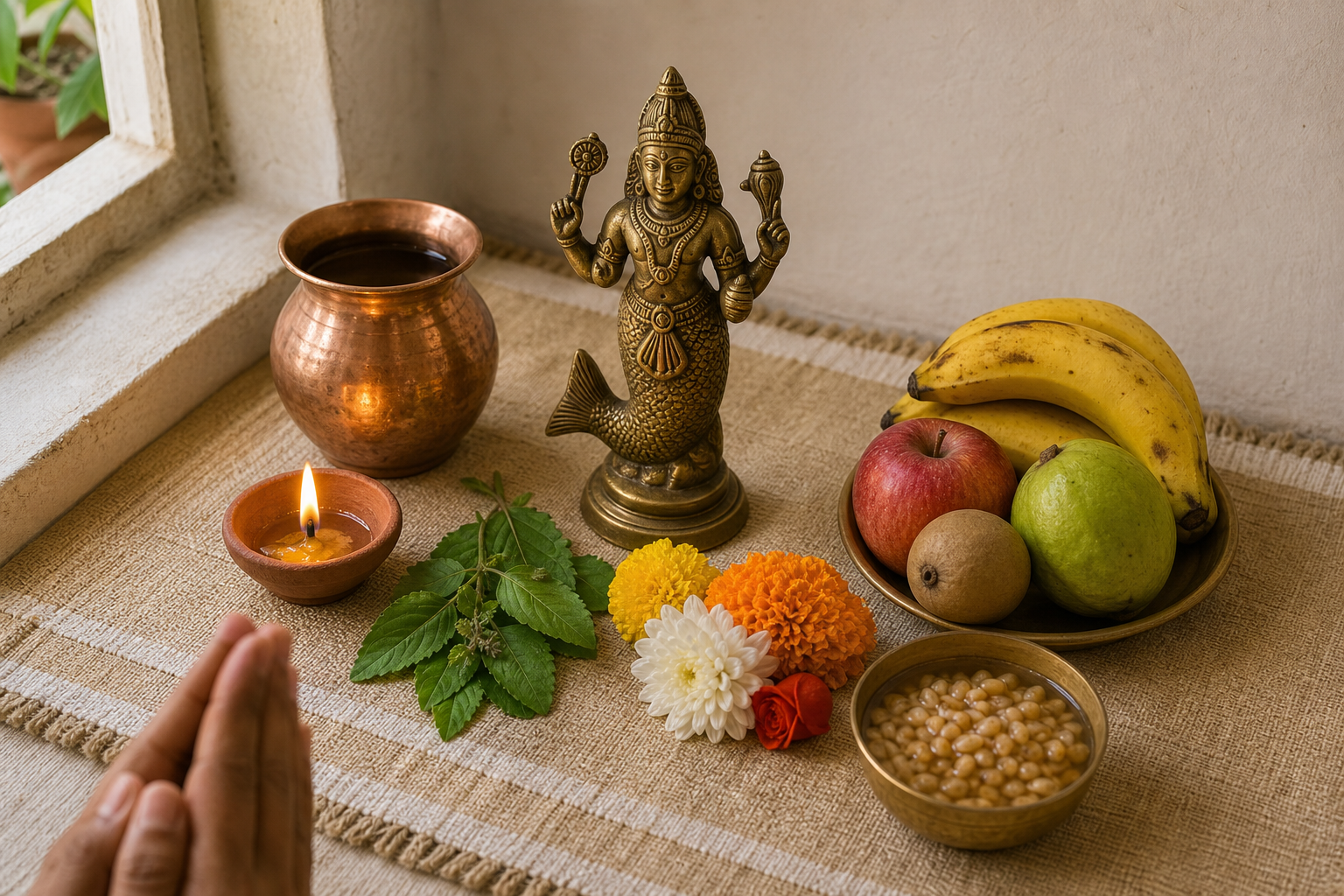
A useful vrata joins inward restraint to something that is preserved in the world. Matsya safeguards life, wisdom and order amid water. Your observance should therefore contain more than the hope of seeing a rare beam of sunlight.
- Make a precise sankalpa. Name one body of knowledge, living relationship, ethical commitment or water-related responsibility you will protect.
- Establish a simple practice. Chant Om Namo Narayanaya, recite Vishnu Sahasranama, or read Bhagavata Purana 8.24. A practice you can complete attentively is better than a large count performed anxiously.
- Offer through the temple’s actual व्यवस्था. Tulasi and Archana suit Vaishnava worship. Seek Abhishekam or Snapana Tirumanjanam darshan only if the temple offers it and follow the day’s instructions rather than constructing a private ritual in a shared space.
- Choose restraint you can safely sustain. Upavasa may be part of the observance, but satvika ahara is a sound form of restraint for anyone who cannot safely keep a strict fast. Shraddha is not measured by ignoring genuine physical limits.
- Preserve something tangible. Support anna-dana, lake rejuvenation, water conservation or another responsible community effort. At the temple itself, reduce disposable plastic and leave no offering waste behind.
Matsya Jayanti is a Hindu observance with a distinctly Vaishnava center, and that identity need not be blurred to recognize wider Dharmic resonances. A pair of golden fish appears among the Buddhist Ashtamangala as a sign of fearlessness and freedom from the ocean of samsara. Jain dharma extends ahimsa to aquatic jivas. Sikh practice joins seva with reverence for sarovars as places of purification and collective service. These traditions do not teach an identical theology of Matsya. Their meeting point is more practical: spiritual freedom does not excuse neglect of living beings or the waters that sustain them.
Before your visit, write one sentence completing this thought: Because Vedanarayana preserved life and knowledge, I will preserve ____. Then confirm the temple’s current timings, choose your morning or evening priority, and carry that sentence through the queue, the darshan and the journey home. That is how Nagalapuram becomes more than a place where sunlight entered a sanctum; it becomes the place where you accepted a duty.