
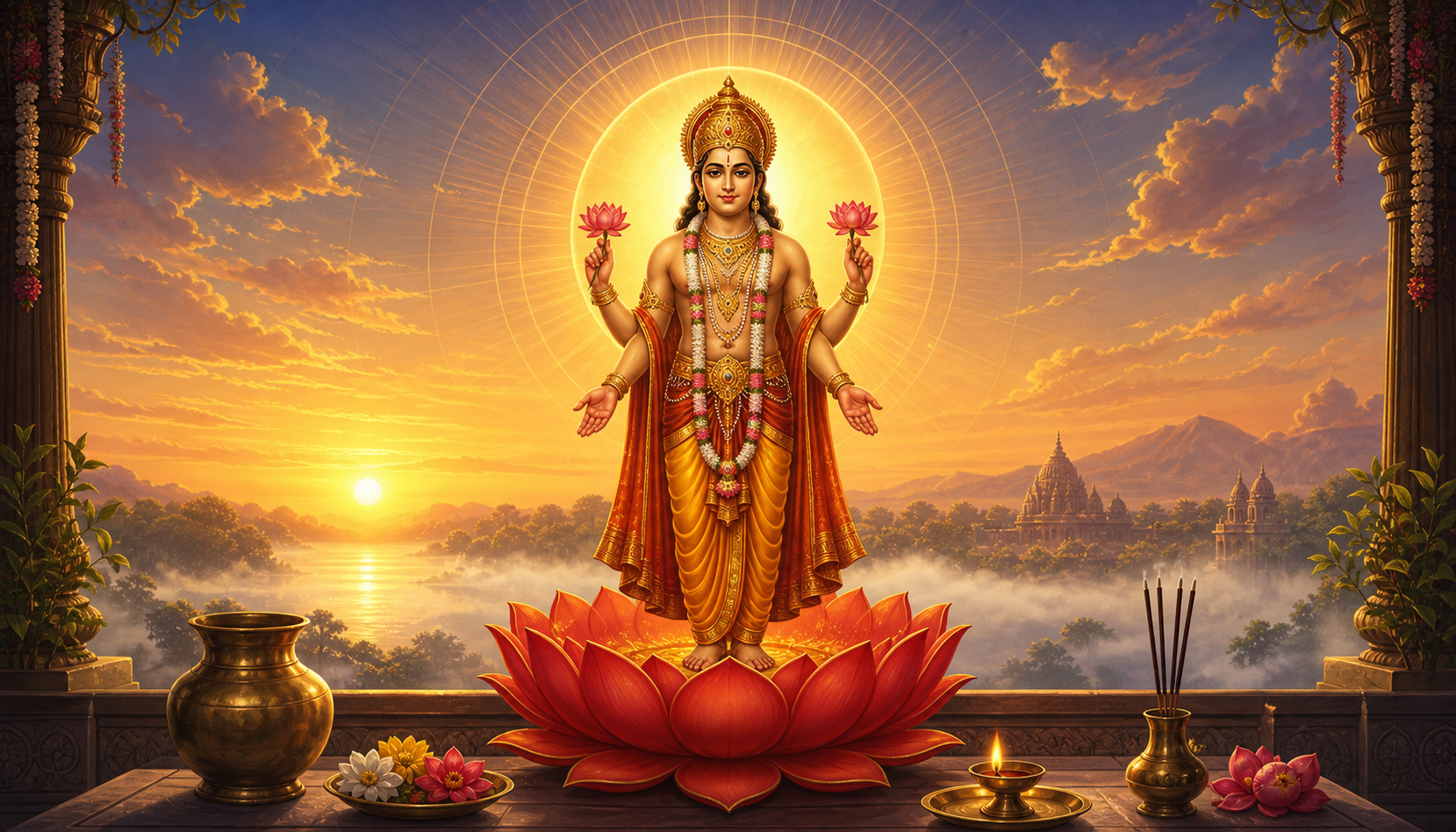
You may have encountered Dhata in a list of the Dwadasha Adityas and wondered what to do next. Is Dhata simply another name for Surya, a distinct deity requiring a separate murti, or a solar form you can approach through an ordinary household puja? For most householders, the practical answer is straightforward: you can honour Dhata through a modest sunrise practice centred on steadiness, right intention, and repetition.
The key is to understand the worship and the iconography together. Dhata represents the power that establishes and sustains order. That makes this Aditya especially meaningful when you are trying to stabilize your health, livelihood, family life, or inner composure without separating those aims from dharma.
Know whom you are invoking as Dhata
The name Dhata comes from the Sanskrit root dha, meaning to place, support, or establish. Dhata can therefore be understood as the Establisher or Sustainer: the divine function that gives form, continuity, and stability to life. This meaning connects Dhata with the maintenance of cosmic order and the measured rhythms that sustain the world.
As one of the twelve Adityas, Dhata belongs to the solar family born of Aditi and Kashyapa. The Adityas are not twelve unrelated gods competing with Surya. They are complementary manifestations of solar divinity, each making a particular aspect of its life-giving and order-preserving power easier to contemplate. Dhata directs your attention to establishment: firm vitality, settled resolve, continuity in righteous work, and harmony within the household.
The names and arrangements of the twelve are not identical in every Puranic and regional enumeration. The Vishnu Purana, Matsya Purana, and Bhagavata Purana belong to the textual world in which the Adityas are presented, but regional paddhatis may arrange their worship differently. A difference between two lists does not make your family practice defective. If your kulachara or parampara gives a particular sequence, use that sequence consistently.
Three distinctions prevent the most common misunderstandings:
- Dhata and Surya: Dhata is a specialized solar manifestation, not a rival to Surya. An offering made to Surya at dawn can provide the solar setting for invoking Dhata.
- Dhata and Brahma: Dhata can also function as a title for the creator because establishing and creating overlap conceptually. When the name appears among the Dwadasha Adityas, however, it refers specifically to the solar Dhata. Context decides which meaning is intended.
- Dhata and Jyotisha: Dhata is not an additional graha. Worship belongs within the wider reverence offered to Surya and the Adityas rather than to a separate planetary category.
This identity should shape your sankalpa. Dhata worship is not a request for an instant windfall or a ritual guarantee against illness. It is a discipline for bringing your aims, habits, and decisions into a more stable relationship with dharma.
Build a sunrise practice you can actually sustain
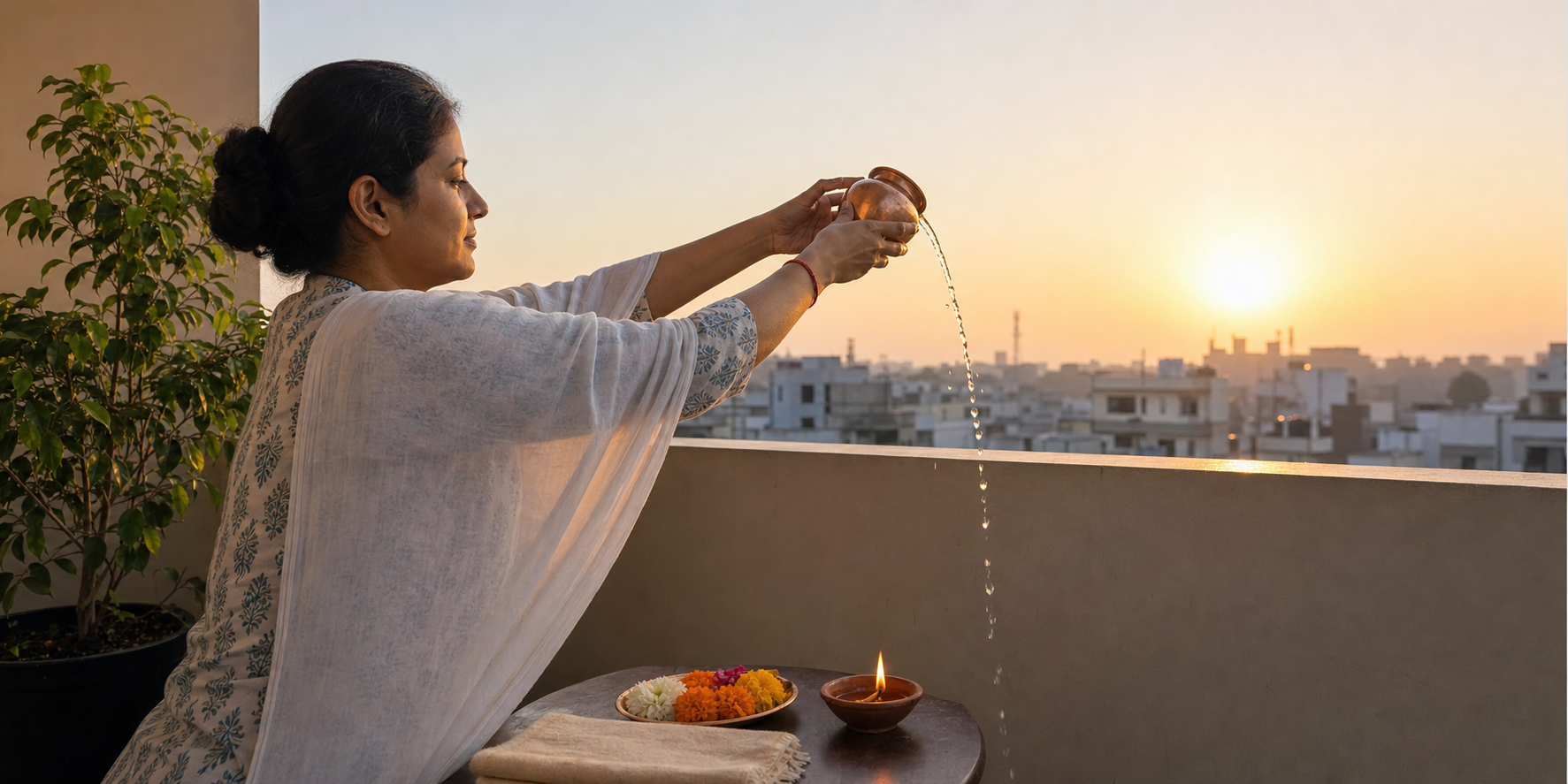
Sunrise is the natural time for Dhata worship because it joins the invocation to the sun’s visible ascent. Sunday, or Ravivara, is widely favoured for Aditya worship, but an elaborate Sunday puja should not prevent you from keeping a simpler regular practice. In this sadhana, steadiness expresses Dhata’s meaning more clearly than occasional intensity.
A practical household sequence is:
- Prepare simply. Complete your ordinary purification, choose a calm place, and gather water for arghya. If available, set out a small ghee lamp, a red or yellow flower, and a simple naivedya such as fruit or jaggery.
- Face east at sunrise. Let the direction orient your attention toward the rising sun. This does not require staring directly at the solar disc; keep the practice physically safe.
- State one clear sankalpa. Name the area in which you seek establishment: personal well-being, family harmony, disciplined work, or a righteous livelihood. Keep the intention short enough to remember.
- Offer arghya to Surya. The water offering acknowledges the common solar source of the Adityas before your attention turns to Dhata’s particular function.
- Light the lamp and make the simple offerings. Offer the flower and naivedya with attention. If Ganapati invocation normally begins puja in your family, retain that order.
- Recite the name-mantra. Use OM SRI DHATA DEVAYA NAMAHA. A customary practice is 108 repetitions counted on a rudraksha or crystal mala.
- Close by connecting worship to conduct. Offer pranam, then identify one action through which you will honour the sankalpa that day: keeping a commitment, addressing a neglected duty, earning honestly, or speaking with greater restraint.
The parts serve different purposes. Arghya places Dhata within solar worship. The mantra focuses the mind on the establishing power. The sankalpa prevents the ritual from becoming an unfocused catalogue of desires. The final action keeps devotion from ending when you leave the altar.
The count of 108 is a respected household pattern, not a reason to rush through the name. If you undertake that count, leave enough time to complete it attentively. When an elaborate arrangement makes regular worship impossible, simplify the number of physical offerings before sacrificing care, presence, or continuity. Follow any mantra count given by your guru or family tradition.
If your sankalpa concerns an illness, use the puja as spiritual support while continuing appropriate medical care. Dhata worship can give devotional form to your hope and discipline, but it is not a substitute for diagnosis, treatment, or professional advice.
When a fuller Dwadasha Aditya vrata is appropriate
You can expand the practice after the basic rhythm is stable. The Dwadasha Aditya Vratam may be observed on Sundays, at a Sankranti, or as a twelve-month cycle honouring the Adityas in turn. Common elements include sunrise arghya, recitation of the Aditya names, partial fasting, charitable giving, and, for practitioners who already use it, the Aditya Hridayam.
Do not assume that every regional vrata follows one universal sequence. Ask which paddhati your temple, guru, or family observes before combining procedures gathered from different traditions. If fasting would threaten your health or conflict with medical guidance, retain the prayer, offering, japa, and charity while seeking qualified advice about the food restriction. The vrata should support dharma, not turn avoidable harm into a test of devotion.
Join Dhata and Lakshmi without turning puja into a transaction
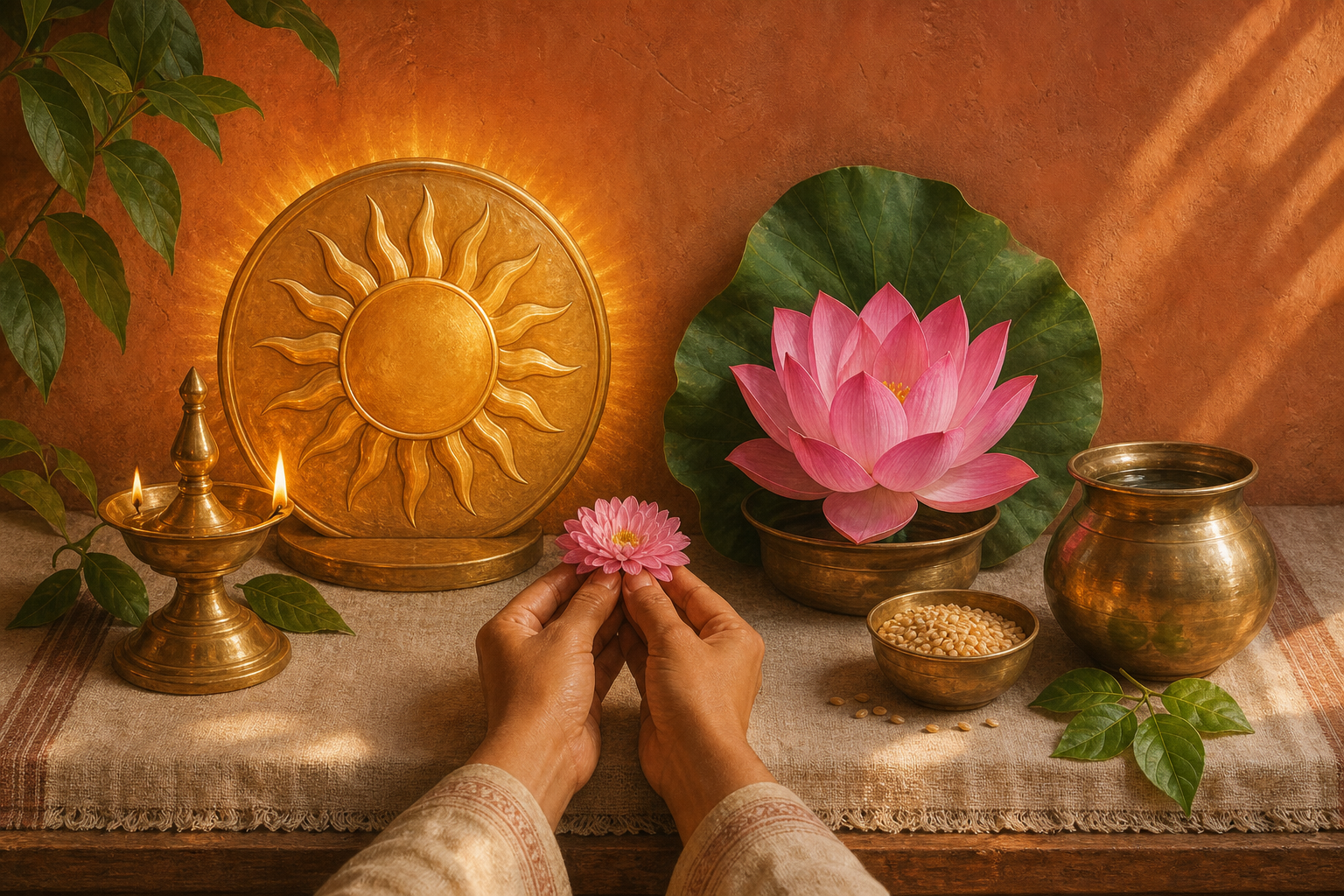
Householders often approach Dhata with Mata Lakshmi because the pairing holds two needs together. Lakshmi represents shri, the auspicious abundance that allows a household to flourish. Dhata’s establishing function emphasizes stability and shanti. The result is not a promise that ritual will produce money. It is a devotional framework in which prosperity should become steady, peaceful, and answerable to ethical purpose.
A simple joint sequence begins by lighting the lamp and invoking Ganapati for an auspicious beginning. Offer gandha, flowers, water, and naivedya to Dhata and Lakshmi. Recite the Dhata name-mantra, followed by the Lakshmi dhyana or name-mantra received in your own tradition. If you have not received a particular Lakshmi mantra, seek guidance from a knowledgeable priest or teacher instead of treating an unfamiliar formula as interchangeable with your family practice.
The sankalpa is where this pairing becomes useful. Avoid asking merely for more wealth. State what prosperity is meant to sustain and the boundary within which it should be pursued. A householder might pray in plain language for a livelihood made steady through honest work, wise restraint, generosity, and family peace. This keeps artha connected to dharma instead of allowing accumulation to become the sole measure of success.
You can also test the sincerity of the sankalpa outside the puja. If you pray for household harmony, identify the conversation you have been postponing. If you pray for stable livelihood, identify the duty, expense, or work habit that requires order. If you pray for health, pair the prayer with the responsible care already available to you. The ritual establishes direction; your conduct must carry it forward.
Read Dhata’s iconography as clues, not as a costume
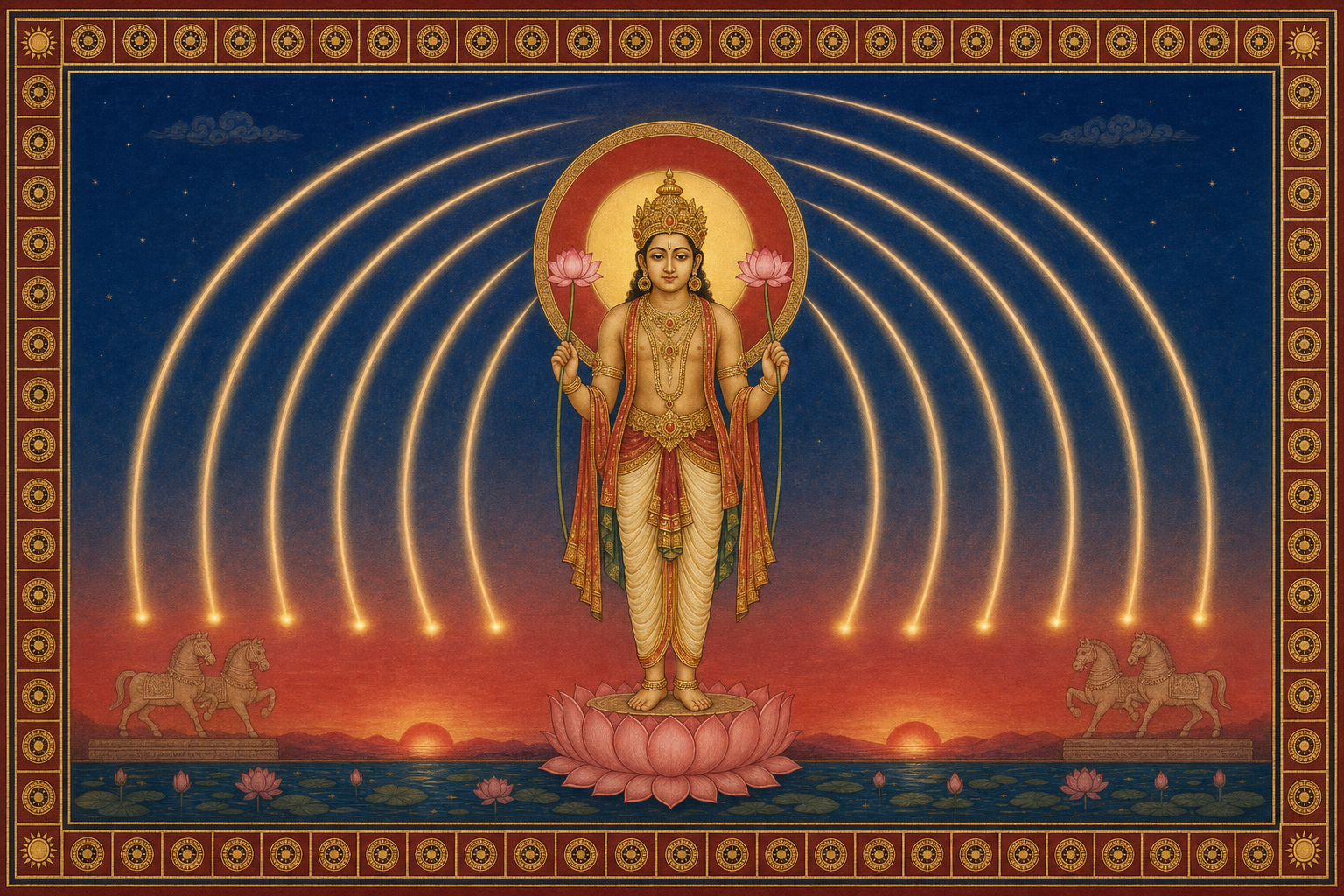
Dhata does not always appear with a single exclusive emblem that settles the identification at a glance. Much of the visual vocabulary is shared with Surya and the other Adityas. You should therefore read an image through several clues and then confirm it through its ritual or temple context.
| Visual clue | What it communicates | What it cannot prove alone |
|---|---|---|
| Radiant or golden appearance | Solar luminosity, beneficence, and an ordered presence | The feature is shared across solar deities and does not uniquely identify Dhata |
| Standing or seated on a lotus | Serenity and auspicious order | The lotus appears in the iconography of many Hindu deities |
| Two or four arms, sometimes holding lotuses | A common form used for Dhata as a beneficent Aditya | The number of arms may vary, and neither number is exclusive to Dhata |
| Abhaya and varada gestures | Assurance and the granting of blessings | These mudras are widely shared and must be read with other clues |
| A chariot with seven horses | The spectrum of solar light and the rhythms of time | It establishes a Surya or Aditya setting more readily than a unique Dhata identity |
Use context to move from possibility to identification. First, determine whether the figure belongs to a set of twelve Adityas. Second, look for a label, inscription, prescribed dhyana, or recited name associated with that position. Third, ask how the temple or household tradition identifies the form. A seven-horse chariot may tell you that you are in a solar setting, but only the surrounding context tells you that the particular manifestation is Dhata.
This method also resolves the apparent overlap with Brahma. If Dhata is being used as a creator’s title, the surrounding theology and imagery may point toward Brahma’s creative function. If the figure stands within a solar cycle, an Aditya set, or an invocation naming the sons of Aditi, the solar identity is decisive. The word remains the same while its role changes with context.
Do not reject a regional image merely because it lacks one feature in the table. Golden radiance, lotuses, two or four arms, blessing gestures, and the seven-horse chariot form a visual grammar rather than an inflexible checklist. Local consecration, naming, and worship carry more identifying weight than an isolated detail.
Key takeaways for starting with confidence
- If you have no separate Dhata murti, begin within Surya worship: face east at sunrise, offer arghya, and invoke Dhata by name.
- If you must choose between a complex occasional ritual and a simple repeatable one, choose the practice you can perform steadily and attentively.
- If two Dwadasha Aditya lists or ritual sequences differ, follow your established parampara, kulachara, or temple paddhati instead of inventing a hybrid.
- If your intention concerns prosperity, connect it to honest livelihood, peace, generosity, and responsibility; joint worship with Lakshmi can make that relationship explicit.
- If you are identifying an image, treat lotuses, mudras, golden radiance, and seven horses as supporting evidence. The image’s name and ritual context are stronger evidence.
- If your intention concerns health or another high-stakes worldly need, let worship support responsible action rather than replace qualified care.
At your next suitable sunrise, start with water, a lamp if available, the Dhata mantra, and one honest sentence of intent. Repeat that foundation until it becomes part of your rhythm. Add a fuller vrata or joint Lakshmi puja only when you can preserve the same clarity, steadiness, and fidelity to your tradition.