
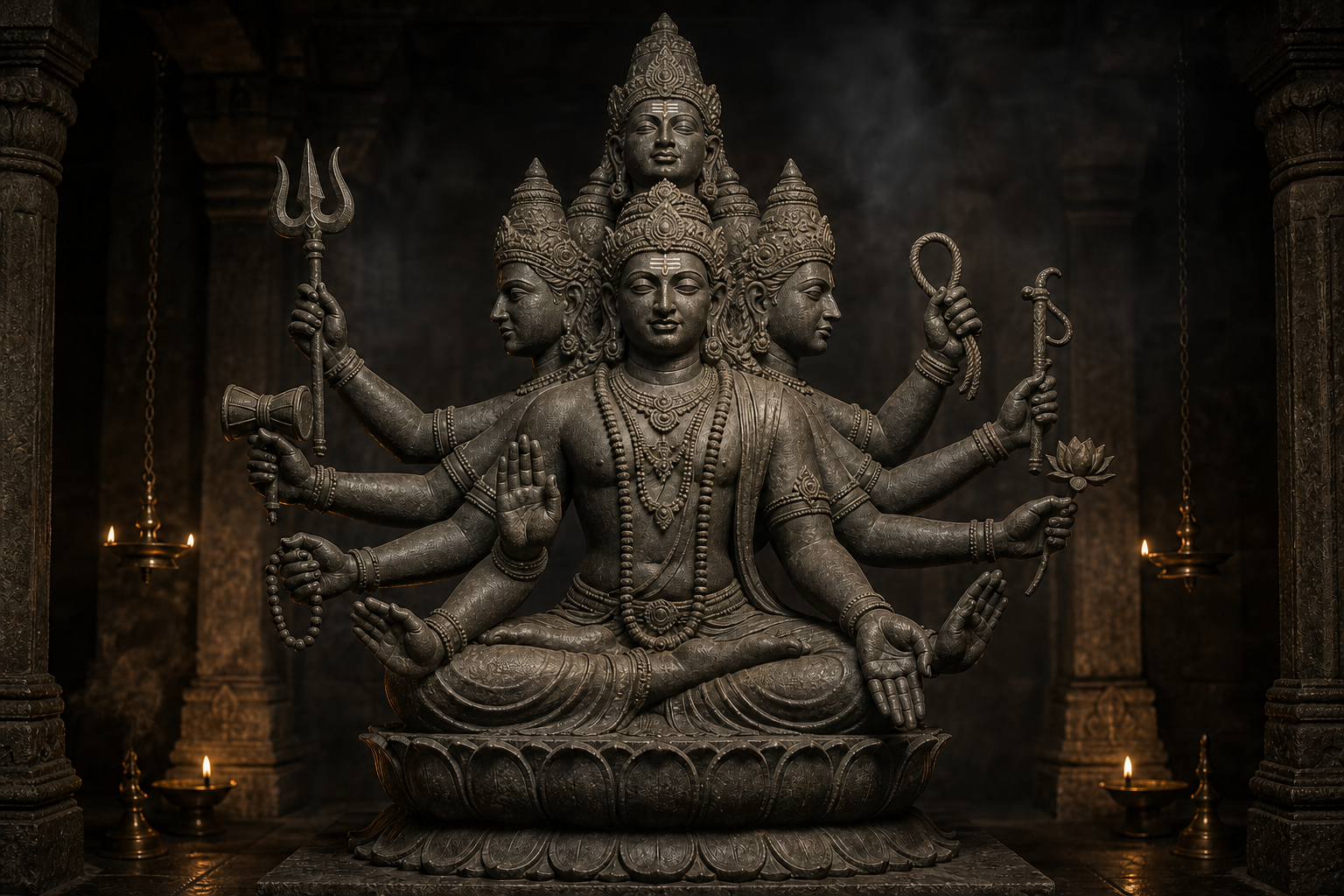
You are standing before a Shaiva image whose faces turn in several directions and whose many hands hold objects you cannot immediately name. Is this Panchamukha Sadashiva, and what are you actually meant to see? Begin with the icon’s geometry, not its ornament.
The five-faced, ten-armed form is a compact statement of Shaiva theology. The faces map divine action across the directions; the hands express capacities ranging from restraint to liberation; the supporting signs confirm how sovereignty, transformation, compassion, and grace belong to one consciousness. Once you know the reading order, an image that first looks crowded becomes remarkably coherent.
Key takeaways
- Pancha Brahma does not mean five competing Shivas. Sadyojata, Vamadeva, Aghora, Tatpurusha, and Ishana are differentiated faces of one Sadashiva.
- A commonly transmitted orientation places Tatpurusha in the east, Aghora in the south, Vamadeva in the north, Sadyojata in the west, and Ishana above.
- The five faces articulate the five divine acts: creation, preservation, dissolution, concealment, and gracious revelation. Detailed correlations can vary by lineage.
- Ten arms do not produce one universal set of ten objects. Agamic and regional variants draw from a wider vocabulary of weapons, ritual objects, symbols, and mudras.
- Identify the form in three passes: establish its type and directions, inventory the faces and hands, and then use the crown, ornaments, inscriptions, and surrounding deities to confirm your reading.
First identify the form and its physical orientation
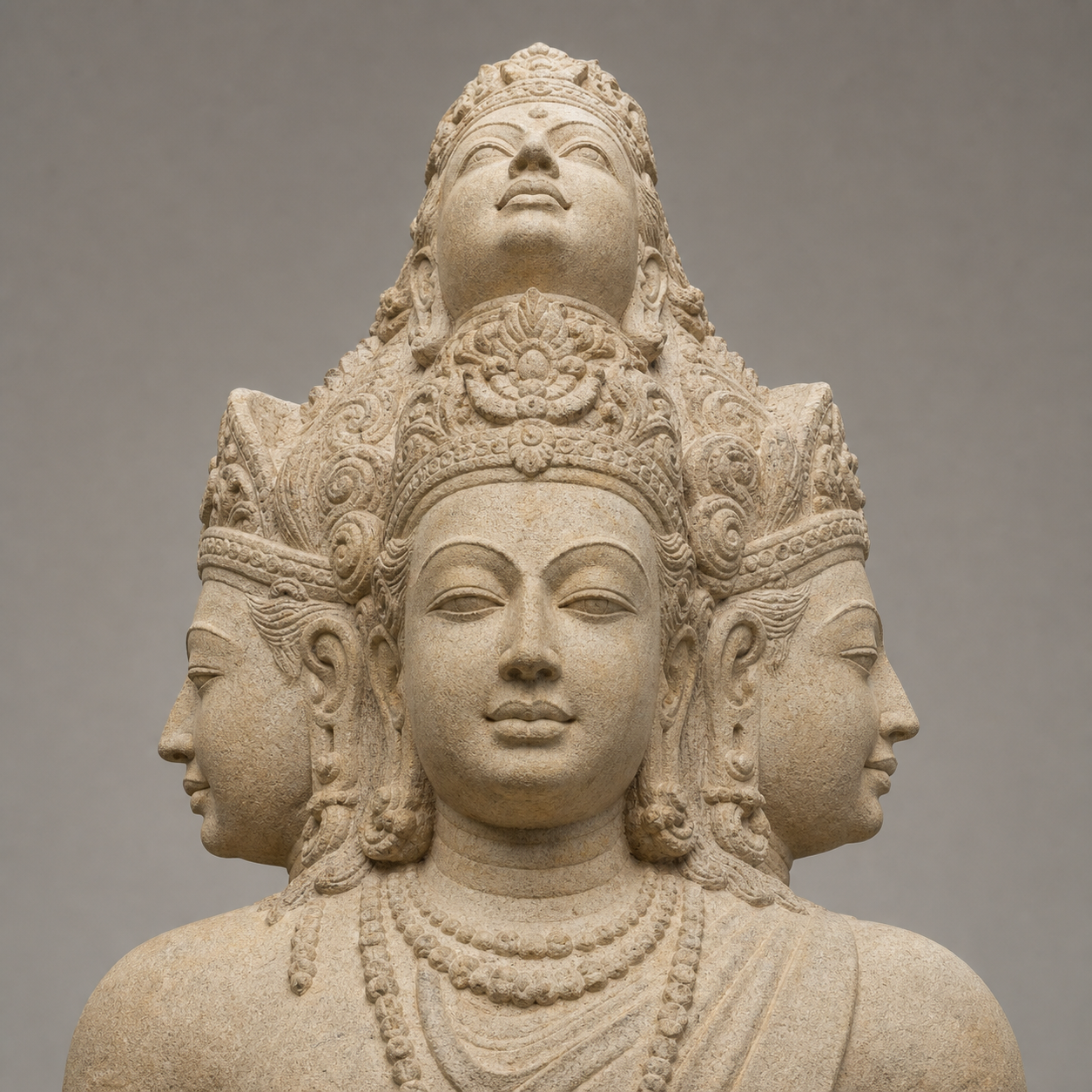
Sadashiva means the ever-auspicious: sada, “ever,” joined to Shiva, “auspicious” or “beneficent.” In Shaiva Siddhanta, the name points beyond a merely powerful divine personality. Sadashiva is the sovereign, awakened consciousness within which manifestation, experience, withdrawal, and liberation occur.
That doctrinal claim explains the multiplication of faces and arms. The image is not suggesting that the divine has been divided into separate beings. It makes an indivisible presence visible in several directions and through several functions. Five faces allow the icon to address the horizons and the zenith. Multiple arms allow simultaneous capacities to appear in a single body.
You will usually encounter this idea in one of two broad formats:
- In a full-bodied or sakala form, Sadashiva appears as an anthropomorphic figure with multiple faces and a prescribed number of arms. A ten-armed form is especially comprehensive, but two-, four-, and eight-armed variants also occur.
- In a mukhalinga, one or more faces emerge from the cylindrical body of the linga. This format holds the iconic face and the linga’s axial, unbounded symbolism together rather than treating them as opposites.
Do not identify the image by counting visible faces alone. A frontal photograph can hide faces on the sides, back, or top. A mukhalinga may also be designed with fewer than five manifested faces. If a label calls an image Panchamukha while you can see only four lateral faces, look for an upward representation of Ishana or for evidence that the zenith face is conceptually present. Do not add a missing fifth face by assumption to every multi-faced linga.
Physical orientation matters more than the viewer’s left and right. “East” means the icon’s eastward direction, not the left side of a photograph or the direction from which you happened to enter. Use the shrine plan, temple orientation, signage, an inscription, or informed local guidance to establish the cardinal points. Without that step, you can correctly name every face yet attach each name to the wrong direction.
The fifth direction is just as important as the four horizontal ones. Ishana turns upward, making the vertical axis part of the teaching. The icon does not merely occupy space; it gathers the surrounding field and directs attention beyond the horizontal plane. Walk around the image when access and temple custom permit. A single front view suppresses the spatial argument the sculpture was built to make.
The five faces map one consciousness through five acts
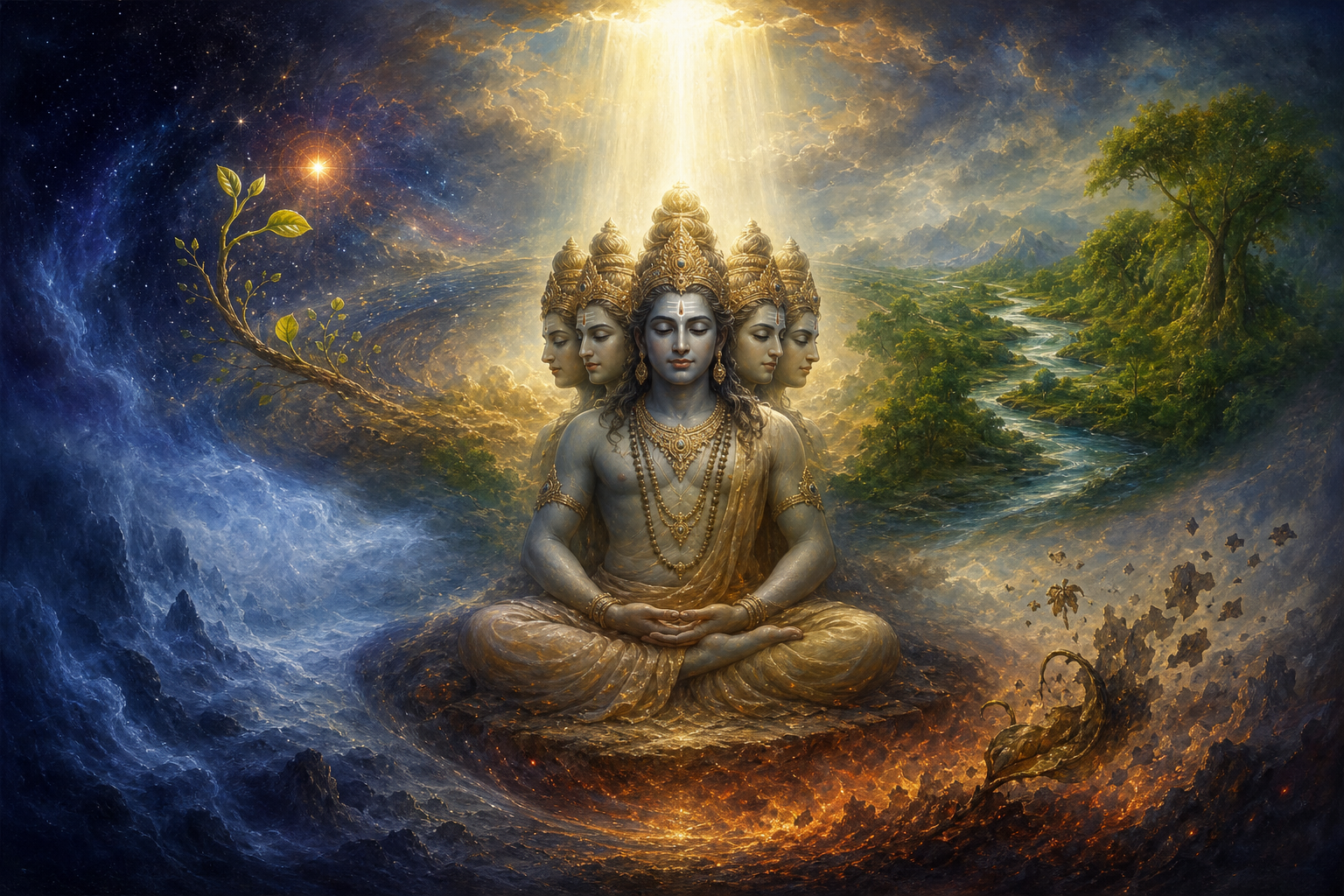
The following table gives a practical working map. It reflects a commonly transmitted arrangement, not a rule that erases every textual, regional, or historical variation. When exact attribution matters, compare the sculpture with the Agamic convention used by its lineage and place.
| Face | Common orientation | Function or quality | A question that helps you read it |
|---|---|---|---|
| Tatpurusha | East | Contemplative inwardness and concealment or veiling | What is hidden when awareness identifies only with appearances? |
| Aghora | South | Dissolution and transformative severity | What must be released or transformed rather than preserved? |
| Vamadeva | North | Preservation, restoration, and sustaining poise | What protects continuity without turning it into attachment? |
| Sadyojata | West | Creation and immediate emergence | What is being brought into form now? |
| Ishana | Upward | Transcendence, gracious revelation, and liberating insight | What becomes clear through grace rather than control? |
These faces correspond to the panchakritya, the five ceaseless divine acts: creation, preservation, dissolution, concealment, and revelation through grace. They should not be imagined only as five distant stages in the life of the universe. The icon places them together because manifestation is continuously arising, being sustained, changing, becoming obscured, and becoming intelligible.
This simultaneity corrects a common misreading of Shiva. Aghora’s power of dissolution is not an alien or evil force opposed to a benevolent deity. It belongs to the same auspicious reality as Sadyojata’s creation and Vamadeva’s preservation. Creation without dissolution would leave no room for renewal. Preservation without grace would become mere continuation. Concealment explains bounded experience, while revelation opens that experience toward liberation.
Tatpurusha is therefore more than a calm front face, and Aghora is more than an angry one. Facial mood can help, but style is not a dependable substitute for orientation and context. A sculptor may express Aghora’s transformative force without an exaggerated grimace, while a weathered or idealized image may make distinctions of expression difficult to see. Direction and the icon’s complete program carry more weight than a modern expectation about how a fierce or gentle face ought to look.
The upward Ishana face completes the theology. Grace is not simply another event alongside creation and destruction. It discloses what the other faces have always belonged to: one unbounded consciousness. In Shaiva Siddhanta’s more technical language, Sadashiva marks a refined level at which iccha, will; jnana, knowledge; and kriya, action, are harmonized in anugraha, grace. The image turns that ontological claim into something you can encounter bodily.
This is why Pancha Brahma must not be translated mentally as a committee of five gods. Brahma here names fivefold divine manifestation, not five independent sovereigns. Each face has a real distinction and function, but none has an existence outside Sadashiva. Diversity is visible without breaking unity.
If you approach the icon through another Dharmic tradition, directional analogies can be illuminating but should remain analogies. The Buddhist schema of five Tathagatas, the Jain chaumukha shrine facing several directions, and Sikh contemplation of the boundaryless, formless Ek Onkar can each help a viewer notice how Indic traditions speak of reality exceeding a single viewpoint. Their doctrines are not interchangeable. Use the resemblance to open careful inquiry, not to flatten distinct paths into one formula.
The ten arms form a vocabulary, not a fixed checklist
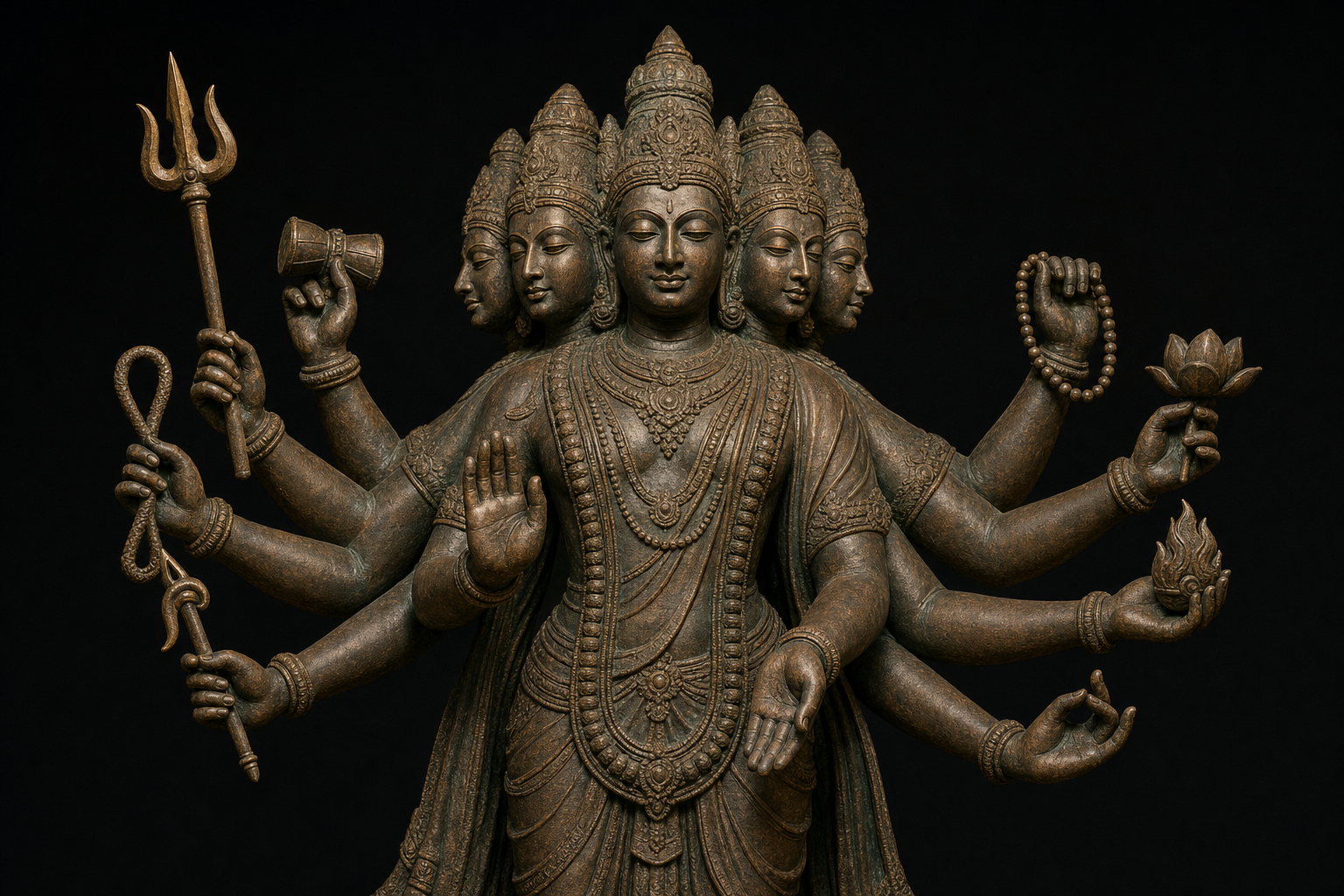
Once you have mapped the faces, turn to the hands. The main trap is expecting every ten-armed Sadashiva to carry the same ten attributes in the same positions. Agamic prescriptions, local lineages, materials, and workshop conventions produce variants. The larger vocabulary includes more possibilities than any one set of ten hands can display.
Begin with gestures because they can change the emotional force of the entire image. Abhaya mudra offers fearlessness and refuge, commonly through an open hand presented to the devotee. Varada mudra signifies giving, blessing, or benefaction. These hands prevent the weapons and fierce implements from being read as displays of violence for its own sake. Sovereignty and compassion appear together.
Then group the held objects by the work they perform in the icon’s visual language:
- The damaru, or drum, evokes rhythm and the pulse through which manifestation unfolds. The trishula, or trident, declares divine sovereignty and concentrated power.
- The parashu, or axe, and khatvanga, a club-staff, express the cutting or breaking of bondage. Their severity is directed toward obstruction, not separated from the icon’s liberating purpose.
- The pasha, or noose, and ankusha, or goad, form a complementary pair of restraint and guidance. One binds or draws near; the other directs what is unruly.
- Agni, the flame, makes transformation and purification visible. The mriga, or antelope, represents the quick, leaping mind brought within mastery.
- The akshamala, or rosary, signifies contemplative continuity and disciplined remembrance. The kapala, or skull cup, confronts the limits of embodied form and the consciousness that is not confined by them.
Do not try to force all these objects into one sculpture. An icon with ten arms may devote two prominent hands to abhaya and varada, leaving eight for implements. Another lineage may choose a different combination or distribute the objects differently. Record what the image actually shows before consulting a generalized diagram.
If an attribute is damaged, worn, obscured by adornment, or difficult to see, note the hand’s position and the surviving shape rather than naming an object prematurely. A loop may suggest a pasha, but certainty depends on more than a curved fragment. A small animal is easier to recognize as the mriga when the hand, posture, and other Shaiva features support that reading. Honest uncertainty is better iconography than a complete but invented inventory.
Use the supporting signs as confirmation
The head, hair, torso, and ornaments provide a second layer of evidence. The third eye signals interior vision. A crescent moon in the matted locks brings cosmic time into the image, while Ganga introduces sacred flow. The rising jata-mukuta, or crown of matted hair, acts like a vertical axis connecting the embodied figure with the upward direction of Ishana.
Serpents may appear as ornaments or as the yajñopavita, the sacred thread. They indicate potent energies that have been mastered and sanctified rather than denied. Rudraksha beads reinforce the ascetic and contemplative identity. Vibhuti, sacred ash, directs attention toward impermanence, detachment, and the clarity that remains when transient forms are no longer mistaken for the whole.
These signs confirm a Shaiva setting, but most do not prove Panchamukha Sadashiva by themselves. Other Shiva forms can bear a third eye, crescent, matted hair, serpents, or a trident. Identification becomes dependable when direction, face count, arm program, gestures, supporting signs, and shrine context converge.
Pay attention to the balance of the whole figure as well. The icon often holds alertness and repose at once. Fierce implements are counterweighted by blessing gestures; the leaping mind is held; flame is carried without agitation. This composure is part of the doctrine. Infinite capacity proceeds from awareness that is not itself thrown into disorder by what it creates, sustains, or dissolves.
A site reading can become informed darshana
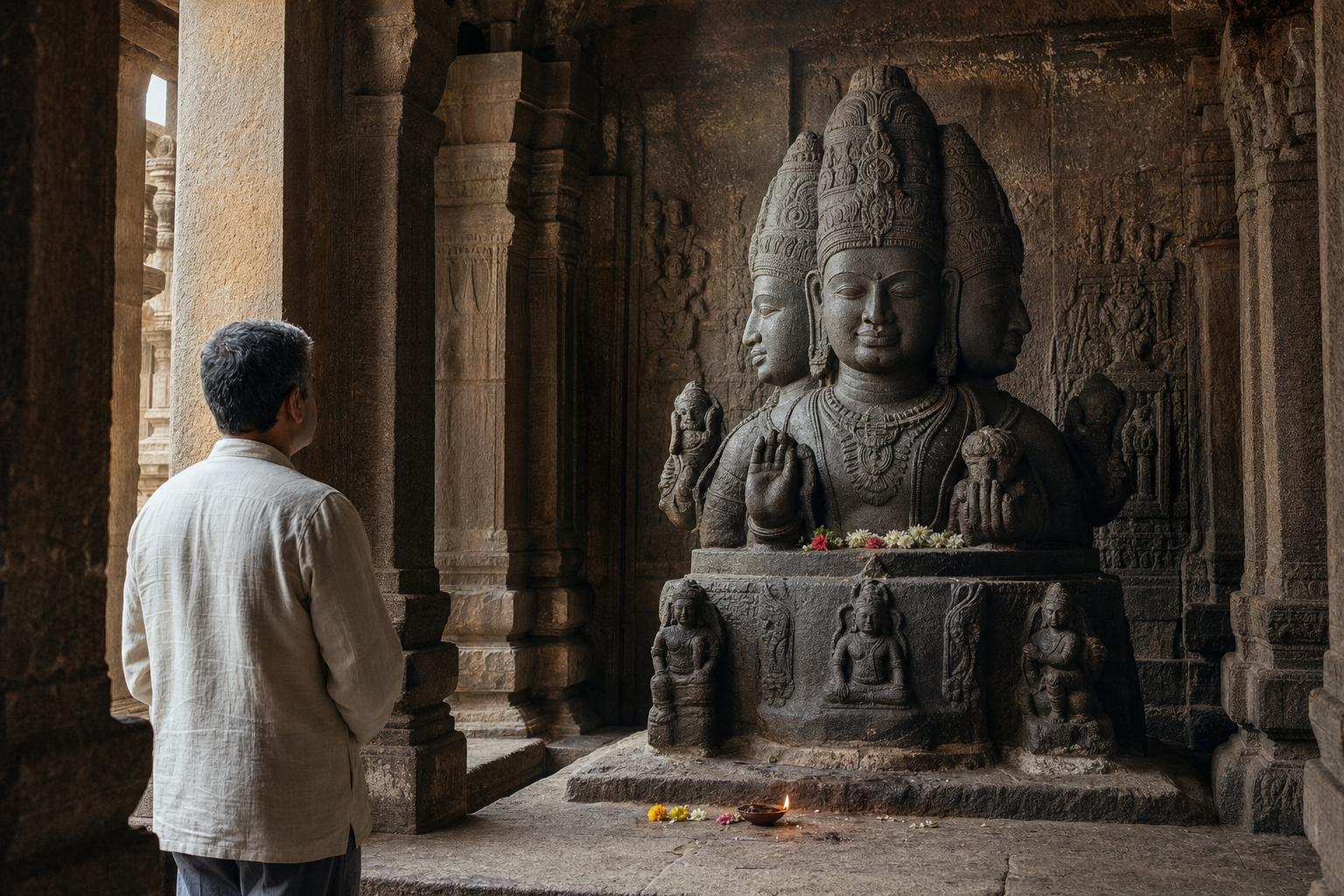
At a temple or museum, use a fixed sequence. It keeps a visually complex object from becoming a guessing game and separates direct observation from later interpretation.
- Identify the basic format. Decide whether you are looking at a full-bodied sakala image or faces emerging from a mukhalinga. Note the material and whether the object is complete enough for confident identification.
- Establish the directions. Determine physical east, south, north, west, and the upward axis. Do not substitute the orientation of a photograph.
- Map the faces. Record which faces are visible and where they turn. Apply the common Tatpurusha-Aghora-Vamadeva-Sadyojata-Ishana map only after orientation is secure.
- Inventory every hand. Work by quadrant so you do not count the same arm twice. Separate recognizable mudras from held objects, and mark uncertain or damaged attributes as uncertain.
- Record the supporting program. Look for the third eye, jata-mukuta, crescent, Ganga, serpents, rudraksha, vibhuti, and the relationship between fierce implements and blessing gestures.
- Test the identification against context. Read inscriptions when available and examine associated figures such as Nandi, Ganesha, Skanda, Shivaganas, and the Dikpalas. For a formal attribution, compare the complete program with the regional use of Agamic prescriptions such as the Kamikagama, Suprabhedagama, and Ajitagama.
A discrepancy is not automatically a sculptor’s mistake. It may preserve the choice of a particular lineage, patron, ritual community, or workshop. The correct response is to describe the variation precisely: which attribute replaces which, which face is emphasized, and how the altered program still relates to the five acts. A generic chart is a starting tool, not a verdict over the object in front of you.
Know what regional style changes
South and Southeast Asian traditions translate the same theological grammar into different visual languages. Chola bronzes tend toward rhythmic elegance. Hoysala stone carving often builds meaning through dense, intricate surface geometry. Orissan forms may emphasize muscularity and ornament. Khmer and Cham mukhalingas often give their emerging faces an idealized, carefully controlled modeling. Chalukya and Pallava examples add further regional solutions to the problem of making several directions present in one form.
These differences change what catches your eye first, but they need not change the icon’s core identity. Do not mistake a restrained face for doctrinal weakness or elaborate ornament for theological excess. Ask whether the essential relationships remain legible: multiplicity held within unity, directional presence, the five divine acts, and capacities governed by one composed awareness.
Let identification lead into contemplation
Once you have identified the icon, stop treating it only as a catalogue of symbols. If circumambulation is permitted, follow the temple’s practice and allow each direction to reorganize your attention. The following sequence is a study-and-contemplation aid, not a claim about a prescribed temple rite:
- With Tatpurusha, notice concealment. Ask which habit, fear, or assumption is narrowing what you can perceive.
- With Aghora, face transformation without confusing it with hostility. Ask what has completed its work and must be released.
- With Vamadeva, notice what genuinely sustains life, relationship, discipline, and memory. Distinguish preservation from clinging.
- With Sadyojata, attend to immediate creation. Ask what your present intention, speech, and action are bringing into form.
- With Ishana, turn attention upward without using transcendence as escape. Leave room for insight and grace that cannot be manufactured by force.
The hands can deepen the same exercise. The goad asks where direction is needed; the noose asks what must be restrained or drawn close; the antelope reveals the mind’s jumpiness; the rosary returns attention to continuity; the flame tests willingness to be transformed. Abhaya and varada keep the encounter grounded in refuge and gift.
Ritual brings this inner reading into outward action. Abhisheka bathes the form, alankara adorns it, and arcana approaches it through offering. These are not decorative additions to an otherwise complete sculpture. They allow body, attention, substance, sound, and devotion to participate in the same fivefold vision. When you join worship, follow the temple’s protocol rather than trying to inspect every attribute in the middle of a rite.
On your next encounter, make three passes: locate the directions, identify the functions, and then ask what each one demands of your attention. That is enough to move from seeing an unusual multi-faced figure to meeting Sadashiva as the single auspicious presence within creation, preservation, transformation, concealment, and grace.
References
