
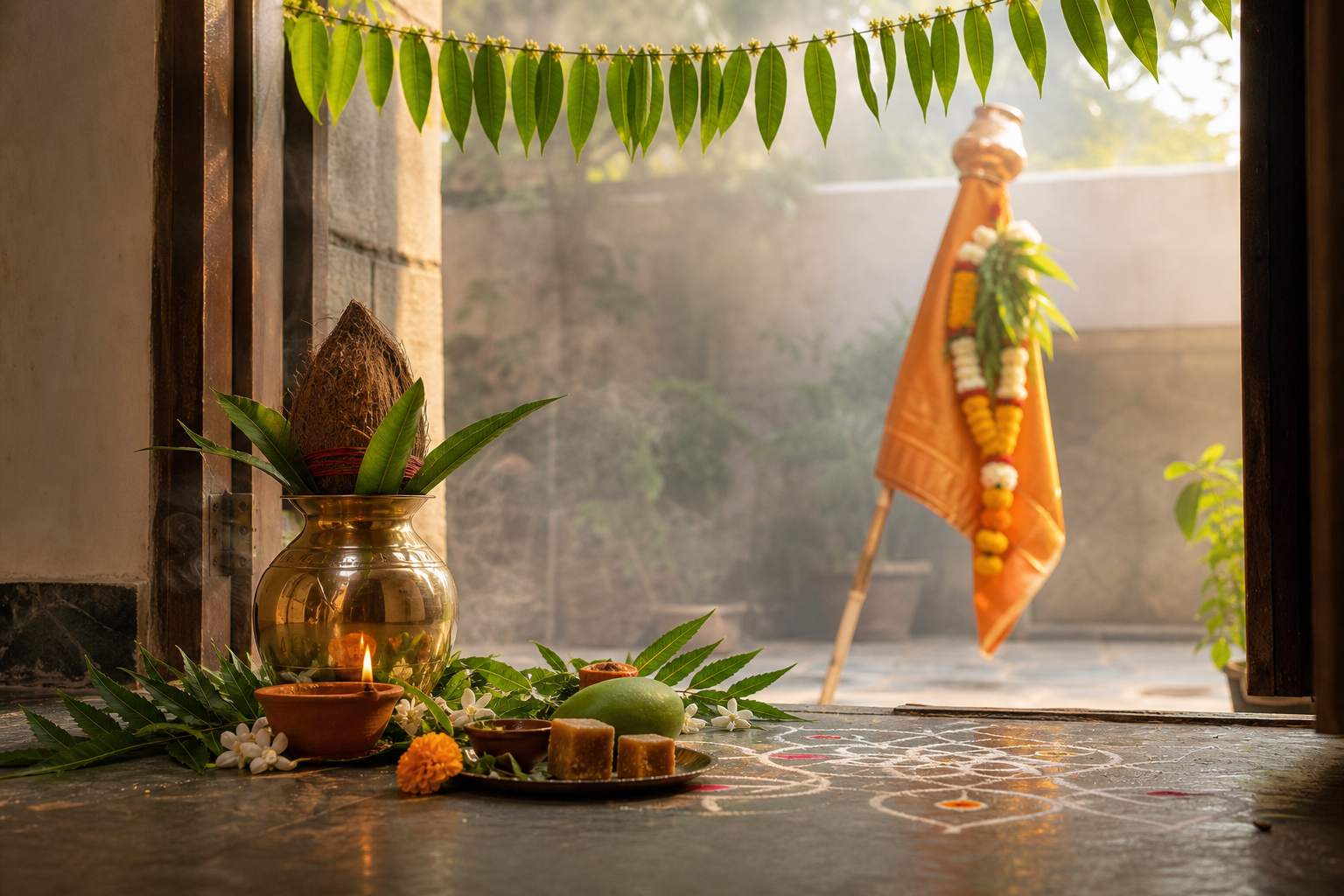
If you have heard that Parabhava means defeat, you may be wondering whether the Hindu year 2026-27 begins under an inauspicious cloud. A calendar name is not a verdict on your family. The useful questions are more immediate: when does the year begin, what should you do that morning, and what kind of sankalpa can survive beyond the festival?
In Telugu and Kannada Panchangam traditions, Ugadi falls on Thursday, 19 March 2026, beginning Parabhava Nama Samvatsara at the Chaitra Shukla Pratipada threshold. Maharashtra observes the same foundational tithi as Gudi Padwa. Because tithi at sunrise and regional calendar conventions matter, use a reliable Panchang calculated for your location before fixing the civil date or puja time.
Read Parabhava as a discipline, not a prediction
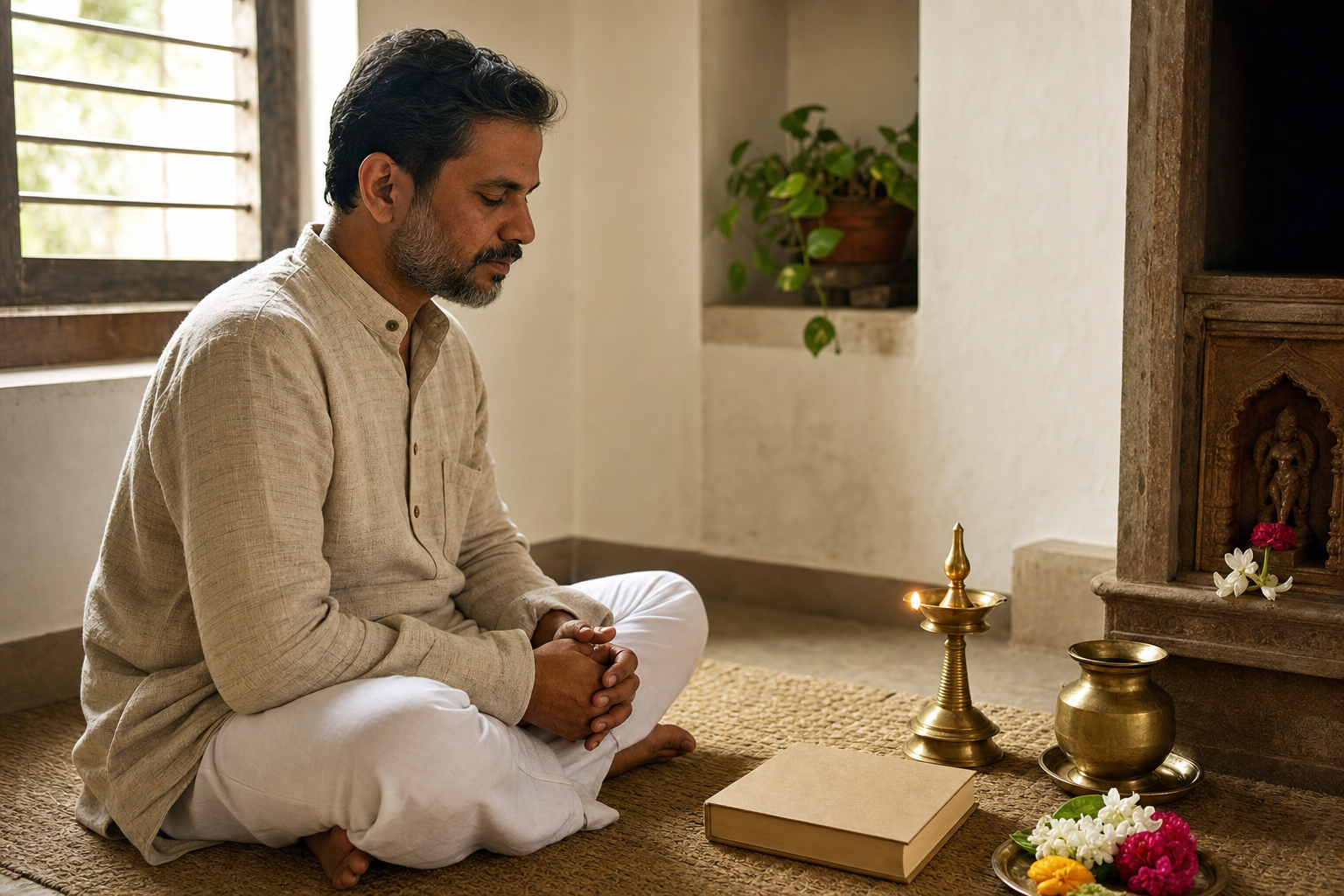
Parabhava is the 40th name in the sixty-year Samvatsara cycle. It follows Vishvavasu and precedes Plavanga. The cycle gives each year a remembered place within Bharatiya calendrical time; it does not make every person born, married, employed, or travelling during that year experience the same result.
The ordinary Sanskrit sense of parabhava includes defeat, decline, humiliation, or setback. That is a reason for sobriety, not fear. A constructive spiritual reading asks what deserves defeat within us: carelessness, pride, anger, greed, confusion, envy, or the habit of postponing Dharma. Another interpretive reading separates para and bhava to evoke a higher mode of becoming. You may use that reading devotionally, but you do not need to erase the word’s cautionary meaning. The caution is precisely what makes the year useful.
A named Samvatsara supplies a collective theme. It is not a personal horoscope. More detailed Jyotisha considers the local Varsha Pravesha, Mesha Sankranti ingress, Navanayaka indications, Aaya-Vyaya balance, planetary transits, and, for personal questions, the janma kundali and its dashas. Even annual conditions can vary by place. That is why the year name alone cannot establish a concrete forecast.
- If someone says Parabhava guarantees financial loss, illness, political defeat, or family trouble, treat the claim as an overreach.
- If a Panchang gives an annual prediction, check which locality and calculations it uses. A name-based generalization is not equivalent to a complete annual reading.
- If fear is used to sell an expensive remedy, pause. Regular japa, honest conduct, dana, restraint, and seva are not inferior because they are simple.
- If you want a personal Jyotisha assessment, ask for the reasoning behind it rather than accepting a frightening conclusion detached from your chart.
The most grounded sankalpa for Parabhava is therefore not, May nothing difficult happen. It is, May difficulty not make me abandon discernment, duty, or compassion.
A complete New Year observance can remain simple
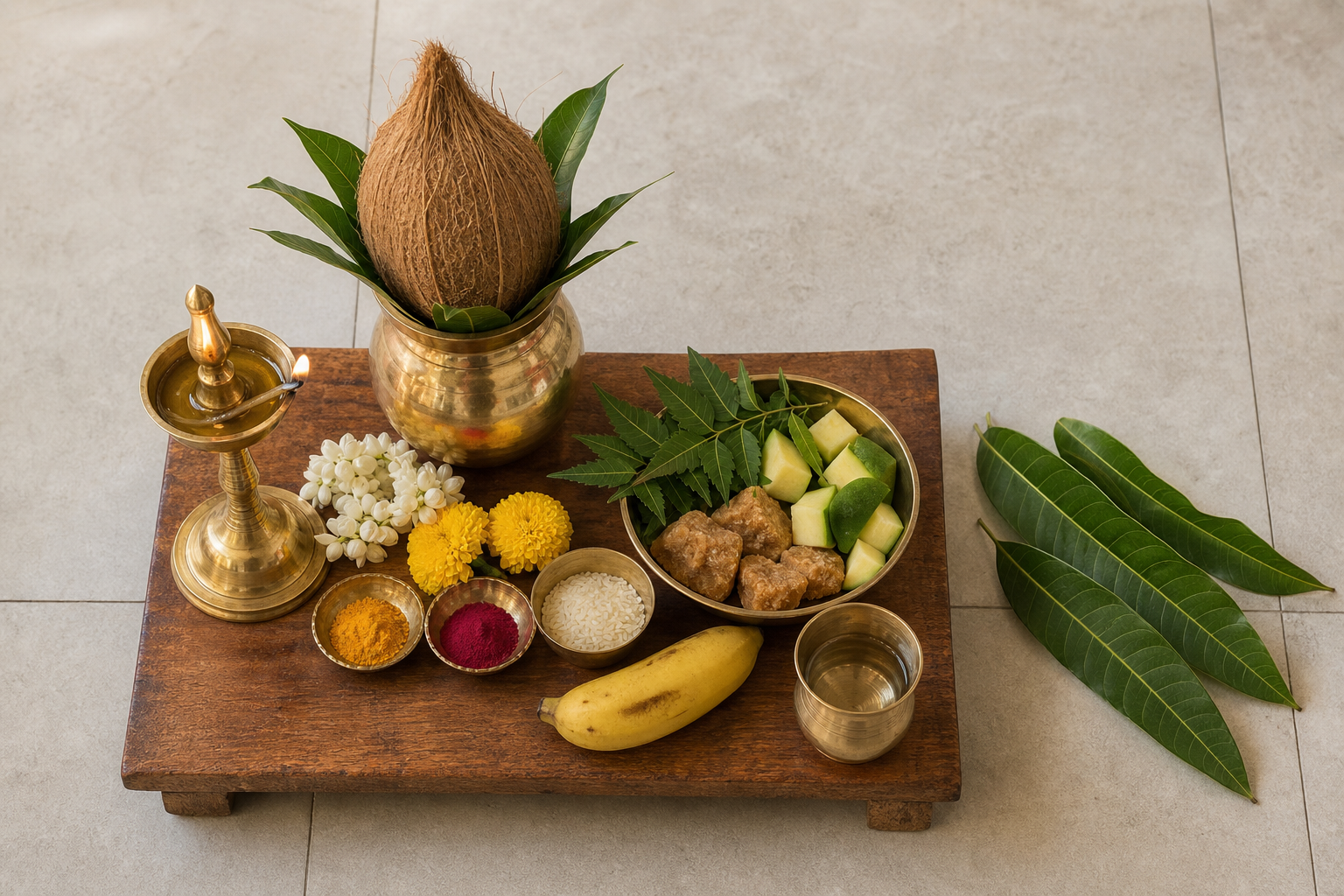
You do not need an elaborate event to welcome the year properly. The minimum is a clean space, a lamp, sincere worship, attention to the Panchang, respect for elders and teachers, and a vow you can actually keep. Preserve your inherited family method wherever you have one; use the sequence below as a practical framework, not as a replacement for sampradaya.
- Confirm the local observance. On the previous day, check when Chaitra Shukla Pratipada prevails at sunrise in your city. Note the recommended puja period from the same Panchang rather than mixing a date from one region with a muhurta calculated for another.
- Prepare the threshold. Clean the home and entrance, reduce visible clutter, draw rangoli or muggulu according to family custom, and install a natural toran if available. Gather the lamp, water, flowers, akshata, naivedya, and regional festival materials before the morning begins.
- Begin with bodily and mental shuddhi. Rise in time for an unhurried bath or abhyanga snana, wear clean clothes, and settle the household before lighting the deepa. The point is not theatrical perfection; it is to enter the year without avoidable haste.
- State the sankalpa. The phrase Parabhava-nama-samvatsare identifies the named year. Complete the intention in Sanskrit if that is your practice, or state it clearly in your own language. Name one spiritual discipline, one household responsibility, and one form of service you will sustain.
- Perform the regional act. Maharashtrian families may raise and worship the gudhi. Telugu families may prepare Ugadi pachadi, while Kannada families may observe the Bevu-Bella custom. Do not replace a living family form with a generic mixture of every regional practice.
- Worship simply and in order. Invoke the Kuladevata and Ishta Devata according to your tradition. Offer haldi-kumkum where customary, followed by akshata, flowers, naivedya, japa, and arati. Pay respects to parents, elders, teachers, and ancestors in the manner your family follows.
- Listen to the Panchang. Hear or read the tithi, vara, nakshatra, yoga, and karana for the day, followed by the annual overview. Record dates that affect your real practice, such as Navratri, Ekadashi, Amavasya, Purnima, Pradosha, Sankranti, or a family vrata.
- Close with shared food and a written commitment. Receive prasada, share the regional bittersweet preparation where appropriate, and write the three parts of your sankalpa on one page. Put the first monthly review in your calendar before the day ends.
Panchang shravan is more than hearing a generalized prediction. Panchanga means the five limbs of calendrical reckoning: tithi, or lunar day; vara, the weekday; nakshatra, the lunar mansion; yoga; and karana. Listening carefully teaches you how ritual time is calculated and why the civil date alone is not always sufficient. It is a compact exercise in civilizational literacy.
The mixed tastes of Ugadi pachadi, and the bitter-sweet pairing of Bevu-Bella, rehearse equanimity in an embodied way. Life will not supply only sweetness, and Dharma does not require pretending otherwise. Keep this as ritual symbolism rather than turning neem or any other ingredient into an unsupported medical claim. If an ingredient is unsuitable for someone, preserve the teaching without insisting that the person consume it.
Two physical details deserve attention. Keep a lit lamp away from cloth, children, and unattended areas. If you erect a gudhi, secure its pole and base before adding the kalash and decorations. Devotion is not diminished by ordinary safety.
Keep the regional form while understanding the shared grammar
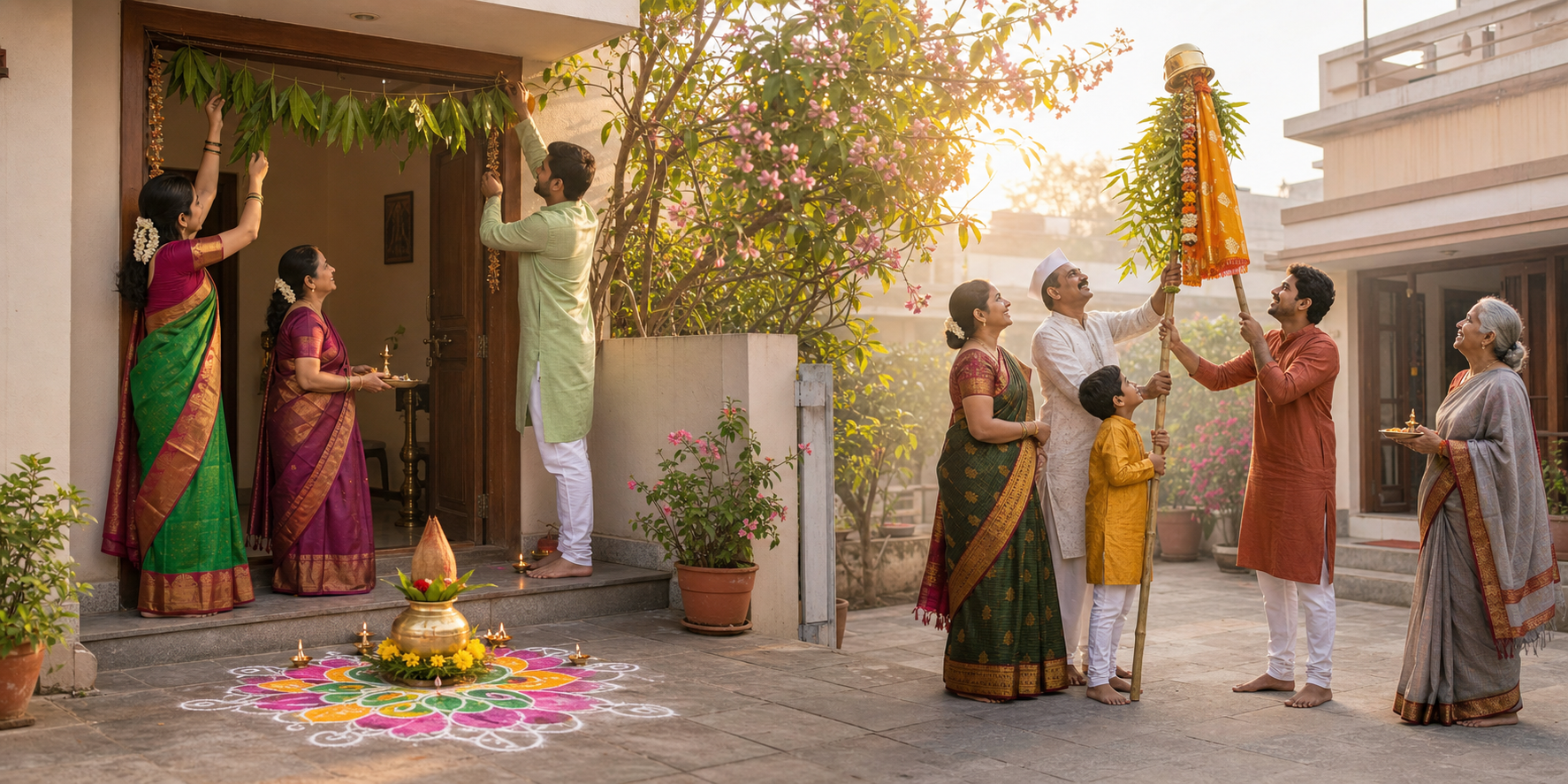
For Gudi Padwa, let the gudhi carry more than decoration
A traditional gudhi uses a bamboo or wooden pole, fine cloth often in saffron or green, an inverted copper or silver kalash, neem and mango leaves, flowers, and a sugar garland. It is commonly placed near the main entrance and worshipped after the household has been prepared. Reusable metal, natural-fibre cloth, and biodegradable decoration allow the same form to be maintained without leaving a trail of plastic waste.
The gudhi can be explained through several inherited meanings. It is remembered as Brahma-dhwaja, a banner of creation and wisdom; as a sign of Shri Rama’s victory and return; and, in Maharashtrian cultural memory, as a standard of sovereignty and renewal associated with the legacy of Chhatrapati Shivaji Maharaj. These meanings need not compete. Hindu symbols often sustain theological, epic, regional, and political memory at the same time.
If a child asks what the gudhi means, do not stop at, It is our custom. Choose one meaning, show how each object contributes to the whole, and then mention that other families may emphasize another meaning. That ten-minute conversation transmits more heritage than an expensive decoration left unexplained.
For Ugadi, preserve the taste, language, and Panchang tradition
Ugadi in Andhra Pradesh, Telangana, and Karnataka shares the Chaitra Shukla Pratipada threshold with Gudi Padwa, but it should not be treated as merely the same festival with a different name. Telugu Ugadi pachadi uses the language of six rasas to contemplate varied experience. Kannada Bevu-Bella places bitter and sweet together with similar ethical force. Prepare the form your family knows, call it by its proper regional name, and explain its meaning in that language if you can.
Navreh among Kashmiri Hindus resonates with the same lunisolar New Year period, while the Sindhi observance of Cheti Chand follows closely. These relationships reveal a shared calendrical civilization without requiring every community to perform identical rites. Chaitra Navratri also begins for many communities at this threshold, so the New Year sankalpa may naturally open into nine nights of Devi worship.
Buddhist, Jain, and Sikh communities maintain their own liturgical calendars and observances. Dharmic kinship is best expressed by respecting those distinctions while recognizing shared commitments to ahimsa, satya, self-restraint, compassion, remembrance, and seva. Unity becomes thinner, not stronger, when distinct traditions are flattened into one ceremony.
For a public or diaspora observance, plan the civic layer
A collective celebration can turn private worship into cultural confidence. Samuhik gudhi pujan in temples, neighbourhoods, and public squares also shows what must be planned beyond the puja itself: safe installation, clear explanations for first-time participants, roles for young people, and respectful coordination with the surrounding community.
- Assign one team to ritual materials and another to physical safety. The person leading mantras should not also be watching an unstable pole or managing traffic.
- Confirm any required civic permission for a procession or use of public space. Provide drinking water, first-aid access, and a clear walking route where crowds are expected.
- Give children and young adults meaningful roles: welcoming families, preparing labels for gudhi elements, reading one Panchang component, managing music, or documenting elders’ explanations.
- Use reusable kalashas, cloth buntings, and natural decoration. Decide before the event how flowers, food, and other offerings will be handled afterward.
- For families separated by distance, share the locally correct time for each household rather than assuming one city’s sunrise applies everywhere. A video call can connect the observance without erasing local Panchang differences.
A public festival succeeds when a first-time participant can understand what is happening without hereditary practitioners feeling that their customs have been diluted. A short printed sequence, accurate pronunciation support, and room for local variation usually serve both needs.
Make the New Year last beyond the morning
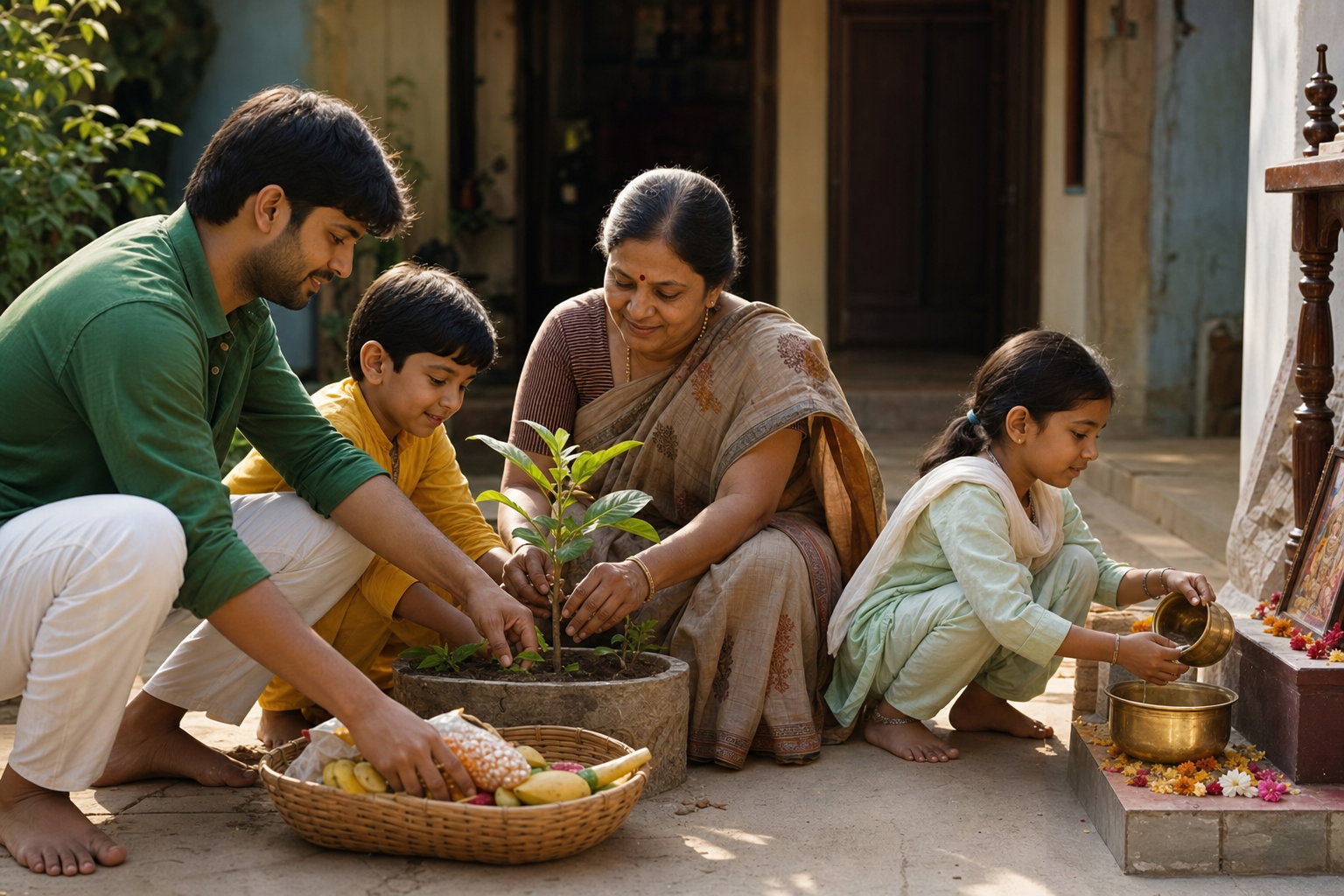
The festival will end by evening; the Samvatsara will not. Sankalpa usually fails because a noble noun such as discipline, service, or study never receives a place on the calendar. Build your year at four cadences and make each one small enough to repeat.
| Cadence | Practical commitment | What to review |
|---|---|---|
| Daily | A lamp, japa, scriptural reading, meditation, or one deliberate act of truthful and restrained speech | Whether the practice changes conduct, not merely whether it was counted |
| Weekly | One chosen upasana or vrata, joined to a related act of service or self-restraint | Whether it is sustainable without anxiety, display, or neglected duties |
| Monthly | An Amavasya, Purnima, Pradosha, Sankranti, or other family observance fixed in advance | Household harmony, missed commitments, and the next month’s calendar |
| Quarterly | A review of Aaya-Vyaya, dana, study, health routines, and the original New Year sankalpa | What should continue, be corrected, or be reduced |
Turn Aaya-Vyaya into a household discipline
Aaya-Vyaya can appear in annual Panchang readings as an income-expenditure indication. At home, its most useful expression is a real ledger. Write down expected income, non-negotiable obligations, planned reserve contributions, and a sustainable dana allocation. Review those figures quarterly. Do not use an auspicious-sounding prediction to justify debt or an ominous-sounding one to abandon necessary work.
Parabhava’s cautionary meaning makes three habits especially relevant: document commitments, distinguish a need from an impulse, and leave room for repairs or income variation. If your finances are complex or distressed, ritual observance cannot replace qualified financial or legal help.
The same boundary applies to muhurta. Auspicious timing can help you choose among equally workable dates. It should not make you delay urgent medical treatment, a safety repair, a legal deadline, or another time-sensitive duty. Dharma includes responding to the reality in front of you.
Test every remedy by the conduct it produces
The five practical pillars of mantra, vrata, dana, upasana, and seva offer a better yearly framework than collecting unrelated remedies. Each pillar has an observable test.
- Mantra: Does repetition make your speech steadier, more truthful, and less reactive?
- Vrata: Does the observance strengthen restraint without making you neglect health, dependants, or work?
- Dana: Is giving planned, ethical, and within your means rather than driven by fear or social display?
- Upasana: Does worship create attention and humility, or merely add ritual tasks?
- Seva: Does someone or something genuinely receive sustained care?
You do not need to perform a different Navagraha remedy every day. Choose one or two practices aligned with your Ishta Devata, family tradition, or considered Jyotisha counsel. A Sunday Surya arghya can be joined to punctuality and integrity. Wednesday study can be joined to careful records and educational support. Thursday worship can include gratitude to a teacher and anna-dana. A Saturday lamp can be joined to keeping promises and serving elders or people whose labour is easily overlooked. The ethical action prevents the ritual from becoming transactional.
The lunar month provides natural checkpoints. Amavasya may be used for ancestral remembrance and quiet reflection where customary. Purnima may hold satsang or Satyanarayana puja. Pradosha supports Shiva upasana, while Sankranti can become a recurring occasion for food sharing. A Buddhist member of the wider family may keep metta practice, a Jain may keep samayika or pratikraman, and a Sikh may emphasize simran, seva, or langar. Shared ethical purpose does not require fused liturgy.
Choose a service commitment that can be maintained after enthusiasm fades: educational mentoring, a book drive, care for a planted tree, support for a community kitchen, water stewardship, or regular help for an elder. One completed responsibility is a stronger parihara than several announced projects.
Key takeaways
- Parabhava Nama Samvatsara begins for Telugu and Kannada Panchangam traditions with Ugadi on Thursday, 19 March 2026; confirm the applicable date and muhurta with a Panchang calculated for your location.
- Parabhava is the 40th name in the sixty-year cycle and can mean defeat or setback, but the name is a theme for vigilance and self-correction, not a guaranteed personal outcome.
- A sufficient New Year observance includes shuddhi, a lamp, worship of the family or chosen deity, sankalpa, Panchang shravan, respect for elders, prasada, and the appropriate regional custom.
- Keep Gudi Padwa, Telugu Ugadi, Kannada Ugadi, Navreh, and neighbouring observances rooted in their own inherited forms. Civilizational unity does not require ritual uniformity.
- Carry the festival into the year through one daily practice, one weekly discipline, one monthly lunar checkpoint, a quarterly Aaya-Vyaya review, and one sustained form of seva.
- Reject fatalistic predictions and fear-driven expenditure. A valid remedy should deepen ethical conduct, steadiness, humility, and responsibility.
Before 19 March, obtain your local Panchang, ask an elder which regional details your family preserves, assemble only the materials you need, and write a one-page sankalpa. Put its first monthly and quarterly reviews on the calendar before you raise the gudhi or taste the Ugadi preparation.
Then let Parabhava name the defeat that is actually within your reach: the defeat of carelessness by attention, excess by restraint, fear by discernment, and isolation by seva.
References
- Hindu Janajagruti Samiti – Gudhi Padwa Unites Maharashtra: HJS Leads Collective Gudhi Pujan Welcoming the Hindu New Year
- HinduPad – Parabhava Nama Samvatsara 2026-2027: Time-Tested Remedies, Ugadi Rituals, and Aaya-Vyaya Insights
- HinduPad – Parabhava 2026-2027 Samvatsara: Hard Truths, Risk Signals, and Dharmic Remedies to Thrive
- HinduPad – Parabhava 2026-2027: Ugadi’s Transformative Year of Karmic Renewal, Resilience, and Dharmic Unity