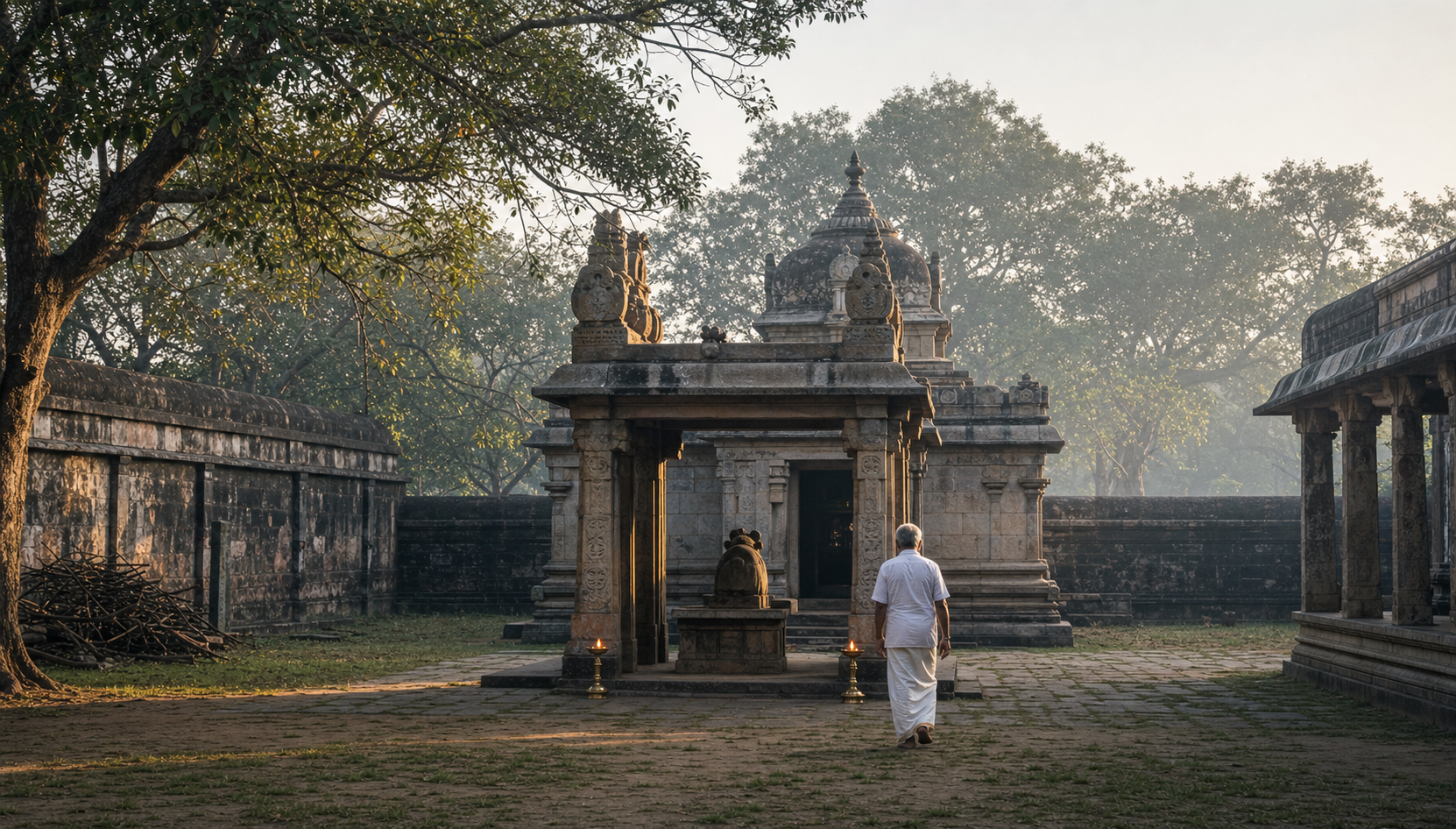
If you are planning darshana at Tiruloki, the main question is not how many temple features you can identify. It is how to approach a shrine where Shiva and Devi are worshipped as an inseparable sacred presence. That understanding gives your visit a clear shape: confirm the local puja schedule, enter without hurry, attend to Sundareswara, and complete the movement through the grace of Akhilandeswari.
Do not build your plans around a generic South Indian temple timetable. Morning and evening are traditionally favored for darshana, but actual opening hours, pujas, offerings, festival arrangements, and photography rules must be confirmed locally. A short verification before you travel can be the difference between witnessing deepa aradhana and arriving at a closed sanctum.
Understand why Sundareswara and Akhilandeswari belong together
The temple’s full name, Sri Akhilandeswari Samedha Sri Sundareswara Swamy Temple, tells you how to read its sacred identity. You may also encounter the place name written as Thiruloki rather than Tiruloki. Using the full temple name when asking for directions or confirming arrangements can prevent confusion.
Sundareswara presents Shiva as the Most Beautiful Lord, while Akhilandeswari presents Devi as the Ruler of the Universes. Beauty here is not merely physical ornament. It points toward the harmony of austerity and compassion: Shiva is the still, disciplined presence whose severity is never separated from grace. Akhilandeswari expands that vision into the sovereignty of the cosmic Mother, whose power protects, clarifies, and sustains.
Do not stop at a domestic reading of Shiva and his consort. In Shaiva-Shakta theology, the pair expresses the complementarity of consciousness and energy. Shiva without Shakti is not a complete account of reality, and spiritual insight that never becomes responsible action is not a complete practice. The temple therefore speaks to both the contemplative and the householder.
This gives you a practical intention for darshana. Before Sundareswara, bring the part of your life that needs steadiness, discernment, or release from distraction. Before Akhilandeswari, bring the duties that require courage, resilience, care, and intelligent action. You need not invent an elaborate request. A simple inward resolve that clarity should become right conduct is faithful to the temple’s Shaiva-Shakta character.
The lingam should also be approached with this understanding. It is not an incomplete image of Shiva. It provides a tangible center for worship of the Lord who exceeds every limited form. At the Devi shrine, the detailed alankara of garments, flowers, and ornaments expresses a complementary truth: the same sacred reality also becomes richly manifest, relational, protective, and near.
Plan around the ritual cycle, not an assumed timetable
South Indian Shaiva worship commonly follows a daily rhythm of kala santhi in the morning, uchikalam around midday, and sayaratchai in the evening. These services may include abhishekam, alankara, naivedya, and deepa aradhana. That pattern helps you know what to ask about, but it does not establish the current schedule at Tiruloki.
Before setting out, confirm the details with temple staff, a local caretaker, or a reliable local contact. Ask precise questions rather than simply asking whether the temple is open:
- What are the sanctum opening and closing times on the day of your visit?
- At what time will the main puja and deepa aradhana take place?
- Will an abhishekam be performed, and may visiting devotees attend it?
- Are bilva leaves, flowers, fruit, or ghee lamps accepted that day, and where should they be handed over?
- Is photography permitted anywhere inside the precinct, and where is it prohibited?
- Does a vrata, festival, or special alankara alter the normal schedule?
If your priority is contemplative quiet, choose an ordinary worship day and allow time on both sides of the puja. If your priority is to witness liturgy, arrive before the stated starting time rather than at the expected moment of arati. Abhishekam is a sequence, not a single visual event. Water may be followed by panchamrita made from milk, curd, ghee, honey, and sugar; sacred ash may be applied; bells, conch, and Shaiva recitation may accompany the offerings. Arriving only for the final lamp means missing the ritual movement that prepares for it.
Modest clothing, a quiet voice, and a silenced phone are simple forms of participation. Remain especially quiet near the garbhagriha, where other devotees may be engaged in mantra or prayer. Never assume that a photograph is acceptable because another visitor is using a phone. Ask first, and accept the answer without negotiation.
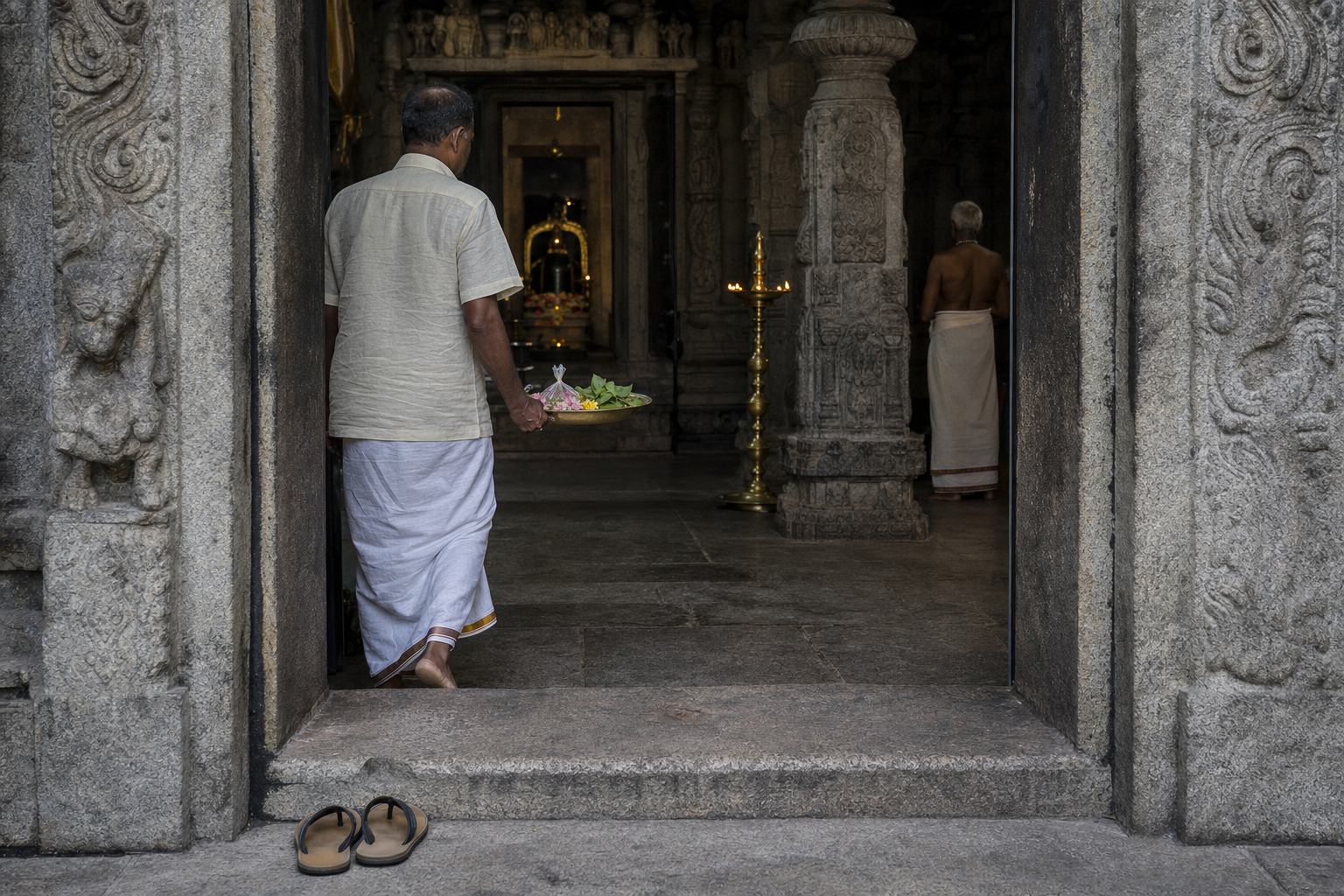
Bring offerings only after learning what the temple accepts. Bilva leaves have a strong place in Shaiva worship, while flowers, fruit, and lamps are also customary, but a temple is not obliged to accommodate every item a visitor arrives with. Local ritual order takes precedence over a general checklist.
Follow a deliberate sequence for darshana
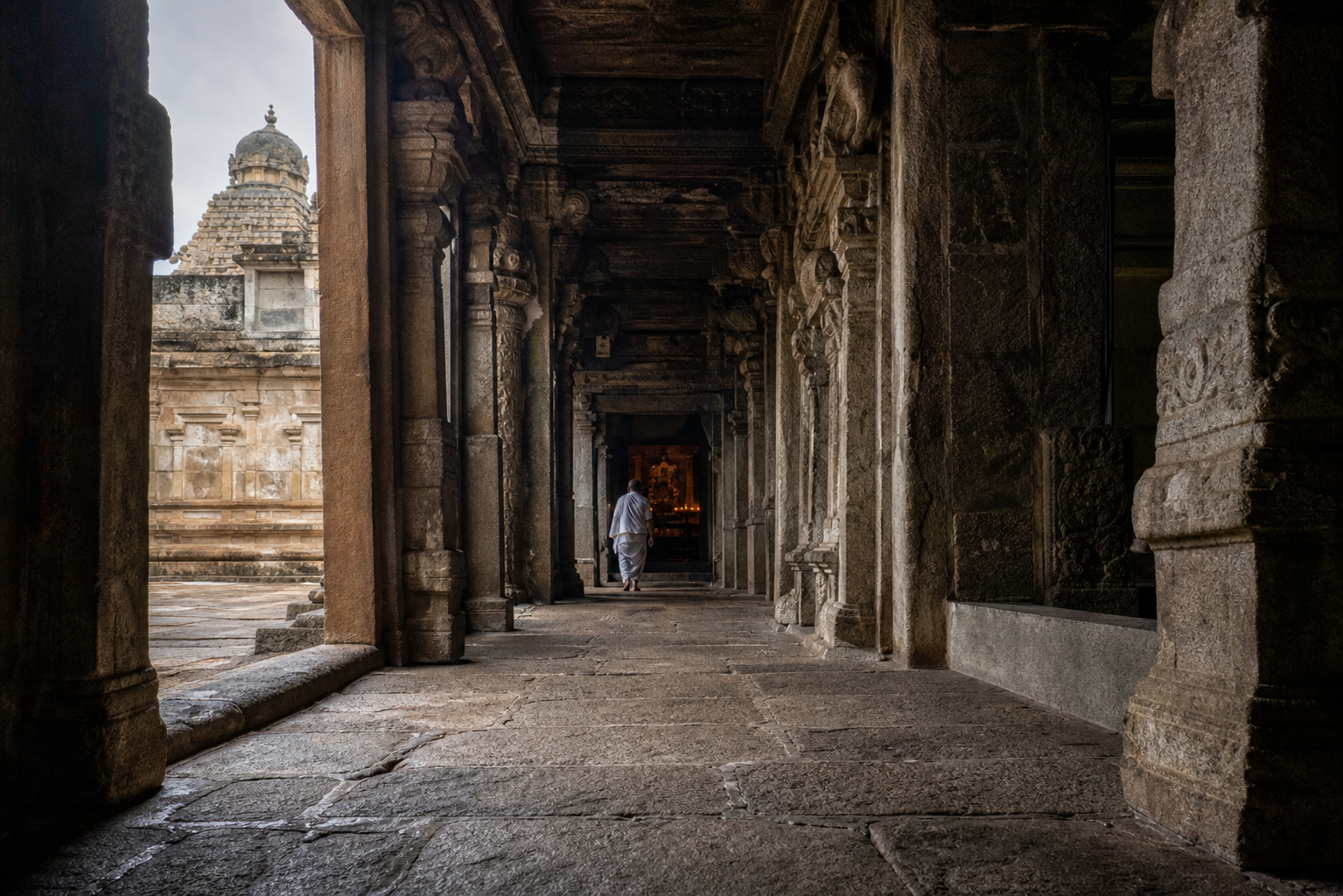
A structured visit does not need to become rigid. Its purpose is to gather your attention as you move from the outer precinct toward the sanctum. If an archaka, posted notice, or established local custom indicates a different order, follow the temple’s order.
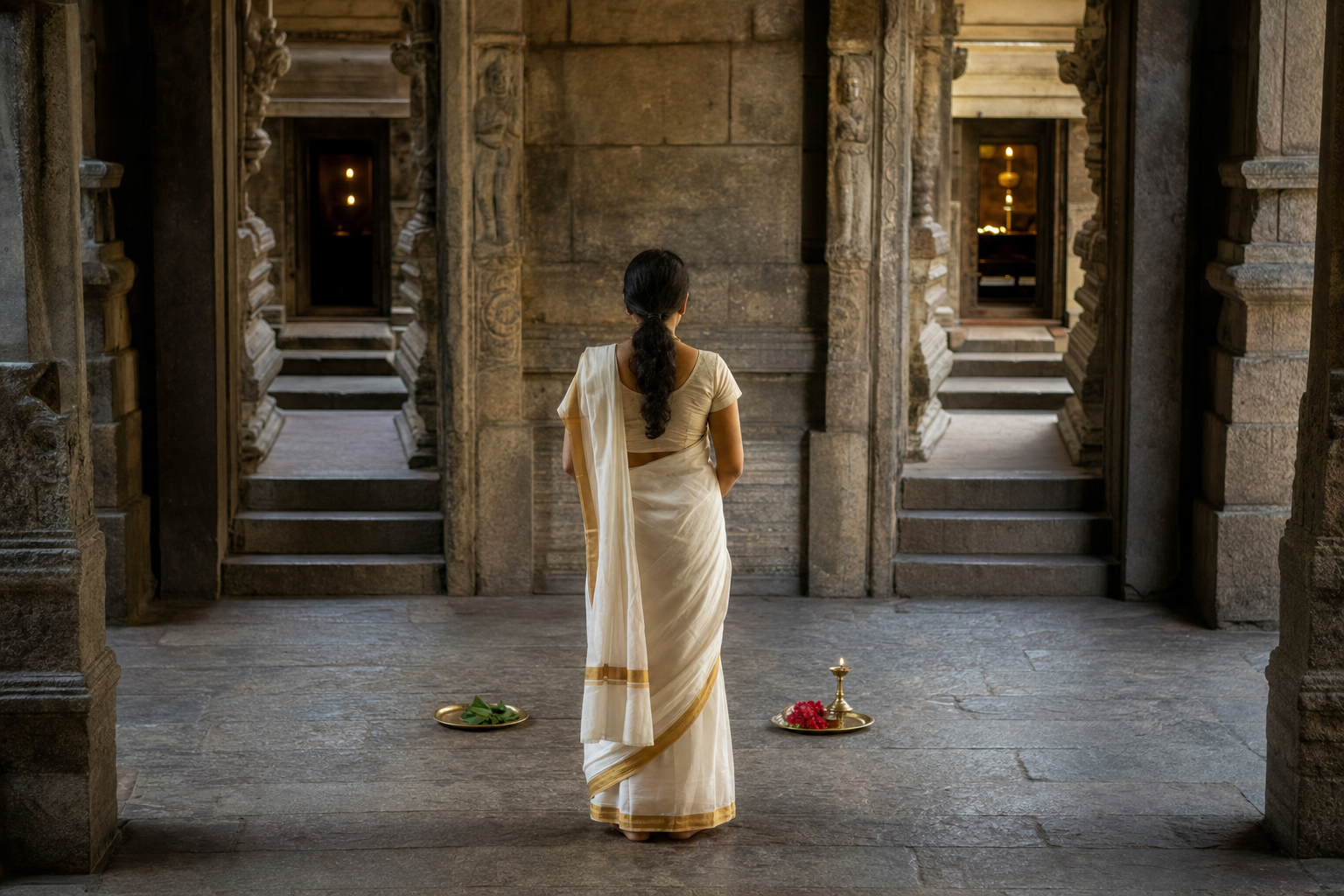
- Settle before approaching the sanctum. Leave footwear and other items where instructed, silence your phone, and let the urgency of travel subside. The transition into sacred space begins before you see the murti.
- Pause near Nandi without obstructing the central line of sight. Nandi’s axial relationship with Shiva’s sanctum directs attention toward steadiness and one-pointed devotion. If quiet breath practice is already part of your sadhana, take a few natural, unforced breaths. Otherwise, simple silence is enough.
- Approach Sundareswara with one clear intention. Attend to the lingam rather than trying to inspect every object around it. You may repeat the Panchakshari mantra, Om Namah Shivaya, inwardly. If bilva leaves are accepted, offer them through the procedure indicated by the priest.
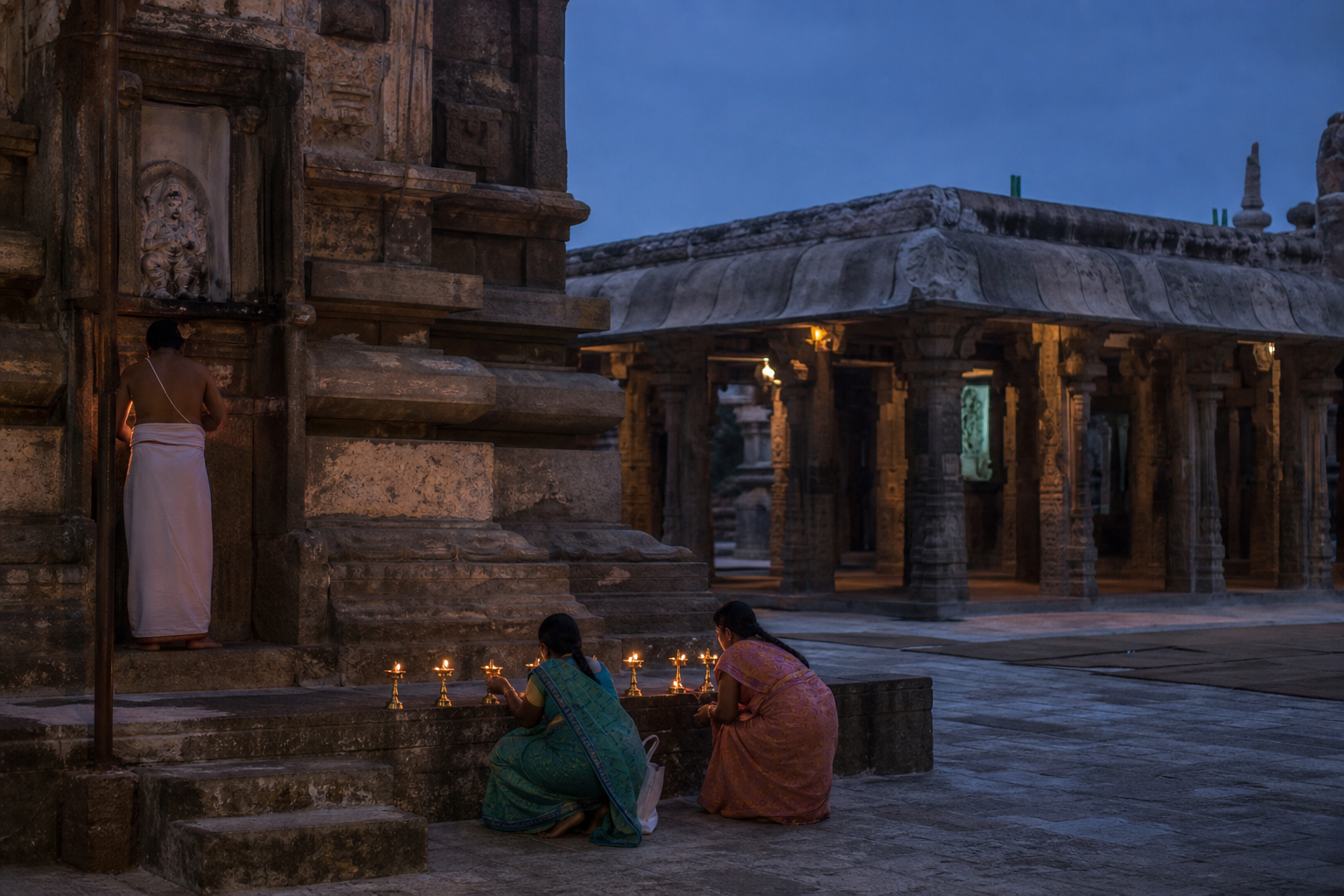
- Receive the puja as a sequence of inner refinement. During abhishekam, do not reduce the rite to a list of substances. Let cleansing, anointing, mantra, and light turn your attention toward what must be purified in your own conduct. During deepa aradhana, remain still and allow others an unobstructed darshana.
- Complete the movement at Akhilandeswari’s shrine. Notice how alankara communicates Devi’s beneficent and protective presence. Prayers for health, clarity, family, study, or work fit the householder dimension of Shakti worship, but connect the blessing you seek to a responsibility you are willing to fulfill.
- Make pradakshina along the route permitted by the temple. Walk without racing or overtaking people in prayer. Coordinate movement with a calm breath, and conclude with gratitude rather than immediately turning to your phone or travel plans.
If Rudra-Namaka-Chamaka or another Shaiva recitation accompanies worship, you do not need to know every word in order to listen attentively. Sound, gesture, offering, and sacred space operate together in Agamic worship. Participate at the level you genuinely understand, without imitating priestly actions or entering restricted ritual areas.
Seva can extend this sequence beyond personal prayer. If the temple maintains annadana, conservation, teaching, music, or documentation efforts, ask how support is properly given. Do not presume that a donation should be directed according to an outsider’s priorities. A living temple community is best served by listening to its custodians and established needs.
Let architecture and festival choice deepen the visit
Read the sacred plan from outside inward
Agamic temple architecture is not a decorative shell placed around worship. Orientation, proportion, thresholds, processional routes, and the concentration of the sanctum organize a gradual movement from ordinary attention toward interior stillness. Where the following elements are present, read them by what they enable you to do:
- Nandi establishes a direct devotional axis toward Shiva and asks you to steady the gaze before proceeding.
- The mandapa makes room for collective chant, recitation, instruction, music, and the gathering of devotees.
- The dhwajasthambha and bali peetha mark a transition into a more concentrated ritual zone; they should not be treated as convenient places to lean, sit, or arrange belongings.
- The prakaras give circumambulation a defined path, turning bodily movement into prayer rather than incidental walking.
- The garbhagriha gathers attention into darkness, stillness, and the brief radiance of the lamp. Its vimana marks the sanctum’s centrality from the exterior.
These are features of the wider South Indian Shaiva architectural grammar, not a substitute for observing Tiruloki carefully. If you photograph, describe, or document the temple, distinguish what you actually saw from what is typical of the tradition. Write that a feature exists at Tiruloki only when you have observed it or verified it locally. This small discipline prevents generic temple descriptions from becoming false site history.
Choose an observance that matches your purpose
A festival visit and an ordinary puja visit offer different kinds of attention. Begin with an ordinary daily service if you want to understand the relationship among the sanctums, architecture, and regular worship. Choose a vrata or festival when you want to enter a more collective and extended expression of the same theology.
- Pradosha is observed fortnightly at the twilight of Trayodashi in Shaiva tradition. Its emphasis on repentance and renewal suits a devotee who wants to examine conduct, repeat the Panchakshari mantra, and make a disciplined new beginning.
- Karthigai, or the wider Karthika season, centers lamps and the vision of Shiva as cosmic light. Choose it when the symbolism of illumination and procession is central to your devotion.
- Arudra Darshan honors Nataraja. It is especially meaningful if you are drawn to the relationship between motion and stillness expressed in Shiva’s cosmic dance.
- Navaratri brings Akhilandeswari’s many dimensions to the foreground through Devi worship and changing alankara. It is the natural choice when your sadhana is centered on Shakti.
- Maha Shivaratri traditionally involves an all-night vigil, mantra, abhishekam, and meditation. Treat it as a sustained vrata rather than a brief sightseeing opportunity.
Shared festival names do not guarantee an identical program at every temple. Confirm which observances are held at Tiruloki, their local form, and the actual start and access arrangements. This is particularly important if your travel depends on witnessing a specific abhishekam, alankara, or procession.
The same care applies to heritage. Temple continuity depends not only on masonry but also on ritual knowledge, regional chant, craftsmanship, oral memory, inscriptions, archaka training, music, and the preparation of prasada. If you want to help preserve the kshetra, ask whether an established effort supports structural care, documentation, or the people who carry its living traditions. Preservation should protect ritual authenticity as well as visible architecture.
Key takeaways
- Approach Sundareswara and Akhilandeswari as the joined presence of Shiva and Shakti, not as unrelated stops on a shrine circuit.
- Confirm the day’s opening hours, puja time, accepted offerings, festival changes, and photography rules locally before traveling.
- Use a simple sequence: settle near Nandi, receive Shiva darshana, attend the ritual without distraction, pray at the Devi shrine, and complete pradakshina.
- Read the mandapa, ritual thresholds, prakaras, garbhagriha, and vimana by the spiritual movement they organize.
- Separate features you personally verify at Tiruloki from architectural and liturgical practices that are merely common across Shaiva temples.
- Choose an ordinary puja for sustained attention and a festival visit for a more collective expression of Shaiva or Shakta worship.
Before you leave for Tiruloki, write down three things: the verified puja time, one offering the temple has confirmed, and one intention you can carry through both sanctums. Once you arrive, let local practice overrule your checklist. After darshana, translate the steadiness of Sundareswara and the active grace of Akhilandeswari into one concrete act of disciplined compassion. That is how a temple visit continues as sadhana after you step outside.