
If your family observes Vishu, Puthandu, or both, the first planning question is simple: when does the new year actually begin in 2026? The answer has two parts. The household celebration begins at dawn on 14 April, while the precisely calculated Mesha Sankranti rites belong to a later punyakalam.
Prepare the kani and festive space on 13 April, welcome the year at dawn on 14 April, and reserve 9:25 AM to 12:17 PM IST for Sankranti observances if that interval agrees with the panchanga followed by your family or temple. The year beginning that day is Parabhava Varusha, the 2026–2027 solar year.
Key takeaways
- Vishu and Puthandu fall on Tuesday, 14 April 2026.
- The Mesha Sankramana moment is 9:25 AM IST.
- The stated Mesha Sankramana Punya Kaalam is 9:25 AM to 12:17 PM IST, with rites placed as close to the ingress as practical.
- The dawn kani and the later Sankranti punyakalam serve different purposes; you do not have to choose between them.
- Parabhava 2026–2027 names the year extending to the next solar-year threshold. Do not reuse the 2026 muhurta in 2027; obtain a fresh local computation.
Fix the date, the ingress and the local clock
The calendrical anchor is Mesha Sankranti, the Sun’s entry into Mesha in the nirayana, or sidereal, zodiac. Tamil traditions call the resulting new year Puthandu, Varusha Pirappu, or Chithirai Vishu. Kerala observes Vishu around the same solar threshold. Souramana Ugadi is another name for this solar beginning.
For 2026, the Mesha Sankramana instant is 9:25 AM IST on 14 April. A more detailed ritual reckoning places the punyakalam from 9:25 AM through 12:17 PM IST. If you can perform only one time-sensitive observance, place your sankalpa, japa, dana, or customary Sankranti rite as near to 9:25 AM as your circumstances permit.
| When | What the time means | What to plan |
|---|---|---|
| Evening of 13 April | Household preparation | Clean the worship area, draw the kolam if customary, hang mango-leaf thoranam, arrange the kani, and set out puja or tharpana materials. |
| Dawn on 14 April | Festive and domestic beginning | View the kani, light the lamp, offer arghya to Surya, wear fresh clothes, greet elders, and begin the day with prayer. |
| 9:25 AM IST | Exact Mesha ingress | Prioritize the time-sensitive sankalpa, japa, Sankranti tharpana, or temple worship followed in your parampara. |
| 9:25 AM–12:17 PM IST | Stated punyakalam | Complete snana, puja, dana, tharpana, or quiet recitation within the available portion of this interval. |
This distinction prevents a common planning mistake. You can view the kani at dawn even though the calculated ingress occurs later in the morning. The first sight establishes the household’s devotional orientation; punyakalam governs rites tied specifically to the solar transition.
If you live outside India, do not copy 9:25 AM onto your local clock. Convert the ingress instant to your time zone, then check how a trusted local temple or panchanga assigns the date and ritual window for your location. Panchangas can differ slightly because schools use different ayanamsa values and astronomical constants. Following the almanac accepted by your community is usually more coherent than mixing the ingress from one calculation with the ritual window from another.
The label 2026–2027 can also cause confusion. It refers to the annual Vishu Phalam frame from 14 April 2026 to 14 April 2027, not to one muhurta that remains valid for two festivals. The next solar ingress needs its own calculation.
Respect the shared solar threshold without flattening the traditions
Vishu and Puthandu meet at Mesha Sankranti, but they are not merely two labels for an identical household script. Their overlap is calendrical and civilizational; their inherited forms remain regional. You can honour the common foundation without turning either observance into a generic festival.
For a Kerala Vishu observance
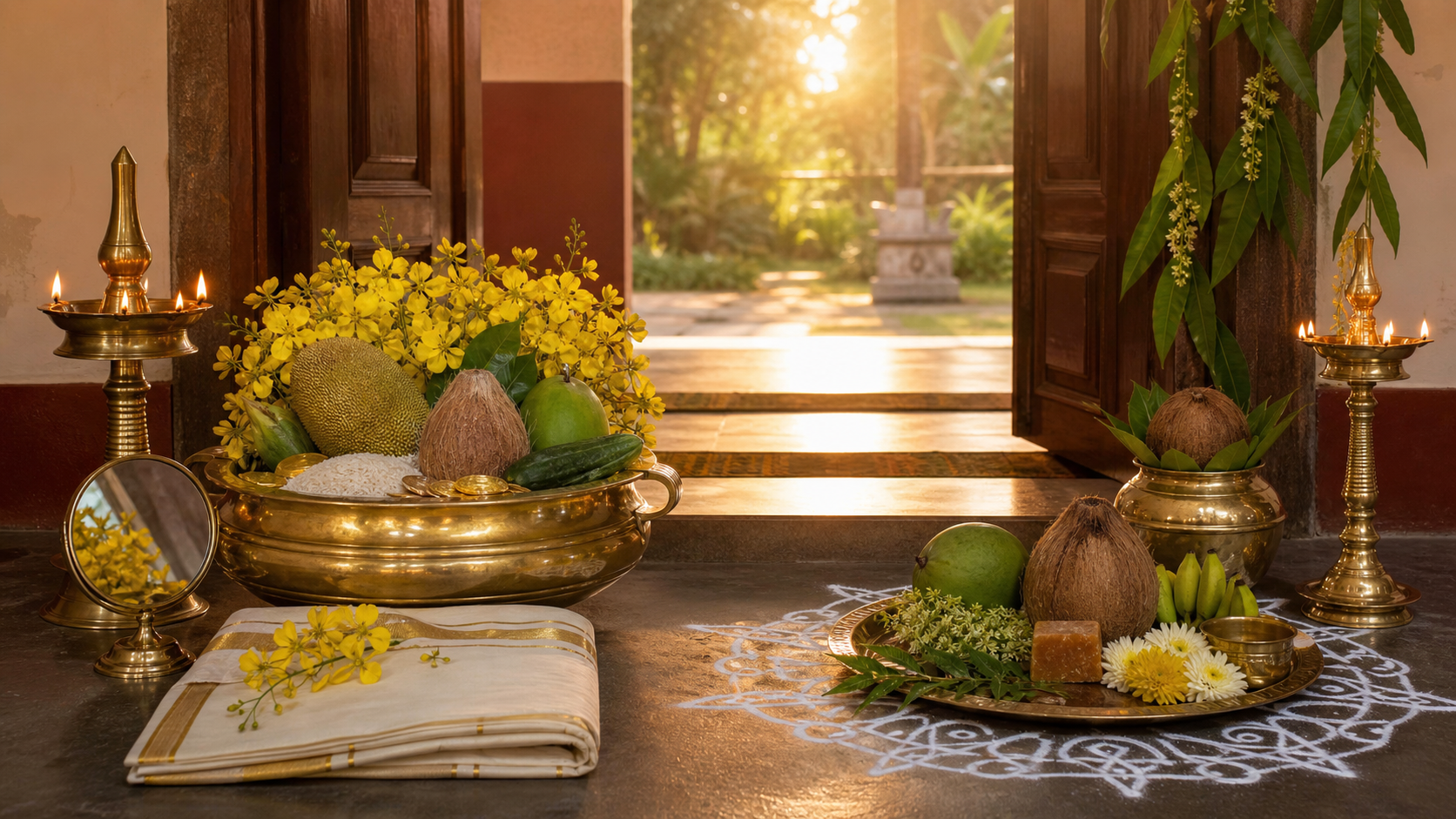
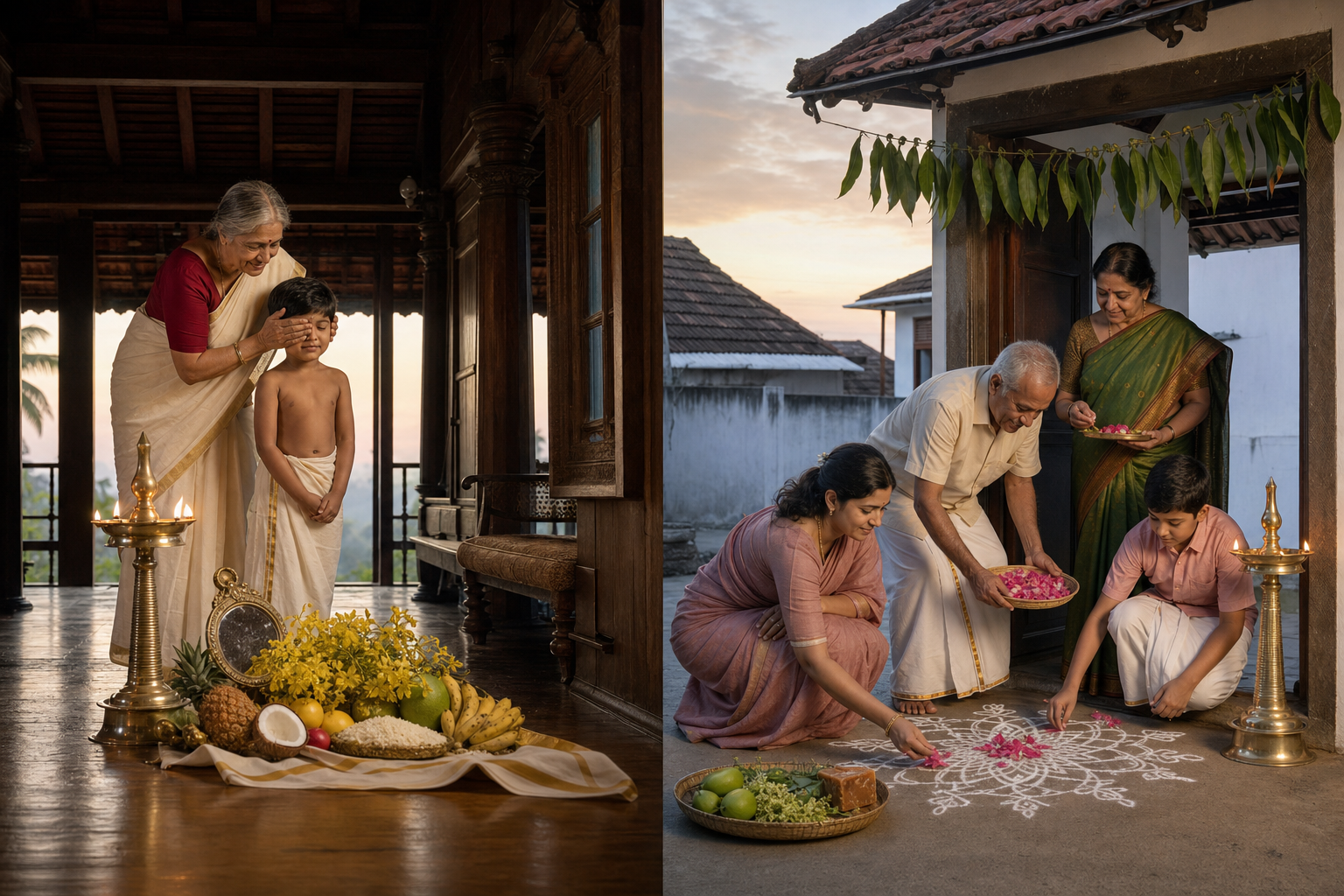
Arrange the Vishukkani before the household sleeps. The traditional visual field can include a lit lamp, grains, fruits, flowers, a mirror, gold or another symbol of prosperity, and kanikonna when seasonally available. At dawn, members of the household view this auspicious arrangement before beginning ordinary activity. The point is not decorative abundance for its own sake. It is to make the year’s first deliberate gaze one of light, nourishment, self-reflection, beauty, and sufficiency.
Vishu kaineettam then turns auspiciousness into relationship. An elder gives a token to younger family members, joining blessing with generosity. Decide the tokens beforehand so the practice is calm and inclusive rather than improvised around status or comparison. A modest gift offered with equal regard carries the ethic more clearly than competitive display.
For a Tamil Puthandu observance
Mark the threshold of the home with kolam and, where customary, a fresh mango-leaf thoranam. Light the deepam, offer worship, seek the blessings of elders, and prepare maanga pachadi. Its varied tastes give the family a concrete way to discuss the coming year: pleasant and difficult experiences will both arrive, and dharma asks for steadiness through them rather than denial of either.
Temple worship may include abhishekam, archana, special alankaram, and the recitation of Vedic or Tamil devotional hymns. Check your temple’s announced programme instead of assuming that household punyakalam and the public service begin at the same minute.
For a mixed Kerala–Tamil household
You do not need to select a winning regional identity. Keep each practice intelligible. Prepare one auspicious visual arrangement at night, use the name preferred by each side of the family when exchanging greetings, include the food and blessings customary to both, and let the established family parampara govern technical rites.
Explain the relationship to children in one clear sentence: we welcome the same solar new year through different inherited languages of worship. That is more accurate than claiming that every mid-April celebration is the same festival. Vaisakhi, Pohela Boishakh, Bohag Bihu, Pana Sankranti, and related new-year observances participate in a broad Indic seasonal rhythm, but each community carries its own history and sacred emphasis.
Build the day around what must happen when
A good festival plan separates preparation, first-light customs, time-sensitive rites, and family hospitality. Trying to perform everything at 9:25 AM creates avoidable tension and obscures why the practices have different timings.
- Prepare on 13 April. Clean the worship area, finish the kolam and thoranam arrangements that can be done in advance, assemble the kani, place fresh clothes where they are easy to find, and gather the materials needed for puja or tharpana. If dana will be made online or through a temple, decide the recipient before the festival morning.
- Protect the first gaze at dawn. If your household follows kani darshan, make sure phones, unopened work messages, and ordinary clutter do not become the accidental first sight. Light the lamp safely and guide children or guests to the arrangement without turning the moment into a photo session.
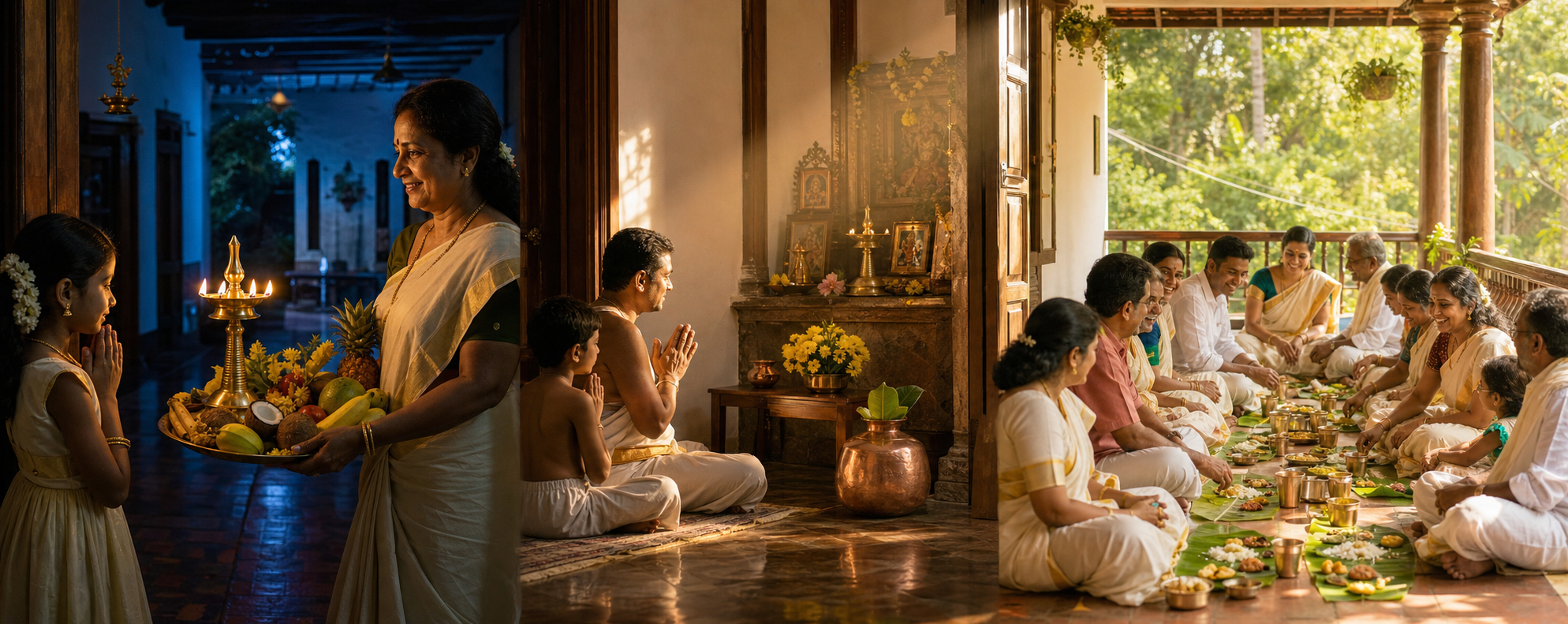
- Begin with a short act of orientation. Offer arghya to Surya if customary, recite a familiar prayer, read a small passage from the Tirukkural, Bhagavad Gita, or a cherished Tamil hymn, and seek the blessings of elders. Use a text your household can understand and continue through the year.
- Reserve the punyakalam for focused practice. Bathe and prepare before the ingress where practical. Near 9:25 AM IST, undertake the sankalpa, japa, customary tharpana, or temple worship. Complete additional dana or recitation by 12:17 PM IST when following the stated Indian interval.
- Let the meal teach the festival. Serve the foods appropriate to your tradition and locality. Explain the range of tastes in maanga pachadi or the symbols in the Vishukkani before conversation moves elsewhere. A child who understands one symbol will carry more forward than a child who merely poses beside an elaborate arrangement.
- Move auspiciousness beyond the house. Give kaineettam or another thoughtful token, contribute to annadanam, help with education, care for an elder, or offer water and food where needed. Dana and seva make the day’s abundance relational rather than private.
If employment, caregiving, illness, or travel makes the full sequence impossible, preserve the core instead of abandoning the day. View or create a simple auspicious arrangement, light a lamp, state your sankalpa, offer a brief prayer, and make a deliberate act of dana. Ritual scale can change; attentiveness need not disappear.
Do not postpone every meaningful act until a convenient weekend and then treat the solar threshold as irrelevant. Keep one real observance on 14 April, however concise, and hold the larger family meal or cultural programme when people can gather. This preserves both calendrical integrity and practical family life.
Handle tharpana through parampara, not improvisation
Sankranti tharpana joins the new beginning to gratitude for those who came before us. It is meritorious in many lineages but is not treated as compulsory by every Puthandu or Vishu household. Eligibility, sequence, participation by women, use of the yajnopavita, and the treatment of recent mourning periods vary by family and sampradaya. Your family elder, acharya, or established ritual manual should settle those questions.
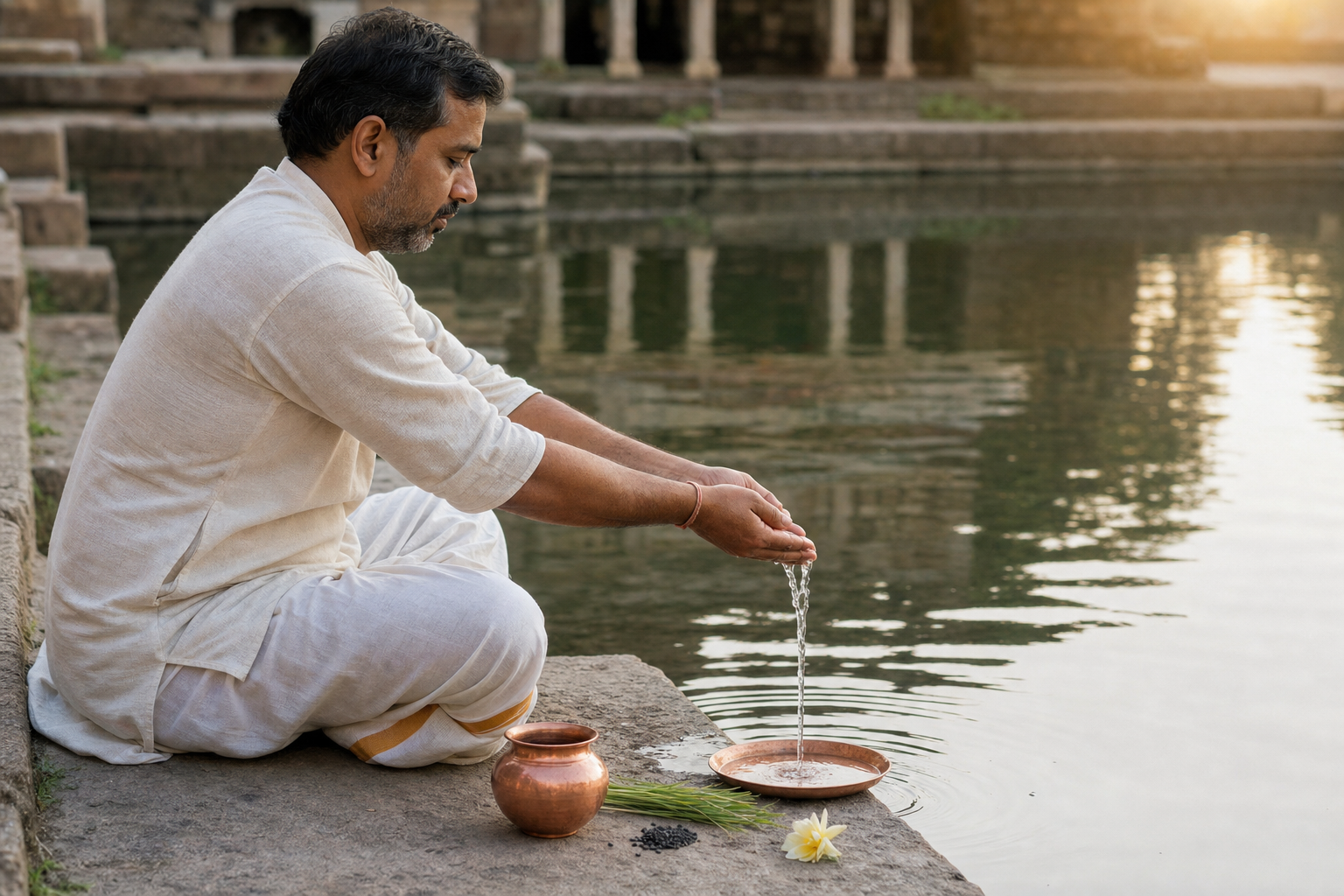
If your parampara directs you to perform it, prepare a clean vessel of water, black sesame, darbha or kusha when available, a spoon, a receiving vessel or suitable surface, and a clean cloth. Ancestor offerings are normally made while facing south. The detailed convention governing hand position and the release of water should come from the procedure you have been taught, because Deva, Rishi, and Pitri offerings can use different forms.
A concise generic remembrance is Om pitṛbhyo svadhā namaḥ, tarpayāmi. The paternal and maternal lines may then be remembered according to household practice. If names are unknown, a generic invocation to the Pitris can be used; if black sesame or darbha is unavailable, plain water offered with sincere remembrance is an available simplified form.
Before the offering, make the sankalpa specific enough to guide your mind. State the place, Parabhava Samvatsara, Mesha Sankranti, the purpose of honouring the ancestors, and your chosen commitment for the year. If you do not use a full Sanskrit formula, you can say in your own language: On this Mesha Sankranti in Parabhava Samvatsara, in this place, I remember my ancestors and undertake this resolve in service of dharma.
Then name the resolve plainly. Satya, daya, dana, ahimsa, and seva become actionable only when attached to conduct: truthful speech in a difficult relationship, a regular contribution to education or food service, patient care for an elder, or restraint from a habit that causes harm. Choose something you can revisit when the initial festival mood has passed.
If your lineage does not authorize you to conduct the rite, do not copy a technical sequence from fragments and present it as your family tradition. Offer a lamp, remember deceased relatives by name, pray for their peace, feed someone, or make dana in their memory. Respect for parampara and sincere gratitude can stand together.
Turn Parabhava Varusha into a lived annual resolve
Parabhava belongs to the traditional cycle of sixty named years. Panchanga Sravanam places the household year within wider questions of rainfall, agriculture, health, economic movement, and social welfare. Aaya–Vyaya, literally concerned with inflow and outflow, belongs to this annual reading. It can prompt disciplined reflection, but it is not a replacement for an actual household budget.
On Puthandu or Vishu, open a fresh annual page and record the resources you can reasonably expect, the obligations already committed, the needs that could disrupt the household, and the portion you intend to direct toward dana or seva. Then identify the habit that most often turns a manageable outflow into disorder: unrecorded spending, delayed paperwork, avoidable debt, or promises made without capacity. The spiritual value lies in bringing artha under dharma, not in treating a favourable forecast as permission to ignore consequences.
Traditional Vishu Phalam uses Rashi, Nakshatra, and slow-moving planetary patterns to describe possible tendencies for the year. Those tendencies remain general. A personal reading can change with Lagna, house placement, Dasha–Bhukti, and the regional panchanga used for timing. Consult the 2026–2027 Rashi and Nakshatra framework as a prompt for reflection, then test any important decision against your actual obligations and evidence.
Do not make an investment, property purchase, career exit, medical choice, or binding contract solely because a general Rashi forecast appears favourable. For consequential financial decisions, use reliable records and qualified professional advice. Jyotisha can help you examine timing, temperament, and neglected duties; it cannot make an unsuitable commitment affordable or remove contractual risk.
A strong annual sankalpa should connect three circles. First, name what must become more disciplined in your own conduct. Second, name the family duty that needs steady attention. Third, name the community need to which you will contribute. This keeps renewal from shrinking into private prosperity alone.
Before the evening of 13 April, decide which family parampara will lead the technical rites, confirm the local timing, choose the scripture passage, prepare the dana, and write the resolve in words you will understand months later. When 14 April arrives, you will be able to welcome Parabhava Varusha with attention rather than last-minute searching.
References
- DharmaRenaissance Blog — Vishu Phalam 2026–2027: Definitive Rashi & Nakshatra Forecasts, Aaya–Vyaya and Timely Remedies
- DharmaRenaissance Blog — Chithirai Vishu (Puthandu) 2026: Astronomical Timings, Sacred Rituals, and Cultural Unity
- DharmaRenaissance Blog — Chithirai Vishu 2026 Punyakaala Tharpana Guide: Exact Timings, Puthandu Sankalpam, Mantras