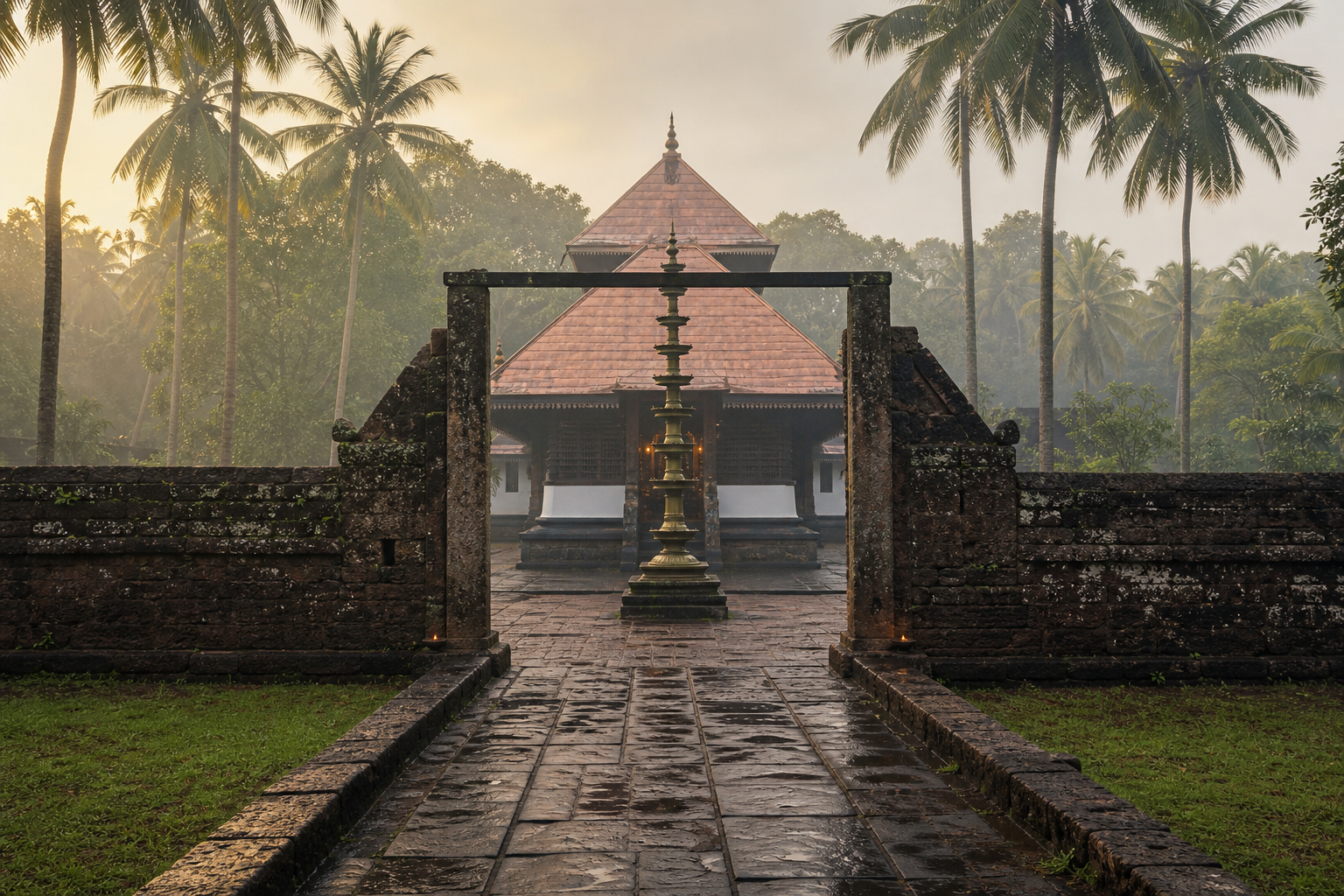
If you have stood before a Kerala temple and felt that its low roof, dark sanctum and measured approach mattered, but could not say how, you were already noticing the right things. Sacred geometry is not confined to a diagram beneath the floor. It directs your movement, frames the murti, regulates sight and light, and joins construction to worship.
On your next visit, read the temple in a sequence: ground, enclosure, sanctum, image and rite. That sequence prevents two common mistakes: treating geometry as decorative symmetry and pretending every hidden ritual detail is available to casual inspection.
Key takeaways before you enter
- Begin with the route to the sanctum. The central axis, thresholds and enclosing structures tell you how the temple intends the body to approach the deity.
- Treat square, circular and apsidal sancta as distinct architectural types, not as ranks in a spiritual hierarchy.
- Read a murti through proportions, posture, gesture, attributes and gaze together. One hand gesture by itself is rarely enough.
- Remember that consecrated geometry continues below and within what you can see, through yantras, foundation deposits, bonding materials and installation rites.
- Respect the boundary between observable architecture and restricted ritual knowledge. If a temple does not publicly disclose a yantra or consecration detail, do not fill the gap with a generic diagram from elsewhere.
Trace the approach before studying the ornament
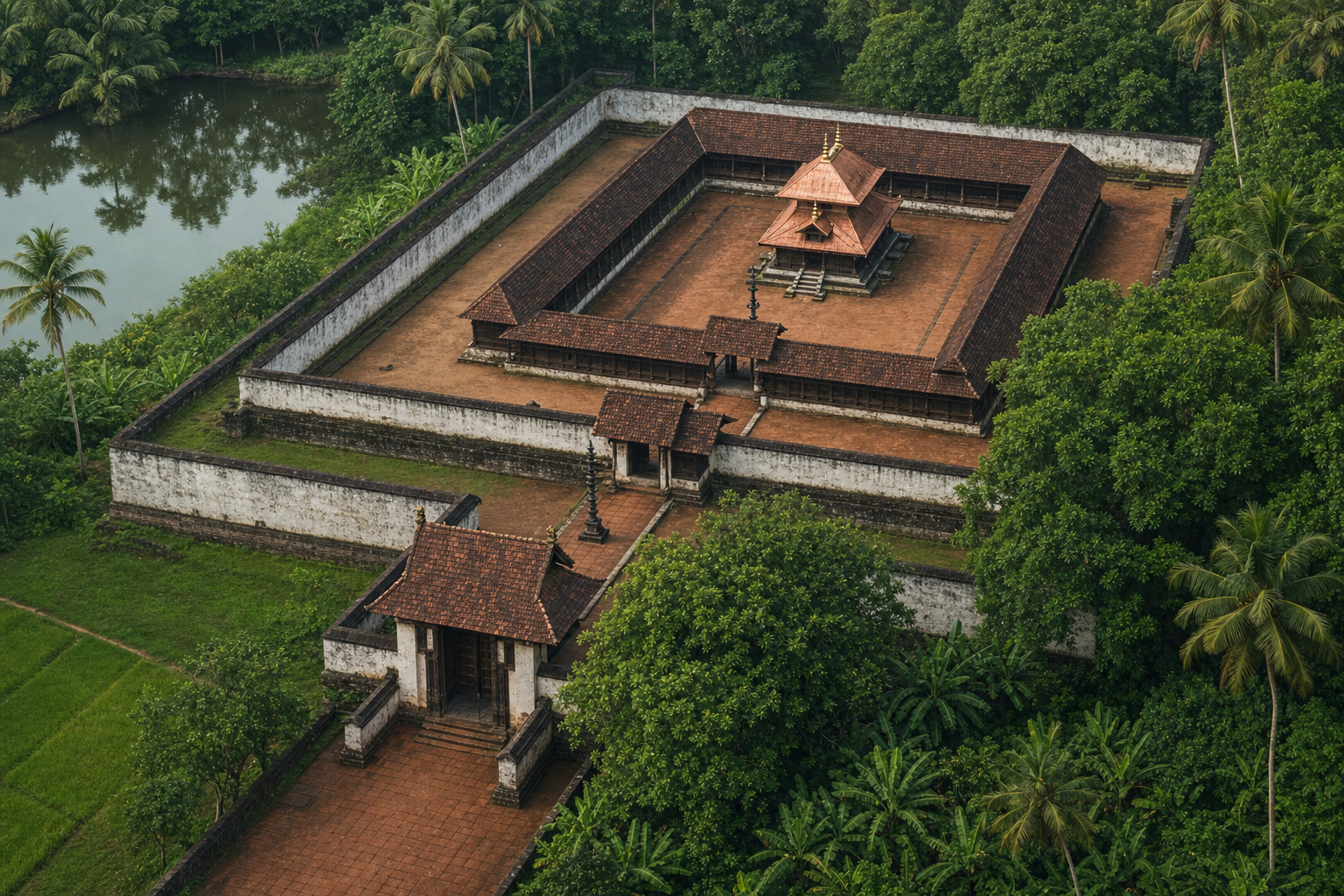
Kerala temple geometry begins with the ground. Site, orientation and layout are ordered through the vastu-puruṣa-maṇḍala, a grid whose divisions are called padas. The sanctum is aligned to the cardinal axes, while enclosing structures organize movement toward a concentrated sacred centre.
Do not expect the planning grid to appear as a visible pattern on the pavement. It is a generative framework: the underlying order from which locations, alignments and relationships are established. Within the temple’s ritual vocabulary, its padas are seats of sacred power rather than neutral construction modules. That theological language does not need to be recast as laboratory terminology in order to be meaningful.
The approach becomes easier to read when you identify the major architectural roles. The chuttambalam forms an enclosed ambulatory. The namaskāra-maṇḍapa provides a ritual hall. The bali-stambha marks an offering point, and the dhvaja-stambha stands as the sacred flag-mast. Local arrangements vary, but these elements are not interchangeable decorations. Each establishes a function, a boundary or a stage in the movement from the everyday world toward the sanctum.
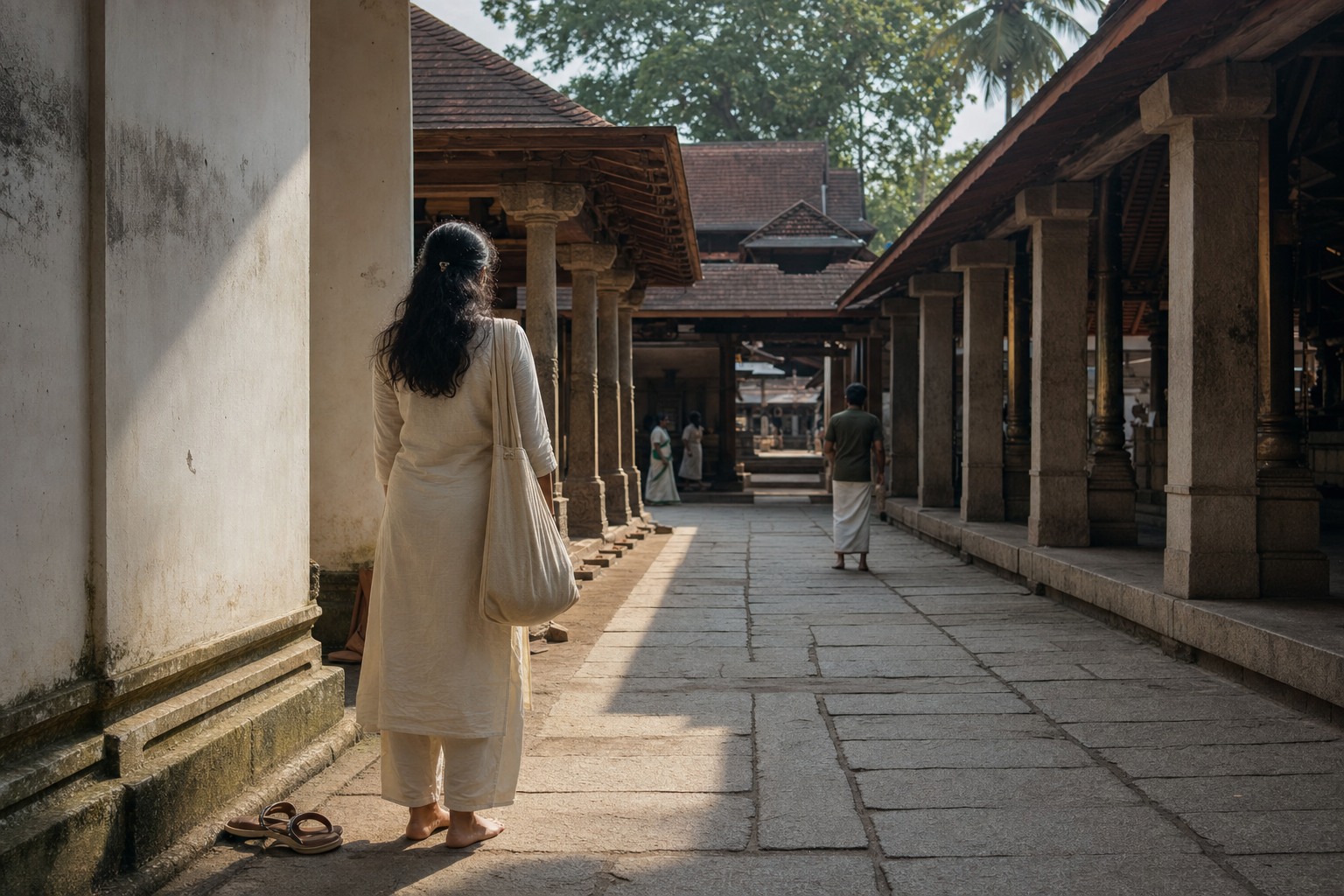
Stand where visitors are permitted on the principal approach and ask four questions:
- Which line most clearly directs your eyes toward the sanctum?
- At which threshold does your pace naturally slow?
- Which structures enclose, repeat or narrow the space around you?
- What remains aligned even when the broad roof and deep eaves dominate the view?
This exercise reveals why a temple plan is more than a symmetrical arrangement. Its geometry disciplines attention. Long before you interpret a sculpture, your body has already been guided through distance, enclosure, pause and orientation.
Let the sanctum’s shape, material and light speak together
Kerala sancta appear in three important plan types: square, or catura; circular, or vṛtta; and apsidal, known as gajapṛṣṭha. These names identify shapes, not levels of sanctity. If the plan is difficult to recognize from the entrance, follow the permitted circulation path and study the outer perimeter rather than guessing from the roofline alone.
Read the sanctum in three passes. First, observe its plan: corners, curvature or an apsidal end. Second, look upward at the relationship between wall, roof and eave. Third, notice how the threshold changes light, sound and your sense of distance from the murti. The three passes keep you from isolating geometry from the material conditions that make it perceptible.
Laterite, polished granite, teak and copper-sheeted roofs form a climate-adapted sacred envelope. Deep eaves and copper-clad roofs modulate daylight, while the arrangement also shapes ventilation and acoustics. Regional adaptation is therefore not an afterthought pasted onto a canonical plan. It is part of how the sacred enclosure remains functional in Kerala’s environment.
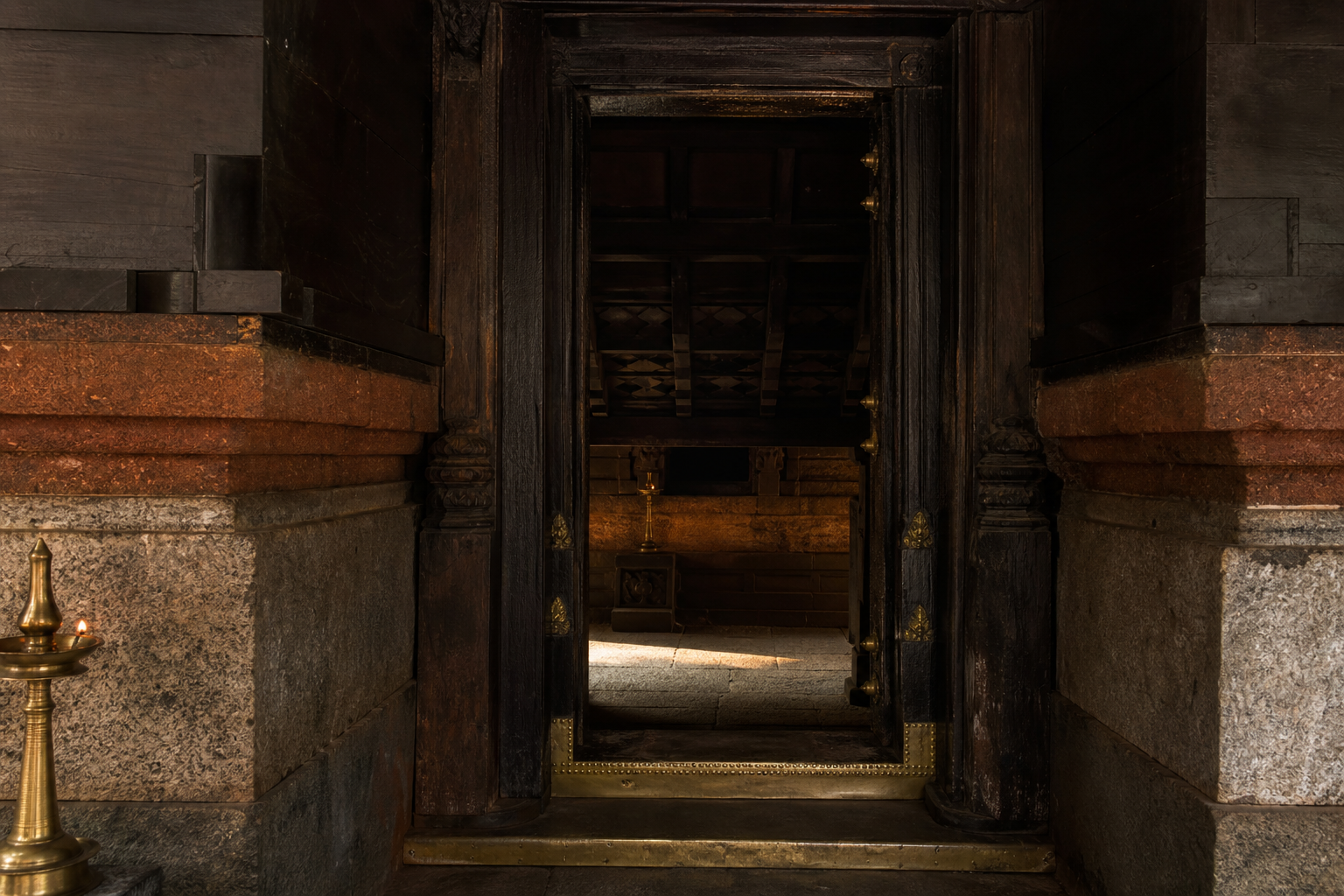
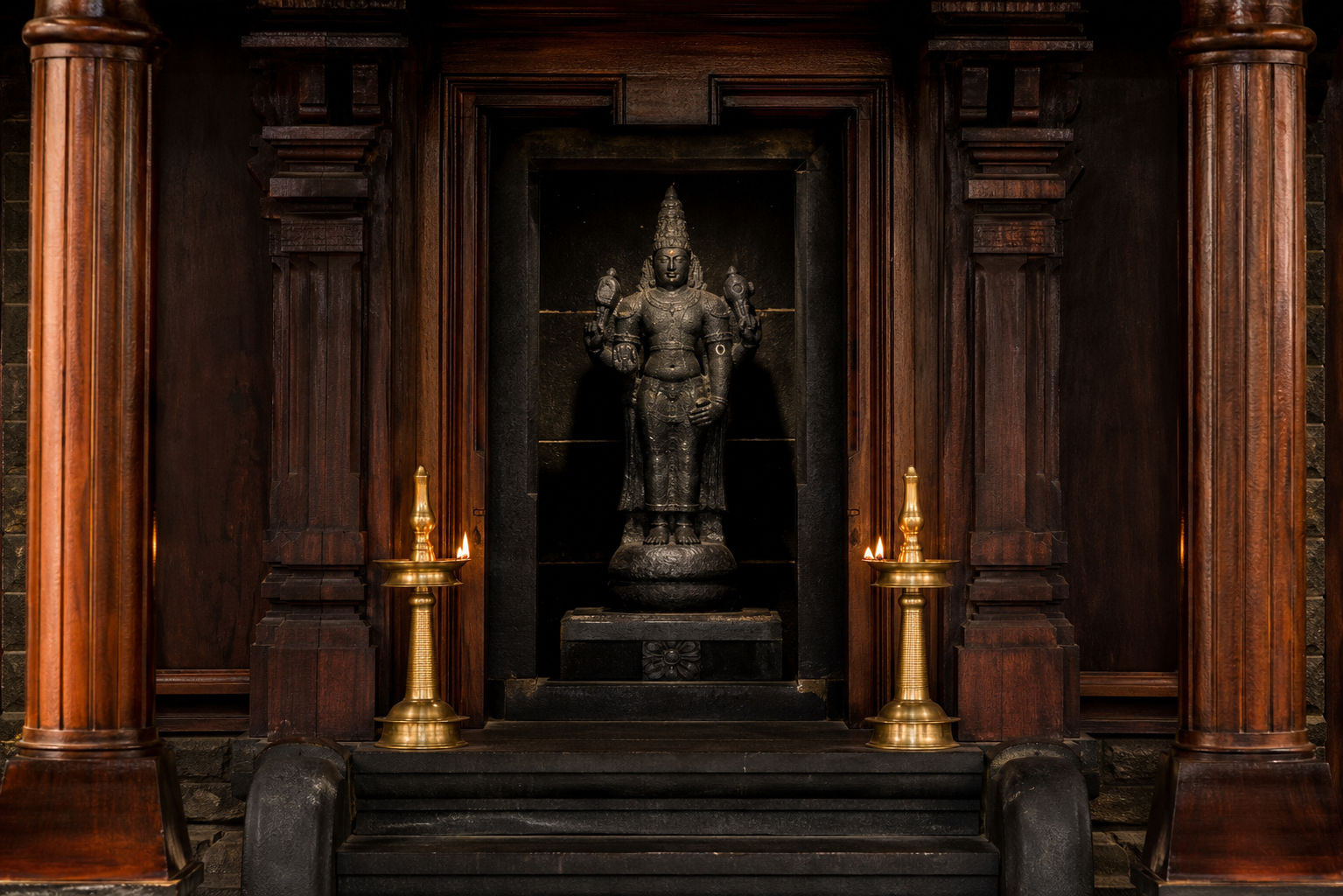
Controlled darkness deserves particular attention. Do not assume that a dim sanctum is withholding the deity from view. Scale and sightlines are calibrated so that lamplight can reveal significant features during dīpārādhana. When you are in the proper public viewing position, remain still long enough to notice which parts emerge first: the eyes, hands, face, crown or attributes. The lighting and the icon have been composed to work together.
Ornament should also be read by location. Kīrtimukha, yāli-vyāla forms, lotus bands and pearl-like strings carry more than decorative value. In some sancta, a comparatively restrained exterior gives way to concentrated ornament around the garbha-gṛha. Instead of collecting motifs as isolated symbols, notice whether visual density increases as you move toward the centre. That movement from many forms toward one focus is itself part of the theological argument.
Read the murti as measured theology
A consecrated image is not designed by adjusting features until they look attractive. Canonical systems use units such as the aṅgula, based on a finger breadth; the hasta, or cubit; and the tāla, a vertical proportional measure. These relationships establish pramāṇa types and govern stance, limb length, facial structure and the overall balance of the figure.
You do not need to carry a measuring tape into a temple. Look for relative proportion instead. Is the figure upright, seated or held in yogic stillness? Do the limbs open toward the devotee or gather inward? Does the face reinforce serenity, sovereignty or protective intensity? Canonical proportion, posture and expression work together to communicate bhāva, the deity’s disposition, and rasa, the experience that disposition evokes in the devotee.
| Visible feature | Primary theological signal | How to read it carefully |
|---|---|---|
| Abhaya mudrā | Fearlessness and protection | Read the raised hand with the face, stance and remaining attributes. |
| Varada mudrā | Giving, grace or the granting of a boon | Check how the gesture is paired with the deity’s other hand. |
| Śaṅkha and cakra | Viṣṇu’s cosmic order | Use both attributes, rather than colour or dress alone, to identify the iconographic form. |
| Triśūla and ḍamaru | Śiva’s transformative power | Consider the attributes together with posture and gaze. |
| Multiple arms of Devī | A spectrum of śakti | Read the complete ensemble to distinguish nurturing, protective and fierce dispositions. |
Three well-known Kerala examples show why this complete reading matters. At Sabarimala, Śrī Ayyappa’s yogapattāsana, yoga-band and contemplative hands gather the body into disciplined stillness. At Guruvayur, Kṛṣṇa’s navanīta-cora form communicates the intimacy of the butter-stealing child while retaining canonical proportion and gesture. At Vadakkumnathan in Thrissur, the aniconic liṅga shows that a non-anthropomorphic form is not an absence of sacred design. Form and formlessness can serve as ritually equivalent approaches to divine presence.
Ritual adornment adds another layer. Garlands, textiles, crowns, weapons and seasonal attributes can present different bhāvas without replacing the underlying identity of the murti. If you visit the same temple at different ritual moments, compare what changes with what remains constant. The canonical body provides continuity; ālāṅkāra changes the mode in which that body meets the devotee.
Gesture literacy also extends beyond the temple. Kathakali, Koodiyattam and Mohiniyattam use codified mudrās and disciplined body geometry. Watching these traditions can train your eye to see posture as meaningful rather than incidental, although any temple gesture must still be interpreted within its own deity, attributes and ritual context.
Respect the invisible geometry of consecration
The visible icon is only one layer of the temple’s sacred construction. A useful mental sequence is sound, diagram and embodiment: mantra establishes the sonic form; yantra or maṇḍala gives it geometric order; and the murti gives it a form available to darśana. Construction and consecration are joined by this sequence rather than treated as unrelated architectural and ceremonial jobs.
Yantras may be inscribed on copper plates or placed beneath a pedestal, especially in Śākta and certain Śaiva installations. They harmonize the deity’s ritual presence with the site’s vastu, but their details can remain restricted to initiated authorities. A visitor should therefore resist declaring that a particular hidden yantra must lie beneath a murti merely because a similar diagram appears in a book or online.
Other unseen elements matter as well. Aṣṭabandha is the traditional compound that secures an image to its pedestal. Garbha-nyāsa deposits can place metals, minerals and gems within the foundation according to cosmological correspondences. Sacred geometry consequently continues into structures that ordinary devotees may never see.
Prāṇa-pratiṣṭhā brings sound, form and space into ritual relationship. Through nyāsa, seed syllables are placed upon the murti’s limbs and senses. Bhūta-śuddhi purifies the ritual space. Netronmīlana opens the eyes of the image and establishes the reciprocal seeing of darśana. These are not ornamental ceremonies performed after the real work of construction. They are integral to the transition from crafted image to ritually embodied deity.
This is also why the sthapati and tantri should not be reduced to architect and priest working in separate compartments. The sthapati carries canonical proportion and material craft into the built form. The tantri maintains tantric and āgamika concordance through installation and later consecration cycles. Kerala’s temple tradition depends on their disciplines meeting correctly.
Use the following sequence during a visit:
- Pause outside the principal sacred enclosure and find the dominant axis of approach.
- Identify the architectural stages that regulate movement, including the flag-mast, offering point, ritual hall and ambulatory where present.
- Walk only along permitted paths and determine whether the sanctum is square, circular or apsidal.
- Observe how roof, eaves, enclosure and lamplight control what you can see from the public viewing point.
- Read the murti through relative proportion, posture, gesture, attributes, gaze and adornment as one composition.
- Stop where observation stops. Ask temple authorities what information is public rather than speculating about hidden yantras, deposits or rites.
This discipline also helps you recognize a wider Dharmic grammar without flattening distinct traditions. Buddhist maṇḍalas and Jain cosmographs likewise use geometry to make a sacred order perceptible. Kerala’s expression remains specifically shaped by Hindu Tantra, Āgama, Śilpa-śāstra, regional materials and living temple authority.
Choose one temple for your next visit and limit the exercise to one axis, one sanctum shape and one gesture. Following those three elements from the outer approach to darśana will teach you more than trying to decode every motif at once. The aim is not to reduce the deity to a blueprint. It is to notice how measured space prepares you to meet divine presence with steadier attention.