
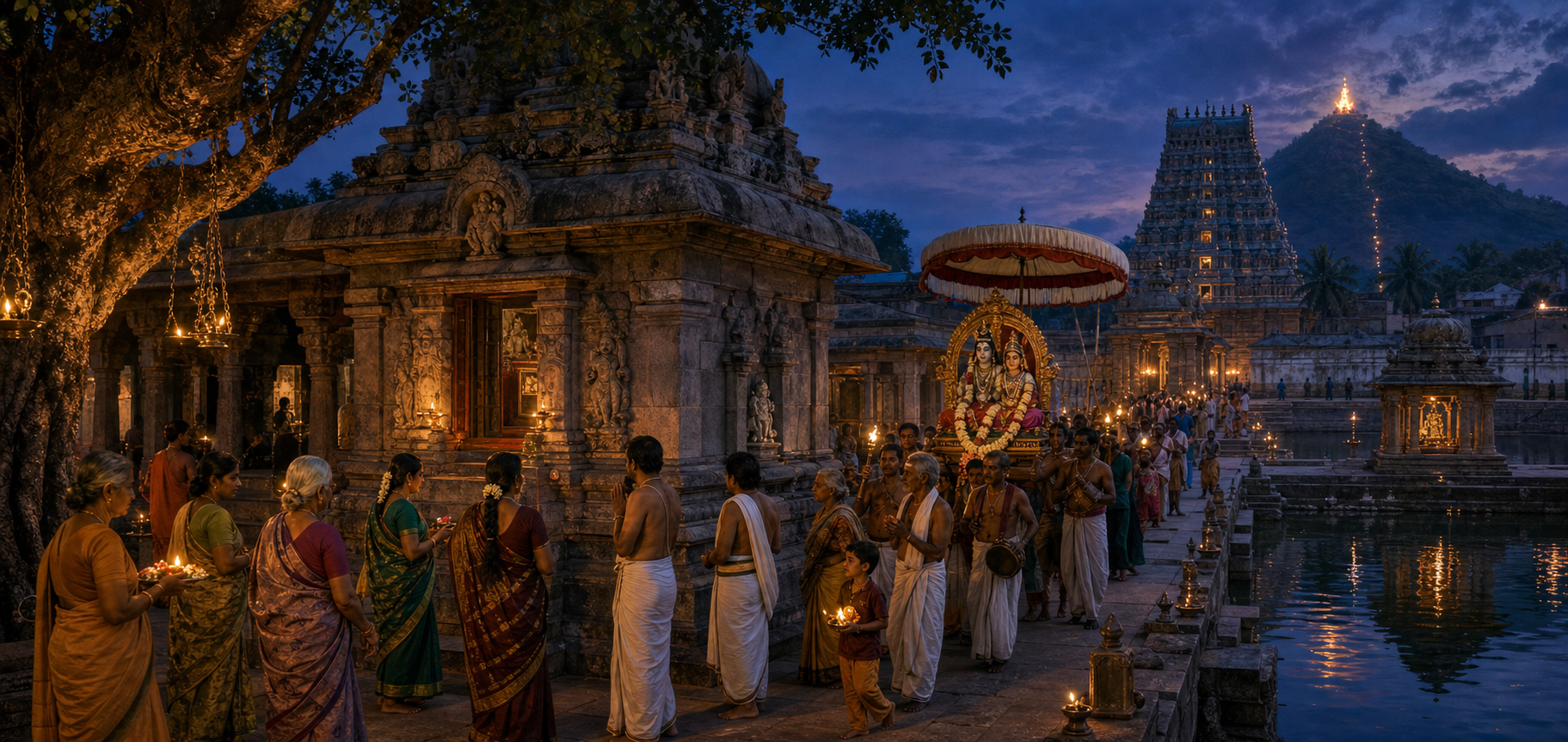
You may recognize Shiva’s pillar of fire, the marriage of Shiva and Parvati, or a temple’s local origin story, yet still wonder what any of it asks you to do once you enter the temple. Should you study an image, join a procession, wait for a puja, or simply receive darshan?
The answer is to follow the myth as it changes form. A Shaiva sacred narrative can become an icon, a route around the sanctum, a lamp on a mountain, a wedding hosted by a neighborhood, or a duty of hospitality. Once you learn to trace those changes, temple and festival practice stops looking like a collection of unrelated customs.
Myth becomes practice through four translations
In this setting, myth does not mean a claim dismissed as false. It means a sacred narrative that joins deity, place, ritual action, and moral order. The most useful first question is therefore not merely, “What does this story symbolize?” Ask what changes in worship because the story belongs to this place.
- Narrative becomes form. An immeasurable blaze becomes the linga or a Lingodbhava relief. A divine marriage becomes a pair of processional deities, a wedding pavilion, and the gestures of a Hindu marriage.
- Form receives a place. The relief appears behind the sanctum; a sacred tank mediates approach; a mountain is revered as a linga; concentric streets become ceremonial paths.
- Place organizes movement and time. You perform pradakshina, attend abhishekam, follow a baraat, watch a divine wedding, or walk a route marked out by the temple calendar.
- Movement creates an obligation. The worshipper is asked to relinquish pride, undertake atonement, honor Shiva and Shakti together, care for fellow pilgrims, or serve the community sustaining the rite.
This sequence prevents two common mistakes. The first is treating sculpture as decoration added to a temple after its theology was settled. The second is extracting a moral from a narrative while ignoring the bodily discipline through which that moral is learned. Shaiva practice often teaches through where you stand, which way you move, what you wait for, and whom you serve.
When you encounter an unfamiliar temple tradition, identify four coordinates: the narrative’s decisive event, its physical anchor, the movement or rite attached to it, and the disposition expected from the participant. That small method will take you further than trying to memorize every name before your visit.
Lingodbhava teaches through the rear wall and the pilgrim’s route
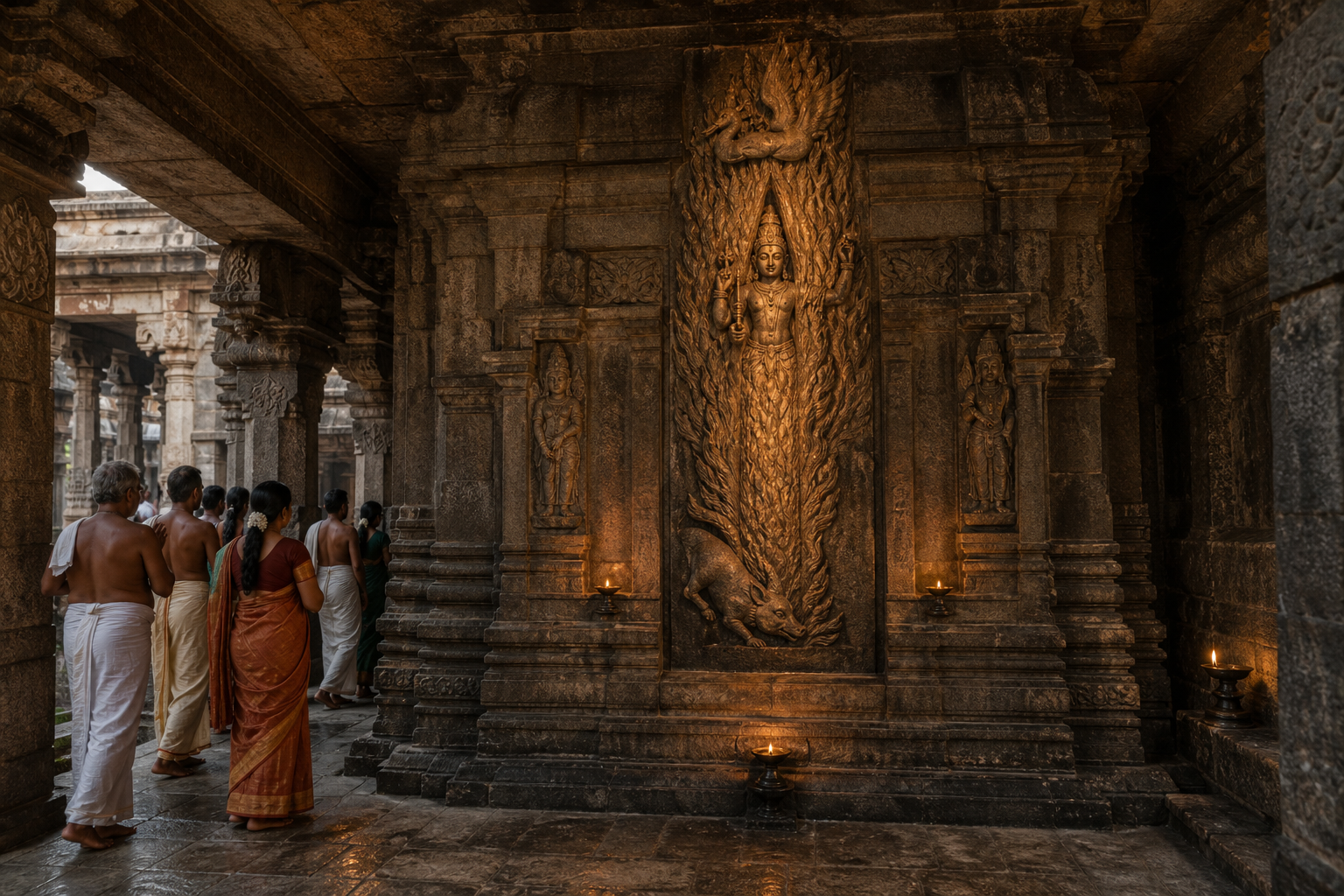
Lingodbhava begins with a dispute between Brahma and Vishnu. Shiva manifests as an endless column of fire. Vishnu descends as Varaha in search of its base, while Brahma flies upward as a hamsa in search of its summit. Neither limit can be found. The contest ends by exposing the inadequacy of pride and finite measurement before the immeasurable Divine. The name itself joins linga, a mark or sign, with udbhava, emergence: the unbounded makes itself perceptible as a sign without becoming confined by that sign.
Stone turns that theology into a scene you can read. Shiva appears within a blazing linga, often with an axe and deer in the upper hands and abhaya and varada gestures below. Varaha searches downward and the hamsa rises above. In many South Indian temples, the Lingodbhava panel occupies the western wall behind the garbhagriha, where a devotee encounters it during pradakshina. Placement is part of the teaching: the consecrated linga is approached in the sanctum, while its unbounded source is contemplated behind it.
A useful way to view the relief is to read from the margins toward the center. First locate the ascending and descending figures. Notice their strenuous movement. Then shift your attention to Shiva’s composed vertical presence. The contrast matters: greater speed and a longer search do not solve a problem created by treating the Absolute as one more object to be measured. Complete the circumambulation with that distinction in mind. The rite then becomes more than walking clockwise around a shrine; it trains attention to move from restless comparison toward humility.
Do not turn this placement into a universal checklist. Temples differ by region, period, lineage, and available space. If no rear-wall panel appears, that does not make the shrine theologically deficient. Where the image is present, however, its relation to the sanctum gives you a precise interpretive clue.
Do not force every school into one explanation
Lingodbhava can sustain several Shaiva and Vedantic readings without becoming vague. An Advaita interpretation can emphasize nirguna Brahman beyond name and form. Shaiva Siddhanta and Kashmir Shaivism can direct attention to Parashiva and Shakti, whose power both conceals and reveals. A bhakti reading stresses surrender and the correction of pride. These are related approaches, not interchangeable slogans. If you explain the icon to someone else, name the interpretive lens instead of presenting one school’s vocabulary as the only possible meaning.
The same myth expands beyond stone at Tiruvannamalai. Arunachala is revered as the Agni-linga among the pancha-bhuta sthalas. During Karthigai Deepam, a great lamp is kindled on the summit, lamps fill the town, and pilgrims circumambulate the mountain as linga. The relief’s vertical blaze has become sacred landscape; pradakshina has moved from the sanctum wall to the mountain’s circuit. Mahashivaratri observances such as nightlong japa, bilva-archana, and abhishekam offer another translation: immeasurable light is approached through wakefulness, repetition, offering, and disciplined attention.
This also corrects a reductive reading of the Shiva linga as merely a biological emblem. Within Lingodbhava, the linga is explicitly intelligible as a cosmological sign and axis of light. The temple’s vertical elements reinforce that grammar: the dhvaja-stambha, the sanctum, the rising vimana, and the Lingodbhava shaft orient awareness across ground, center, and height. You do not need to deny the generative dimensions of Shaiva symbolism to recognize that a narrowly phallic explanation cannot account for the icon, narrative, architecture, and ritual together.
The divine wedding makes kinship a public institution
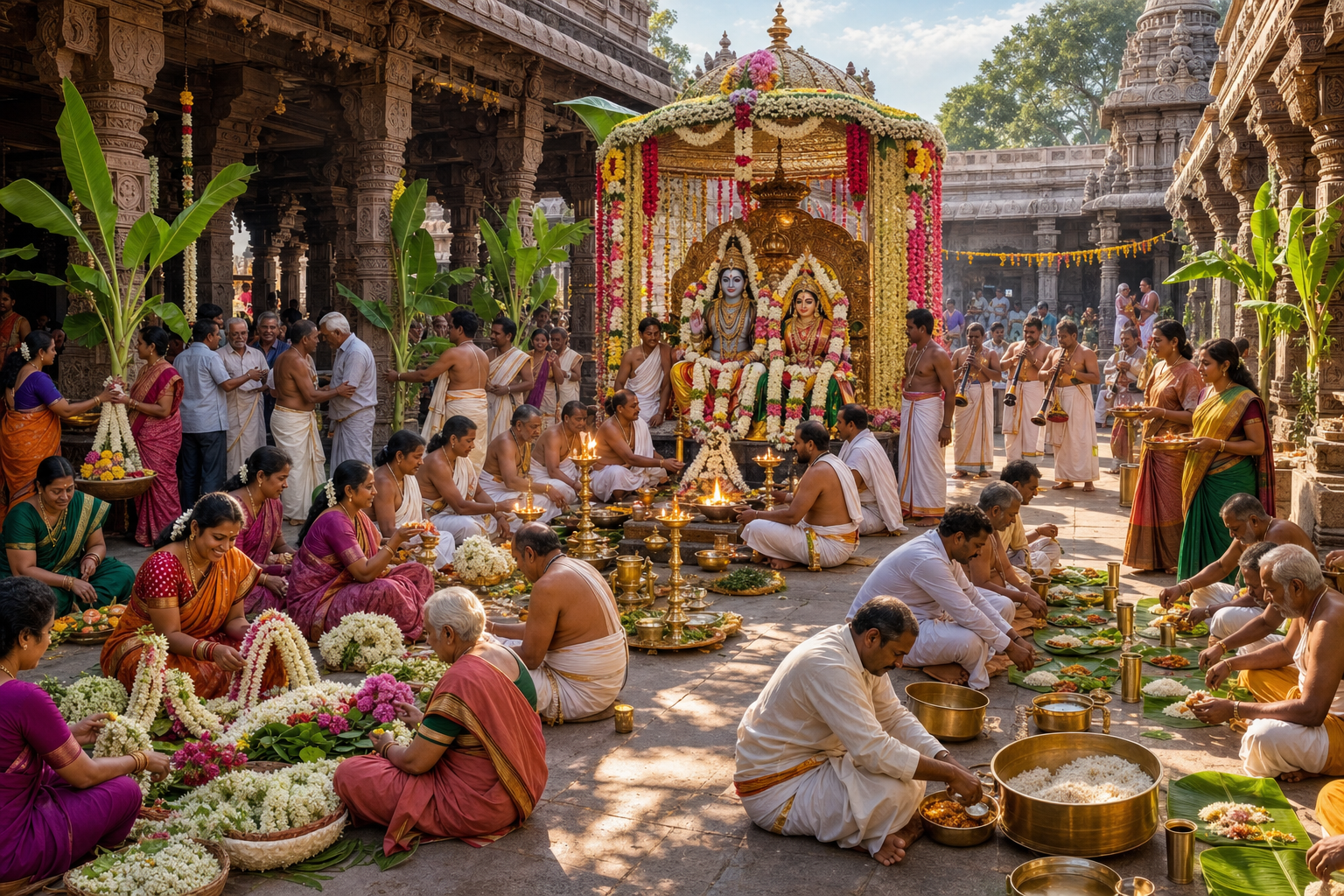
The Shiva-Parvati wedding moves Shaiva myth in a different direction. Lingodbhava interrupts a contest over supremacy; the wedding establishes relation, complementarity, and auspicious order. Its ritual force becomes clearest when a community does more than stage a costumed scene and instead assumes the obligations of a family.
At Sital Sasthi in Sambalpur, a local household ritually adopts Parvati and serves as the bride’s family. Shiva arrives in a jubilant baraat, accompanied by musicians, dancers, ganas, sages, devas, and other figures represented in the public celebration. The marriage includes recognizable rites such as kanyadaan, invocation of Agni, panigrahan, and saptapadi. Neighborhood committees coordinate the adoption, wedding, processions, hospitality, folk performances, water stations, and crowd care. A divine relationship therefore redistributes real work among households and localities.
If you attend, do not watch only the most spectacular float. Find out which household has accepted the bride’s kinship, which locality is hosting a stage of the observance, and where the public procession gives way to the solemn marriage rite. That transition is the festival’s interpretive center. The drumming and visual abundance are not distractions from the vivaha; they are the civic welcome surrounding it.
Sital Sasthi also carries the seasonal meaning of coolness during Jyeshtha, with relief from summer heat and anticipation of the monsoon. Sambalpuri music, Dalkhai performance, akhada displays, ikat textiles, food stalls, and artisan livelihoods locate the sacred marriage in western Odisha rather than in an interchangeable festival setting. To understand the rite, pay attention to regional music, cloth, food, and seasonal expectation. Local form is not a decorative shell around a supposedly generic myth; it is how the community receives the myth as its own responsibility.
Madurai gives the marriage another civic form. Meenakshi emerges from a royal yajna, is raised as a warrior and ruler, and sets out toward Kailasa. A prophecy attached to her extraordinary birth is fulfilled when she meets Shiva. Their recognition leads to the Meenakshi-Sundareshwarar wedding and the establishment of harmonized Shakti-Shiva presence in Madurai.
The temple does not make Meenakshi disappear into her consort’s identity. Meenakshi and Sundareshwarar possess principal sanctums crowned by two golden vimanas, visibly expressing dual sacred sovereignty within one complex. During Chithirai Thiruvizha, their marriage moves through Madurai’s ritual and urban life. Kallazhagar, a form of Vishnu honored as Meenakshi’s brother, also binds Vaishnava and Shaiva relationships into the wedding’s kinship world.
Here is the practical distinction to carry with you: Sambalpur foregrounds neighborhood adoption and collective hosting, while Madurai foregrounds Meenakshi’s sovereignty, divine kinship, and a city arranged around the temple. Both make marriage public, but they do not do identical theological work. Ask who is recognized as ruler, bride, groom, sibling, host, and guest. Those roles reveal what a particular city is renewing through the festival.
Sthala Purana makes the tank, tree, shrine, and street readable
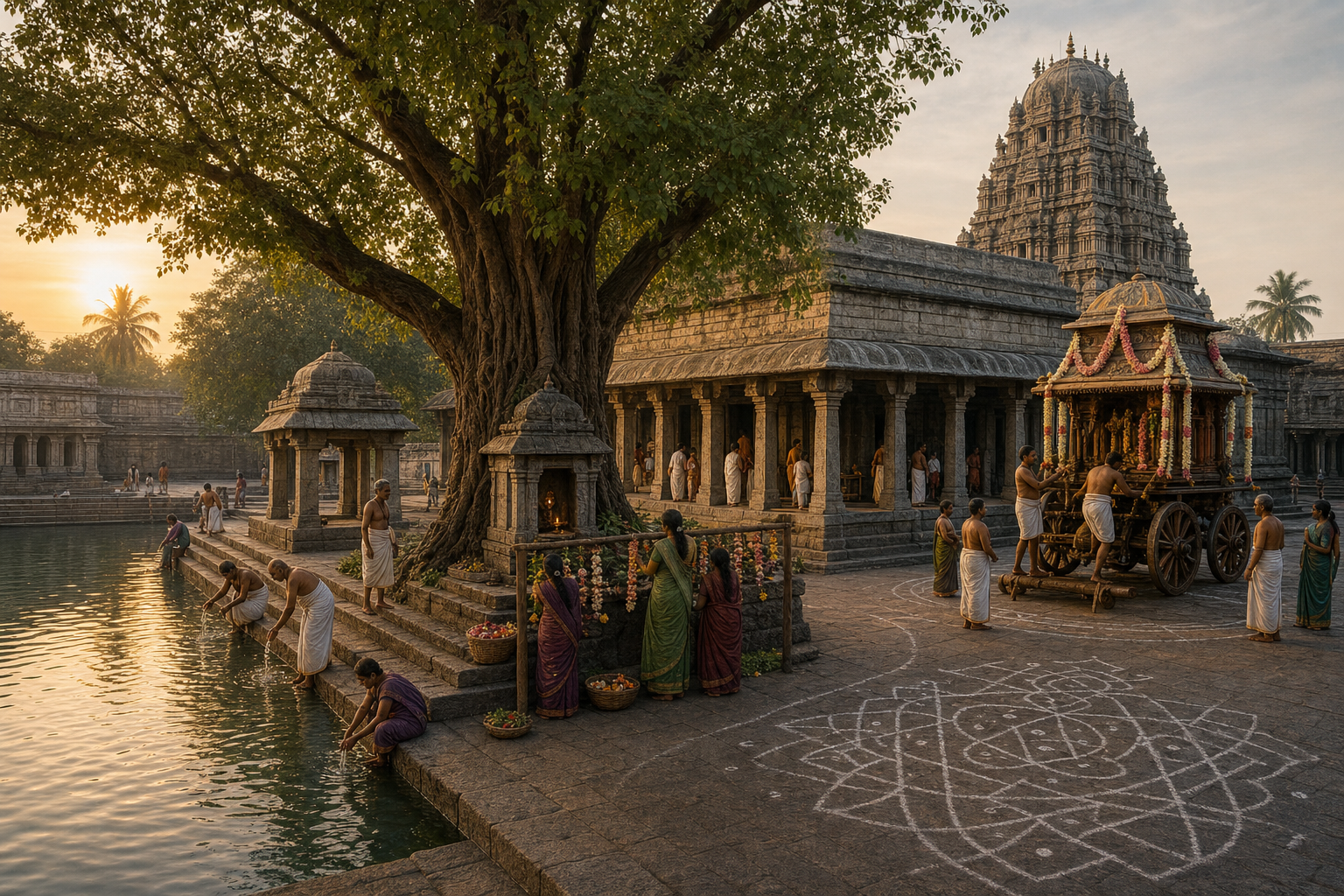
A sthala purana is local sacred history. Its purpose is not exhausted by explaining how a temple was founded. It tells you why this tank, this tree, this shrine, and these streets belong to a connected field of worship. Without that local grammar, you may see impressive architecture but miss why one feature governs the order of approach.
Madurai’s sacred geography begins with Indra wandering under the burden of grave demerit. In a kadamba grove he discovers a linga and worships it with golden lotuses from a nearby tank. Atonement is therefore fixed to place: the kadamba tree, linga, and Pottamarai Kulam, the Golden Lotus Tank, become coordinates of remembered purification. The city’s name is also associated with sweetness and divine nectar from Shiva’s matted locks, so landscape, name, and Shaiva presence reinforce one another.
When you approach the temple, treat the tank as a ceremonial threshold rather than a convenient background for a photograph. Pause long enough to recall the movement from moral burden to worship. This does not make harmful action inconsequential. It gives repentance a discipline: recognition, pilgrimage, offering, and changed orientation precede entry toward the inner shrines.
The local sacred world continues in the sixty-four Tiruvilaiyadals, the divine plays of Sundareshwarar involving kings, poets, artisans, and ordinary residents. Their trials, reversals, mercies, and debates show Shiva engaging a civic world, not remaining sealed in metaphysical distance. The Avani Moola festival carries these plays into the calendar, while Chithirai carries the divine wedding through the city.
Daily worship works at another scale. Six daily Shaiva Agamic pujas include abhishekam, alankaram, naivedyam, and deepa aradhana. These acts wash, adorn, feed, illuminate, and offer reverence to the consecrated presence. The great festival does not replace this recurring liturgy. It extends temple relationships across a larger territory and a longer ceremonial time.
- Permanent scale: the tank, kadamba memory, sanctums, gopurams, pillared spaces, and concentric streets hold the sacred geography in place.
- Daily scale: the Agamic puja cycle renews service to the deities within the temple.
- Annual scale: weddings, divine plays, lamps, chariots, and processions bring particular narratives into public time.
- Personal scale: pradakshina, darshan, offering, restraint, and seva allow the individual worshipper to enter those larger patterns.
Use these scales when a large temple feels overwhelming. Begin with one permanent anchor, learn which daily rite relates to it, identify the major annual enactment, and decide what conduct is asked of you. You do not need to decode every sculpted figure in one visit. You need to understand enough of the place’s sequence to stop treating its parts as disconnected attractions.
Key takeaways for your next Shaiva temple or festival visit
- Trace one myth across four coordinates: narrative, physical anchor, ritual movement, and ethical obligation. If you can identify all four, you have moved from recognition to practical understanding.
- Complete pradakshina attentively: in temples where Lingodbhava stands behind the sanctum, slow down at the western wall and read the searching figures before turning to Shiva’s still central axis.
- Keep doctrinal labels attached: distinguish Advaita, Shaiva Siddhanta, Kashmir Shaivism, and bhakti interpretations instead of blending them into a vague claim that every school says exactly the same thing.
- At a divine wedding, look for real kinship duties: identify who hosts the bride, receives the groom, organizes the route, supplies music, offers water, and maintains order. Those duties are part of the festival’s meaning.
- Learn the local sacred geography: note the sthala tree, tank, mountain, rear-wall icon, subsidiary shrine, and processional street. Ask which narrative makes each one ritually significant.
- Check the local calendar near your visit: tithi-based festival timings and procession routes are set through local panchangs, temple authorities, and committees. A daily puja, a night observance, and a citywide jatra require different preparation.
- Protect the rite from your camera: avoid close-range flash during worship, do not obstruct a procession, and follow temple or volunteer instructions. Receiving the event respectfully matters more than recording every moment.
- Let participation end in seva: use designated waste points, reduce disposable plastic, support legitimate local crafts, and assist only through authorized community arrangements. The myth has reached practice when devotion improves how pilgrims and hosts treat one another.
On your next visit, choose one sacred narrative before trying to master the whole temple. Find where it lives in stone or landscape, follow the movement it creates, and accept the conduct it requires. That is how a Shaiva myth becomes more than something you have heard: it becomes a discipline you can enter.
References
- DharmaRenaissance Blog – Lingodbhava, Shiva’s Infinite Pillar of Light: Iconography, Temple Rituals, and Timeless Wisdom
- HinduPad – Sital Sasthi 2026, Sambalpur: Shiva-Parvati’s Sacred Wedding and Odisha’s Grand Carnival
- HinduPad – Madurai Meenakshi Sthala Puranam: Indra’s Atonement, the Divine Wedding, and Temple History