
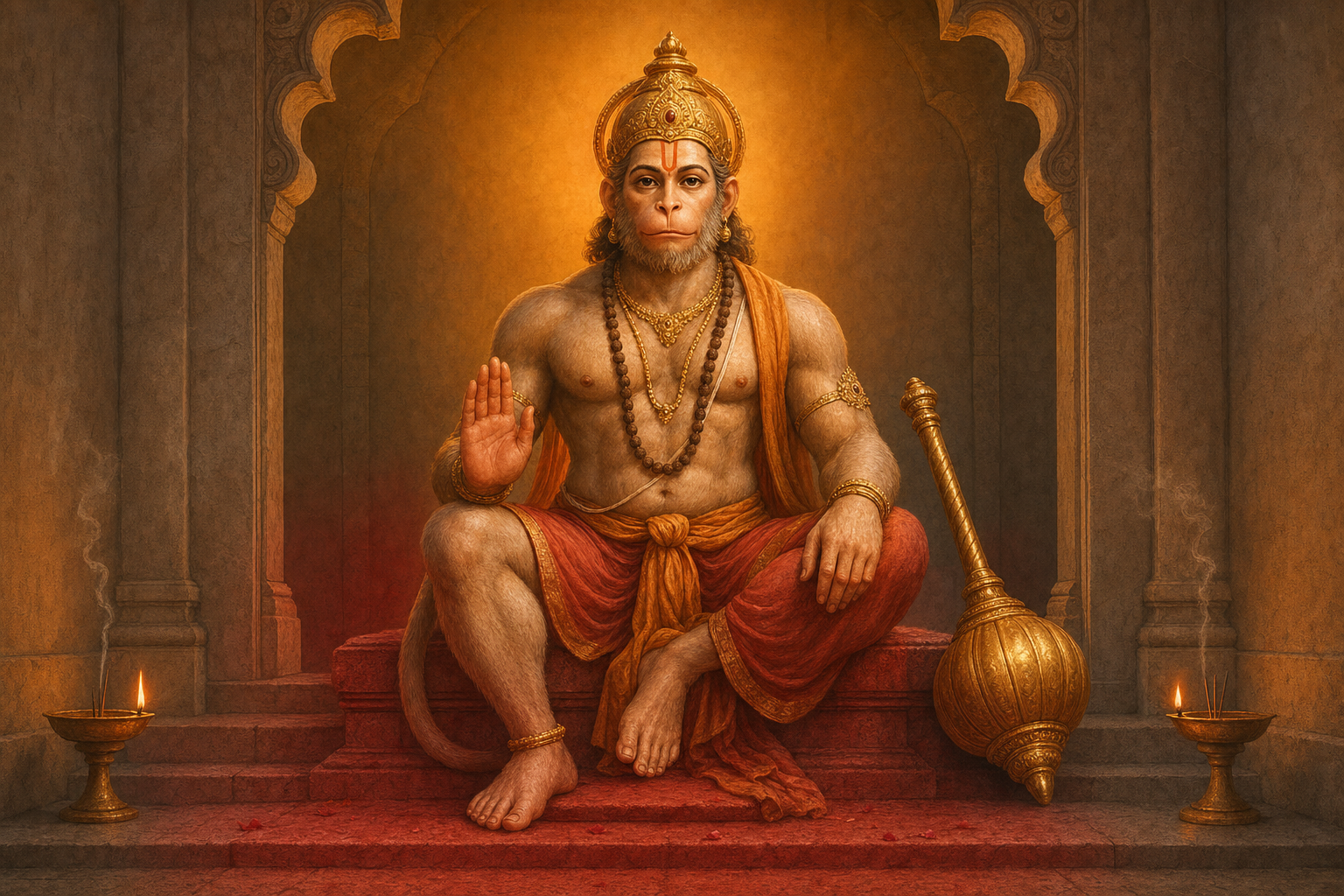
If you have wondered whether Hanuman is supposed to be saffron, scarlet, bright orange, or the natural colour of stone, you are asking the right question in the wrong way. A sindoor-covered murti in North or Western India and an unpainted granite or panchaloha murti in South India can express the same theological centre through different regional forms.
The more useful distinction is this: saffron tells you how Hanuman holds power, while scarlet tells you how he uses it. Saffron disciplines energy through tapas, renunciation, and self-mastery. Scarlet sends that energy into courageous service. Both remain governed by unwavering remembrance of Sri Rama. Read the colours in that order, and they cease to be decoration. They become instructions.
The two colours answer two different questions
Modern eyes tend to merge saffron, vermilion, orange, and red into one vivid band. Dharmic symbolism makes a finer distinction. Saffron points toward the fire that purifies motive before action begins. Scarlet represents the vigour needed to carry righteous action through difficulty. Hanuman embodies their union: inward restraint without passivity, and outward strength without vanity.
This is why Hanuman’s palette cannot be reduced to a vague claim that red means power. Power by itself is morally unfinished. In Hanuman, power is first trained, then offered. His strength belongs to dharma because his will belongs to Rama.
Key takeaways
- Saffron signifies tapas, tyaga, brahmacharya, purified intention, and vitality brought under discipline.
- Scarlet signifies purposeful rajas, vira-bhava, decisive service, and the courage to defend dharma.
- The beloved sindoor tradition expresses total devotion to Sri Rama; it does not require every Hanuman murti to be painted red.
- Regional differences in colour are legitimate. Gesture, weapon, flag, posture, and devotional context can carry Hanuman’s identity without pigment.
- The practical lesson is to purify your motive before acting, act firmly once duty is clear, and surrender the credit afterward.
Saffron is strength mastered before it is used

Bhagwa, kesari, and gerua belong to a related family of sacred colours, but they should not be forced into a modern paint chart. Their shades can move from earthy ochre to glowing orange. What remains steady is the association with tapas, tyaga, and agni: austerity that generates inner heat, renunciation that clears away possessiveness, and fire that both purifies and illuminates.
On Hanuman, saffron makes three qualities visible:
- Brahmacharya gathers vitality instead of allowing it to scatter through impulse.
- Nishkama-seva directs effort toward service rather than personal reward.
- As Vayuputra, Hanuman represents prana harnessed to dharma: speed governed by steadiness, force moderated by compassion, and ability placed at the feet of a higher purpose.
The gunas provide another useful lens. Red commonly evokes the dynamism of rajas, while white is associated with sattva and black with tamas. Saffron can be read as sattva illuminated and strengthened by disciplined rajas. It is not inert purity. It is lucid energy. This is an interpretive aid, not a rigid colour code that every lineage must formulate in exactly the same terms.
That distinction matters in ordinary life. Renunciation does not always mean abandoning a duty, possession, or position. For you, it may mean renouncing the need to be praised while doing the necessary work. Before a difficult conversation, family responsibility, or act of cultural service, let saffron pose the first question: what attachment must be burned away so that I can act cleanly?
The colour also belongs to a wider Dharmic vocabulary. Buddhist kasaya robes make renunciation visible; Jain ascetic disciplines elevate non-possession and ethical purification; Sikh kesri conveys sovereign resolve in the defence of righteousness. These traditions are not interchangeable, and their theologies should not be flattened. Their shared civilizational vocabulary of restraint, courage, and service, however, helps explain why Hanuman’s saffron can speak across sectarian boundaries.
Scarlet is devotion willing to enter the world
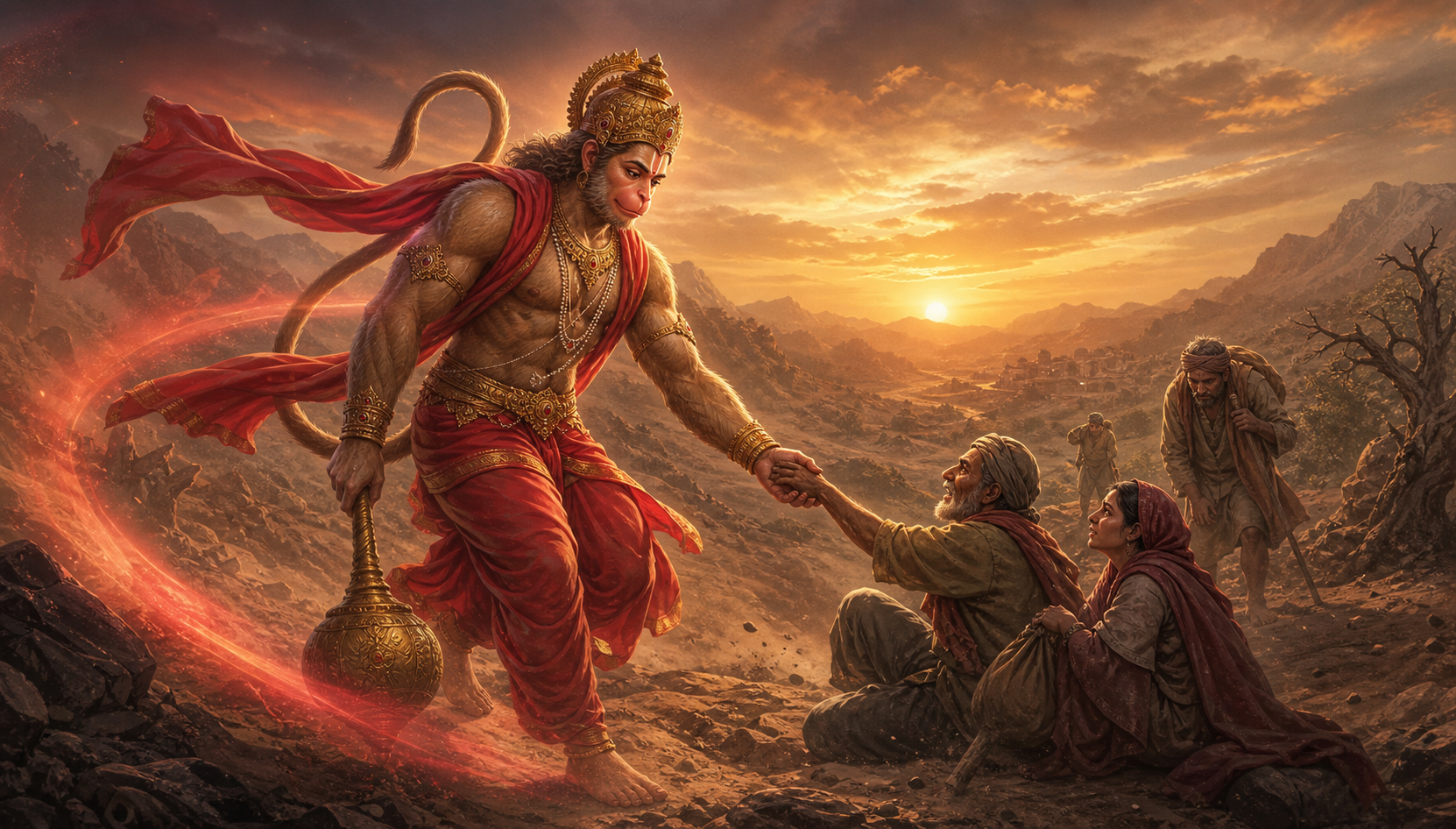
Scarlet moves the symbolism from preparation to performance. In the language of the gunas, it carries the motion and intensity of rajas. In Hanuman’s iconography, that dynamism becomes vira-bhava, the heroic disposition, and kshatra, the disciplined readiness to protect dharma. It does not authorize rage for its own sake. It signifies energy made purposeful by bhakti.
The Sundara Kanda gives you the pattern to notice. Hanuman crosses the ocean, enters hostile territory, searches intelligently, responds to obstacles, and completes his mission without turning the mission into a monument to himself. His movement is immense, but its centre is stable. Scarlet is therefore not mere excitement. It is the willingness to do what devotion requires when reverence must become action.
A widely loved lok-parampara narrative brings that principle into a single image. Sita applies a small mark of sindoor for the long life of Bhagavan Rama. When Hanuman learns its devotional meaning, he covers his whole body with it. The sindoor-covered form expresses unreserved bhakti: if a little vermilion serves Rama, Hanuman will withhold nothing of himself.
Read that narrative for its devotional logic, not as a demand for uniform iconography. It explains why many devotees recognize the orange-red Hanuman as a visual proclamation of total service. It does not make an unpainted Hanuman less authentic, nor does it mean that applying more pigment proves greater devotion.
Temple preparations have historically produced different orange-red shades. Mineral and plant-derived pigments have been used, including cinnabar-based vermilion and turmeric-lime combinations, sometimes mixed with sesame, mustard, or chameli oil. Regional variation is therefore not a defect to be corrected. The hue may change while the intention remains constant: the warmth of agni, the glow of devotion, and the readiness to act.
Tuesdays and Saturdays give this symbolism a recurring ritual rhythm. Tuesday, associated with Mangal, resonates with red’s assertive energy. Saturday brings Hanuman’s protective relationship with Shani into devotional focus. Offerings of sindoor, chameli oil, and marigold garlands can unite colour, scent, touch, mantra, and vrata around one intention. Treat these observances as disciplines of remembrance, not as transactions that mechanically purchase courage or protection.
A murti can be fully Hanumanic without orange or red
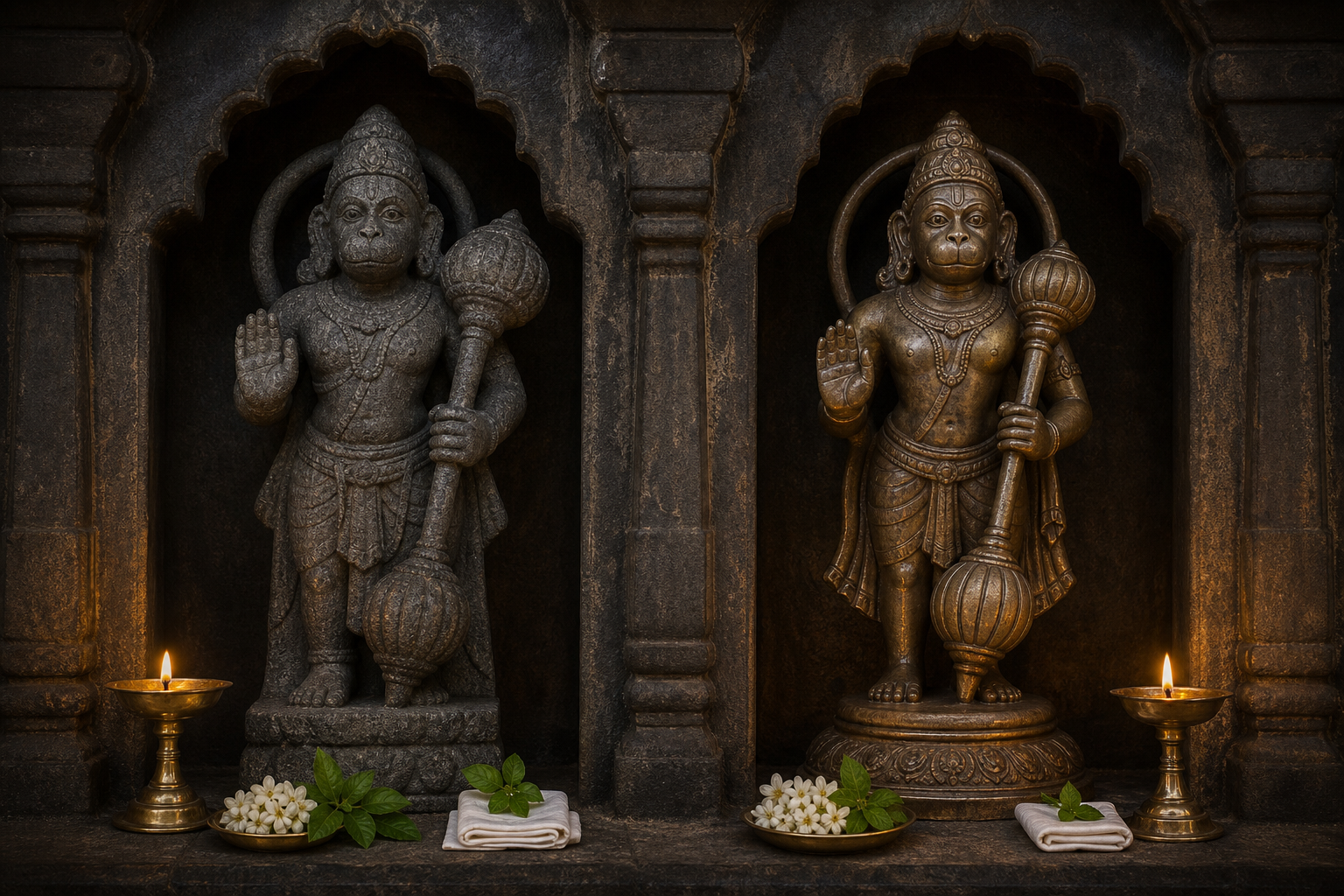
If you visit Hanuman temples across Bharat, do not use paint as an authenticity test. North and Western Indian shrines often present Hanuman in intense orange-red. South Indian temples frequently preserve the visible surface of granite or panchaloha while using chandan, vibhuti, kumkum, textiles, flowers, and jewellery for alankara. One mode foregrounds devotional warmth and heroic energy; the other can foreground permanence, gravity, and concentrated darshan.
Agamic and shilpa traditions allow Hanuman’s attributes to communicate what colour alone cannot. At your next darshan, widen your attention to the entire form:
- The gada signifies strength that has been trained and placed under command. It is not a celebration of uncontrolled force.
- Abhaya mudra assures protection and the dispelling of fear.
- Varada mudra directs attention toward grace, generosity, and the granting of blessings.
- The Rama-dhvaja identifies the sovereignty Hanuman serves. His force has an allegiance and is never self-authorizing.
- Panchamukhi Hanuman places emphasis on directional guardianship, protection, and the mantric geometry of the five faces; colour remains secondary to the structure of the form.
This fuller reading protects you from two opposite errors. The first is to treat colour as meaningless ornament. The second is to treat one colour convention as the complete measure of orthodoxy. Hanuman’s mudras, gada, flag, posture, and protective forms preserve his theological identity across different palettes.
The bhagwa dhvaja deserves the same care. At a Hanuman temple, the saffron banner announces the victory of dharma as an ethical commitment. Read it first as a demand for self-mastery, courage, and seva, not merely as a partisan badge. A flag raised above a temple should also raise the standard of conduct in the person standing beneath it.
Turn Hanuman’s palette into a home practice
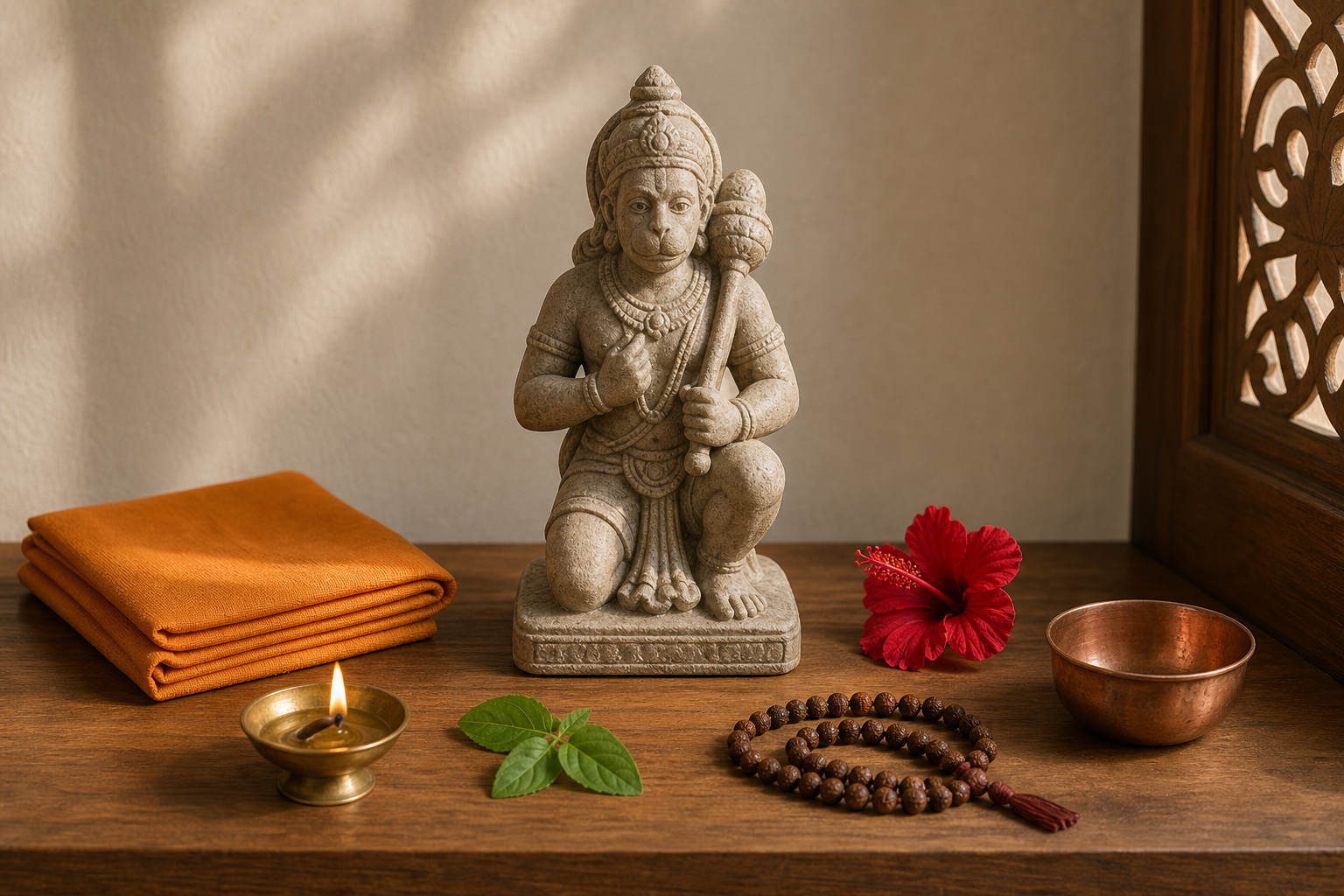
A colour-aware Hanuman puja does not require an elaborate altar. Its purpose is to connect what your eyes see with the quality you intend to cultivate. Keep the arrangement simple enough that the symbolism remains clear.
- Choose the inner work first. Use saffron as your cue when you need restraint, clarity, or purification of motive. Use scarlet when duty is already clear but courage and follow-through are lacking. Use both when you need disciplined action.
- Select modest offerings that fit your tradition. A saffron cloth, marigold or hibiscus flowers, and a small amount of natural sindoor can carry the symbolism. If your murti is not customarily anointed, place the colour before it through cloth or flowers instead of improvising a coating.
- Anchor the colour in Rama-smriti. Offer it with Ram-nama japa or an unhurried recitation of the Hanuman Chalisa. The colour should return the mind to Rama, because Hanuman’s strength becomes intelligible through that allegiance.
- Name one act of restraint. It may be refusing a boast, containing an angry reply, completing a vrata, or giving up the desire to control another person’s response. This is the saffron commitment.
- Name one act of service. Finish the neglected duty, defend someone without cruelty, help without advertising the help, or take the necessary step you have delayed through fear. This is the scarlet commitment.
- Review both at the end of the day. Ask whether restraint purified your action or merely became avoidance. Then ask whether courage served dharma or merely fed agitation. Correct the imbalance the next day.
If your family or temple observes a particular Tuesday or Saturday procedure, let that living tradition guide the details. The simplest home arrangement of cloth, flowers, sindoor, and Ram-nama is already sufficient when it deepens shraddha, smriti, and seva. A brighter altar cannot compensate for a motive left unexamined.
The next time Hanuman’s saffron-scarlet form meets your eyes, pause before asking what the colour promises you. Ask what it requires from you. Begin with saffron: master the impulse and purify the motive. Continue with scarlet: cross the distance and complete the duty. End as Hanuman does: return the deed and its credit to Sri Rama.