

If Akshaya Tritiya has started to feel like a shopping deadline, step back before you open a jewellery app. You do not need an expensive purchase to observe the day faithfully. You need a clear sankalpa, a practice rooted in your tradition, and a gift that genuinely sustains someone.
That is the practical meaning to carry into Vaishakha Shukla Tritiya. Akshaya means that which does not diminish, but the festival is not a bargain in which spending guarantees a multiplied material return. Its enduring logic is that devotion becomes credible when it moves outward as dana, seva, nourishment, gratitude, and restraint.
Begin with the meaning of akshaya, not a purchase
A useful household rule is simple: worship first, give deliberately, and buy only what serves a real purpose. Gold may represent permanence and family security, but the dharmic meaning of wealth is stewardship. Artha supports dharma when it protects a household while also circulating toward hunger relief, education, health, and community welfare.
Do not borrow money, carry costly debt, or disturb essential household expenses merely to buy gold for the occasion. An auspicious purchase does not become prudent because it was made on an auspicious tithi. If gold already fits your family’s savings plan, keep the purchase within that plan. If it does not, lighting a lamp, offering food, distributing water, or serving with your own time is a complete and meaningful observance.
Before spending, apply three tests:
- Purpose: Does this expense meet a genuine household or community need, or is it driven by social pressure?
- Proportion: Can you afford it without reducing money needed for food, housing, health, education, or existing obligations?
- Circulation: What portion of your available money, goods, or time will move outward in service rather than remain only as personal possession?
This distinction matters because prosperity is not simply whatever stays locked away. The day asks you to notice whether wealth is being governed by discernment. A modest gift that reaches the right person can embody that principle more clearly than a large ceremonial expense made for display.
Build an observance that fits your sampradaya and household

Akshaya Tritiya, also called Akha Teej, falls on Vaishakha Shukla Tritiya in the Hindu lunar calendar. Many dharmashastric and regional traditions regard it as especially suitable for beginning study, taking a sankalpa, and performing dana. That does not mean every family must assemble every custom associated with the day.
Use your family’s panchanga and the guidance of your temple, guru, or established lineage when observances differ. A coherent practice rooted in one tradition is better than a crowded ritual assembled from unrelated social-media instructions.
A simple sequence can carry the day:
- Prepare the previous evening. Decide whom you will serve, what you will give, and which household expenses must remain untouched.
- Begin with snana and a few quiet minutes of recollection. Cleanliness should create attention, not become an elaborate performance.
- State a precise sankalpa. Name the act, the intended beneficiary, and whether you will repeat it after the festival.
- Perform the worship customary to your home. This may include puja to your ishta-devata, tulasi archana, japa, scriptural reading, or pitri tarpan where that belongs to family practice.
- Observe a simple upavasa only if it is customary and compatible with your health. Fasting is not a test of spiritual worth; when it conflicts with health needs, choose another form of restraint and follow appropriate professional guidance.
- Complete the chosen act of dana or seva before errands and celebration consume the day. If another person is coordinating it, confirm the arrangement in advance.
Some Vaishnava and Smarta lineages commemorate Bhagavan Parashurama’s appearance on Akshaya Tritiya. Select traditions associate the day with Balarama, while some Puranic and regional calendars connect it with the beginning of Treta Yuga. These associations are not uniform across all sampradayas. Treat a regional or lineage-specific memory with reverence, but do not present it as a universal requirement.
The familiar connection between Akshaya Tritiya and Vyasa’s dictation of the Mahabharata to Ganesha should be handled with the same care. Their collaboration belongs to Pauranic tradition, but the Mahabharata’s Adi Parva does not assign it a fixed calendrical date. You can honour the association by beginning serious study, supporting knowledge transmission, or helping someone obtain learning materials without turning a devotional calendar tradition into an uncontested textual claim.
Regional observances reveal another dimension of the festival. In Puri, the day begins Chandan Yatra and the ceremonial construction of the Ratha Yatra chariots. Gangotri and Yamunotri traditionally open their portals, linking pilgrimage with reverence for the rivers. Farming communities in several regions honour seed, soil, rain, and the beginning of sowing. These are not extra items for every household checklist. They show how a sacred tithi can organize craftsmanship, pilgrimage, ecology, agriculture, and collective labour around dharma.
Choose charity by the need it meets
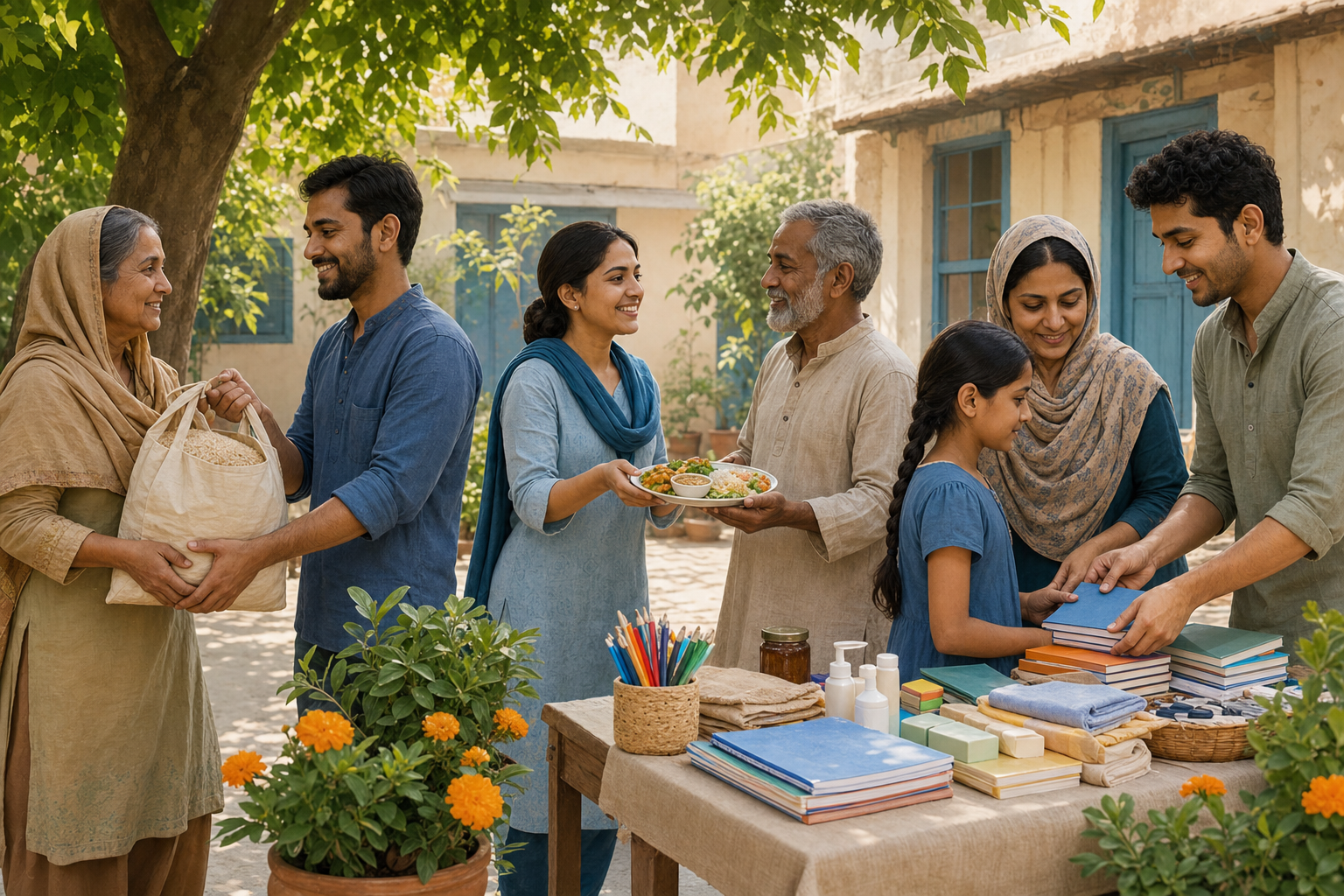
The strongest Akshaya Tritiya charity begins with a real need, not a photogenic symbol. Ask what is missing, who is already doing reliable work, and what will happen after your contribution is delivered. A water pot that no one cleans or refills is a gesture. A maintained water-distribution point is seva.
The festival’s traditions give you several practical directions:
- Annadana: Sponsor meals through a temple, community kitchen, or trusted local group. You can also contribute grain or other requested staples when an organization is equipped to store and distribute them.
- Jal-dana: Support drinking-water distribution during the hot season. If you organize it yourself, assign responsibility for safe water, clean vessels, regular replenishment, and waste removal.
- Gau-seva: Ask a trustworthy goshala what it presently needs rather than assuming. Feed, upkeep, and care are more useful when they answer a verified requirement.
- Education: Provide requested books, learning materials, or financial support through a credible school or community initiative. Knowledge-giving fits the day’s association with disciplined study and transmission.
- Health and hunger relief: Contribute through an established organization that can identify recipients and use funds responsibly. Do not substitute an improvised remedy for qualified care.
- Personal seva: Cook, serve, clean, transport supplies, or help with administration. A household with little spare money can still give attention, effort, and dependable time.
Annadana has special force on this day because anna is treated as sacred sustenance, not ordinary surplus. Devi Annapurna’s offering of alms to Shiva expresses the truth that no status places a being beyond the need for nourishment. Let that affect the way you serve. Offer food you would be willing to receive, protect the recipient’s dignity, and do not turn another person’s hunger into devotional scenery.
Use this five-check plan before making a donation:
- Identify the need. Ask the recipient or organizer what is actually required.
- Verify the channel. Confirm who will receive the contribution, how it will be used, and who is responsible for delivery or upkeep.
- Protect dignity. Do not require public gratitude, religious performance, or a photograph in exchange for help. Obtain consent before recording anyone.
- Count the full cost. Include transport, storage, preparation, cleaning, and follow-up so the activity does not leave those burdens to someone else.
- Choose a repeatable element. Even if the main gift is annual, add a smaller monthly or seasonal commitment that your household can sustain without strain.
For Jains, Akshaya Tritiya commemorates Rishabhanatha, or Adinath, breaking his long fast after Shreyansh Kumar offered sugarcane juice in the correct manner. The memory is not merely about giving a substance. It is about learning how to give in a way appropriate to the recipient. If you offer alms to ascetics or support a religious community, respect its disciplines instead of expecting it to adapt to the donor’s convenience.
The family resemblance across dharmic paths is real, but their forms should not be blurred. Hindu annadana, Jain dana and fasting, Buddhist dana, and Sikh seva and langar are not interchangeable rites. They converge around generosity, right intention, non-violence, and service. If you join another community’s effort, ask what help is useful, follow its dietary and monastic protocols, and allow that tradition to name its own practice.
Read the sacred stories as instructions, not guarantees
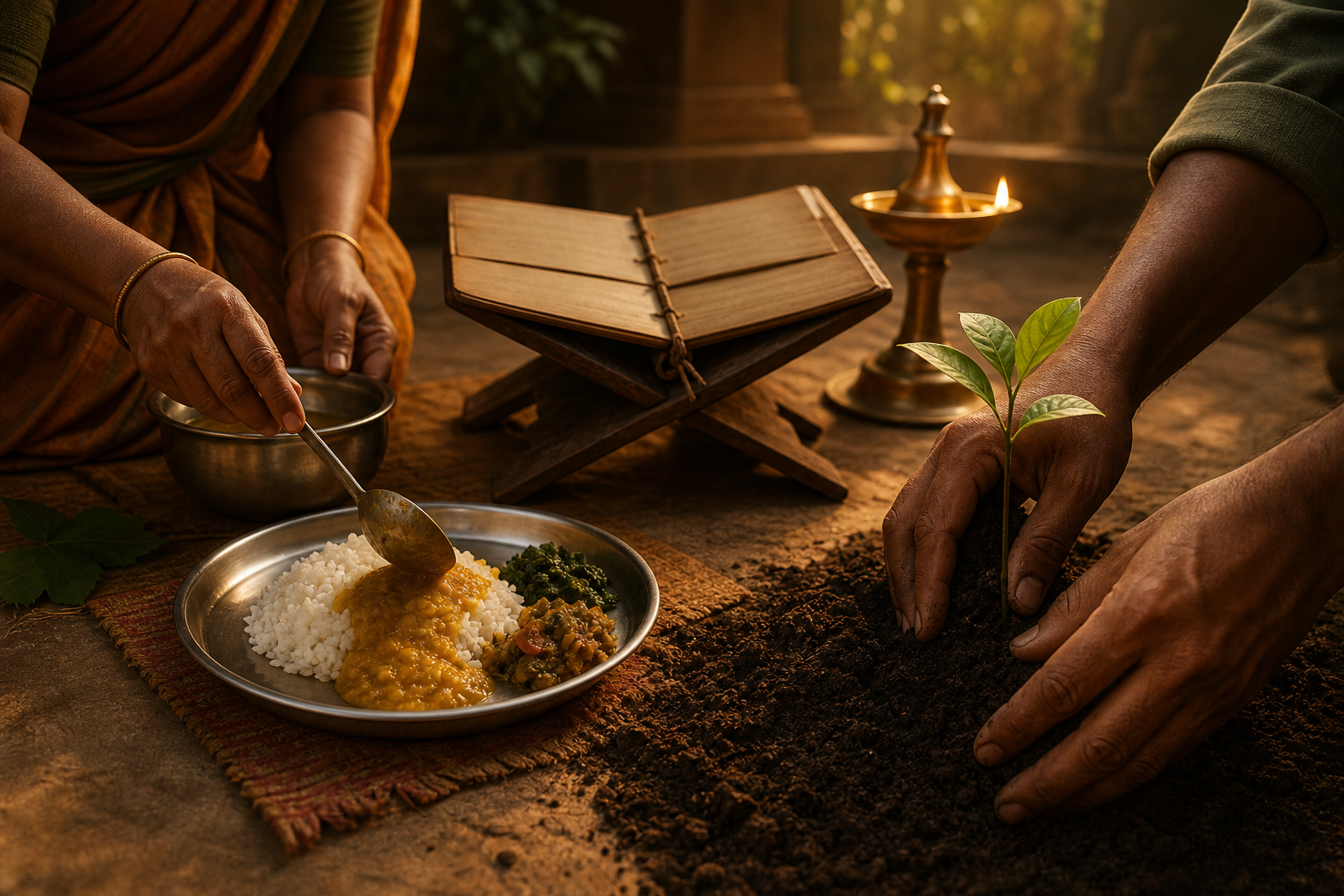
Akshaya Tritiya gathers stories of inexhaustible nourishment, humble offering, disciplined power, and divine grace. Their value is not that they promise a mechanical return on a transaction. Each one trains your attention toward a different quality of giving.
- Akshaya Patra teaches preparedness in scarcity. In popular retellings of the Mahabharata’s Vana Parva, the vessel granted by Surya sustains the Pandavas in exile. Draupadi’s prayer and Krishna’s acceptance of a remaining morsel bring relief when Sage Durvasa and his disciples seem likely to overwhelm the household’s ability to offer hospitality. The practical question is whether your community has dependable systems for feeding people when ordinary resources are strained.
- Sudama teaches that the worth of an offering is not set by its market price. He brings Krishna humble parched rice, asks for nothing, and receives immeasurable grace. Give without humiliating the recipient, advertising the donor, or treating gratitude as repayment.
- Annapurna teaches that food is a sacred trust. Buy and prepare with care, serve without contempt, and avoid waste. Feeding someone is not the lesser alternative to a more visibly religious act; it is itself an expression of dharma.
- Parashurama teaches that strength requires restraint. If you control money, land, organizational authority, or family resources, use that power without domination. Charity that creates dependence on the donor’s approval has missed the ethical point.
- Vyasa and Ganesha teach disciplined knowledge transmission. If education is your chosen field of dana, support the patient work that makes learning possible: materials, access, teaching, and the conditions needed for sustained study.
None of these narratives turns a donation or gold purchase into a risk-free financial instrument. The festival’s language of inexhaustible merit belongs to a moral and devotional vision. Continue to use ordinary scrutiny for investments, business decisions, contracts, and large purchases. Dharma does not require you to suspend viveka.
Turn one auspicious day into a durable discipline

A single day of generosity can be sincere, but the word akshaya becomes more intelligible when the good created by your action outlives the calendar date. Food should reach a person, water service should remain maintained, knowledge should continue to circulate, and a household vow should survive the enthusiasm of the festival.
Key takeaways
- You do not need to buy gold to observe Akshaya Tritiya meaningfully.
- Choose worship and charity that fit your family, temple, panchanga, and sampradaya.
- Prioritize a verified need such as food, water, care, education, or dependable personal service.
- Give in a form appropriate to the recipient, especially when serving ascetics or another dharmic community.
- Protect essential household finances; generosity funded by harmful debt contradicts responsible stewardship.
- Add one repeatable commitment so the observance produces benefit beyond the tithi.
Write your sankalpa in operational language: On Akshaya Tritiya, our household will provide or perform [specific gift or service] for [recipient or community] through [trusted channel]. We will repeat [smaller action] at [realistic interval] and check whether it continues to meet the stated need.
Give each part an owner. One person confirms the recipient’s requirement. Another arranges funds or materials. Someone handles delivery and follow-up. If children participate, give them a real responsibility suited to their capacity, such as preparing supplies or helping serve, rather than letting charity remain an adult transaction they merely watch.
Before the next Akshaya Tritiya arrives, make two decisions: who will be served, and what your household can continue without strain. Put both in writing before making any purchase. That small discipline turns an auspicious date from a wish for abundance into a practice of responsible abundance.