

You may know the names of deities, asuras, chakras, yoginis, and bīja syllables yet still be unsure what to do when envy, anger, confusion, or compulsive speech takes hold. That is the practical test. If a sacred map cannot help you recognize the next dharmic choice, it remains information rather than sādhanā.
Purāṇic and Tantric maps become useful when you read them at different resolutions. The Purāṇic map identifies the pattern governing you and presents the divine capacity that can overcome it. The Tantric map brings the inquiry into breath, voice, silence, and embodied habit. Used carefully, without treating distinct lineages as interchangeable, they give you a disciplined way to notice an affliction, choose a corrective action, and see whether transformation is actually occurring.
One journey mapped at two different resolutions

Purāṇic storytelling places an inner conflict on a cosmic stage. An asura can be read not only as an enemy in a narrative but also as an affliction that occupies attention and distorts conduct. The divine form is not merely a rescuer arriving from outside. It reveals the awakened capacity with which the affliction must be met. The conflict becomes memorable because envy, pride, greed, and anger are given names, forms, consequences, and antidotes.
The eightfold Gaṇeśa scheme associates distinct forms of Gaṇapati with envy, pride, delusion, greed, anger, desire, possessiveness, and conceit. This is a moral and devotional map. It helps you ask three practical questions: What has seized my attention? Which divine quality opposes it? What action would embody that quality now?
Tantric mapping changes the scale of observation. Instead of dramatizing the whole conflict, it examines the places where consciousness, breath, sound, and bodily habit meet. At Viśuddhi, the throat centre, the question becomes audible: Has your insight changed how you speak, listen, pause, and transmit meaning? A refined philosophy delivered through sarcasm, intimidation, dishonesty, or compulsive interruption has not yet refined the person speaking it.
Do not collapse the two maps into crude equivalences. A Gaṇeśa form is not a chakra, an asura is not a gland, and a yoginī is not a medical symptom. Their relationship is functional. Purāṇic narrative helps you identify the drama of bondage and liberation; Tantric subtle-body language helps you notice how that drama is carried through attention, breath, sound, and action.
Key takeaways
- Name the affliction by its observable behaviour rather than turning it into a permanent identity.
- Use the corresponding divine form to identify the quality and conduct required from you.
- Watch the throat because inner disorder often becomes visible in tone, timing, silence, exaggeration, or aggression.
- Judge progress by changed relationships and choices, not by the quantity of symbolism you can explain.
- Keep initiatory mantra, nyāsa, breath retention, and lineage-specific visualisation within qualified transmission.
Use the eight Gaṇeśa forms as an ethical diagnostic
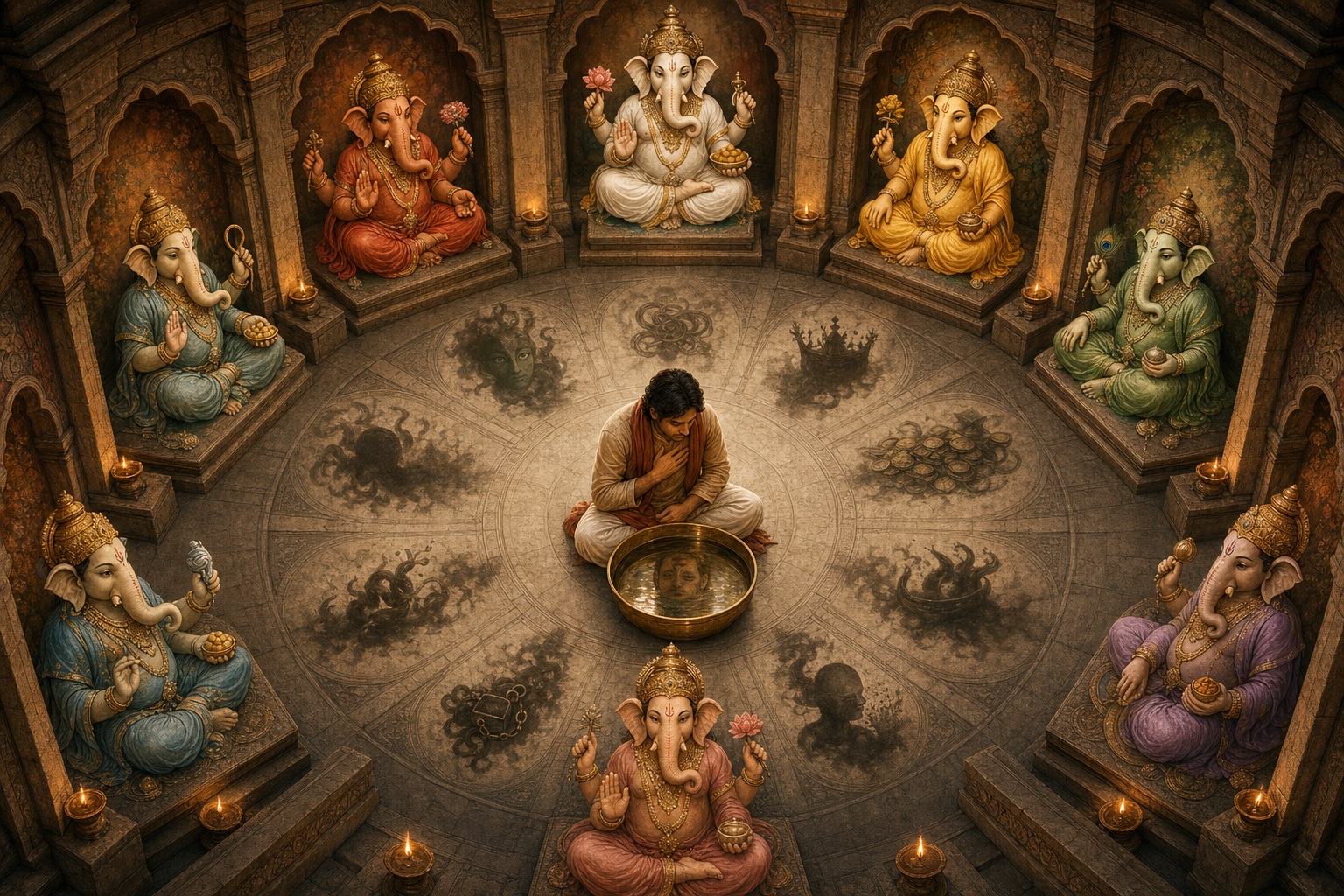
The eight forms are most useful when you resist the temptation to choose the one you find aesthetically appealing. Begin instead with evidence. Recall a recent moment in which your values and your conduct separated. Identify the force active in that moment, then use the corresponding form to select a corrective response.
| Gaṇeśa form | Affliction overcome | How the pattern may appear in you | First corrective move |
|---|---|---|---|
| Vakratunda | Envy, or matsara | Another person’s excellence feels like your diminishment, so appreciation turns into comparison or resentment. | Name what is genuinely admirable, express sincere appreciation, and identify a quality you can learn. |
| Ekadanta | Pride or intoxication, or mada | Talent, learning, status, or success makes correction feel beneath you. | Ask what you may be missing and recommit to the higher task rather than the image of yourself performing it. |
| Mahodara | Delusion or infatuation, or moha | You treat a fear, attachment, assumption, or preferred story as established fact. | Separate what you know from what you are assuming; use patient reflection, steady breath, and mantra before deciding. |
| Gajanana | Greed, or lobha | The point of enough keeps moving, and every gain immediately becomes the basis for wanting more. | Convert ownership into stewardship through responsible use, gratitude, sharing, and restraint. |
| Lambodara | Anger, or krodha | Urgency pushes speech and action ahead of discernment. | Contain the first reaction through pause and prayer, then direct the energy toward protection, service, or necessary correction. |
| Vikata | Unbridled desire, or kāma | An appetite repeatedly dictates attention even when it conflicts with your purpose. | Use tapas, noble company, and one-pointed remembrance to place passion in service of a worthy aim. |
| Vighnaraja | Possessiveness, or mamā | You treat knowledge, resources, authority, relationships, or lineage as extensions of yourself. | Act as a guardian: protect what is valuable, improve it where you can, and share it as a trust rather than a private possession. |
| Dhumravarna | Conceit, or abhimāna | Your need to appear important, superior, indispensable, or unquestionably right takes over the moment. | Choose contemplative silence or japa, acknowledge your limits, and restore a truthful sense of proportion. |
Several distinctions in this map matter. Greed and possessiveness are related, but they are not identical. Greed keeps reaching for more; possessiveness fastens the self to what has already been claimed. Pride and conceit also require different treatment. Mada is an intoxication with capacity, status, or success. Abhimāna is the self-importance that makes an identity or role seem absolute. If you merge all four into a vague category called ego, you lose the diagnostic precision that makes the map actionable.
Use behavioural language when applying the map. Instead of declaring that you are an angry person, identify what anger did: it shortened your listening, hardened your tone, made punishment feel like justice, or pushed you to answer before understanding. Instead of calling yourself greedy, identify the decision in which accumulation displaced stewardship. This keeps moral responsibility intact without turning a passing affliction into your permanent nature.
The same discipline prevents projection. If you use the asura names mainly to classify relatives, colleagues, political opponents, or rival communities, the map has become another instrument of conceit. Begin with the force operating through your own attention. You can still oppose adharma in the world, but you will be less likely to reproduce the same disorder through the way you oppose it.
Viśuddhi makes inner transformation audible

Viśuddhi is associated with the throat, ākāśa, the bīja haṃ, and a lotus of sixteen petals corresponding to the Sanskrit vowels. In the Kaula mappings represented by the Kubjikā and Kularnava traditions, Śākinī presides where breath, sound, and meaning are purified. The vowels are not treated as arbitrary marks. They are powers of voiced openness carried by breath, while consonants give that current defined form.
Śākinī is also associated with asthi, or bone tissue. Her bone-breaking force should be read as transformative symbolism, not literal violence. Bone signifies deep structure: the habits and identities that have become so rigid that they feel natural and unquestionable. What must be broken is the rigidity that keeps producing sarcasm, suppression, timidity, compulsive argument, or speech shaped by fear. The intended result is not weakness. It is a voice capable of being firm without becoming cruel and gentle without becoming evasive.
This gives you a practical test for every supposed spiritual gain. If contemplation has made you more certain but less able to listen, something remains unresolved. If mantra has made you more forceful but less truthful, the carrier of the mantra still needs purification. If silence is being used to punish or manipulate, it is not the spaciousness of ākāśa. The throat reveals whether an inner insight has become relationally trustworthy.
A non-initiatory speech check
- Let your breath return to its natural movement. Do not force it or hold it.
- Notice the throat, jaw, and root of the tongue while also noticing the sentence you are preparing to say.
- Name the force shaping that sentence: envy, pride, delusion, greed, anger, desire, possessiveness, or conceit.
- Edit the sentence for truthfulness, timing, measure, and benefit. If it cannot yet meet those tests, remain silent without using silence as retaliation.
- Speak as clearly as the situation requires, then listen to the response instead of planning your next defence.
This is an ethical observation practice, not a substitute for initiation. The bīja haṃ, mātṛkā-nyāsa across the petals, mudrā, specialised prāṇāyāma, and breath retention belong to technical systems whose visualisations and ritual details differ by lineage. A diagram can orient you, but it does not confer authority to assemble advanced practices from disconnected instructions. If you have received a method from a qualified teacher, follow that method accurately. If you have not, natural breathing, attentive listening, truthful speech, and restraint provide substantial work without pretending to an initiation you do not possess.
Do not interpret persistent pain, hoarseness, swallowing difficulty, or another physical throat problem as proof of a blocked chakra or a spiritual failure. Such symptoms deserve appropriate health evaluation. The Viśuddhi map can guide ethical and contemplative attention, but it is not a medical diagnosis and should not replace clinical care.
Turn the maps into a repeatable sādhanā loop

A useful routine must connect devotion, observation, conduct, and review. Otherwise you may feel sincere during worship yet remain unprepared at the exact moment an old pattern returns. The following loop keeps the sacred image present without reducing it to decoration.
- Choose from evidence. At the beginning of your day, recall the most recent situation in which an affliction distorted your behaviour. Select that pattern rather than trying to work on every affliction at once.
- Invoke the counter-form. Bring the corresponding Gaṇeśa form to mind. If Gaṇeśa worship already belongs to your practice, a simple ārati or the mantra Om Gam Ganapataye Namah can establish the devotional orientation.
- Make the vrata observable. Do not vow merely to be less angry or more humble. Choose conduct that can be seen: ask for correction without defending yourself, congratulate someone without qualification, share knowledge you have been guarding, or postpone a heated response until you can state its dharmic purpose.
- Catch the pattern at the throat. When the trigger appears, notice the breath, jaw, tongue root, intended tone, and impulse either to attack or withdraw. Name the affliction before it becomes speech.
- Review consequences and repair. Later, identify the trigger, what you actually said or did, which counter-quality you attempted, and whether a repair remains necessary. If harm was done, apology and correction are more important than constructing a spiritual explanation for it.
What the loop looks like in an ordinary moment
Suppose another person receives recognition and your first impulse is to diminish the achievement. The Purāṇic map identifies matsara and directs you toward Vakratunda. The throat-centred map catches the affliction as it prepares a sarcastic remark, a dismissive qualification, or a conspicuous silence. Your vrata supplies the alternative: let the remark pass unspoken, acknowledge the merit sincerely, and identify something in the person’s work that you can learn.
The evening review does not ask whether you managed to feel no envy. It asks whether envy governed your speech and action. That distinction matters. Immediate emotional purity is often an unrealistic demand; refusing to make another person carry the cost of your affliction is an available dharmic choice. Repeated choices of this kind gradually retrain the habit that the asura personifies.
Traditional offerings can support the same training when you understand them pedagogically rather than transactionally. Durvā, modaka, seasonal fruit, ārati, mantra, and vrata orient attention toward freshness, simplicity, gratitude, and disciplined sweetness. The outer act should remind you of the inner commitment. If an offering is followed by the same unchecked greed, anger, or possessiveness, add a behavioural vrata instead of merely adding more ritual complexity.
Judge the path by conduct while respecting each lineage
Progress in these maps is less theatrical than people sometimes expect. Vakratunda is becoming active when another person’s success can teach you rather than diminish you. Ekadanta is visible when correction no longer threatens your whole identity. Mahodara appears as the capacity to hold conflicting impressions until discernment becomes possible. Gajanana is present when prosperity becomes stewardship. Lambodara is evident when anger is contained and redirected into protective care. Vikata appears when desire can accept discipline. Vighnaraja is working when possession becomes guardianship. Dhumravarna clears the haze when dignity no longer requires dominance.
Viśuddhi supplies a parallel set of signs. Speech becomes more truthful without becoming needlessly abrasive. Tone becomes compassionate without becoming vague. Listening becomes part of communication rather than a pause before rebuttal. Silence becomes contemplative rather than punitive. Words become timely, measured, and beneficial. These are more reliable signs of purification than unusual sensations in the throat or the ability to recite a long catalogue of correspondences.
Do not force the eight Gaṇeśa forms into a rigid timetable for every practitioner. They provide a curriculum of afflictions, not permission to declare that everyone must encounter them in an identical sequence. Your dominant pattern may change with circumstance. Greed may conceal fear; anger may defend pride; possessiveness may imitate care. Return to observed conduct whenever the classification becomes uncertain.
Dharmic traditions share striking ethical resonances without becoming interchangeable systems. Buddhist discussions of lobha, dosa, and moha, Jain reflection on krodha, māna, māyā, and lobha, and Sikh attention to haumai all recognize that liberation requires more than assent to a doctrine. Right Speech, the Jain alignment of satya with ahiṃsā, and Sikh remembrance through nām and kīrtan likewise show that voice can become a field of discipline. This is a civilisational family resemblance, not evidence that each tradition teaches the same theology, ritual method, or final account of liberation.
Begin with the last moment when your speech failed to reflect your values. Name the affliction, select the corresponding Gaṇeśa form, and set a behavioural vrata for the next recurrence. When the trigger returns, meet it at the throat before it becomes harmful speech. Then review the consequence honestly. That is how a sacred map stops being something you admire and becomes a path you can walk.
References
- DharmaRenaissance Blog — Mudgala Purana Decoded: Timeless Ganesha Wisdom, Eight Incarnations, and Why It Matters
- DharmaRenaissance Blog — Shakini of the Vishuddhi Chakra: Bone-Breaking Power in Kubjika and Kularnava Tantras