
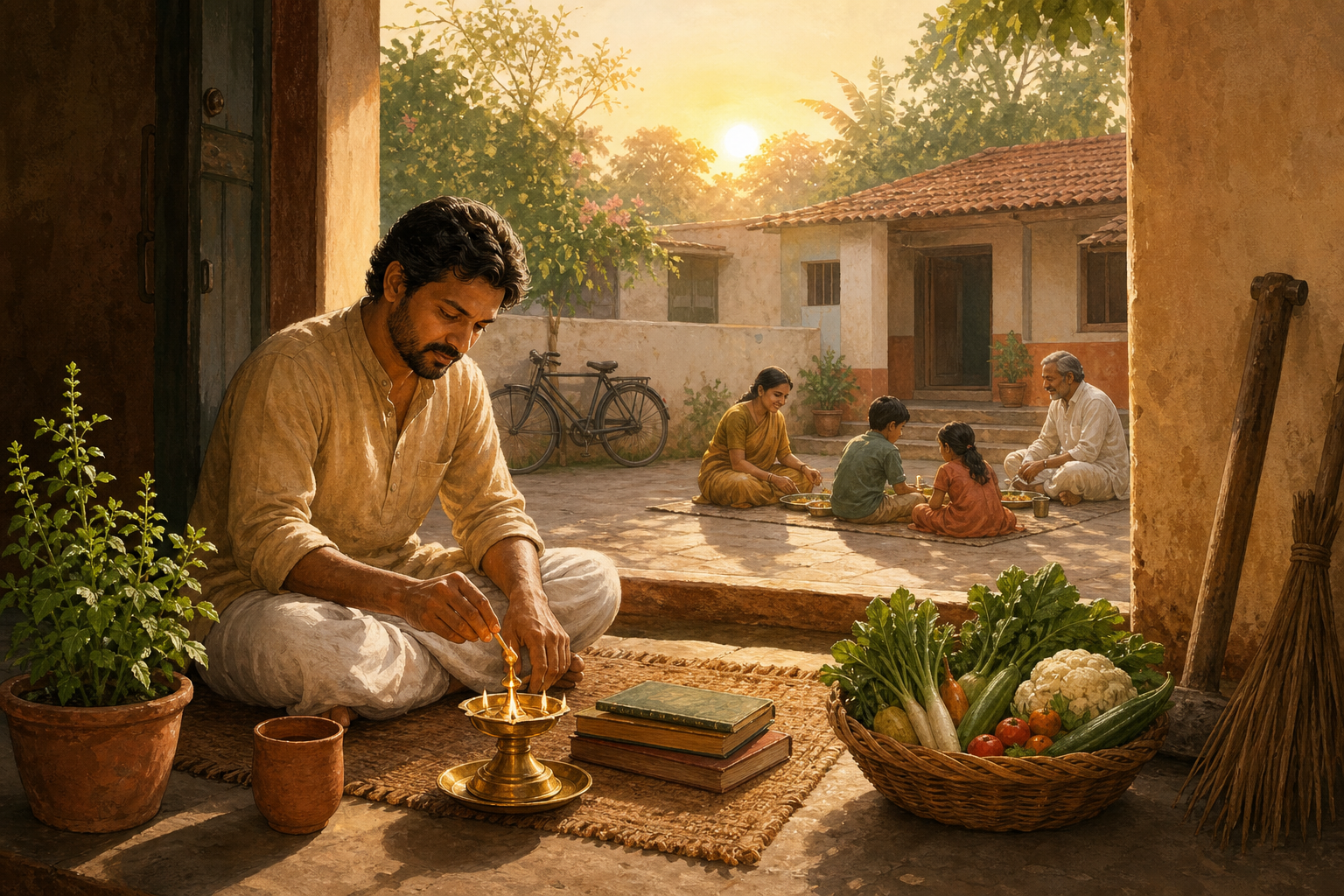
If your honest vision of a good life is a modest home, useful work, unhurried meals, dependable relationships, spiritual practice, and enough money to meet your duties, you may wonder whether you are settling. The surrounding culture has trained many of us to treat every limit as a defect and every contented person as insufficiently ambitious.
You do not have to turn life into an expansion project. But wanting less becomes liberating only when it is chosen clearly. It should reduce grasping without reducing responsibility, curiosity, generosity, health, or joy. That distinction is the heart of Dharmic minimalism.
First decide whether you want simplicity or merely relief
A smaller life is not automatically a wiser life. Sometimes the wish to withdraw appears because your current pattern is wasteful and misaligned. At other times it comes from exhaustion, discouragement, financial fear, grief, or a loss of interest that extends far beyond possessions. The outer wish may sound the same while the inner condition is entirely different.
Before making a major change, ask what you expect simplicity to restore. A clear answer sounds like more time for family, steadier sadhana, less debt pressure, work that does not consume every waking hour, or freedom from maintaining things you do not value. A vague answer such as wanting to disappear from every demand deserves more attention before you resign, relocate, sell essential assets, or isolate yourself.
- Test for choice: If nobody praised your simplicity, would you still want it?
- Test for vitality: Does the smaller life make room for learning, affection, service, play, and devotion, or does it make everything feel pointless?
- Test for duty: Can you still meet obligations to children, elders, dependants, creditors, and your own future needs?
- Test for fear: Are you refusing a status race you do not respect, or avoiding a meaningful challenge because failure would hurt?
- Test for reversibility: Can you experiment with lower consumption before making an expensive or irreversible decision?
A broad or sudden loss of interest, persistent inability to function, or urge to abandon every relationship is not a minimalist insight to romanticise. It can warrant support from a qualified mental-health professional. Spiritual language should not be used to rename distress or delay appropriate care.
Financial simplicity also requires sobriety. Do not leave necessary employment or dispose of a home merely to prove detachment. First map essential expenses, debt, healthcare, dependants, insurance, and a buffer for disruptions. Aparigraha asks you to loosen possession’s hold on the mind; it does not require you to make other people bear the cost of an impulsive renunciation.
Why desire returns even after you get what you wanted

Wanting is rarely a simple response to need. It is shaped by what you repeatedly see, what your peers reward, and what your social world treats as normal. A functional car can begin to look inadequate beside premium cars. A safe home can feel embarrassing after enough exposure to carefully staged interiors. Even rest can become a status display involving distant travel, specialist equipment, and photographic proof.
Part of the pressure comes from positional goods, whose appeal depends heavily on relative standing. Another part comes from hedonic adaptation and lifestyle inflation: improved circumstances soon become familiar, and yesterday’s luxury is quietly recategorised as today’s baseline. The finish line moves because the mind adapts and the comparison group changes.
This is why a purchase can solve the practical problem yet fail to settle the desire. The object may work perfectly, but the hidden request was for admiration, security, belonging, attractiveness, or proof that life is progressing. Those needs cannot be permanently satisfied by replacing the object again.
Algorithms intensify the cycle by repeating whatever holds your attention. Looking at a desirable home, body, holiday, or device teaches the feed to show you more of it. Repetition creates familiarity; familiarity begins to feel like a social norm; the norm is then mistaken for a personal aspiration. You can end up pursuing a desire that entered your life through exposure rather than reflection.
When a new want appears, do not immediately debate whether you deserve the object. Diagnose the desire first:
- Name the trigger. Did the desire appear after inconvenience, comparison, boredom, criticism, advertising, or genuine repeated need?
- Name the promised feeling. Are you buying usefulness, or hoping to feel respected, safe, disciplined, beautiful, modern, or included?
- Apply the privacy test. Would you still choose it if nobody could see the brand, price, photograph, neighbourhood, or achievement?
- Count the maintenance. Include storage, cleaning, repairs, subscriptions, insurance, upgrades, attention, and the work required to pay for all of it.
- Compare it with the displaced good. What will the purchase consume besides money: quiet, space, sleep, mobility, family time, generosity, or freedom to leave unsuitable work?
The point is not to prove that every desire is false. It is to separate a useful preference from a socially implanted command. Once the hidden promise is visible, you can decide whether an object is the right instrument for fulfilling it.
Dharmic restraint is not deprivation dressed as holiness
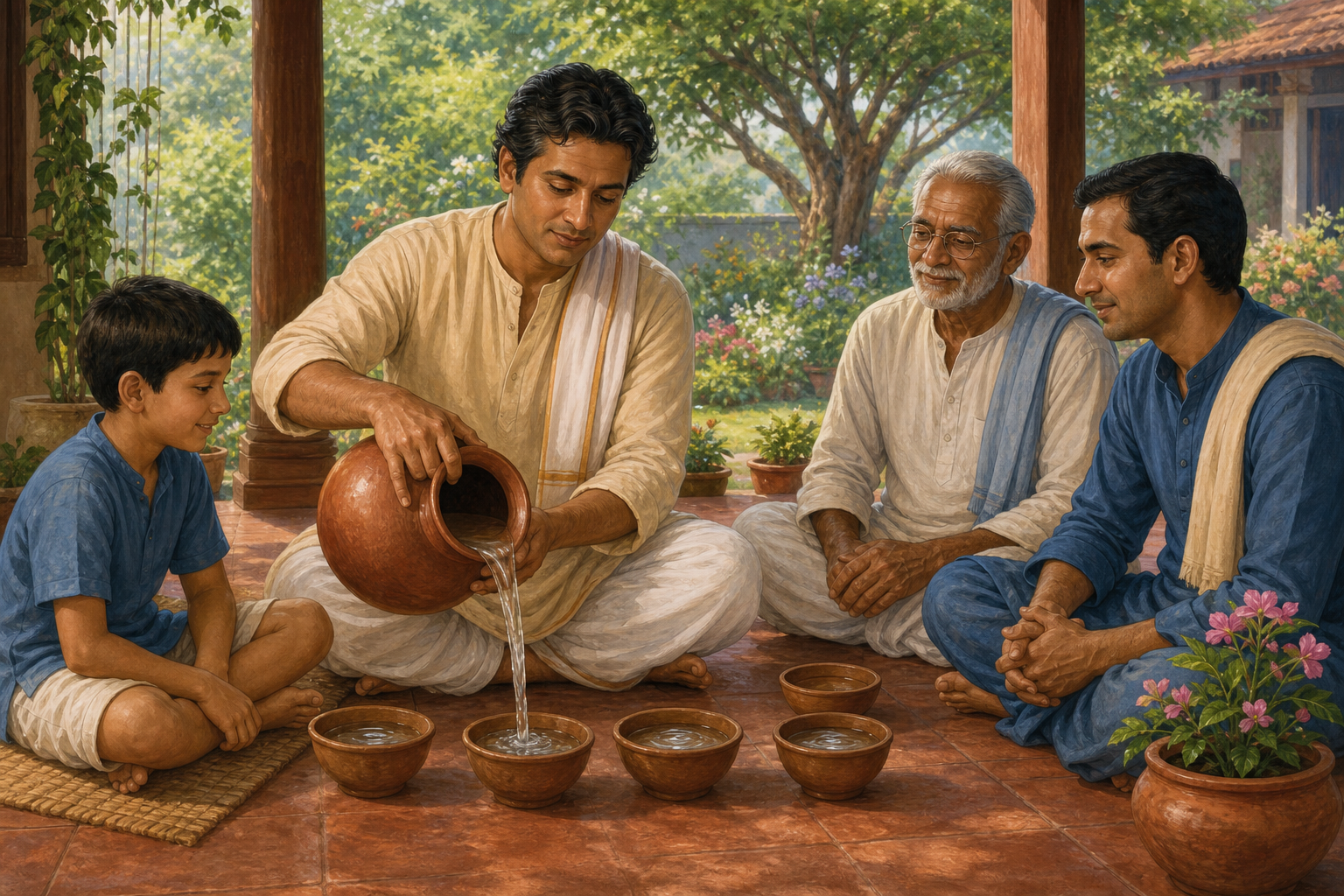
Dharmic minimalism is useful modern shorthand, not the name of a single doctrine shared without distinction by Hinduism, Buddhism, Jainism, and Sikhism. These traditions have different metaphysics, disciplines, communities, and understandings of liberation. Yet several of their practices can help you examine possession without declaring material life inherently impure.
Aparigraha: notice what you possess and what possesses you
Aparigraha is commonly rendered as non-hoarding or non-possessiveness. Its psychological force lies in the second meaning. You may legally own an object while emotionally depending on it to establish superiority, identity, or safety. You may also use a valuable object responsibly without being ruled by it.
Ask whether you can use, share, repair, replace, or release the thing without a crisis of identity. The practice is not careless disposal. Throwing away usable possessions to create a fashionable empty room simply turns minimalism into another consumption cycle. Keep what serves duty and wholesome enjoyment; release what imposes cost without serving a considered purpose.
Santosha: let enough register as enough
Santosha, or contentment, is not forced cheerfulness. It does not require you to call injustice acceptable, remain in abuse, ignore illness, or pretend that material insecurity is spiritually desirable. It trains you to receive what is genuinely good without immediately converting it into a platform for the next demand.
Practice it at the moment of sufficiency. When a meal nourishes you, a garment serves you, a home shelters you, or a walk restores you, pause before evaluating how each could be upgraded. Contentment begins when satisfaction is allowed to complete its sentence.
The Middle Path: reject both indulgence and self-punishment
The Buddhist Middle Path is not an arithmetic midpoint between luxury and misery. It redirects attention away from extremes that obstruct clarity. In daily life, that means you need not oscillate between uncontrolled spending and a severe purge, overeating and punitive restriction, frantic work and total collapse.
Choose a level of consumption that supports steadiness. If a cheaper option repeatedly fails and creates waste, buying the durable option may be the less grasping choice. If an expensive option mainly displays rank, declining it may protect both attention and freedom. Price alone cannot tell you which choice is moderate.
Seva and simran: give released attention somewhere worthy
Possessions are only part of the problem. A person can own little and remain completely preoccupied with the self. Seva and simran offer a corrective by orienting life toward service and remembrance. The practical question is not merely, “What can I remove?” It is, “What will become possible when this no longer occupies me?”
Use the released money, time, or attention deliberately. Call an elder. Help at a community kitchen. Mentor someone. Maintain a temple or neighbourhood space. Feed and care for animals responsibly. Study, pray, meditate, or sit with family without a device between you. Without a positive destination, the space created by simplification is easily recolonised by shopping, scrolling, and optimisation.
The Hindu purushartha framework adds another safeguard. Artha, or material well-being, has a legitimate place alongside dharma, kama, and moksha. Money can provide safety, care, education, hospitality, and room to choose ethical work. The question is whether artha supports the rest of life or quietly becomes its sole measure. Wanting less is healthy when it restores proportion, not when it denies legitimate material needs.
Define enough before comparison defines it for you

“I want a simple life” is too vague to guide a difficult decision. You need a working definition of enough. Otherwise every promotion, purchase, invitation, and family comparison reopens the argument from the beginning.
Build your definition around four different ideas, even if you record them without formal categories:
- Your floor: the conditions required for food, housing, health, safety, transport, education, care obligations, and basic resilience.
- Your chosen comforts: things that reliably add usefulness, beauty, rest, or connection and are worth their full cost to you.
- Your ceiling: the point beyond which more income, ownership, work, or optimisation would consume values you rank higher.
- Your purpose for the surplus: savings, dana, family support, study, pilgrimage, community work, creative practice, or greater freedom over time.
Your answer will differ by household, life stage, place, health, and obligation. A caregiver’s necessary floor will not resemble that of a student living with family. A person in an area with weak public transport may need a private vehicle. Someone with unstable income may reasonably hold a larger financial reserve than someone with secure support. Visible simplicity cannot measure inner non-attachment.
A useful enough statement can be plain: “Our household will protect safety, health, education, care, and a reasonable buffer. We welcome comforts we regularly use, but we will not trade relationships, sleep, integrity, or spiritual practice for visible status. When our duties change, we will review the boundary.” Write your own version before the next major financial decision.
Then read your bank activity beside your calendar. Money shows what you maintain; time shows what actually governs you. A low-spending household can still be consumed by status work. A comfortable household can be disciplined, generous, and inwardly free. Look for mismatches between declared values and recurring commitments rather than chasing a particular visual aesthetic.
Psychologically durable goals tend to support autonomy, competence, and relatedness: acting with meaningful choice, becoming capable at something worthwhile, and belonging to others. Use those needs as a check on ambition. A demanding career may serve them when it develops mastery and contributes to a community. The same career may undermine them when it is pursued solely for image while eliminating agency and relationship. The size of the goal is less important than the kind of person and pattern it produces.
Make wanting less an ordinary practice
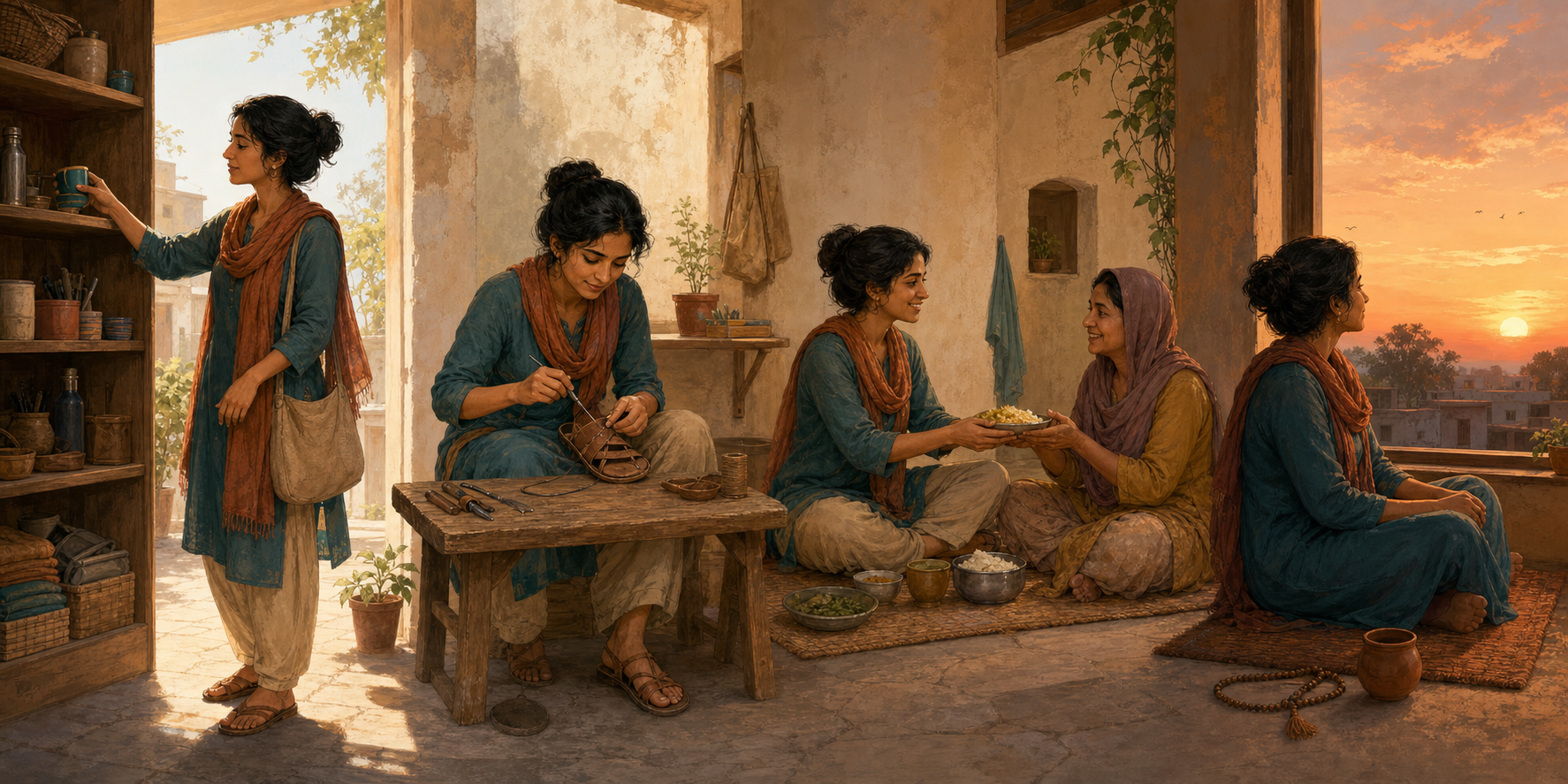
Minimalism fails when it is treated as a dramatic purge followed by ordinary habits. The mind that accumulated everything remains intact, so empty shelves become an invitation to refill them. Work with the recurring moment of desire instead.
- Begin with a low-risk category. Choose clothing, subscriptions, digital distractions, kitchen duplicates, or recreational purchases before touching housing, employment, healthcare, or essential transport.
- Prefer replacement to accumulation. When the present item still performs its job, keep using it. When it no longer does, replace it according to function, durability, repairability, and total upkeep rather than novelty alone.
- Add friction to impulsive buying. Remove saved payment details, leave the item off the immediate order, and revisit it after the emotional charge has settled. Genuine recurring needs survive a pause more reliably than comparison-driven urges.
- Clean the attention environment. Mute accounts that repeatedly convert ordinary life into inadequacy. Keep people who teach useful skills, deepen understanding, or help you appreciate what is already present.
- Budget toward values, not punishment. Protect necessities and consciously chosen pleasures. Redirect waste toward savings, generosity, time freedom, family, study, or service. A budget that permits no wholesome enjoyment often produces rebellion rather than contentment.
- Assign the space you recover. Put prayer, reading, a walk, an unrushed meal, community care, creative work, or conversation into the calendar. Otherwise the freed hour will usually be claimed by the loudest available stimulus.
- Release responsibly. Sell, share, repair, recycle, or donate clean and useful belongings. Do not transfer broken objects, disposal costs, or clutter to someone poorer and call it dana.
Apply the same principle to the body. Movement need not become a performance league to count. Walking, dancing, gentle yoga, mobility work, and other suitable forms can serve health and pleasure without becoming public evidence of discipline. At the same time, minimalism is not a reason to neglect symptoms, necessary treatment, adequate food, dental health, or professional care. Rejecting a market-driven appearance standard is different from refusing healthcare.
Rest does not have to be spectacular either. A quiet meal, nearby walk, local excursion, or unstructured afternoon may restore you more effectively than an itinerary designed for display. Judge rest by whether you return more present, not by how far you travelled or how impressive it looked online.
Key takeaways
- Wanting less is not failure when it is a conscious choice that preserves duty, vitality, and care.
- Aparigraha examines attachment, not merely the number of objects you own.
- Santosha lets genuine sufficiency register without denying hardship or legitimate aspiration.
- The Middle Path rules out both compulsive consumption and self-punishing deprivation.
- Your definition of enough should include necessities, chosen comforts, a ceiling, and a purpose for what you free.
- Simplification lasts when released money, time, and attention are directed toward relationship, service, competence, remembrance, and joy.
Choose a modest place to begin: a recurring expense that adds little, a comparison-heavy feed, or an object you maintain without using. Remove that burden and decide in advance where the recovered capacity will go. Wanting less becomes freedom when the answer is not merely “away from more,” but “toward what matters.”