
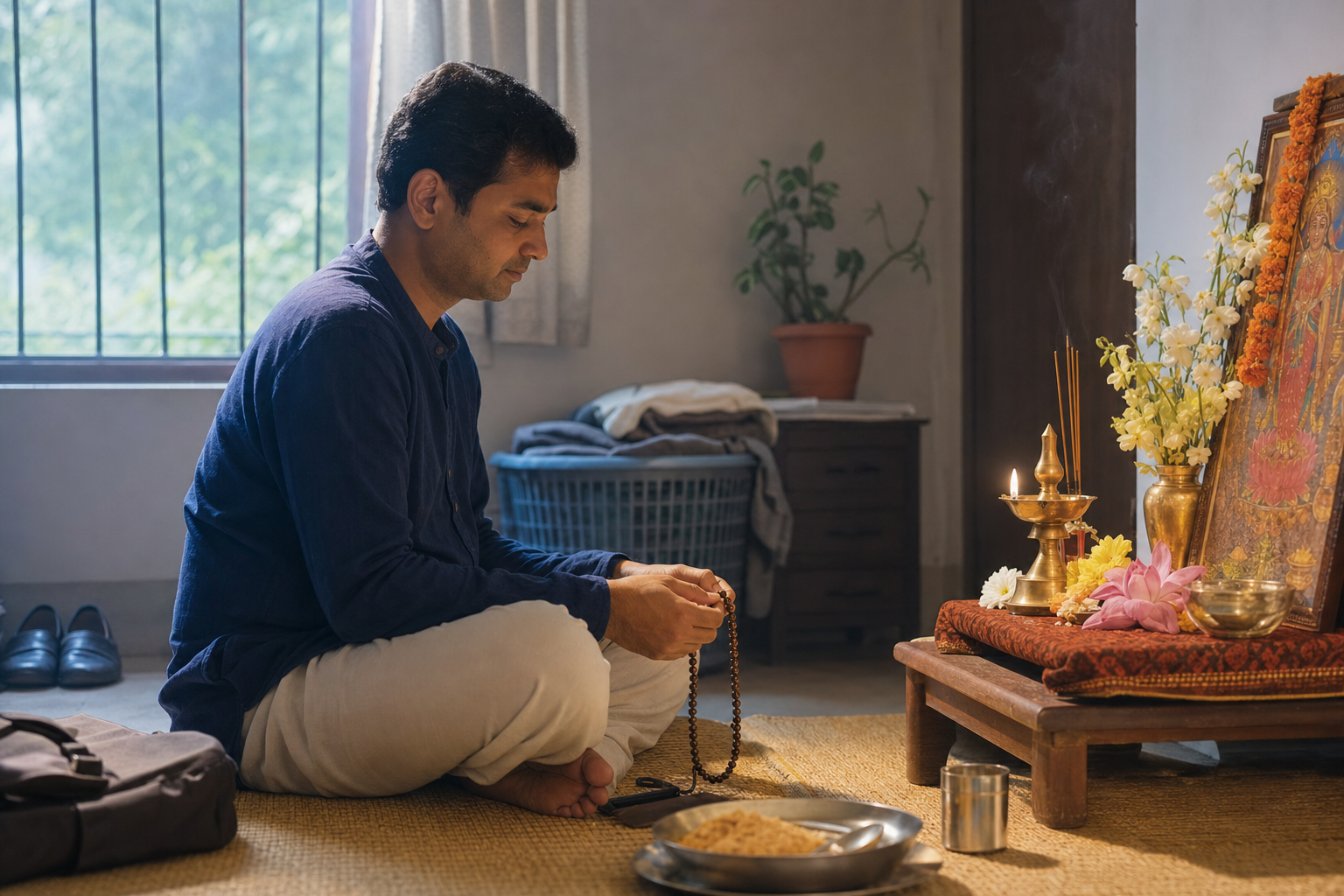
If your devotion feels strong during kirtan but fragile in ordinary life, you may wonder whether bhakti is truly changing you. A demanding week interrupts your practice, old desires return, and the clarity you once felt seems distant. It is easy to read that fluctuation as failure.
Bhakti becomes durable in a different way. It does not make every day spiritually intense or remove every contradiction at once. It gives your life a new center of gravity: something within you remembers where fulfillment was deeper, learns how to return, and gradually brings attention, desire, conduct, and relationship into alignment with the Divine.
Bhakti lasts when it changes what you want

Willpower can maintain a routine for a while. It cannot, by itself, sustain a lifetime of devotion. A durable path must work at the level of desire. You continue because chanting, hearing, remembrance, darshana, and service begin to reveal a quality of fulfillment that ordinary acquisition cannot provide.
The Gaudiya Vaishnava tradition uses the language of rasa-graha for this transformation. The expression can indicate the devotee grasping devotional rasa and devotional rasa taking hold of the devotee. The second meaning is especially important. Bhakti is no longer only something you perform; it becomes a relationship and a taste that exert their own attraction.
Rasa here does not mean any pleasant religious emotion. A moving melody, a beautiful temple, or the energy of a festival can produce a temporary high. Mature devotional rasa is more stable. In Gaudiya theology, it arises when a lasting devotional disposition, sthayi-bhava, becomes the organizing center of experience and is nourished by devotional stimuli, outward responses, and passing emotions. Feelings may rise and fall while the underlying orientation grows stronger.
This distinction protects you from two common mistakes. The first is dismissing a genuine devotional awakening merely because its original emotional intensity faded. The second is declaring every intense experience to be advanced realization. A sweet kirtan may open a door, but the evidence of transformation appears in what you repeatedly seek, how readily you return, and how you conduct yourself when the music has stopped.
Instead of asking only, “Did I feel spiritual today?”, notice more durable signs:
- After an ordinary pleasure passes, do you recognize more quickly that it cannot carry the full weight of your longing?
- When life becomes difficult, does a mantra, sacred form, teaching, or memory of seva return without being forced?
- Are truthfulness, restraint, compassion, and responsibility becoming more influential in your decisions?
- When you act against your values, do you feel moved to repair the breach and resume practice rather than justify it?
None of these signs entitles you to claim an elevated spiritual stage. They tell you something more practical: bhakti is beginning to reorganize your priorities.
The traditional progression from shraddha through sadhu-sanga, bhajana-kriya, anartha-nivritti, nishtha, ruchi, asakti, bhava, and prema gives you a useful map. Faith leads toward constructive association; association supports disciplined practice; practice exposes and removes impediments; steadiness makes room for taste; taste deepens into attachment; and devotional attachment matures toward spiritual emotion and love.
Use that map diagnostically, not competitively. If your practice is irregular, your next task is not to manufacture rasa but to establish bhajana-kriya. If practice is regular but feels dry, remember that nishtha, steadiness, has its own value and need not wait for ruchi. If taste has appeared, protect it through humility, ethical integrity, and service instead of turning it into a claim about your status.
A setback is not the same as starting over
A durable path needs an honest account of lapses. If durability meant uninterrupted performance, almost any disruption would disprove it. Bhakti offers a more exact distinction: practice can be interrupted without everything formed through practice being erased.
Srimad-Bhagavatam 1.5.17–19 gives unusually strong assurance on this point. Even when a person takes shelter of Hari’s lotus feet and later falls while devotion is still immature, the devotional beginning is not treated as spiritually worthless. External duty performed without bhakti cannot produce the same gain. The passage shifts attention from an immaculate record to the lasting spiritual consequence of turning toward Bhagavan.
That assurance is not permission to become careless. A lapse can still damage relationships, weaken discipline, or reinforce an unhealthy tendency. The point is that you should respond with correction and renewed sadhana, not with the fatalistic conclusion that you have become an ordinary beginner again.
It helps to identify what kind of difficulty you are facing:
- An interruption occurs when the structure around practice breaks. Travel, changing responsibilities, exhaustion, or a disrupted household rhythm may remove the cue that once made sadhana almost automatic. Restore the structure instead of questioning the whole path.
- An anartha is a lingering inner impediment that practice has begun to expose. Pride, envy, selfishness, distraction, or attachment may become more visible after you start serious sadhana. Visibility is not the same as creation; sometimes you are finally seeing what was already governing you.
- An aparadha is an offense that can obstruct devotional progress. It calls for humility, sincere correction, repair where someone has been harmed, and renewed attention to practice. It should not be relabeled as an innocent fluctuation merely to avoid responsibility.
When you have drifted, use a concrete return sequence:
- Name the break precisely. “My bhakti disappeared” is too vague to act on. “I stopped sitting for morning japa after my schedule changed” identifies a repairable problem.
- Restore the smallest complete anchor. Return to the mantra, place, text, or worship routine that already has devotional meaning for you. Do not wait to recreate the mood of your best retreat or festival.
- Correct conduct where necessary. If the lapse involved deception, neglect, hostility, or harm, spiritual recovery includes making amends. More chanting does not make accountability irrelevant.
- Reconnect with sadhu-sanga. Tell a trustworthy practitioner what actually changed. Specific disclosure invites useful guidance; a vague announcement that you are “struggling” often leaves the practical cause untouched.
- Resume at the next real opportunity. Do not build such an ambitious compensation plan that returning becomes harder than continuing. Re-enter the normal rhythm and let steadiness do its work.
The important measure is not whether you ever wander. Notice how you interpret the wandering, how long you remain passive, and whether remembrance still directs you home. A devotional samskara becomes visible in the act of return.
Build a daily practice that can survive an ordinary life
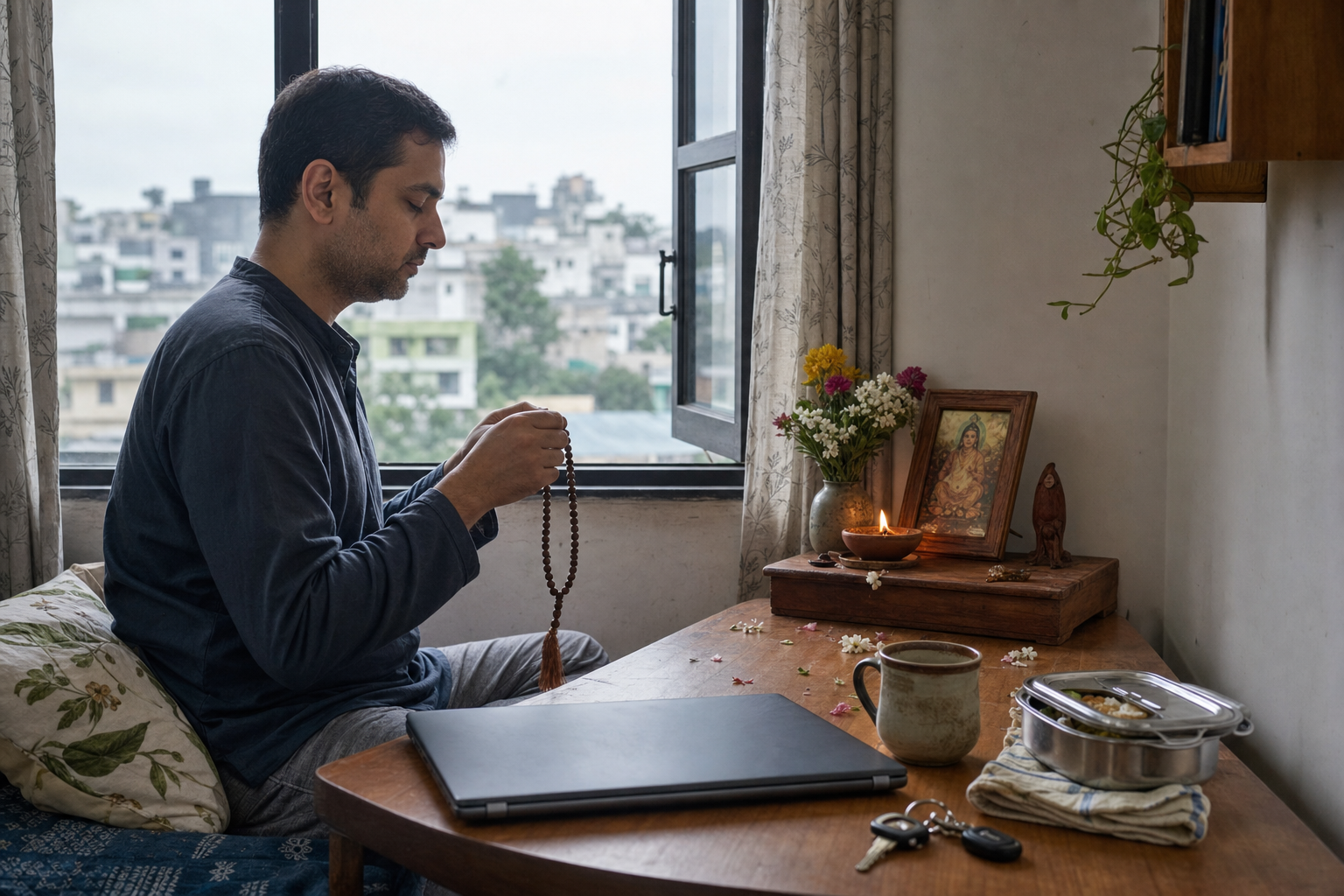
Intensity is memorable, but consistency carries transformation into your habits. A pilgrimage, retreat, extended study period, or powerful kirtan may reveal what devotion can taste like. Daily sadhana teaches your attention where to go after the exceptional setting disappears.
Classical bhakti offers nine broad modes: hearing about the Divine, chanting, remembrance, service, worship, prayer, servitorship, friendship, and full self-offering. You do not need to express all of them equally every day. You need a stable entrance into devotion and enough supporting practices to engage more than one part of your life.
A practical daily rule should contain four clearly defined elements:
- A cue: decide what existing event begins your practice, such as waking, bathing, entering your prayer space, or returning home. “When I find time” is not a cue.
- A minimum: choose a measure of chanting, hearing, or worship that you can complete attentively even on a difficult day. If you have accepted a vow or instruction from a qualified teacher, that commitment sets the standard; convenience does not silently replace it.
- A fuller form: know what you will add when conditions permit. This may include more attentive japa, kirtan, sustained scriptural study, temple worship, or additional seva. The fuller form should deepen the same orientation rather than constantly chase novelty.
- A recovery rule: decide in advance what you will do after a missed practice. A simple rule such as returning at the next established cue prevents one interruption from becoming an undefined absence.
For a seeker who is not yet under a formal discipline, a workable pattern is straightforward: chant the chosen mantra without multitasking, read one coherent passage from a foundational text, pause long enough to remember what the practice is for, and identify a concrete act of service. Keep the form modest enough to repeat and serious enough to require attention.
Mantra meditation, kirtan, scriptural study, seva, and a mindful way of life form a mutually supporting discipline. Chanting gathers attention. Hearing corrects the mind’s private interpretations. Seva moves devotion from sentiment into conduct. Ethical restraint protects the clarity that practice cultivates. Each element covers a weakness that the others cannot fully address alone.
Use devotional cues deliberately. A mantra engages speech and hearing. Kirtan adds melody and collective participation. Scripture gives language to insight. Darshana connects remembrance with sacred form. Temple worship, pilgrimage, and recurring ritual connect memory with place and action. When one channel feels inaccessible, another can reopen attention to the same devotional center.
This does not mean changing practices every time concentration weakens. Constantly replacing a dry discipline with a more stimulating one can make novelty, rather than Krishna, the hidden object of pursuit. Keep your primary commitment stable. Use supporting forms to renew attention, then bring that attention back into the practice you are responsible for maintaining.
At the end of a regular practice cycle, assess effects that matter outside the prayer space. Are you less governed by status and comparison? Do you recover more quickly from resentment? Are you more dependable in service? Can you hear correction without immediately defending yourself? These questions keep spiritual evaluation connected to character rather than mood alone.
Let relationship, service, and discernment deepen the change
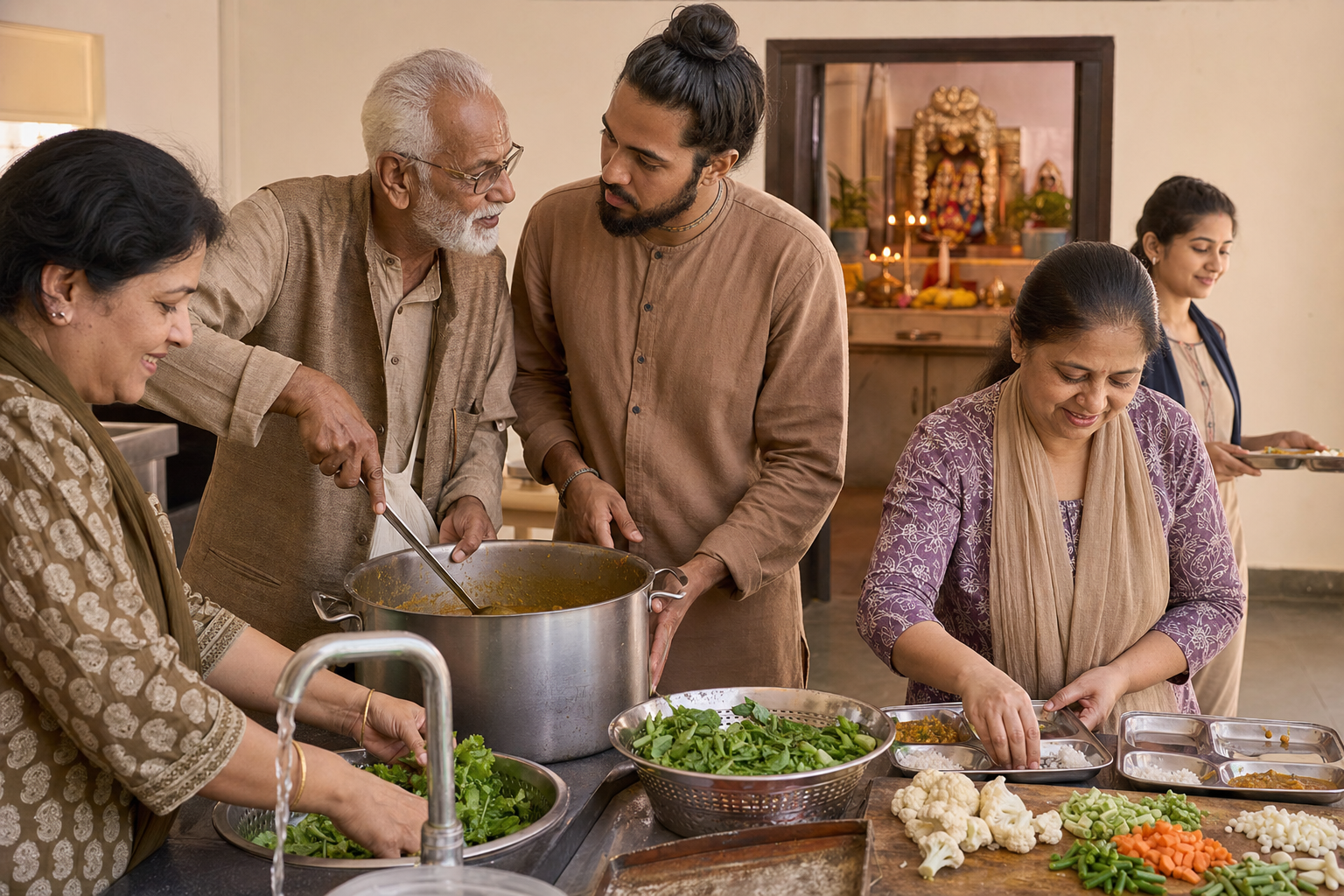
Bhakti is relational in its aim and in its method. Solitary practice has a place, but private intention is easy to reinterpret whenever desire becomes inconvenient. Guru, sadhu, and sangha provide teachings you did not invent, examples you can observe, responsibilities you cannot redefine at will, and support when your own enthusiasm is weak.
The guru-shishya tradition treats sabda-pramana, authoritative testimony, as a genuine way of knowing. Properly understood, this does not require hostility toward questions. Guidance transmitted through an accountable lineage gives inquiry a tested framework, while practice allows you to examine its effects over time. Srila Prabhupada’s pedagogy joined Bhagavad-gita study with mantra, kirtan, seva, disciplined living, and room for serious examination rather than reducing bhakti to either blind sentiment or abstract debate.
Discernment still matters. Not every confident personality represents trustworthy spiritual authority. Before placing serious reliance on a teacher or community, notice:
- Whether sincere questions are answered through reasoned teaching rather than humiliation or pressure.
- Whether leaders are themselves accountable to a lineage, a community, and ethical standards.
- Whether admitted failures lead to truth, correction, and protection from further harm rather than concealment.
- Whether association strengthens your daily practice and responsible conduct outside group events.
- Whether service cultivates humility and care or merely expands someone’s prestige.
Seva is indispensable because it reveals what your devotion does when another person’s needs interrupt your preferences. It moves identity from consumer to contributor. It also prevents spiritual taste from becoming private self-absorption. Choose a responsibility definite enough that someone can rely on you: assist with worship, prepare or distribute prasada, support congregational work, care for a shared space, help a practitioner in difficulty, or apply your ordinary skills to a genuine need.
Do not evaluate seva only by how inspired it makes you feel. Notice whether you keep commitments, accept unglamorous work, cooperate without demanding recognition, and remain teachable. If enthusiasm for kirtan is increasing while honesty and responsibility are deteriorating, something has become disconnected. The answer is not less devotion but better-integrated devotion.
Dharmic kinship without collapsing real differences
Bhakti has a distinct theological center: loving relation with Bhagavan, and in Krishna-bhakti, devotion to Krishna as the heart’s ultimate object. Yet the insight that authentic realization changes the future direction of a life has recognizable counterparts elsewhere in the Dharmic family.
Buddhist traditions speak of the stream-enterer as having crossed a consequential threshold. Jain thought gives samyag-darshana, right vision, a decisive role in the progressive transformation mapped through the guna-sthanas. Sikh practice understands the ras of Naam-simran as reordering desire and making worldly intoxications comparatively hollow. These are not interchangeable doctrines, and respecting them does not require pretending that their metaphysics are identical. They reveal a shared Dharmic recognition that deep spiritual insight can redirect the whole trajectory of conduct.
For you, that kinship has a practical implication. Honor the distinctive form of the path you actually practise, while learning to recognize disciplined remembrance, ethical purification, nonviolence, humility, and service across Dharmic traditions. Unity becomes credible when it preserves difference and strengthens conduct, not when it reduces every path to the same vocabulary.
Key takeaways
- Durable bhakti is not continuous emotional intensity. It is a growing reorientation of desire, memory, conduct, and relationship toward the Divine.
- A devotional lapse does not erase every samskara formed through sincere practice, but scriptural assurance never removes the need for correction and accountability.
- Distinguish a disrupted routine from an exposed anartha and from an aparadha; each requires a different response.
- Define a daily cue, a sustainable minimum, a fuller form, and a recovery rule so that practice can survive changing circumstances.
- Use chanting, hearing, remembrance, worship, and seva as mutually supporting disciplines rather than chasing one recurring emotional high.
- Judge progress partly by conduct: truthful repair, steadier responsibility, reduced domination by status, and greater readiness to serve.
- Choose sangha and guidance that welcome sincere inquiry, maintain ethical accountability, and make devotion more livable beyond communal events.
Begin at your next stable cue, not at an imagined future moment when life becomes uncomplicated. Choose the devotional act you will keep, the concrete service for which someone may rely on you, and the person you will contact if your routine breaks. If your sadhana is already established, add nothing merely for novelty; identify the weakest link between practice and conduct, and work there.
The durability of bhakti is tested less by your best day than by what you do after an ordinary one. Protect the taste, accept correction, and keep returning until remembrance is no longer an occasional visitor but the direction of your life.
References
- Dandavats — Once Tasted, Never Lost: The Transformative Power of Rasa-Graha in Bhakti-Yoga
- Dandavats — From Atheism to Bhakti: How Srila Prabhupada Guided Visakha Devi Dasi Toward Lasting Fulfillment