
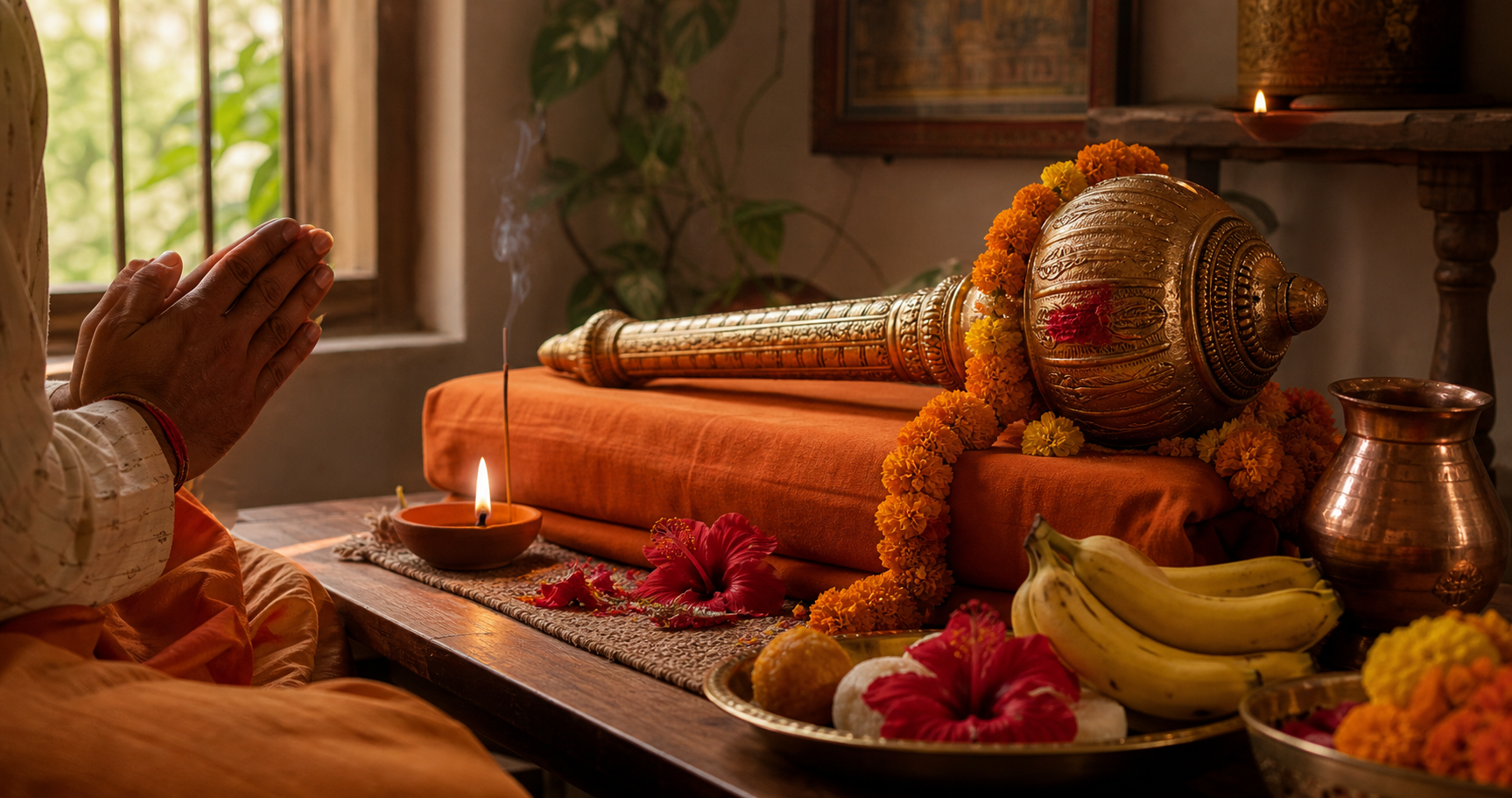
You want to perform Gada Pujan on Hanuman Jayanti, but you don’t want the observance to become an elaborate display whose meaning gets lost. Begin with the sankalpa, not the decoration. Decide what kind of strength you are asking Hanuman to awaken in you, and what you will do with it after the puja.
A meaningful Gada Pujan joins three things: devotion that governs power, discipline that governs emotion, and service that turns worship outward. The ritual can be simple. Its demand on your conduct should not be.
The gada is a discipline before it is a display

Hanuman’s gada represents protective strength, steadfast discipline and courage placed in service. Worshipping it does not mean treating a material object as an end in itself. The object concentrates your attention on the qualities it signifies, just as other sacred forms make an otherwise abstract teaching visible and memorable.
This distinction matters because the gada resembles a weapon. In a dharmic setting, its presence cannot be used to sanctify rage, intimidation or cruelty. It points instead to the capacity to prevent harm, defend the vulnerable and remain restrained even when action is necessary. The moral test is whether power remains answerable to bhakti, ahimsa and proportion.
Before preparing the offerings, answer three questions. They will give your sankalpa substance:
- What requires protection? Name a person, responsibility, institution or principle rather than an imagined enemy.
- What requires discipline? Identify an impulse such as anger, fear, vanity, carelessness or the habit of postponing your duty.
- Who will receive your service? Choose someone or some part of community life that can benefit from a concrete act after the festival.
These questions keep bala, or strength, connected to vinaya and seva. If the ceremony increases pride but produces no greater self-command or willingness to serve, the symbol has been admired without being understood.
Choose the tithi and scale before planning the ritual
Hanuman Jayanti does not fall on one universally observed tithi in every Hindu community. Chaitra Purnima is common, while other regional traditions observe Hanuman’s appearance in Margazhi or Vaisakha. Follow your family parampara, local temple calendar or trusted acharya. A calendrical difference is not a reason to declare another sampradaya mistaken.
Then decide whether you are preparing a household puja or a community gathering. The devotional core can remain the same, but the responsibilities are different:
- For a household observance, use a clean place, a Hanuman murti or a stable representation of the gada, and the offerings already familiar in your family puja.
- For a community observance, appoint people for recitation, offerings, explanation of the symbol, prasada, crowd movement and cleanup. Do not leave practical work to whoever happens to notice it.
- If children will participate, use a lightweight or securely supported representation. Do not place a heavy mace where it can fall or be pulled down.
- Use reusable decorations and vessels where practical. Plan plastic-free prasada distribution before purchasing supplies, because waste cannot be undone by an ecological message delivered after the event.
- Give elders, adults and young people real roles. One person can explain the meaning, another can lead the recitation, another can coordinate digitally, and children can help with flowers or orderly prasada distribution under supervision.
You do not need to imitate an unfamiliar liturgy to make the day sacred. If your parampara prescribes particular mantras, nyasas or forms of abhisheka, follow its guidance. If you do not have that instruction, keep the ceremony modest and do not present an improvised procedure as universally authoritative.
A simple Gada Pujan sequence you can follow
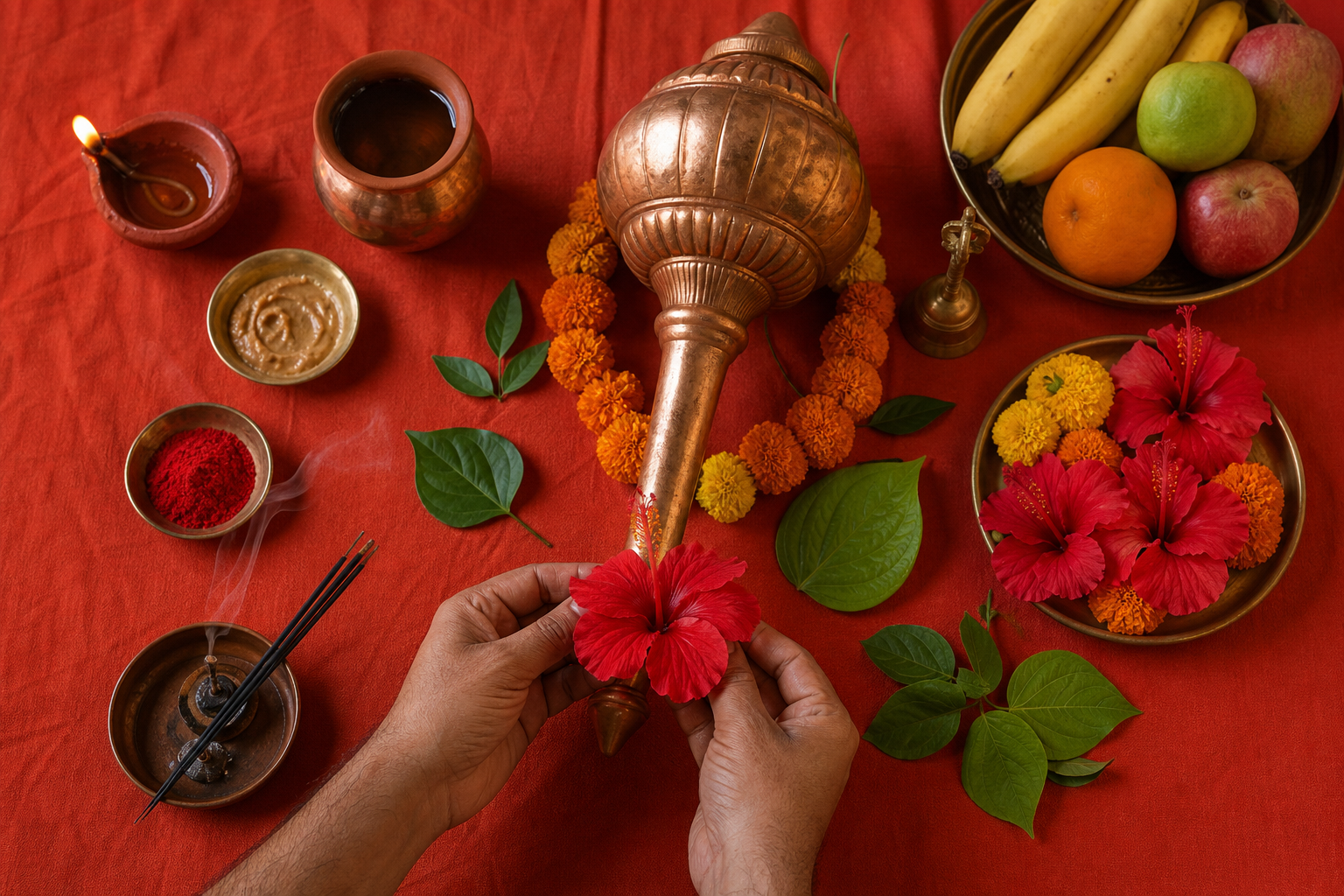
A widely used devotional arc includes sankalpa, offerings, Hanuman Chalisa or Sundara Kanda recitation, reflection, aarti and prasada. Adapt the following sequence to your sampradaya rather than treating it as a replacement for inherited practice.
- Prepare the place. Clean the puja area and place the Hanuman murti or gada representation on a steady surface. Arrange water, flowers, sandalwood and the materials your household normally uses for aarti. Remove unrelated clutter so that participants are not distracted by continuous setup during the worship.
- State the sankalpa. Include personal and social well-being, but make the intention concrete. A plain-language form could be: May this worship help us develop courage governed by humility, discipline governed by devotion, and strength used in service. This is an intention, not a substitute for a traditional sankalpa mantra taught in your parampara.
- Offer water, flowers and sandalwood. If your tradition includes abhisheka and alankara, perform them according to that practice. If the representation is not made to be washed, offer water beside it rather than damaging it for the sake of appearance.
- Recite attentively. The Hanuman Chalisa, with its forty chaupais in the Awadhi tradition, provides a shared form that many participants can follow. Recite at a steady pace rather than racing to completion. A leader may recite each portion and allow the gathering to respond. Add selected verses from Sundara Kanda only where the group can do so with attention and respect.
- Keep a period of silence. After the recitation or aarti, do not move immediately into announcements and photographs. Let each person choose one quality of Hanuman to practise. Courage might mean speaking truth without humiliating another person. Humility might mean accepting correction. Seva might mean performing an unglamorous duty without seeking recognition.
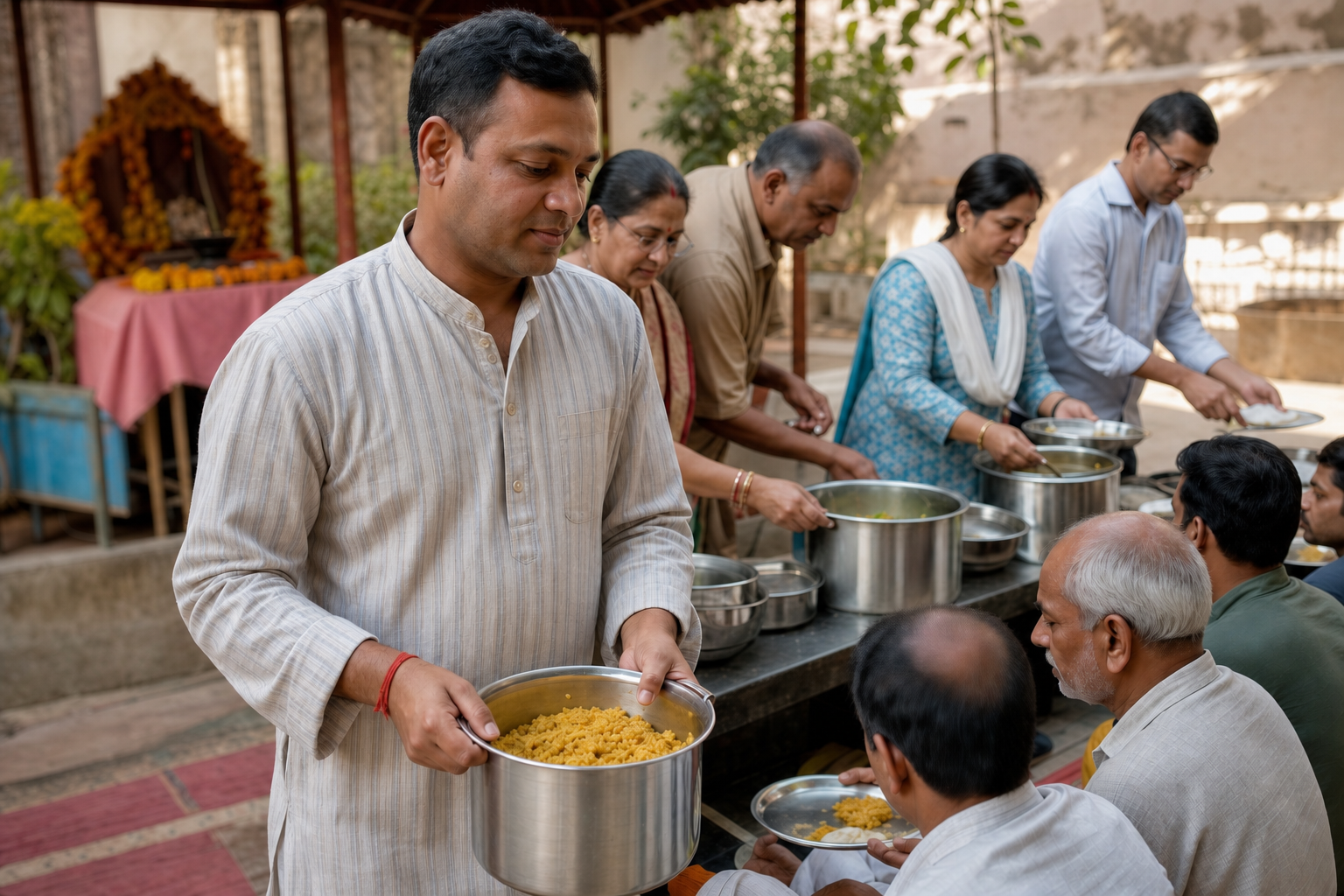
- Conclude with aarti and prasada. Distribute prasada in an orderly way, with attention to elders, children and anyone who needs assistance. The conduct of the queue is part of the worship; devotion is not suspended when the formal recitation ends.
- Record the follow-through. A household can write one shared commitment and keep it near the puja space. A community can name one service task, one coordinator and the date on which participants will check whether it happened.
The purpose of this order is not ritual minimalism for its own sake. It prevents a common inversion: spending most of the preparation on visual arrangements while leaving the sankalpa vague. Give the most attention to the part that must survive after the altar is cleared.
Make Ram Rajya a practice, not a slogan
When Gada Pujan carries a resolve for Ram Rajya, the phrase needs ethical content. It can be understood as a social order shaped by satya, nyaya, karuna and lokasangraha: truthfulness, justice, compassion and concern for collective welfare. That makes Ram Rajya a standard by which you examine conduct, not merely a phrase to repeat in a charged gathering.
- Practise satya by refusing exaggeration, rumour and convenient falsehood, including claims circulated in the name of protecting dharma.
- Practise nyaya by giving people fair treatment, clear responsibilities and a dignified hearing, especially when they have less status or influence.
- Practise karuna by noticing who is excluded, overburdened or unable to participate without help.
- Practise lokasangraha by pairing rights with duties and asking whether an action strengthens shared life rather than only rewarding your own group or reputation.
A public ritual can encourage volunteerism, cooperation between households and renewed interest in scriptural study, but only when organizers provide a path from feeling to action. Before participants disperse, choose one bounded commitment: a recurring Hanuman Chalisa study circle, a seva rota, assistance for elders, or a plastic-free plan for the next festival. Assign responsibility instead of leaving the promise to the crowd as a whole.
Gada Pujan is a Hindu observance, and respectful Dharmic unity does not require pretending that all traditions have identical theology or ritual. You can acknowledge genuine ethical resonances: Sikh seva and shaurya join service with disciplined courage; Buddhist karuna and viriya bring compassion together with energetic perseverance; Jain ahimsa and aparigraha restrain harm and possessiveness. Present these as points of fellowship, not as a claim that distinct paths are interchangeable.
Set one further guardrail for a public ceremony: no speaker should use the gada to excuse threats, humiliation or theatrical aggression. Hanuman’s strength is compelling precisely because it remains dedicated to a higher purpose. A gathering that frightens the vulnerable contradicts the quality it claims to honour.
Key takeaways: your five-decision checklist
- Tithi: decide which family, temple or sampradaya calendar you are following before announcing the observance.
- Meaning: name the form of courage, restraint and service represented by the gada in your sankalpa.
- Method: use a clear sequence of preparation, offering, recitation, silence, aarti and prasada, adapted to your tradition.
- Guardrails: keep heavy objects secure, public language restrained, participation dignified and festival waste low.
- Continuation: choose one service or study commitment, give it an owner and fix the next check-in before everyone leaves.
Before Hanuman Jayanti, write down your tithi, your sankalpa and your act of seva. Those three decisions will do more to preserve the purpose of Gada Pujan than another layer of decoration.