
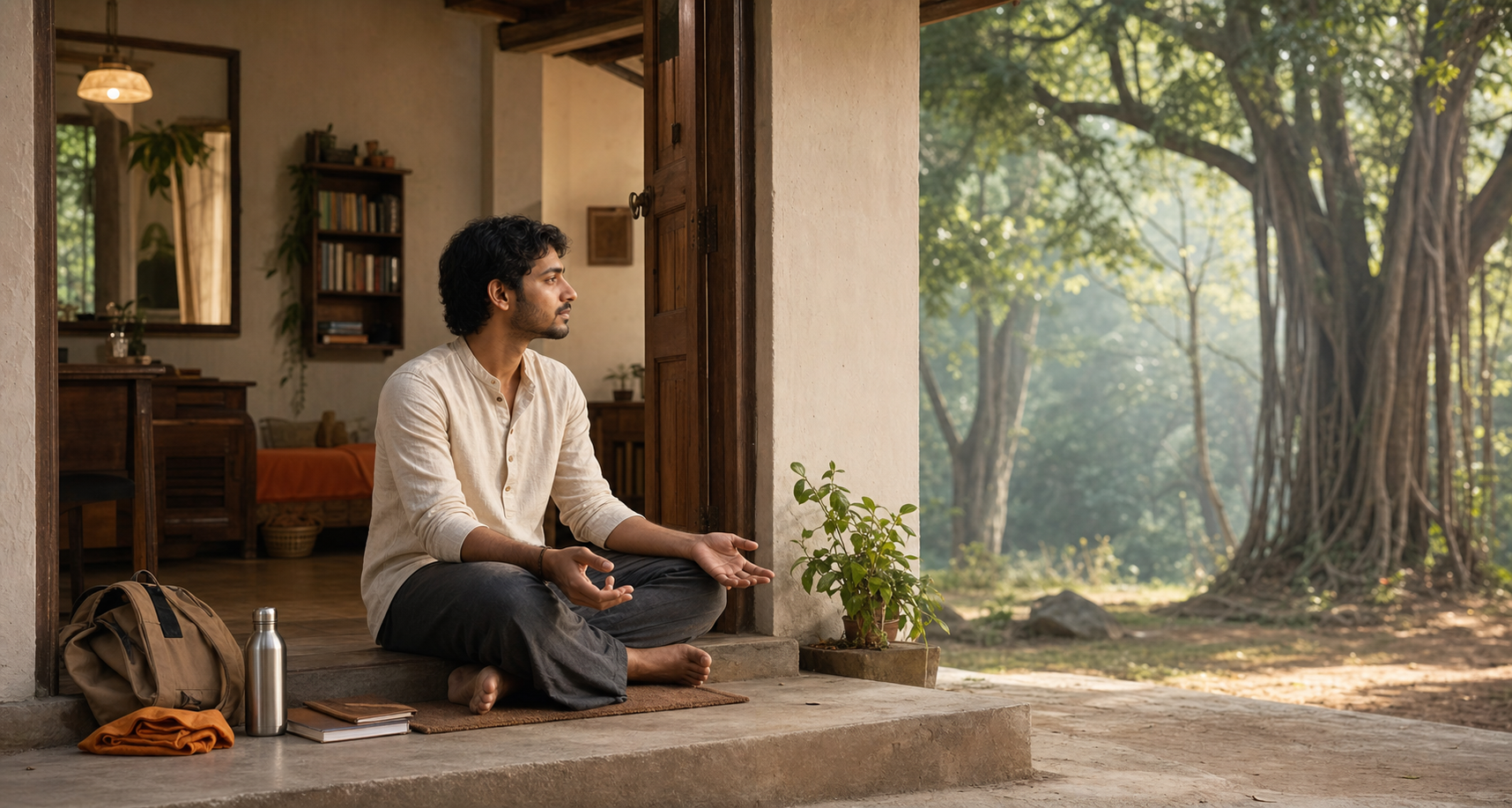
If you are wondering whether a serious spiritual life requires you to leave home, the Dharmic answer is more demanding than a simple yes or no. Formal sannyāsa is a real vocation, but renunciation begins before a change of clothing, residence, or social status. It begins wherever you stop treating possessions, praise, comfort, and personal roles as the foundation of who you are.
That distinction protects you from two opposite mistakes: romanticizing monastic life and reducing renunciation to fashionable minimalism. You need to determine whether you are being called toward an established renunciant discipline, or toward a more truthful and restrained life as a householder. The same Upanishadic question tests both paths: are you becoming less governed by grasping and more available to truth?
Renunciation begins with the object, not the costume

Several related terms need to be kept distinct. Sannyāsa denotes formal renunciation, while pravrajyā means going forth. Muni, yati, parivrājaka, and bhikṣu name different kinds or aspects of contemplative, disciplined, wandering, or mendicant life. Vairāgya is dispassion, and tyāga is relinquishment. These words overlap, but they are not interchangeable.
A householder may develop deep vairāgya without claiming to be a sannyāsin. Conversely, someone may possess the external signs of renunciation while remaining fiercely attached to reputation, authority, comfort, or being recognized as holy. Outer discipline matters, especially within a lineage, but its purpose is to expose and weaken inner possession.
When the wish to renounce arises, sort it into three questions:
- What do you want to leave? Name it precisely: conflict, exhaustion, financial pressure, family expectations, sensory excess, social status, or identification with every role you perform.
- What do you want to approach? Sannyāsa has a positive direction: liberation, knowledge, disciplined contemplation, and steady abidance in truth. Mere dislike of your present circumstances is not yet a spiritual vocation.
- What discipline are you willing to accept? A desire for fewer obligations is different from readiness for ahiṁsā, truthfulness, celibate discipline, non-accumulation, study, humility, and obedience to a legitimate path of training.
This is where vairāgya must be distinguished from disappointment. Disappointment still expects another arrangement of worldly life to provide final satisfaction. Vairāgya recognizes the limits of every arrangement without turning bitter toward the world. Burnout says, “I need a different experience.” Dispassion asks why any finite experience was expected to supply limitless freedom.
A Vedic current became an Upanishadic discipline
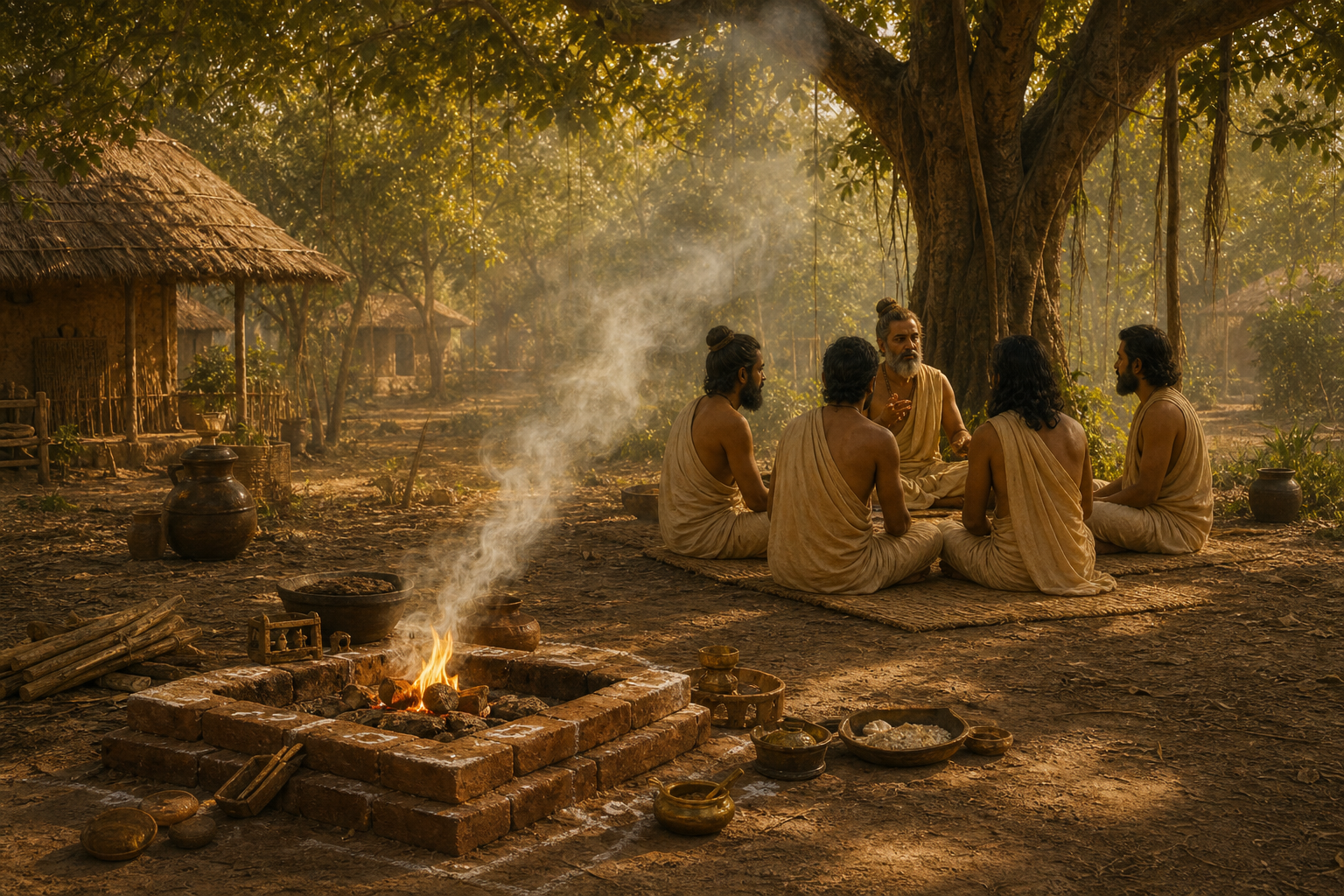
Renunciation did not suddenly enter Hindu thought as a rejection of the Vedic inheritance. Its earliest forms are less institutional than later sannyāsa, but the spiritual type is already visible. The Ṛgveda’s Keśin Hymn, 10.136, portrays long-haired ascetics associated with tapas, unusual states of awareness, and a wind-like freedom of movement. These figures stand at the edge of ordinary social expectations, yet remain within a sacred Vedic horizon.
The Atharvaveda’s Vratya-sūkta presents another liminal figure, the vrātya. Vedic society did not respond to such sanctity only by excluding it. The later vratya-stoma provided a ritual means of inclusion. The important point is not that early Vedic India already possessed every feature of a mature monastery. It is that disciplined, mobile, possession-light forms of sacred life were recognizable enough to require interpretation and integration.
The Brāhmaṇas, Āraṇyakas, and Upanishads then mark a decisive inward turn. Public sacrifice is not simply mocked or discarded. Its logic is interiorized. The forest becomes a setting for contemplation, and the fires, offerings, and powers once approached primarily through external rites become ways of investigating consciousness, selfhood, bondage, and freedom. This is creative continuity, not civilizational amnesia.
The Muṇḍaka Upanishad sharpens the decision. A person examines the worlds obtained through action, recognizes their limits, and approaches a teacher who is both grounded in sacred learning and established in Brahman. The same Upanishadic movement insists that the Self is not captured by eloquent discourse alone. Study remains necessary, but information without transformation does not become realization.
This history gives you a practical test for interpreting renunciation. Be cautious whenever it is described as hatred of ritual, society, embodiment, or Bharat’s inherited civilization. The movement from Veda to Upanishad is better understood as deepening: from the outer act to its inner meaning, from the limited fruit of action to freedom, and from inherited identity to realized knowledge. The earlier forms are not erased; their deepest questions are carried inward.
How to distinguish a vocation from an escape
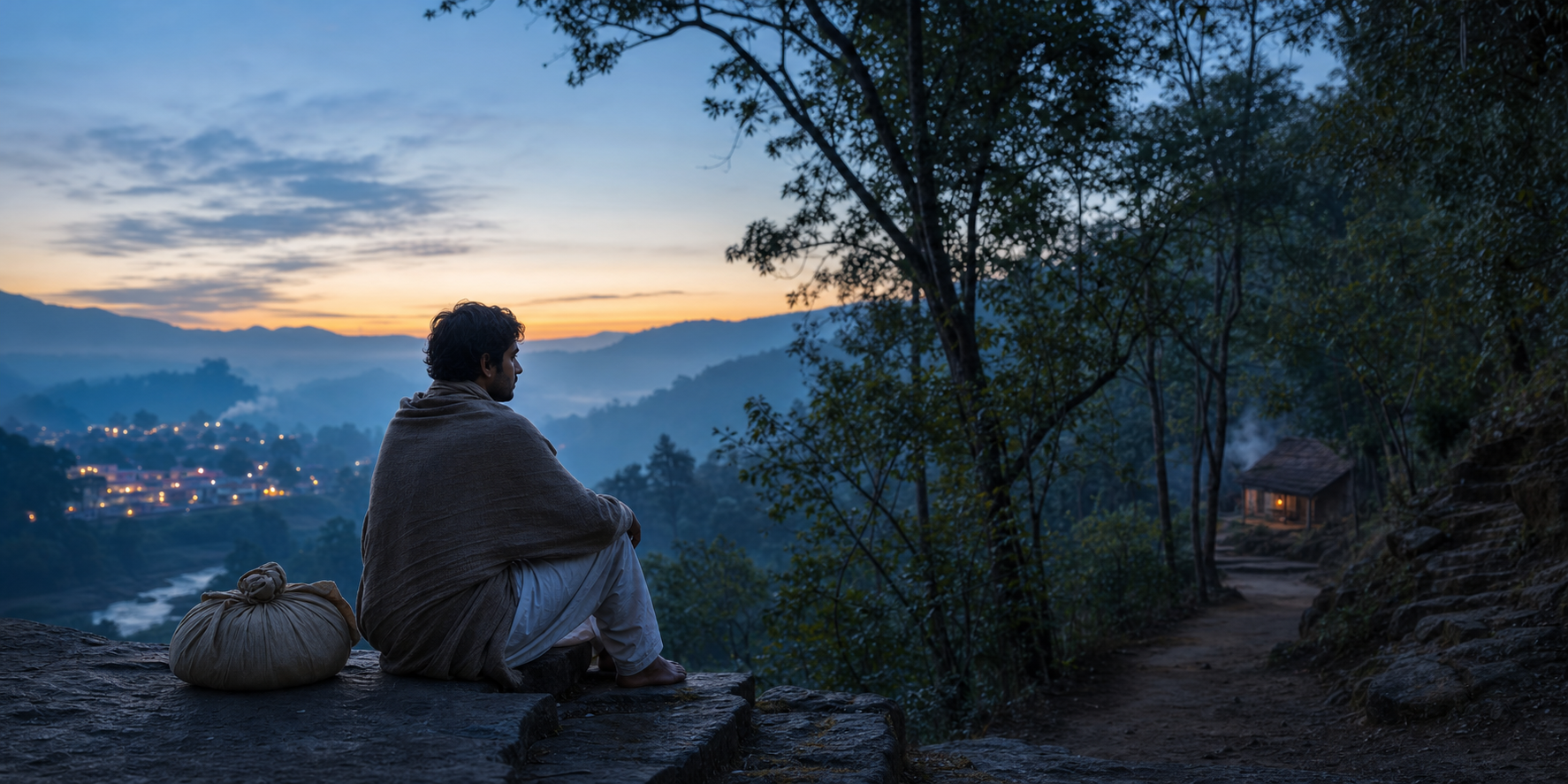
The Jābāla Upanishad gives unusual flexibility to the timing of renunciation. Going forth may follow studentship, follow household life, or occur when genuine dispassion has arisen. This prevents the four āśramas from becoming a merely mechanical timetable. Spiritual ripeness does not always arrive at the same age or after the same biography.
That flexibility is not a blank cheque for impulsive departure. The Dharmasūtras attributed to Āpastamba, Gautama, and Baudhāyana preserve debate over whether the āśramas are necessarily sequential or can be valid alternatives. The debate establishes plurality within discipline; it does not make every strong emotion a command to abandon one’s present life.
Before treating your attraction to sannyāsa as a call, examine it with these tests:
- Test it after the immediate crisis passes. If the desire disappears as soon as a relationship, job, or household conflict improves, you may have wanted relief rather than renunciation.
- Ask what cannot be practised where you are. Simplicity, study, meditation, truthful speech, moderated consumption, and seva can begin in household life. Refusal to attempt them now is weak evidence that you are ready for stricter discipline elsewhere.
- Examine the ethical foundation. Renunciant codes consistently emphasize ahiṁsā, satya, non-stealing, brahmacarya, and non-possession. A dramatic decision cannot compensate for dishonesty, cruelty, manipulation, or undisciplined desire.
- Look for mumukṣutva. The decisive positive qualification is a sustained longing for liberation, supported by viveka, vairāgya, self-mastery, endurance, attention, trust, and inner composure. A wish to be admired as detached points in the opposite direction.
- Seek a qualified teacher, not just confirmation. The Muṇḍaka ideal joins scriptural competence with establishment in Brahman. A teacher’s role is not to flatter your preferred decision, but to test your understanding and fitness.
- Account honestly for people who depend on you. Abruptly leaving children, elders, or others materially reliant on you can cause concrete harm. If duties remain unresolved, begin with supervised household discipline and seek lineage-specific guidance before making an irreversible vow.
Formal sannyāsa is not merely a private declaration that you now feel detached. The later Sannyāsa Upanishads describe initiation, external disciplines, and types such as Kuṭīcaka, Bahūdaka, Haṁsa, and Paramahaṁsa. These classifications reflect a developed culture of training. They should not be used as a do-it-yourself ladder on which a seeker awards himself the most exalted title.
The safest principle is simple: reduce before you sever. Practise restraint before claiming dispassion. Accept instruction before claiming realization. If a genuine vocation is present, disciplined testing will clarify it rather than destroy it.
A householder can practise renunciation without pretending

The gṛhastha and the sannyāsin are complementary figures. Householders sustain society, learning, and service, while renunciants keep liberation and ethical universality visible. One role should not imitate the other superficially. A householder does not need monastic status to loosen greed, and a renunciant does not become more authentic by showing contempt for household life.
A four-week diagnostic practice
The following exercise is not a traditional vow and does not substitute for initiation. It is a way to discover what your attraction to renunciation is actually made of while keeping your present duties intact.
- Week one: inventory attachment. List the possessions, roles, comforts, opinions, and forms of approval you would be most afraid to lose. Beside each one, distinguish a real duty from an identity claim. Caring for a child is a duty; needing to be seen as the perfect parent is an attachment added to it.
- Week two: stabilize attention. Establish a fixed daily period for silence, meditation, prayer, or Upanishadic study. Remove one optional distraction from that period. Notice whether resistance comes from lack of time or from unwillingness to be without stimulation.
- Week three: practise measured non-possession. Pause one category of nonessential acquisition. Redirect the saved money, time, or useful surplus toward seva. The point is not to perform poverty but to observe how quickly desire manufactures necessity.
- Week four: submit the result to scrutiny. Continue your duties while watching for the wish to advertise your discipline. Discuss what you observed with a trustworthy teacher rooted in an established tradition. Ask for correction, not endorsement.
At the end, do not judge the practice by how austere it looked. Ask whether you became more truthful, less reactive, more attentive, and more reliable in service. If restraint makes you harsh, self-congratulatory, or neglectful, attachment has probably changed costume rather than weakened.
A shared Dharmic grammar does not erase differences
Buddhist, Jain, Sikh, and Hindu paths have developed distinct teachings and institutions, yet they share a recognizable discipline of inner transformation. Buddhist saṅgha and vinaya, Jain mahāvratas, and Hindu renunciant codes all give serious attention to restraint, contemplative training, and freedom from possessiveness. Sikh history includes Udāsī and Nirmalā ascetic streams, while the mainstream Sikh ideal places particular weight on ethical householding, remembrance, and seva.
You do not need to claim that every Dharmic tradition teaches the same metaphysics in order to recognize this kinship. Hindu mokṣa, Buddhist nirvāṇa, and Jain kevala should not be flattened into synonyms without qualification. The more useful comparison concerns practice: each tradition asks how craving, false identity, violence, and possession can be disciplined so that a freer mode of life becomes possible.
Key takeaways
- Formal sannyāsa is a lineage-shaped vocation; it is not another name for decluttering, travel, retirement, or temporary withdrawal.
- Vedic ascetic figures, forest contemplation, and Upanishadic interiorization form a continuous development rather than evidence of an alien interruption.
- The Jābāla Upanishad allows flexibility in when renunciation may occur, but genuine dispassion must still be distinguished from exhaustion, conflict, and evasion.
- Ahiṁsā, truthfulness, non-stealing, brahmacarya, non-possession, discernment, and longing for liberation are better tests of readiness than romantic feelings about monastic life.
- A householder can practise real renunciation through restrained consumption, disciplined attention, truthful conduct, study, and seva without claiming monastic status.
- Shared renunciant values connect the Dharmic family, but Hindu, Buddhist, Jain, and Sikh teachings should not be treated as doctrinally identical.
Your next step should match your actual question. If you are considering formal sannyāsa, approach a recognized lineage and allow its discipline to test the impulse before you disrupt the lives joined to yours. If you remain a householder, choose one attachment, one attention practice, and one concrete form of seva to work on now. Renunciation becomes credible when it produces less grasping, clearer duty, and a quieter need to be seen as renounced.